
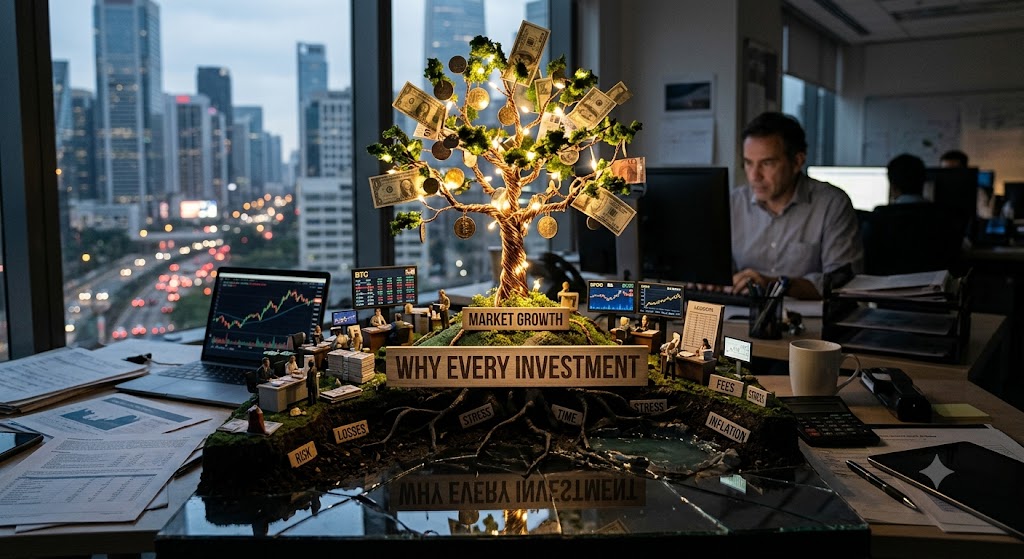
Why Every Investment Carries an Invisible Price
Most people think the price of an investment is the amount of money they transfer from their bank account. They look at a stock chart, a piece of land, a business opportunity, a course, a cryptocurrency, a rental property, or a side hustle and ask a simple question: “How much does it cost?” The problem is that this question is incomplete. Money is only the visible price. The invisible price is often far greater, and it is the part that determines whether the investment becomes a blessing or a burden.
This is why two people can invest the same amount of money and get completely different outcomes. One person becomes financially stronger, emotionally calmer, and more disciplined. The other becomes anxious, distracted, impatient, and eventually loses both money and confidence. The difference is not always intelligence. It is often the hidden cost they were willing or unwilling to pay.
Every investment carries an invisible price because nothing valuable is obtained without a trade off. Nature itself operates on exchange. To gain one thing, something else must be surrendered. When people say they want financial freedom, they usually imagine the rewards. They imagine the passive income, the freedom to travel, the ability to provide for family, and the respect that often follows financial success. What they rarely imagine is the years of uncertainty, delayed gratification, rejected opportunities, missed entertainment, difficult learning curves, and emotional pressure that usually come before the visible reward appears.
Consider the person who buys a piece of land on the outskirts of a growing city. The visible price is the purchase amount. The invisible price is patience. That land may remain undeveloped for years. Friends may mock the decision. Other investments may appear to perform better in the short term. The owner must resist the temptation to sell too early. They must continue paying taxes, monitoring the property, and believing in a future that has not yet arrived. Many people can pay the visible price of land, but far fewer can pay the invisible price of waiting.
The same principle applies to stock investing. A beginner sees a company trading at a certain price and thinks that is the cost of entry. Experienced investors know that the real cost includes volatility. The market may fall twenty percent after purchase. News headlines may create fear. Social media may convince everyone that a crash is coming. The investor must endure emotional discomfort without abandoning a sound strategy. The invisible price is the ability to remain rational when others become emotional.
This is one reason why wealth is often less about finding perfect investments and more about developing the character required to hold good investments long enough for compounding to work. Compounding is not just a mathematical phenomenon. It is a psychological test. The returns that look magical after twenty years usually looked boring, uncertain, and insignificant during the first few years.
Think about the invisible price of entrepreneurship. Many people admire successful business owners, but they do not see the hidden expenses. The entrepreneur pays with sleep, attention, reputation, relationships, and mental energy. They carry responsibility even during holidays. They think about payroll when others are thinking about relaxation. They absorb uncertainty that employees may never experience. The visible investment might be capital, but the invisible investment is emotional endurance.
This is why some people earn more money after leaving a business than they did while running it. The business was profitable on paper, but the invisible price became too high. It consumed their health, peace of mind, and family life. A truly wise investor does not evaluate returns in money alone. They ask whether the return justifies the total cost, including the invisible one.
Education is another powerful example. A university degree has tuition fees, but its invisible price includes years of study, opportunity cost, stress, and delayed earnings. A professional certification may require nights of preparation while friends are socialising. A self taught skill such as programming, design, digital marketing, or video editing may cost little money but demand hundreds of hours of focused practice. The invisible price is often concentration. In an age of constant distraction, sustained attention has become one of the most expensive currencies in the world.
People frequently underestimate opportunity cost because it does not appear on a receipt. If you invest money in one asset, you lose the ability to invest that same money elsewhere. If you spend five years building a business, you cannot simultaneously spend those same five years pursuing every other path that looked interesting. Every “yes” silently creates multiple “no” decisions. The invisible price of commitment is the surrender of alternatives.
This is particularly important for young people who feel pressured to try everything at once. They want to trade, create content, build a startup, learn multiple skills, travel, and maintain an active social life simultaneously. The reality is that meaningful results usually require concentrated effort. The invisible price of excellence is selective neglect. You must choose what deserves your energy and accept that some attractive opportunities will be left behind.
Relationships also reveal the hidden economics of investment. Investing in a marriage, friendship, or family is not merely about spending money. It is about spending presence. You can buy gifts without offering attention. You can pay bills without offering emotional support. The invisible price is often ego. Healthy relationships require compromise, forgiveness, listening, and vulnerability. Many people are willing to pay the visible price but resist the invisible one.
Even health follows this pattern. A gym membership has a visible cost, but the real price is consistency. Healthy food may cost money, but it also requires planning, discipline, and the willingness to resist convenient unhealthy options. Sleep is free in theory, yet many people sacrifice it for entertainment, scrolling, or work that could have been managed differently. The invisible price of long term health is daily discipline when no immediate reward is visible.
One of the most dangerous financial mistakes is focusing only on potential returns while ignoring invisible costs. A high yield investment may demand constant monitoring. A business opportunity may require travel that strains family relationships. A side hustle may generate income but eliminate time for recovery. A property portfolio may produce cash flow while creating significant management stress. When investors evaluate only numbers, they may become richer financially while becoming poorer emotionally.
This is why wealthy individuals often talk about buying back time. They eventually realise that time is the ultimate invisible currency. Money can be earned, lost, and earned again. Time moves in one direction. An investment that produces high returns but consumes all meaningful life experiences may not be as successful as it appears from the outside.
The invisible price is also connected to identity. Every investment asks a deeper question: “Who must you become to sustain this?” A person may inherit wealth, but if they have not developed discipline, judgment, and emotional control, the wealth may disappear. Another person may start with very little but gradually become the kind of person who can create, protect, and grow assets over decades. The greatest investments often transform the investor more than the portfolio.
This transformation is rarely comfortable. Learning to manage money forces people to confront habits they would rather avoid. Impulsive spending, comparison with others, fear of missing out, procrastination, and the desire for quick rewards become visible. The invisible price of financial growth is self awareness. You must become honest about your patterns before you can change them.
Social pressure is another hidden cost that receives far too little attention. When someone begins investing seriously, they may appear less exciting to their peers. They may decline expensive outings, avoid unnecessary purchases, or choose long term goals over short term status. In cultures where visible consumption is celebrated, disciplined investing can feel socially isolating. The invisible price is the willingness to be misunderstood.
This is especially true in the age of social media. Platforms constantly display curated lifestyles: luxury cars, vacations, designer clothing, and apparent overnight success. The disciplined investor often looks ordinary during the wealth building phase. Their money is working quietly rather than being displayed publicly. The invisible price is delayed recognition. You may look less successful than people who are actually less financially secure than you.
Many investment failures occur not because the opportunity was bad, but because the investor was unprepared for the invisible price. Someone buys a stock expecting quick profits and panics during the first downturn. Someone starts a business expecting freedom and quits when they encounter uncertainty. Someone purchases rental property expecting passive income and becomes overwhelmed by tenant issues. The opportunity did not deceive them; their expectations were incomplete.
This is why due diligence should include psychological due diligence. Before investing, ask not only “Can this investment make money?” but also “Can I realistically handle the process required for this investment to succeed?” A strategy that works brilliantly for another person may be disastrous for you if it conflicts with your temperament, schedule, risk tolerance, or life stage.
For example, day trading may suit a highly disciplined individual who can manage risk, follow rules, and tolerate rapid decision making. The same strategy may destroy someone who is impulsive, easily influenced by emotion, or unable to accept losses. The invisible price of active trading is emotional control under pressure. Without that, the visible capital becomes vulnerable.
Real estate investing illustrates the principle beautifully. People see rental income, appreciation, and leverage. They often miss the invisible costs: maintenance calls at inconvenient times, legal responsibilities, vacancy periods, property damage, administrative work, and the mental load of managing assets. Some investors happily pay this price because the rewards align with their goals. Others discover that the stress is not worth the return.
There is also an invisible price attached to not investing. This is perhaps the most overlooked cost of all. When people keep all their money idle out of fear, they avoid the visible risk of loss, but they may pay the invisible price of inflation, missed compounding, reduced future options, and dependence on a single income source. Safety itself can become expensive when it prevents growth.
Fear often disguises itself as prudence. A person may spend years waiting for the “perfect time” to invest, learn a skill, start a business, or pursue a meaningful goal. During that waiting period, opportunities pass, knowledge compounds elsewhere, and confidence gradually erodes. The invisible price of excessive caution is stagnation.
At the same time, reckless action has its own hidden cost. Jumping into investments without understanding them can damage more than a bank account. It can damage trust in oneself. A major financial loss caused by impulsiveness may lead someone to avoid investing altogether for years. The invisible price of recklessness is often future hesitation.
Wise investing therefore requires balance. It is not about avoiding all invisible costs, because that is impossible. It is about choosing costs consciously. Every worthwhile path has a price. The question is whether the price is aligned with the value you seek.
Imagine two individuals with the same income. One spends most of it maintaining an image of success. The other invests consistently in skills, assets, and long term opportunities. In the beginning, the first person may appear more successful. They enjoy immediate gratification and social validation. The second person pays the invisible price of restraint. Years later, the outcomes may reverse dramatically. The hidden payments made in silence become visible through results.
This is why discipline often looks expensive in the short term and cheap in the long term, while impulsiveness looks cheap in the short term and expensive in the long term. The person who saves and invests sacrifices immediate pleasure. The person who spends freely enjoys immediate pleasure. Eventually, one gains freedom while the other may gain financial pressure.
The concept extends beyond money into purpose. If you want to create something meaningful, whether a company, a book, a blog, a ministry, a career, or a body of work, you must pay with repetition. The invisible price of mastery is boredom. Experts are often people who became comfortable doing important things repeatedly even when the activity stopped feeling exciting.
This is particularly relevant for content creators and bloggers. Many beginners focus on monetisation, traffic, and viral growth. The invisible price is consistency when nobody is watching. Writing articles that receive little attention, publishing content for months before search engines respond, improving skills without immediate applause, and continuing despite slow progress are all part of the real investment.
Success stories are often compressed into a few dramatic moments, which creates the illusion that outcomes appeared suddenly. What is usually omitted are the thousands of invisible payments: the mornings of doubt, the evenings of study, the rejected ideas, the failed experiments, the lonely periods, and the decisions to continue when quitting would have been easier.
Understanding invisible prices changes how you evaluate opportunities. Instead of asking only “How much can I make?” you begin asking “What will this require from me emotionally, mentally, socially, physically, and spiritually?” This question protects you from attractive opportunities that demand a version of life you do not actually want.
It also helps you appreciate the achievements of others more accurately. When you see someone who has built wealth, expertise, influence, or a remarkable life, remember that you are seeing the visible result, not the invisible payments that preceded it. Envy often disappears when you understand the full cost of what you are admiring.
The most powerful insight is that invisible prices are not punishments; they are filters. They separate casual interest from genuine commitment. Many people want the reward, but fewer are willing to pay the hidden cost consistently over time. That is why extraordinary results remain relatively rare.
In the end, every investment carries an invisible price because every meaningful gain requires a corresponding sacrifice. Money is simply the easiest part to measure. The harder part is measured in patience, discipline, attention, courage, uncertainty, opportunity cost, emotional resilience, and time. The investor who understands this is less likely to be surprised by the journey and more likely to remain committed long enough for the investment to mature.
Before making your next investment, pause for a moment and ask a deeper question. Beyond the money, what is this opportunity asking me to give? The answer may include years of patience, uncomfortable learning, temporary criticism, delayed gratification, or the courage to continue without immediate evidence. Once you identify the invisible price, you can decide consciously whether the potential reward is worth paying it. That single habit may save you from costly mistakes and guide you toward investments that not only grow your wealth but also preserve your peace, your purpose, and the life you are ultimately trying to build.

EarnSmartOnline.com.ng is dedicated to helping readers make smarter financial decisions through practical guides on online income, personal finance, technology, digital business, and wealth creation. Our goal is to provide reliable, easy-to-understand, and actionable content that empowers individuals to earn smarter, build sustainable income streams and achieve long-term financial success.
Recommended: Start Earning Online
- Ultimate Affiliate Marketing Program — learn affiliate marketing with a done-for-you sales system ($15). Check it out
- The Newbie Affiliate Guide — the beginner-friendly starter guide (~$6.68). Check it out
- Easy Dollar Maker — earn in dollars uploading AI images and videos from your phone ($17). Check it out
Disclosure: These are affiliate links. If you buy through them, I may earn a commission at no extra cost to you.



