
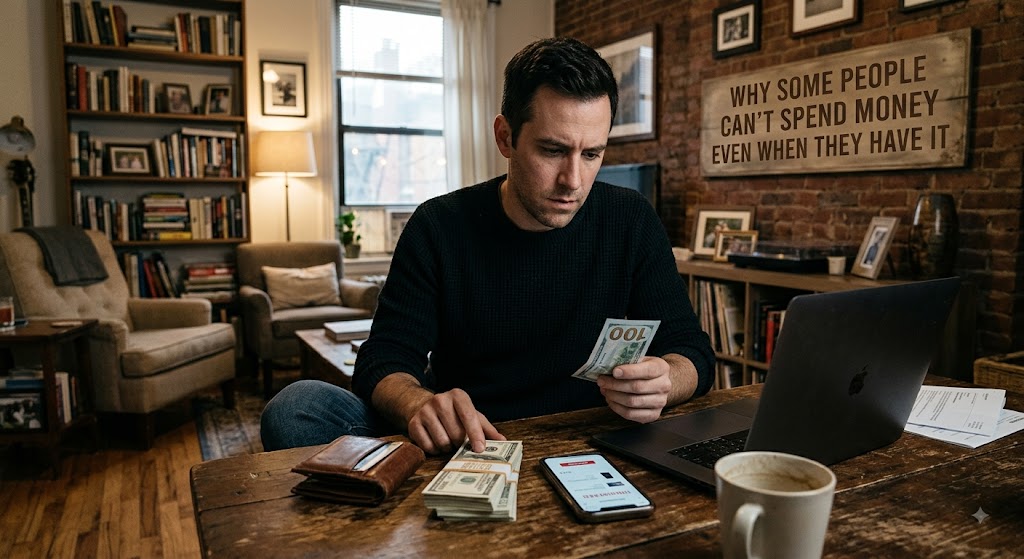
Money is supposed to make life easier. It pays the bills, buys food, creates opportunities, provides comfort and gives people the ability to enjoy some of the things they have worked hard to achieve. Yet there are people who can have money sitting comfortably in their bank accounts and still struggle to spend even a small portion of it. They may have enough to afford a better meal, replace an old phone, take a holiday, buy something they genuinely need or simply enjoy an experience, but something inside them says, “Don’t touch the money.”
At first glance, this behaviour can look like extreme discipline. Sometimes it is. Saving money, avoiding unnecessary spending and preparing for the future are important financial habits. But there is a difference between being financially responsible and being psychologically unable to spend. One is a conscious financial decision. The other can become an emotional reaction.
The interesting thing is that people who cannot spend money even when they have it are not necessarily poor. Some are high earners. Some have substantial savings. Some own businesses, properties or investments. Others have more than enough money to handle their immediate needs. Yet they continue behaving as though financial disaster is waiting around the corner.
They save for tomorrow, then tomorrow arrives and they save for another tomorrow.
They reach one financial target and immediately create another.
They increase their income but do not increase their sense of security.
They look at their bank balance and feel relief, but spending even a tiny percentage of that balance creates anxiety.
Why does this happen?
One major reason is fear. For some people, money represents safety rather than enjoyment. They are not simply saving money. They are trying to protect themselves from uncertainty. Their financial balance becomes an emotional security blanket. The larger the balance becomes, the safer they feel.
This can happen after experiencing financial hardship. Someone who has struggled to pay rent, gone hungry, experienced unemployment, depended on other people or watched their family suffer financially may develop a deep fear of returning to that situation. Even after their circumstances improve, their mind may continue operating as if the crisis is still happening.
Imagine someone who spent years struggling to survive. Eventually, they get a better job and start saving. Their income becomes stable. Their savings grow. They can now afford things they could never afford before.
But emotionally, they are still living in the period when money was scarce.
They may have ₦5 million saved but behave as though they have ₦50,000. Every purchase feels dangerous. Every withdrawal feels painful. Every unexpected expense feels like a threat to their survival.
This is one reason financial behaviour cannot always be understood by looking at someone’s bank account. Two people can have exactly the same amount of money and completely different relationships with it.
One person sees ₦1 million and thinks, “I have enough to handle emergencies and enjoy part of my life.”
Another sees the same ₦1 million and thinks, “What if everything goes wrong next month?”
The difference is not necessarily mathematics. It is psychology.
Another reason some people cannot spend money is that they grew up in households where money was associated with danger, conflict or scarcity. Perhaps their parents constantly argued about bills. Maybe they were repeatedly told that money was difficult to find. Perhaps every purchase was criticised. Maybe they watched adults sacrifice everything and never enjoy anything.
Why Some People Can’t Spend Money Even When They Have It
Children absorb these experiences.
A child who repeatedly hears “We cannot afford that” may grow into an adult who struggles to believe they are allowed to afford anything.
Even when the financial situation changes, the internal script can remain.
The person may earn significantly more than their parents ever did, but mentally they still feel like the child who must be careful because money can disappear at any moment.
This explains why increasing income does not automatically solve unhealthy financial behaviour.
You can give someone more money without giving them a healthier relationship with money.
Another powerful factor is guilt. Some people feel guilty whenever they spend money on themselves. They can easily spend money on their children, parents, friends, business or household, but spending on themselves feels selfish.
They might buy an expensive gift for someone else without hesitation, yet spend weeks debating whether they should buy a pair of shoes they genuinely like.
They can pay for everyone else’s meal but feel guilty ordering something slightly more expensive for themselves.
They may even believe that suffering is proof of responsibility.
This can become particularly complicated when someone has people depending on them. In many families, the person who earns money becomes responsible for solving everyone’s problems. Their income is no longer psychologically “their money”. It becomes family money.
The moment they receive money, their mind starts distributing it.
This goes to the parents.
This goes to the children.
This goes to school fees.
This goes to rent.
This goes to emergencies.
This goes to the business.
This goes to relatives.
This goes to savings.
And after everything has been allocated, there is nothing left for them.
Eventually, they can become financially successful while personally feeling deprived.
Another reason people struggle to spend is that they have become addicted to the feeling of saving. Saving money can produce a powerful sense of achievement. Watching a bank balance grow can feel like winning.
For some people, the number itself becomes the goal.
They do not know exactly what they are saving for, but they want the balance to keep increasing.
₦500,000 becomes ₦1 million.
₦1 million becomes ₦5 million.
₦5 million becomes ₦10 million.
But the emotional satisfaction does not necessarily increase proportionally.
Instead, the target keeps moving.
This creates a strange financial situation where someone becomes wealthier on paper but not necessarily happier in everyday life.
The problem is not saving. The problem is when saving becomes the only way someone allows themselves to feel financially successful. Why Some People Can’t Spend Money Even When They Have It
Money is a tool. If the tool becomes the destination, something has gone wrong.
There is also a fear of regret.
Some people imagine every possible future scenario before spending money. “What if I need it later?” “What if my business fails?” “What if I lose my job?” “What if something happens to my family?” “What if prices increase?” “What if I never make this amount again?”
These questions are not irrational. Life is unpredictable.
The problem begins when hypothetical future disasters become powerful enough to prevent reasonable present decisions.
If every purchase is evaluated against every possible catastrophe, spending becomes almost impossible.
A person could have enough money for an ordinary holiday and still imagine ten financial disasters that could occur while they are away.
They could afford a better laptop but worry that their income might suddenly disappear.
They could replace an old mattress but decide the money should remain untouched because “you never know”.
Eventually, “you never know” becomes a permanent excuse for never living.
Another factor is identity.
Some people have built their entire identity around being the person who saves money. They are proud of being extremely frugal. Friends know them as the person who never spends. Family members expect them to be careful. Their reputation reinforces the behaviour.
If they suddenly begin spending reasonably, they may feel like they are becoming someone else.
This is why financial habits can be difficult to change. They are not always just habits. They can become part of a person’s identity.
Someone might say, “I am not the type of person who spends money on luxury.”
That statement can be healthy if it reflects genuine values.
But it becomes unhealthy when the person cannot spend money even on things that improve their wellbeing, productivity, health, relationships or quality of life.
There is another subtle reason some people refuse to spend: they are waiting to become “rich enough”.
They believe there will eventually be a point where spending feels completely safe.
They imagine that once they have ₦10 million, they will relax.
Then they reach ₦10 million and decide they need ₦20 million.
At ₦20 million, they decide they need ₦50 million.
At ₦50 million, they become concerned about protecting the money.
The finish line keeps moving.
This can happen because financial security is not purely a numerical concept. A person can reach a financially comfortable position and still feel insecure.
That is why one of the most important questions about money is not simply, “How much do you have?”
It is also, “How much is enough for you to feel safe?”
Without an answer, accumulation can become endless.
Of course, there is another side to this discussion. Not everyone who refuses to spend money has a psychological problem. Sometimes people are simply being responsible.
If someone has irregular income, large debts, dependants, uncertain employment or inadequate emergency savings, being cautious with money can be completely reasonable.
The goal should never be to encourage reckless spending simply because someone has money.
Financial freedom does not mean spending everything you earn.
It means having enough control over your money that you can make deliberate decisions rather than being controlled by fear, pressure or impulse.
That distinction matters.
Someone who refuses to spend ₦100,000 because they genuinely have important financial priorities is exercising discipline.
Someone who has ₦10 million in accessible savings, has no immediate financial emergency and still experiences intense anxiety about spending ₦20,000 on something meaningful may be dealing with something deeper. Why Some People Can’t Spend Money Even When They Have It
The healthiest relationship with money is usually somewhere between reckless consumption and extreme deprivation.
Money should protect your future, but it should also serve your present.
There is little value in spending everything today and destroying tomorrow.
But there is also little value in sacrificing every meaningful experience today for a future that is never guaranteed.
Life is not a financial spreadsheet.
There are moments that cannot be postponed forever.
A family holiday when the children are young.
A special meal with someone you love.
A course that could improve your career.
A comfortable chair that makes working easier.
A visit to someone important.
A celebration.
A memorable experience.
These things have value even though they may not increase your bank balance.
This is where intentional spending becomes important.
Intentional spending is not the opposite of saving. It is the reason saving exists.
You save so that your money can eventually support something meaningful.
That could be security.
That could be freedom.
That could be education.
That could be entrepreneurship.
That could be family stability.
That could be travel.
That could simply be peace of mind.
The problem begins when saving becomes detached from purpose.
A person should occasionally ask themselves, “What am I saving this money for?”
If the answer is clear, excellent.
If the answer is always “just in case”, it may be worth examining what “just in case” actually means.
Some people need a financial plan that gives their money different jobs. Instead of seeing their entire bank balance as one untouchable pile, they can separate money for emergencies, long term goals, investments and reasonable personal enjoyment.
This can make spending less emotionally difficult because the person knows that spending from one category does not mean destroying their entire financial safety net. Why Some People Can’t Spend Money Even When They Have It
For example, someone might decide that after covering essential expenses and maintaining an appropriate emergency reserve, a small percentage of their income can be used for enjoyment without guilt.
The exact percentage depends on individual circumstances. The principle is more important than the number.
You are allowed to have money that is not required to perform a serious financial duty.
You are allowed to enjoy part of what you earn.
You are allowed to buy something because it makes you happy.
You are allowed to spend money without turning every purchase into a moral debate.
This does not mean becoming careless.
It means understanding that financial responsibility includes knowing how to use money, not merely how to keep it.
There is also an important emotional lesson here. Sometimes people think they are protecting their money when they are actually protecting themselves from disappointment.
If you never spend, you never risk regretting the purchase.
If you never take the holiday, you cannot regret the holiday.
If you never invest in an experience, you cannot feel that the experience was not worth it.
If you never buy something for yourself, you never have to question whether you deserved it.
Extreme saving can therefore become a form of emotional protection.
But avoiding every possibility of regret also eliminates many possibilities for joy.
Life requires some reasonable risk.
Money requires some reasonable spending.
The goal is not to remove all financial risk. It is to learn which risks are worth taking.
Another important issue is that money can become a measure of personal worth. Someone who has spent years struggling financially may feel powerful when they finally accumulate wealth. Their bank balance becomes proof that they have succeeded.
Spending money can then feel like losing a piece of that achievement.
The person may not consciously think this way, but emotionally, every withdrawal feels like moving backwards.
This is why some wealthy people still behave as though they are poor.
Their financial reality has changed, but their emotional relationship with money has not.
Changing that relationship takes awareness.
It begins by recognising that having money and feeling safe with money are two different things.
You can have enough and still feel afraid.
You can be financially secure and still feel deprived.
You can be wealthy and still behave as though you are one emergency away from disaster.
None of this means that saving is bad. In fact, saving is one of the most important foundations of financial stability.
But money should create options.
If your savings give you no freedom, no peace and no ability to enjoy your life, it is worth asking whether your money is serving you or whether you are serving your money.
There is something deeply ironic about spending your entire life trying to accumulate enough money to enjoy life while never allowing yourself to enjoy the money you accumulate.
The purpose of building wealth should not simply be to die with the largest possible bank balance.
It should be to create a life where money supports your values.
For some people, that means building a large investment portfolio.
For others, it means owning a home.
For others, it means travelling.
For others, it means supporting their family.
For others, it means having enough savings to leave a terrible job without fear.
There is no universal definition of financial success.
But there should be a personal definition of enough.
Without one, the pursuit of money can become an endless race.
And perhaps the biggest lesson is this: being unable to spend money can be just as complicated as being unable to save it.
Both behaviours can come from fear.
One person fears not having enough tomorrow, so they spend everything today.
Another fears not having enough tomorrow, so they refuse to spend anything today.
Both need balance.
Money should be respected, but it should not be worshipped.
Saving should be encouraged, but deprivation should not be celebrated as a virtue.
Spending should be intentional, but enjoyment should not automatically be labelled wasteful.
The healthiest financial life is not necessarily the one with the biggest bank balance. It is the one where your money and your values are working together.
So if you have money but struggle to spend any of it, perhaps the question is not, “Why am I so cheap?”
Perhaps the better question is, “What am I afraid will happen if I spend this?”
The answer might reveal more about your relationship with money than your bank statement ever could.
And sometimes, the hardest financial lesson is not learning how to make more money.
It is learning that you are allowed to use some of the money you worked so hard to earn.

EarnSmartOnline.com.ng is dedicated to helping readers make smarter financial decisions through practical guides on online income, personal finance, technology, digital business, and wealth creation. Our goal is to provide reliable, easy-to-understand, and actionable content that empowers individuals to earn smarter, build sustainable income streams and achieve long-term financial success.
Recommended: Start Earning Online
- Ultimate Affiliate Marketing Program — learn affiliate marketing with a done-for-you sales system ($15). Check it out
- The Newbie Affiliate Guide — the beginner-friendly starter guide (~$6.68). Check it out
- Easy Dollar Maker — earn in dollars uploading AI images and videos from your phone ($17). Check it out
Disclosure: These are affiliate links. If you buy through them, I may earn a commission at no extra cost to you.



