
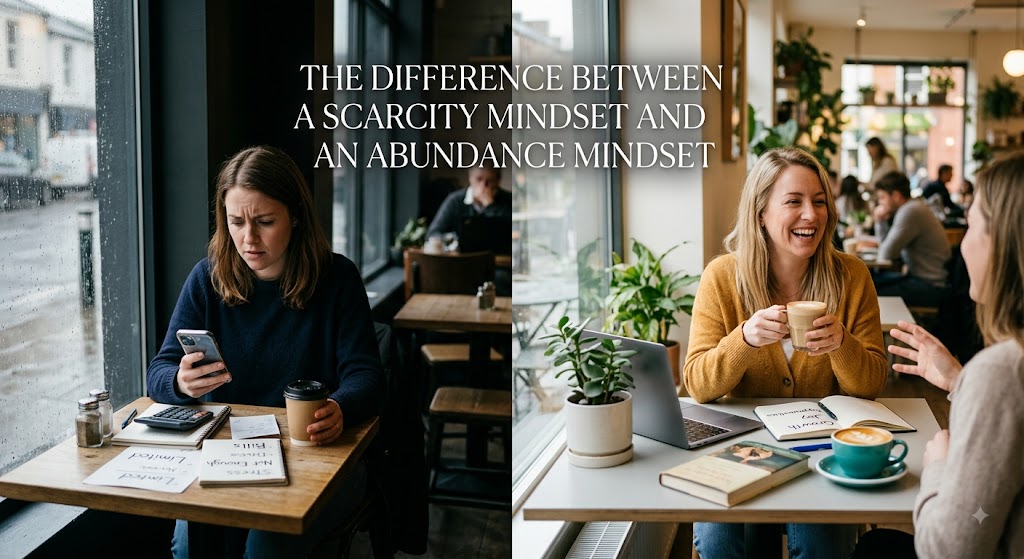
The difference between a scarcity mindset and an abundance mindset can quietly shape almost every major decision you make in life. It influences how you think about money, relationships, opportunities, career growth, success, failure, competition and even your own potential. Two people can face exactly the same situation and walk away with completely different conclusions simply because they are looking at life through different mental lenses.
A scarcity mindset tells you that there is never enough. There is not enough money, not enough opportunity, not enough success, not enough attention, not enough time and not enough room for everybody to win. When you operate from scarcity, another person’s success can feel like evidence that your own chances are disappearing. You may become overly protective of what you have, afraid to take calculated risks and constantly worried about losing what little you believe you possess.
An abundance mindset operates from a different belief. It recognises that resources can be created, opportunities can be developed, knowledge can be shared and success does not always have to come at somebody else’s expense. Instead of seeing life as a fixed pie where one person’s larger portion leaves less for everyone else, an abundance thinker understands that people can create new value and expand the possibilities available to themselves and others.
This does not mean that an abundance mindset requires pretending that problems do not exist. It does not mean ignoring poverty, economic difficulties, competition, rejection, limited resources or genuine obstacles. It simply means refusing to allow those realities to convince you that your future is permanently limited.
A scarcity mindset often begins with fear. Someone who has experienced financial hardship may become deeply afraid of spending money, even when spending is necessary or productive. Someone who has been rejected repeatedly may begin believing that nobody will ever choose them. Someone who grew up constantly comparing themselves with others may start measuring their worth according to what other people have.
The problem is not always the experience itself. The problem is the belief that develops from the experience.
If you lose money and conclude that you must become more financially disciplined, you can grow from the experience. If you lose money and conclude that money is impossible to keep, you may develop a scarcity mindset that follows you for years.
If someone rejects you and you conclude that you need to improve your approach, you have created an opportunity for growth. If you conclude that you are simply not good enough for anyone, rejection becomes an identity instead of an experience.
This is one of the most important differences between scarcity and abundance. Scarcity tends to turn temporary circumstances into permanent conclusions. Abundance tends to view circumstances as information that can be used to make better decisions.
Consider money. A person with a scarcity mindset may constantly think, “If I spend this money, I will have less.” An abundance minded person is more likely to ask, “How can I use this money wisely to create more value?” The first person focuses primarily on preservation. The second focuses on preservation and creation.
Of course, both approaches have dangers when taken to extremes. Someone who spends recklessly while calling it an abundance mindset is not practising abundance. They are simply being financially irresponsible. Real abundance does not mean believing that money will magically appear. It means understanding that money can be earned, saved, invested, managed and multiplied through productive decisions.
The same principle applies to knowledge. A scarcity mindset can make people afraid to share information because they believe that somebody else might become more successful if they learn what they know. This can create unnecessary secrecy and competition.
An abundance mindset understands that teaching someone does not automatically make you less knowledgeable. In many cases, sharing knowledge strengthens your own understanding, builds relationships and creates opportunities that would not have existed otherwise.
Think about the people who refuse to recommend someone because they are afraid that person might become more successful than them. That is scarcity thinking.
The person who says, “I know someone who can help you,” demonstrates a different way of thinking. They understand that connecting two people does not necessarily reduce their own value. In fact, it can increase their reputation, relationships and opportunities.
Scarcity also appears strongly in the workplace. Someone with a scarcity mindset may become threatened whenever a colleague receives recognition. They may hide information, avoid collaboration or secretly hope that another person’s project fails.
An abundance minded employee can celebrate another person’s achievement while continuing to pursue their own growth. They understand that another person’s promotion does not automatically eliminate every opportunity available to them.
This is particularly important in today’s world because social media has made comparison almost impossible to escape. Every day, people see someone buying a house, launching a company, travelling internationally, getting married, receiving an award, becoming famous or announcing a financial achievement.
Without an abundance mindset, this constant exposure can create the illusion that everyone else is moving forward while you are standing still.
You may begin asking, “Why them and not me?”
That question can become dangerous when repeated too often because it shifts your attention away from what you can control.
An abundance mindset asks a more productive question: “What can I learn from what they have done, and what can I do differently with my own circumstances?”
That simple change in questioning can completely alter your behaviour.
Instead of becoming jealous of another person’s success, you can study it.
Instead of feeling defeated by someone else’s progress, you can become curious about it.
Instead of assuming that their success proves you cannot succeed, you can recognise that success is possible and investigate the habits, skills, decisions and opportunities that contributed to it.
This does not mean copying another person’s life. Abundance is not imitation. It is the belief that your path can be developed even when someone else’s path is already successful.
Another major difference between scarcity and abundance is how each mindset responds to opportunity.
Scarcity often creates paralysis. A person may spend so much time worrying about making the wrong decision that they make no decision at all. They may see every risk as a potential disaster.
Abundance does not eliminate fear. It simply refuses to let fear make every decision.
An abundance thinker can say, “This might not work, but I can learn something from trying.”
That attitude is powerful because many opportunities do not arrive as guarantees. They arrive as possibilities.
Starting a business is a possibility.
Learning a new skill is a possibility.
Launching a website is a possibility.
Applying for a better job is a possibility.
Starting a conversation with someone who could change your career is a possibility.
Writing a book is a possibility.
Investing in yourself is a possibility.
The scarcity mindset often asks, “What if I fail?”
The abundance mindset asks, “What happens if I never try?”
That does not mean every opportunity should be accepted. An abundance mindset still requires judgement. The difference is that the decision is based on possibility, evidence and calculated risk rather than fear alone.
Relationships also reveal the difference between these two ways of thinking.
A scarcity mindset can make people believe that love, friendship and attention are limited resources. Someone may become extremely jealous when their partner speaks to another person. They may see every new friendship as a threat. They may believe that if someone else is attractive, successful or interesting, their own position becomes weaker.
Abundance allows people to understand that healthy relationships are built on trust rather than constant competition.
The same principle applies to friendship. If you believe there are only a few genuinely good people in the world, you may hold onto unhealthy relationships simply because you are afraid you will never find better ones.
An abundance perspective does not mean treating people as disposable. It means understanding that healthy relationships can be built, repaired and discovered throughout life.
The Difference Between a Scarcity Mindset and an Abundance Mindset
Scarcity can also influence how people see themselves.
One of the most damaging forms of scarcity is believing that your abilities are fixed. You might think, “I am not intelligent enough,” “I am not creative,” “I am not good with money,” “I am not good at speaking,” or “People like me never become successful.”
These statements may sound like harmless descriptions, but they can become self fulfilling beliefs.
An abundance mindset introduces the possibility of development.
Instead of saying, “I am bad with money,” you can say, “I have not learned how to manage money properly yet.”
Instead of saying, “I am not good at technology,” you can say, “I have not developed those skills yet.”
That little word, “yet,” can change the entire psychological direction of a person’s life.
Scarcity says, “This is what I have.”
Abundance asks, “What can I build from what I have?”
Scarcity says, “I missed my chance.”
Abundance asks, “What can I do with the chances that remain?”
Scarcity says, “They are ahead of me.”
Abundance says, “What can I learn from their journey?”
Scarcity says, “There is not enough.”
Abundance says, “How can I create more?”
This distinction is especially important for entrepreneurs and people trying to build additional income. When you believe that there are no opportunities, you may stop looking for them. When you believe opportunities can be created, you start paying attention to problems that people need solved.
Every business exists because someone solved a problem.
Someone needed food delivered faster.
Someone needed transportation.
Someone needed accommodation.
Someone needed education.
Someone needed entertainment.
Someone needed financial information.
Someone needed software.
Someone needed convenience.
The abundance mindset trains you to look at problems differently. Instead of seeing a problem only as an inconvenience, you may start seeing it as a potential opportunity to create value.
This is why abundance is closely connected to creativity.
When you believe resources are limited, your brain focuses heavily on protecting what already exists. When you believe possibilities can be created, you become more willing to experiment, learn and discover new approaches.
However, abundance should never be confused with unrealistic optimism.
There will be situations where resources genuinely are limited. There will be times when you cannot afford something. There will be businesses that fail. There will be applications that get rejected. There will be people who do not choose you. There will be opportunities you genuinely miss.
An abundance mindset does not deny reality. It refuses to make reality the final definition of your future.
This is an important distinction.
You can acknowledge that you currently have little money without believing that you will always be poor.
You can acknowledge that your business is struggling without believing that it can never improve.
You can acknowledge that you lack a particular skill without believing that you are permanently incapable of learning it.
You can acknowledge that someone is ahead of you without believing that your own journey is over.
That is psychological freedom.
Developing an abundance mindset begins with becoming aware of your automatic thoughts. Pay attention to what you say when someone succeeds. Notice how you react when a friend gets an opportunity. Observe what happens inside you when you see someone making more money than you.
Do you immediately think they are lucky?
Do you assume they cheated?
Do you become angry?
Do you feel inspired?
Do you become curious?
Your reaction can reveal the mindset you are operating from.
Another powerful exercise is to replace comparison with learning. When you see someone achieving something you want, instead of spending your energy asking why they have it, ask what their success can teach you.
You can also practise gratitude without becoming complacent. Gratitude reminds you to recognise the resources, relationships, skills and opportunities that already exist in your life. Abundance does not require pretending that everything is perfect. It requires learning to see what is available rather than focusing exclusively on what is missing.
Your environment matters too. If you constantly surround yourself with people who believe that everyone is competing against everyone else, their thinking can influence you. If every conversation is about jealousy, betrayal, shortage and hopelessness, scarcity can begin to feel like reality itself.
Seek out people who think constructively. Learn from people who have built things. Read stories of people who started with limited resources. Spend time around individuals who solve problems instead of simply complaining about them.
Most importantly, remember that abundance is not about having more than everybody else.
That is another common misunderstanding.
A person can have millions of pounds or naira and still live with a scarcity mindset. They can constantly worry about losing money, constantly compare themselves with wealthier people and never feel that they have enough.
Another person can have modest resources while maintaining an abundance mindset. They can believe in their ability to learn, adapt, create value and improve their circumstances.
Abundance is therefore less about the size of your bank account and more about the way you interpret possibilities.
The ultimate goal is not to eliminate every scarcity thought. Human beings naturally worry about resources, security and the future. The goal is to recognise when scarcity is protecting you and when it is imprisoning you.
Sometimes caution is necessary.
Sometimes saving is necessary.
Sometimes saying no is necessary.
Sometimes walking away is necessary.
But when fear becomes the reason you never learn, never invest in yourself, never trust anyone, never attempt anything new and never believe that your circumstances can improve, scarcity has stopped protecting you and started controlling you.
An abundance mindset gives you permission to believe that your current situation is not the final version of your life.
It encourages you to develop skills rather than complain about limitations. It encourages you to create opportunities rather than wait endlessly for them. It encourages you to celebrate other people’s success without interpreting it as your personal failure. It encourages you to see setbacks as lessons, competition as information and uncertainty as part of growth.
The difference between a scarcity mindset and an abundance mindset ultimately comes down to one powerful question: Do you believe life is primarily about protecting what you have, or creating what you need?
There is wisdom in protecting what you have. But there is also tremendous power in learning how to create more.
You may not control the circumstances in which you started. You may not control the economy, your past, other people’s decisions or every opportunity that comes your way. But you can influence how you interpret those circumstances and what you decide to do next.
That is where the abundance mindset becomes more than a motivational phrase.
It becomes a way of thinking.
You stop asking whether there is enough room for you and start building your own room.
You stop believing that someone else’s light makes yours dimmer.
You stop treating every closed door as proof that there are no doors left.
You stop seeing your limitations as permanent definitions of who you are.
And you begin to understand that sometimes the greatest resource you have is not the money in your account, the opportunities around you or the advantages you were born with. Sometimes it is your willingness to believe that you can learn, adapt, create and try again.
A scarcity mindset asks, “What if there is not enough?”
An abundance mindset asks, “What can I create from what I have?”
That difference may look small on paper, but over years, it can produce two completely different lives.
If you want to change your financial life, career, business, relationships or personal growth, changing the way you think about possibility may be one of the most important places to begin. You do not need to become blindly optimistic. You do not need to ignore reality. You simply need to stop assuming that today’s limitations are permanent.
There may not be enough of everything today.
But there may be enough opportunity to start.
Enough knowledge to learn.
Enough time to take one step.
Enough resources to make one improvement.
Enough courage to try once more.
And sometimes, that is where abundance begins.
Keywords: scarcity mindset, abundance mindset, difference between scarcity mindset and abundance mindset, abundance mentality, scarcity mentality, growth mindset, positive mindset, financial mindset, money mindset, psychology of money, wealth mindset, personal development, success mindset, mindset and success, overcoming scarcity mindset, developing an abundance mindset, abundance thinking, financial success, personal growth, mindset transformation, limiting beliefs, self improvement, success habits, wealth building, positive thinking, entrepreneurship mindset
Meta description: Discover the difference between a scarcity mindset and an abundance mindset, how each affects money, success, relationships and personal growth, and how to develop a healthier abundance mentality.

EarnSmartOnline.com.ng is dedicated to helping readers make smarter financial decisions through practical guides on online income, personal finance, technology, digital business, and wealth creation. Our goal is to provide reliable, easy-to-understand, and actionable content that empowers individuals to earn smarter, build sustainable income streams and achieve long-term financial success.
Recommended: Start Earning Online
- Ultimate Affiliate Marketing Program — learn affiliate marketing with a done-for-you sales system ($15). Check it out
- The Newbie Affiliate Guide — the beginner-friendly starter guide (~$6.68). Check it out
- Easy Dollar Maker — earn in dollars uploading AI images and videos from your phone ($17). Check it out
Disclosure: These are affiliate links. If you buy through them, I may earn a commission at no extra cost to you.



