
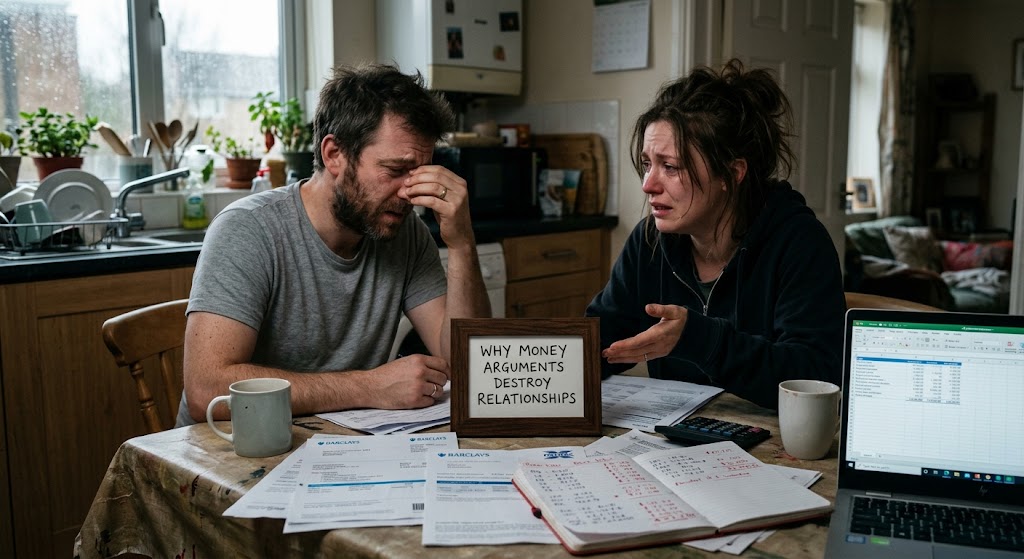
Money is one of the most common sources of tension in relationships, yet many couples still underestimate how deeply financial disagreements can affect love, trust, communication and emotional intimacy. Two people can genuinely love each other, care about each other and have plans for the future, but repeated arguments about money can slowly turn that relationship into a battlefield. This is one of the reasons Why Money Arguments Destroy Relationships is a subject that deserves serious attention, especially for couples who want to build something lasting together.
Money itself is not always the real problem. The deeper problem is often what money represents. For one person, money may represent security. For another, it may represent freedom. Someone may see saving as wisdom, while their partner sees excessive saving as unnecessary restriction. One person may believe that enjoying money today is important because life is short, while the other may be focused on building financial stability for tomorrow. When these beliefs collide repeatedly, arguments become more than arguments about money. They become arguments about values, priorities, trust and the future.
This is why Why Money Arguments Destroy Relationships cannot be understood simply by looking at bank balances, bills or spending habits. Financial conflict can expose unresolved differences that were already present beneath the surface. When couples do not learn how to communicate about those differences, even a small financial disagreement can become an emotional explosion.
Imagine a couple arguing because one partner spent money without telling the other. On the surface, the issue may appear to be the amount spent. But the person who is angry may actually be thinking, “Why didn’t you consider me before making that decision?” The issue is no longer simply spending. It has become a question of respect and partnership.
Another couple may argue because one partner earns more than the other. The higher earning partner may begin to feel that they are carrying too much of the financial responsibility. The lower earning partner may feel embarrassed, controlled or constantly reminded of their financial limitations. If the situation is handled poorly, resentment can develop on both sides.
Money arguments also destroy relationships because they can create a dangerous pattern of blame. Instead of asking how the problem can be solved, couples start asking who is responsible for the problem. One person says, “You are always wasting money.” The other responds, “At least I enjoy my life. You are too stingy.” Eventually, the conversation stops being about solving a financial problem and becomes an attack on each person’s character.
Once this pattern becomes normal, communication begins to deteriorate. Partners become defensive before the conversation even starts. A simple question about a purchase can sound like an accusation. A discussion about household expenses can quickly turn into an argument about previous mistakes. Before long, both people are keeping score.
Why Money Arguments Destroy Relationships
“You spent this much last month.”
“You borrowed money from me last year.”
“I have paid more bills than you.”
“You never appreciate what I contribute.”
These statements may contain legitimate frustrations, but repeatedly bringing up old financial issues prevents couples from solving the current problem. Instead of moving forward, they remain trapped in a cycle of accusation and defence.
One of the biggest reasons Why Money Arguments Destroy Relationships is that financial disagreements can damage trust. Trust is not built only through emotional affection. It is also built through honesty, consistency and responsible behaviour. If one partner secretly takes loans, hides purchases, lies about income or conceals debts, the other partner may begin questioning everything.
Financial secrecy can be especially damaging because it creates uncertainty. When someone discovers that their partner has been hiding significant financial information, they may start wondering what else has been hidden. The problem becomes much larger than the original debt or purchase. The relationship itself begins to feel unsafe.
This is why couples should discuss money openly, even when the conversation feels uncomfortable. It is much better to have a difficult conversation about debt, income, spending habits and financial goals than to allow secrets to accumulate until they eventually destroy trust.
Different financial backgrounds can also create serious problems. Two people may enter a relationship having completely different experiences with money. One person may have grown up in a home where money was scarce and every expense had to be carefully considered. Another may have grown up in a financially comfortable environment where spending was normal and saving was not heavily emphasised.
Neither person is necessarily wrong. They simply learned different lessons.
The person who grew up with financial insecurity may become extremely cautious with money. Their partner may interpret that caution as being cheap or unnecessarily fearful. Meanwhile, the cautious partner may interpret their partner’s spending habits as irresponsible. Without understanding the history behind these behaviours, both people may judge each other unfairly.
Money can also become a source of power in relationships. When one person controls most or all of the money, they may begin using financial dependence to control the other person’s decisions. This can create an unhealthy dynamic in which the person who earns more believes they have greater authority.
Statements such as “I pay the bills, so I make the decisions” can gradually destroy equality and respect within a relationship. Financial contribution is important, but earning more money does not automatically make one partner more valuable than the other.
At the same time, financial responsibility should not be ignored in the name of romance. Love does not eliminate the need for accountability. A partner who consistently refuses to contribute when they are capable of doing so can create enormous resentment. A healthy relationship requires both people to recognise that financial responsibilities affect both partners.
Another reason Why Money Arguments Destroy Relationships is that financial stress affects emotional health. When bills are overdue, debts are increasing and income is uncertain, people often become anxious and irritable. A person who is worried about paying rent may have very little emotional energy left for romance. Someone who is constantly thinking about school fees, electricity bills, food costs, transportation or debt repayments may become easily frustrated.
This does not mean financial stress gives anyone permission to mistreat their partner. It means couples need to recognise how external financial pressure can enter the relationship. Sometimes the enemy is not the person sitting across the table. The real problem is the financial situation both people are trying to survive.
Unfortunately, couples sometimes turn against each other when they should be standing together against the problem.
Instead of saying, “You are the reason we are broke,” it may be more productive to say, “Our finances are under pressure. What can we do together to improve the situation?”
That small change in language can completely transform a conversation.
Financial arguments can also destroy intimacy. When couples repeatedly fight about money, emotional closeness often suffers. Affection becomes less natural. Conversations become transactional. Romance may begin to feel impossible when one partner is constantly angry about what the other has spent.
Some couples stop communicating altogether. They sleep in the same room but live emotionally separate lives. They avoid discussing financial issues because they know the conversation will end badly. Unfortunately, avoiding the problem does not make the problem disappear. It often makes it worse.
Unresolved financial disagreements accumulate like unpaid bills. Eventually, the emotional cost becomes greater than the original financial problem.
Another major issue is unrealistic financial expectations. Social media has made this problem even more complicated. Couples constantly see other people’s holidays, houses, cars, restaurants, weddings, clothes and lifestyles. It becomes easy to compare your relationship with an edited version of someone else’s life.
A partner may begin asking, “Why can’t we live like them?”
The other person may respond, “Because we cannot afford it.”
What started as admiration for another lifestyle can quickly become pressure within the relationship.
Couples need to understand that financial success is not about looking rich. It is about building a financial life that matches their actual income, responsibilities and goals. Trying to impress other people can create financial pressure that eventually damages the relationship.
There is also a difference between financial equality and financial fairness. Equality might mean dividing every expense exactly in half. Fairness may sometimes mean contributing according to each person’s ability. If one partner earns significantly more, insisting that every expense must be split equally may create unnecessary pressure.
The important thing is that couples agree on a system that both people consider reasonable.
They should also discuss financial goals before major decisions are made. What are they trying to achieve? Do they want to buy a house? Start a business? Have children? Travel? Build savings? Pay off debt? Support relatives? Invest for the future?
Without shared goals, each person may be pulling the relationship in a different direction.
One person may be trying to save for a home while the other is spending heavily on entertainment. One may be building an emergency fund while the other keeps borrowing money for unnecessary purchases. These differences can become extremely frustrating because both partners may believe they are doing what is best.
The solution is not necessarily for one person to dominate the other. The solution is to create shared financial priorities.
Couples should also learn to distinguish between needs, wants and emotional spending. Sometimes people spend money because they are stressed, unhappy, bored or trying to prove something. A purchase can temporarily provide excitement, but the consequences can create long term problems.
If emotional spending becomes a repeated pattern, the couple needs to address the behaviour rather than simply fighting about each individual purchase.
A healthier financial relationship begins with honesty. Both partners should know the basic financial reality of the household. Income, major expenses, debts, savings, investments and significant financial obligations should not be hidden from each other.
This does not necessarily mean every couple must combine every account. Different couples can organise their finances in different ways. What matters most is transparency, agreement and responsibility.
It is also important to have money conversations when both partners are calm. Trying to solve a financial problem in the middle of an argument rarely works. When emotions are high, people are more likely to say hurtful things and less likely to listen.
Choose a suitable time and talk about the issue as a team.
Instead of saying, “You always waste money,” say, “I am worried about how much we are spending, and I would like us to find a better system.”
Instead of saying, “You never contribute anything,” say, “I feel overwhelmed by the financial responsibilities and I need us to review how we are sharing them.”
The goal is not to win the argument. The goal is to protect the relationship while solving the problem.
Couples should also learn how to apologise. Financial mistakes happen. People overspend. Businesses fail. Investments lose money. Jobs disappear. Unexpected emergencies occur. A single mistake does not have to define a relationship.
What matters is how the person responds after the mistake.
Taking responsibility, being honest and working towards a solution can rebuild trust. Hiding the problem, blaming someone else or repeating the same behaviour will make matters worse.
It is also important to remember that financial compatibility matters. Love is powerful, but love alone does not guarantee that two people will have compatible financial values. Couples should talk about money before making major commitments because financial habits that appear small during dating can become enormous after marriage or when children enter the picture.
Questions about saving, spending, debt, family support, business, housing and lifestyle should not be considered unromantic. They are part of understanding the person you intend to build a life with.
The truth about Why Money Arguments Destroy Relationships is that money often becomes the language through which deeper problems are expressed. A couple may argue about a shopping bill when the real issue is lack of respect. They may fight about rent when the real issue is unequal responsibility. They may fight about a bank account when the real issue is broken trust.
Understanding the deeper issue can change everything.
Instead of asking only, “Who spent the money?” couples should sometimes ask, “Why is this situation hurting us so much?”
That question can open a completely different conversation.
A healthy relationship does not require two people to agree about every financial decision. Disagreements are normal. What matters is how those disagreements are handled. Couples can disagree without insulting each other. They can have different priorities without humiliating each other. They can make mistakes without destroying each other’s dignity.
Money should be a tool for building a life together, not a weapon used against one another.
If your relationship is already experiencing frequent money arguments, do not wait until resentment becomes permanent. Sit down and have an honest conversation. Write down your income and major expenses. Discuss your debts. Identify unnecessary spending. Agree on priorities. Create realistic goals. Decide who handles which responsibilities. Most importantly, agree that financial problems will be treated as problems to solve together rather than opportunities to attack one another.
And if the conversations repeatedly become hostile or impossible to manage, seeking professional financial or relationship guidance may be worthwhile. Sometimes an outside perspective can help couples see patterns they cannot see while they are emotionally involved.
Ultimately, money can either become a source of unity or a source of division. The difference is often not how much money a couple has, but how they communicate about it.
A wealthy couple can destroy their relationship through financial secrecy, entitlement and constant competition. A couple with very little money can build extraordinary closeness through honesty, teamwork, discipline and shared goals.
The amount in the bank account is important, but the relationship between the people managing that account matters even more.
If every financial conversation ends with shouting, blame and resentment, the problem deserves attention. Do not wait until the argument about money becomes an argument about whether the relationship should continue.
Learn to talk about money before money becomes the thing you cannot talk about.
Because at the end of the day, the most expensive financial mistake a couple can make may not be a bad investment, an unpaid bill or an unnecessary purchase. It may be allowing repeated money arguments to destroy the trust, respect and companionship that money was supposed to help them build.

EarnSmartOnline.com.ng is dedicated to helping readers make smarter financial decisions through practical guides on online income, personal finance, technology, digital business, and wealth creation. Our goal is to provide reliable, easy-to-understand, and actionable content that empowers individuals to earn smarter, build sustainable income streams and achieve long-term financial success.
Recommended: Start Earning Online
- Ultimate Affiliate Marketing Program — learn affiliate marketing with a done-for-you sales system ($15). Check it out
- The Newbie Affiliate Guide — the beginner-friendly starter guide (~$6.68). Check it out
- Easy Dollar Maker — earn in dollars uploading AI images and videos from your phone ($17). Check it out
Disclosure: These are affiliate links. If you buy through them, I may earn a commission at no extra cost to you.



