
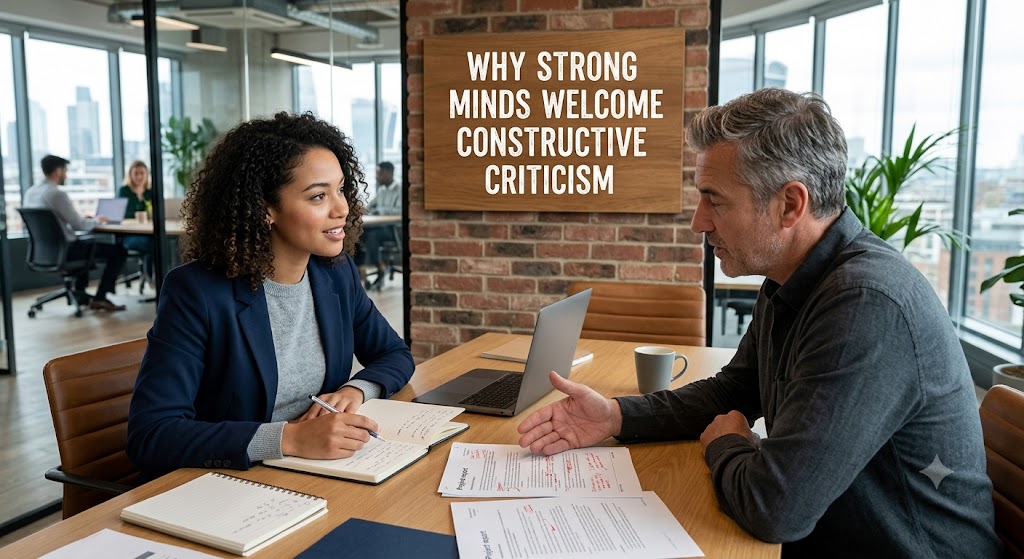
Why Strong Minds Welcome Constructive Criticism
Every person dreams of becoming wiser, more successful, and more respected, yet many people unknowingly reject one of the most valuable tools for personal and professional growth. That tool is constructive criticism. The phrase “Why Strong Minds Welcome Constructive Criticism” may sound simple, but it carries a profound truth that separates individuals who continuously improve from those who remain trapped by their own limitations. A strong mind does not see criticism as an attack. Instead, it recognises it as valuable information that can expose weaknesses, reveal blind spots, and create opportunities for meaningful growth.
One of the greatest misconceptions in modern society is that confidence means believing you are always right. In reality, genuine confidence comes from knowing that you do not know everything and being willing to learn whenever new information becomes available. People with strong minds understand this difference. They realise that accepting constructive criticism does not reduce their worth or diminish their achievements. Instead, it strengthens their character by allowing them to become more capable, knowledgeable, and resilient.
Constructive criticism differs significantly from destructive criticism. Destructive criticism seeks to belittle, embarrass, or discourage someone without offering useful guidance. Constructive criticism, on the other hand, is intended to help someone improve by pointing out weaknesses alongside practical suggestions for growth. Strong-minded individuals develop the wisdom to distinguish between the two. They ignore insults designed to provoke emotional reactions while paying close attention to honest feedback that has the potential to make them better.
One reason strong minds welcome constructive criticism is because they understand that every human being has blind spots. No matter how intelligent, experienced, or successful someone becomes, there will always be things they cannot see about themselves. These hidden weaknesses often become barriers to greater success if they remain undiscovered. Constructive criticism acts like a mirror, reflecting aspects of our behaviour, thinking, or performance that we might never notice on our own.
Many people resist criticism because they associate it with failure. They assume that being criticised means they are incompetent or incapable. Strong-minded individuals reject this way of thinking. They understand that criticism is not proof of failure but evidence that there is still room for improvement. Even the most accomplished professionals continue seeking feedback because they know perfection is an impossible destination. Growth is a lifelong process, and constructive criticism serves as one of its most reliable guides.
Another reason mentally strong people value constructive criticism is that they focus on progress rather than pride. Pride often convinces people that admitting mistakes will make them appear weak. Ironically, refusing to acknowledge mistakes usually causes greater damage over time. Strong minds choose progress instead of protecting their ego. They recognise that temporary discomfort is a small price to pay for long-term improvement.
History provides countless examples of individuals who embraced criticism and used it to achieve remarkable success. Great inventors refined their inventions after repeated feedback. Successful authors revised manuscripts after editors identified weaknesses. Elite athletes continuously improve by listening to coaches who analyse every mistake they make. Outstanding business leaders surround themselves with advisers who challenge their assumptions instead of simply agreeing with every decision. Their achievements are not built on avoiding criticism but on learning from it.
In today’s digital world, criticism appears everywhere. Social media platforms allow people to express opinions instantly, making it easier than ever to receive both praise and criticism. While this environment can be overwhelming, strong-minded individuals learn to separate emotional reactions from useful information. They understand that not every opinion deserves equal attention, yet they remain open to valuable insights regardless of where they come from.
Emotional intelligence plays a significant role in welcoming constructive criticism. People with high emotional intelligence recognise their feelings without allowing those emotions to control their decisions. Receiving criticism may initially create disappointment or frustration, but emotionally mature individuals pause before reacting. Instead of responding defensively, they ask themselves whether there is truth within the feedback. This simple habit transforms criticism into an opportunity rather than a threat.
Self-awareness also contributes to the ability to accept constructive criticism. Individuals who understand their own strengths and weaknesses are less likely to become defensive when someone points out an area for improvement. Because they already acknowledge that they are imperfect, criticism feels less like an attack on their identity and more like useful information that supports their development.
Another characteristic of strong minds is intellectual humility. Intellectual humility means recognising that your current knowledge is always incomplete. Regardless of education, experience, or expertise, there is always something new to learn. This mindset encourages curiosity rather than defensiveness. Instead of assuming they already know the best solution, intellectually humble people remain eager to discover better approaches through feedback and observation.
Constructive criticism also strengthens resilience. Every challenge people face in life presents an opportunity to become stronger, and criticism is no exception. Those who regularly receive and apply constructive feedback gradually develop thicker skin. They become less dependent on constant praise and more focused on continuous improvement. This resilience enables them to handle setbacks with greater confidence because they no longer fear being corrected.
One overlooked benefit of constructive criticism is its ability to improve decision-making. When people operate inside their own perspectives, they naturally overlook certain risks and possibilities. Feedback from others introduces new viewpoints that expand understanding. Strong minds welcome these alternative perspectives because they know better decisions are often made when different opinions are carefully considered.
Professionals who consistently seek constructive criticism often experience faster career growth than those who avoid it. Employers value individuals who are coachable because they adapt quickly, solve problems effectively, and demonstrate a genuine commitment to improvement. Employees who become defensive whenever mistakes are discussed often struggle to develop new skills, while those who appreciate honest feedback become increasingly valuable to their organisations.
Relationships also benefit when constructive criticism is welcomed. Friends, family members, and colleagues can often identify behaviours that individuals fail to recognise in themselves. Honest conversations conducted with respect can prevent misunderstandings, strengthen trust, and encourage personal maturity. Strong-minded individuals understand that people who genuinely care about them will sometimes say uncomfortable things because they want to see them succeed rather than fail.
Personal development depends largely upon accurate self-assessment. Unfortunately, self-assessment alone is often unreliable because human beings naturally favour information that confirms their existing beliefs. Constructive criticism challenges these assumptions and creates opportunities for deeper understanding. Rather than seeing disagreement as hostility, mentally strong people view it as a chance to test the accuracy of their own thinking.
The willingness to receive criticism also demonstrates maturity. Children often reject correction because they focus primarily on protecting their emotions. Mature adults gradually learn that correction serves a greater purpose than immediate comfort. They understand that temporary embarrassment can produce permanent improvement if handled with wisdom. This shift in perspective marks an important stage of emotional and intellectual growth.
Many successful entrepreneurs actively encourage criticism within their businesses because they know innovation depends upon honest communication. Companies that punish employees for raising concerns often overlook serious problems until they become expensive crises. Organisations that welcome constructive criticism, however, continuously improve their products, services, and internal systems because employees feel safe sharing valuable observations. The same principle applies to individuals. Personal growth accelerates when honest feedback is welcomed instead of rejected.
Strong minds also understand that criticism often reveals opportunities hidden beneath discomfort. A suggestion that initially feels unpleasant may eventually become the key to solving a long-standing problem or achieving an important breakthrough. By resisting the temptation to react emotionally, individuals give themselves the opportunity to discover valuable lessons that would otherwise remain hidden.
Perhaps one of the greatest strengths of people who embrace constructive criticism is their commitment to lifelong learning. They never reach a point where they believe they have mastered everything worth knowing. Every conversation, every project, every mistake, and every piece of feedback becomes another lesson that contributes to their growth. This attitude keeps them adaptable in a world that changes rapidly. Industries evolve, technology advances, customer expectations shift, and new challenges emerge every day. Those who refuse to accept correction often find themselves left behind, while those who continue learning remain relevant regardless of changing circumstances.
Another important reason strong minds welcome constructive criticism is because they understand the difference between identity and behaviour. A person’s behaviour can be corrected without diminishing their value as a human being. Unfortunately, many people confuse the two. When someone points out an error, they interpret it as a personal rejection rather than an observation about a specific action. Mentally strong individuals avoid this trap. They recognise that improving a habit, correcting a mistake, or refining a skill does not change their worth. Instead, it enhances their ability to succeed.
This distinction becomes especially valuable in professional environments. Every career involves continuous evaluation. Managers review employee performance. Clients provide feedback on services. Customers leave reviews. Colleagues suggest better approaches to completing tasks. Individuals who understand that feedback targets performance rather than personal value respond with professionalism instead of defensiveness. Their willingness to improve often earns greater respect than flawless performance ever could.
Constructive criticism also encourages innovation. New ideas rarely emerge from people who believe they already possess every answer. Innovation requires questioning existing assumptions, testing different approaches, and accepting that some methods can always be improved. Inventors, scientists, engineers, artists, and entrepreneurs all rely upon criticism during the creative process because it reveals weaknesses that may otherwise remain hidden. Every improvement begins with recognising that something could work better.
Leadership provides another powerful example of why strong minds welcome constructive criticism. Weak leaders surround themselves with people who never disagree. They seek constant approval because criticism threatens their authority. Strong leaders do the opposite. They actively encourage honest opinions because they understand that no single individual possesses complete knowledge. Teams become stronger when diverse perspectives are welcomed, and organisations become more resilient when leaders remain open to correction.
This willingness to receive feedback creates an atmosphere of trust. Employees become more engaged when they know their ideas will be heard. Family relationships become healthier when individuals can discuss concerns honestly without fear of anger or rejection. Friendships become deeper when people know they can speak the truth with kindness. Constructive criticism therefore benefits not only personal growth but also the quality of every meaningful relationship.
Psychologists have long recognised that people naturally seek information that confirms what they already believe. This tendency, often referred to as confirmation bias, can prevent significant personal development. Strong-minded individuals deliberately challenge this tendency by inviting alternative viewpoints. Instead of asking only those who agree with them, they seek opinions from people who think differently. They understand that disagreement often contains valuable insights that agreement cannot provide.
The ability to receive criticism calmly also demonstrates emotional stability. Emotions are natural, and nobody enjoys hearing that they have made mistakes. However, emotionally stable people recognise that immediate feelings should not determine permanent decisions. They pause, reflect, and analyse the information before deciding how to respond. This thoughtful approach prevents unnecessary conflict while creating opportunities for genuine improvement.
Another overlooked benefit of constructive criticism is increased self-confidence. At first glance this may appear contradictory because many people assume criticism destroys confidence. In reality, lasting confidence grows from competence rather than constant praise. Every time individuals accept feedback, improve their performance, and overcome previous weaknesses, they become more capable. Their confidence becomes rooted in proven ability instead of fragile ego. Such confidence remains stable even when challenges arise because it is based upon continuous growth rather than temporary approval.
The world’s highest achievers rarely become successful by avoiding criticism. Elite athletes review recordings of their performances to identify mistakes. Musicians spend countless hours refining techniques after receiving guidance from experienced instructors. Public speakers analyse audience reactions to improve future presentations. Writers welcome editors who identify unclear arguments and grammatical errors. Business owners study customer complaints to improve products and services. Each example demonstrates the same principle. Improvement requires honest evaluation.
One practical way to benefit from constructive criticism is to ask thoughtful questions instead of defending yourself immediately. Rather than saying, “I don’t think that’s true,” a stronger response might be, “Can you explain what you noticed?” or “What would you recommend I do differently?” These questions transform criticism into a learning opportunity while demonstrating maturity and professionalism.
Listening carefully is equally important. Many people appear to listen while secretly preparing arguments to defend themselves. Strong-minded individuals listen with genuine curiosity. They seek understanding before responding. Even if they ultimately disagree with certain aspects of the feedback, they first ensure they have understood the other person’s perspective accurately. This habit reduces misunderstandings and promotes healthier communication.
Reflection is another essential part of using criticism wisely. Not every piece of feedback requires immediate action, but every thoughtful observation deserves consideration. Taking time to reflect allows individuals to compare criticism against their experiences, goals, and values. Some suggestions may prove highly valuable, while others may be less relevant. The key is making deliberate decisions rather than emotional reactions.
Strong minds also understand that criticism should never become an excuse for discouragement. Receiving feedback does not mean abandoning confidence or constantly doubting oneself. Instead, it means maintaining enough confidence to recognise that improvement is always possible. Confidence and humility are not opposites. In fact, they strengthen one another. Genuine confidence allows people to admit mistakes without feeling threatened, while humility encourages them to continue learning regardless of previous success.
Constructive criticism also develops patience. Meaningful improvement rarely happens overnight. Correcting habits, refining skills, and changing patterns of thinking require consistent effort over time. Strong-minded individuals understand this reality and remain committed even when progress appears slow. Every small improvement contributes to greater excellence in the future.
Another lesson that mentally strong people understand is that criticism often reflects opportunity. When someone invests time explaining how another person can improve, they are demonstrating a belief that improvement is possible. Indifference is often far more damaging than criticism because it communicates a lack of expectation. Honest feedback, when delivered respectfully, expresses hope that someone can become even better than they are today.
Learning to welcome constructive criticism also prepares individuals for greater responsibilities. As careers advance and leadership opportunities increase, decisions affect more people. The ability to receive honest feedback becomes increasingly valuable because mistakes carry greater consequences. Leaders who remain teachable continue growing throughout their careers, while those who reject correction often repeat avoidable errors.
Ultimately, why strong minds welcome constructive criticism comes down to perspective. They view criticism as information rather than insult, guidance rather than humiliation, opportunity rather than rejection. This mindset transforms uncomfortable moments into valuable stepping stones towards greater wisdom, stronger character, improved performance, and lasting success. Instead of asking whether criticism feels pleasant, they ask whether it contains truth that can make them better. That single question often determines whether a person remains limited by pride or continues growing throughout life.
Every individual has a choice whenever constructive criticism appears. One path leads towards defensiveness, excuses, and stagnation. The other leads towards learning, maturity, and continuous improvement. Strong minds consistently choose the second path because they understand that personal excellence is not achieved by avoiding correction but by embracing it with humility, courage, and determination. Those who learn this lesson discover that constructive criticism is not an obstacle standing in the way of success. It is one of the most reliable guides leading directly towards it.

EarnSmartOnline.com.ng is dedicated to helping readers make smarter financial decisions through practical guides on online income, personal finance, technology, digital business, and wealth creation. Our goal is to provide reliable, easy-to-understand, and actionable content that empowers individuals to earn smarter, build sustainable income streams and achieve long-term financial success.
Recommended: Start Earning Online
- Ultimate Affiliate Marketing Program — learn affiliate marketing with a done-for-you sales system ($15). Check it out
- The Newbie Affiliate Guide — the beginner-friendly starter guide (~$6.68). Check it out
- Easy Dollar Maker — earn in dollars uploading AI images and videos from your phone ($17). Check it out
Disclosure: These are affiliate links. If you buy through them, I may earn a commission at no extra cost to you.



