
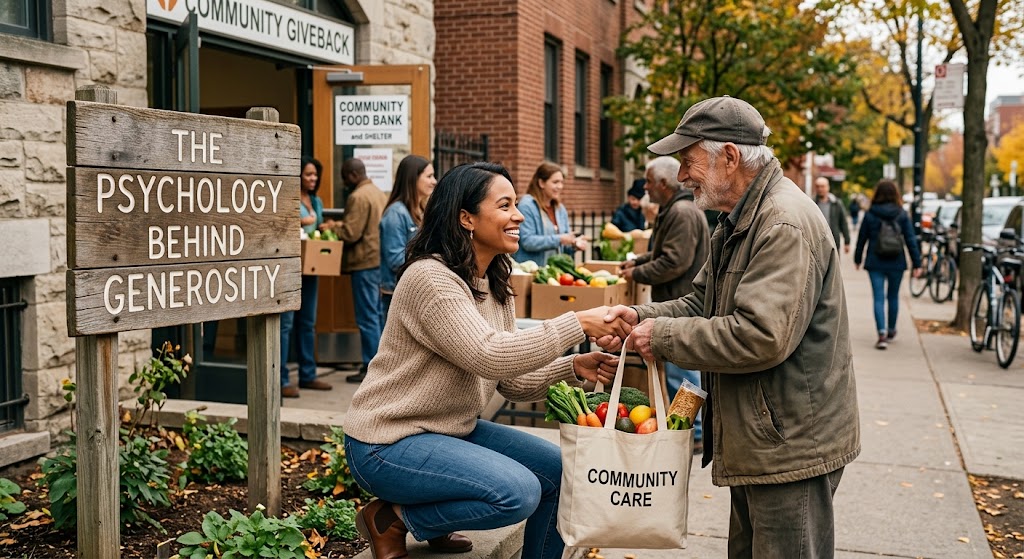
Generosity is one of the most powerful expressions of human kindness, yet it is often misunderstood. When we think about generosity, we usually think about giving money, buying food for someone, donating to charity, helping a friend, or supporting someone who is struggling. But generosity goes far beyond financial giving. It can be expressed through time, attention, forgiveness, encouragement, knowledge, patience, opportunities, and simple acts of kindness. At its heart, generosity is the willingness to give something of value without demanding an immediate reward in return. The Psychology Behind Generosity.
The psychology behind generosity reveals that giving is not simply about having enough resources to share. Human beings can be generous even when they have very little, while people with considerable wealth can sometimes struggle to give. This suggests that generosity is deeply connected to emotions, values, social relationships, personal experiences, identity, empathy, and the way people understand their relationship with others.
The psychology behind generosity begins with one of the most important qualities of human behaviour: empathy. Empathy allows us to recognise and emotionally understand what another person may be experiencing. When we see someone struggling, empathy can create an internal response that makes their problem feel personally significant. We may imagine what it would be like to be in their position, and that emotional connection can motivate us to help.
For example, imagine seeing someone sitting outside a hospital looking worried and overwhelmed. You may not know their story, but your mind can immediately begin imagining what they might be going through. If you have experienced fear, uncertainty, or financial pressure before, their situation may trigger memories of your own experiences. That emotional connection can make you more willing to offer assistance.
This is one reason generosity is not purely rational. People do not always calculate the financial cost and benefit of helping someone before acting. Sometimes they simply feel compelled to help. The emotional brain can respond before the logical mind has finished analysing the situation.
Interestingly, generosity can also make the person giving feel good. This does not necessarily make generosity selfish. It simply means that the human brain has mechanisms that can reward helpful behaviour. When people perform acts of kindness, they may experience positive emotions such as happiness, satisfaction, connection, gratitude, and fulfilment. Giving can create a sense that our actions matter.
This psychological reward helps explain why some people continue to give even when nobody is watching. They are not necessarily seeking praise, recognition, or social approval. The act itself can provide an emotional reward.
The psychology behind generosity therefore challenges the idea that every act of giving must be completely selfless to be meaningful. A person can genuinely want to help another individual while also experiencing happiness from helping. These motivations can exist at the same time.
Consider someone who regularly buys food for people who cannot afford it. They may not receive anything material in return, but they may feel peaceful knowing that they made someone’s day easier. The emotional reward does not cancel out the generosity. Instead, it may strengthen the person’s desire to continue helping.
Another important psychological factor behind generosity is social connection. Human beings are naturally social creatures. We depend on relationships, communities, families, friendships, and networks of cooperation. Throughout human history, survival has often depended on people helping one another.
Generosity strengthens relationships because it communicates something powerful: you matter to me.
When someone gives you their time, listens to your problems, helps you solve a difficult situation, or supports you during a challenging period, the value of the action is often greater than the practical assistance itself. The act communicates care.
This is why generosity can create stronger relationships. People tend to remember those who stood beside them during difficult moments. Years later, they may forget the exact words that were spoken, but they may remember who showed up when they needed someone.
Generosity can also build trust. When people consistently demonstrate that they are willing to help others, they become more trustworthy within their communities. Others are more likely to cooperate with them because generosity signals that the relationship is not based entirely on personal gain.
However, generosity is influenced by something else that is often overlooked: reciprocity. Human beings naturally notice whether relationships are balanced. When someone helps us, we often develop a desire to return the favour. This is commonly known as the principle of reciprocity.
Reciprocity does not mean generosity is always transactional. Rather, it shows that giving can create social bonds that encourage cooperation. Someone helps you today, and you may help them tomorrow. In a healthy community, these exchanges can create a network where people support one another over time.
This explains why generous communities can become resilient. When people are willing to share resources, information, opportunities, skills, and support, individuals do not have to face every problem alone.
Generosity is also strongly influenced by upbringing. Children learn many behaviours by observing the adults around them. If a child grows up watching parents regularly help neighbours, share food, donate items, care for relatives, or support people experiencing difficulties, generosity may become normal to them.
On the other hand, someone raised in an environment where resources were treated as something that must always be protected may develop a different relationship with giving. They may associate generosity with risk, loss, or vulnerability.
This does not mean childhood completely determines adult behaviour. People can change their attitudes and develop new values throughout life. But early experiences can influence how individuals perceive scarcity, abundance, trust, and responsibility.
Personal experience can also transform someone’s attitude towards generosity. A person who has experienced poverty, loneliness, rejection, unemployment, or hardship may become deeply motivated to help others facing similar circumstances. Their own experience gives them an understanding that cannot always be obtained through theory.
Someone who once struggled to afford food may become particularly sensitive to food insecurity. Someone who once needed financial assistance may become passionate about helping others get through difficult periods. Someone who remembers being ignored when they needed encouragement may become the person who always encourages others.
In this sense, pain can sometimes become a source of compassion.
However, the psychology behind generosity also includes an uncomfortable truth: people are not equally generous towards everyone. Generosity can be influenced by similarity, familiarity, social identity, and emotional connection.
The Psychology Behind Generosity
People are often more willing to help someone they perceive as similar to themselves. They may feel closer to people who share their culture, profession, interests, beliefs, background, or personal experiences. This can make generosity easier within familiar communities than towards strangers.
This is one reason campaigns often use individual stories when asking for donations. A specific human story can create a stronger emotional connection than an abstract statistic. When people can imagine a real person, their emotional response may become stronger.
There is also the issue of visibility. People are sometimes more likely to give when they believe their generosity will be noticed. Public recognition can encourage charitable behaviour because humans naturally care about reputation and social approval.
This does not automatically make public generosity fake. A person can genuinely want to help while also enjoying recognition. Human motivation is rarely as simple as one single reason.
The important question is not always whether someone receives recognition for being generous. A more useful question is whether the person is genuinely creating value for someone else.
Generosity also affects the person receiving it. Being helped can create feelings of gratitude, relief, hope, dignity, and belonging. But receiving help can sometimes produce uncomfortable emotions as well. Some people feel embarrassed when they need assistance. Others may feel indebted or powerless.
This is why healthy generosity should preserve dignity.
There is a significant difference between helping someone and humiliating them while helping them. A person who gives money while publicly reminding the recipient of their poverty may technically be giving, but the emotional experience of the recipient can be damaging.
True generosity considers not only what is being given but also how it is given.
Sometimes the most generous thing you can offer someone is not money. It may be respect.
A person who is struggling may need someone who listens without judgement. A young person may need someone to share knowledge with them. Someone searching for employment may need a genuine recommendation. An aspiring entrepreneur may need someone to introduce them to the right person. A friend going through a difficult period may simply need someone to sit with them.
Generosity therefore involves recognising what another person actually needs rather than giving only what is convenient for ourselves.
This distinction matters because people sometimes give what makes them feel generous rather than what genuinely helps the other person.
Someone may give advice when the other person needs to be heard. Someone may give money when the person actually needs an opportunity. Someone may give criticism when encouragement would be more useful.
The most effective generosity begins with attention.
Before asking, “What can I give?” it can be useful to ask, “What does this person actually need?”
Another fascinating aspect of generosity is that it can become a habit. The more frequently people engage in meaningful acts of kindness, the more natural those behaviours can become. Generosity does not necessarily require dramatic gestures. Small consistent actions can shape identity.
A person who regularly shares knowledge may begin to see themselves as a mentor. Someone who frequently helps neighbours may see themselves as a community minded person. Someone who consistently supports friends may develop a stronger identity around loyalty and compassion.
Identity matters because people often behave in ways that are consistent with how they see themselves.
If you believe you are generous, you may be more likely to notice opportunities to help. You begin seeing situations through a different psychological lens. Instead of asking, “Why should I get involved?” you may naturally ask, “How can I help?”
This is one reason generosity can become contagious. When people witness acts of kindness, they may become more willing to perform similar actions themselves. A generous action can influence another person, who influences someone else, creating a chain reaction.
Imagine a customer quietly paying for another person’s meal. The recipient is surprised and grateful. Later that person decides to help someone else. The next recipient experiences the same kindness and passes it forward.
One act can travel much further than the original giver ever knows.
The psychology behind generosity also teaches an important lesson about abundance. People who constantly believe they do not have enough may find it difficult to give. This is understandable because generosity requires some willingness to share resources.
But abundance is not always measured by how much money someone has.
You can have little money and still have time. You can lack financial resources and still possess valuable knowledge. You may not be able to solve someone’s entire problem, but you can offer encouragement. You may not be able to fund someone’s dream, but you may be able to introduce them to someone who can help.
Generosity is therefore less about possessing everything and more about being willing to share something.
At the same time, healthy generosity requires boundaries. Being generous does not mean allowing people to exploit you. It does not mean giving away everything you own, constantly rescuing irresponsible people, or sacrificing your wellbeing to satisfy endless demands.
There is a difference between generosity and self destruction.
A person can be generous while maintaining boundaries. In fact, sustainable generosity requires boundaries because someone who constantly gives beyond their capacity may eventually become exhausted, resentful, or financially unstable.
Generosity should ideally create value without destroying the giver.
This is particularly important because some people struggle to say no. They may give because they fear rejection, guilt, criticism, or disappointment. In such situations, giving may not come from genuine generosity but from emotional pressure.
Healthy generosity is freely chosen.
It comes from the ability to say, “I want to help,” rather than feeling that you must help in order to be accepted.
The psychology behind generosity ultimately points towards something profound about human beings. People are not driven only by competition, survival, and personal achievement. There is also a deep human desire to connect, contribute, protect, encourage, and make life better for someone else.
Generosity gives people an opportunity to move beyond themselves.
In a world that often measures success by what people own, how much they earn, how many followers they have, and how impressive their lifestyle appears, generosity introduces another measurement of a meaningful life: what difference did you make in someone else’s life?
You may not remember every person who helped you. But some acts of kindness stay with you for decades.
A teacher who believed in you.
A stranger who helped you when you were lost.
A friend who stayed when everyone else disappeared.
A relative who supported you when you had nothing to offer in return.
A mentor who opened a door that changed your career.
A person who gave you hope at a time when you were close to giving up.
These moments demonstrate why generosity is so powerful. Sometimes the value of what we give cannot be measured immediately.
A small act can change someone’s direction.
A few minutes of encouragement can prevent someone from quitting. A simple introduction can create an opportunity. A meal can carry someone through a difficult day. A kind word can restore confidence. A second chance can completely change a person’s future.
The giver may move on and forget the moment. The receiver may carry it for the rest of their life.
That is perhaps one of the most beautiful things about generosity.
It allows people to create effects they may never fully witness.
The psychology behind generosity is therefore not simply about why people give. It is also about what happens when human beings recognise that their lives are connected. We influence one another through our actions, our words, our attention, and our willingness to share what we have.
Generosity reminds us that success is not only about climbing higher. Sometimes it is about reaching back and helping someone else climb.
It reminds us that having more is not necessarily the same as living better. Sometimes the greatest satisfaction comes from knowing that something we possessed became useful to someone else.
It reminds us that kindness is not weakness. Giving does not automatically make a person vulnerable or foolish. When guided by wisdom and boundaries, generosity can strengthen relationships, build communities, improve wellbeing, encourage cooperation, and create a sense of purpose.
Most importantly, generosity gives ordinary people the ability to make an extraordinary difference.
You do not have to become wealthy before you become generous. You do not have to wait until your own life is perfect before you help someone else. You do not need millions in the bank to contribute something meaningful to another person’s life.
Start with what you have.
Give your time when someone needs attention. Share your knowledge when someone needs direction. Offer encouragement when someone is losing confidence. Give opportunities when you have the power to open a door. Share resources when you genuinely can. Forgive when forgiveness is appropriate. Listen when someone desperately needs to be heard.
And when you give, remember that generosity is not about proving that you are better than the person receiving your help. It is about recognising that circumstances can change, that everyone needs help at different points in life, and that the person receiving today may be the person giving tomorrow.
The psychology behind generosity ultimately reveals a simple but powerful truth: humans need one another.
We may spend our lives trying to become independent, successful, wealthy, powerful, and self sufficient, but no meaningful life is built entirely alone. At some point, someone helps us. Someone teaches us. Someone encourages us. Someone gives us an opportunity. Someone believes in us before we believe in ourselves.
Generosity is one of the ways we return that goodness to the world.
And sometimes, the most valuable thing you can give is not what costs you the most.
It is what means the most to someone else.
When generosity becomes part of your character rather than an occasional performance, giving stops being something you do only when circumstances demand it. It becomes part of who you are. You begin to understand that every day presents opportunities to make someone’s burden lighter, someone’s hope stronger, someone’s journey easier, or someone’s future brighter.
That is the deeper psychology behind generosity.
We give because we are human.
We give because we understand pain.
We give because we remember what it felt like to need help.
We give because connection matters.
We give because kindness can create meaning.
And sometimes, we give simply because we have discovered that making another person’s life a little better can make our own life feel much more meaningful too.

EarnSmartOnline.com.ng is dedicated to helping readers make smarter financial decisions through practical guides on online income, personal finance, technology, digital business, and wealth creation. Our goal is to provide reliable, easy-to-understand, and actionable content that empowers individuals to earn smarter, build sustainable income streams and achieve long-term financial success.
Recommended: Start Earning Online
- Ultimate Affiliate Marketing Program — learn affiliate marketing with a done-for-you sales system ($15). Check it out
- The Newbie Affiliate Guide — the beginner-friendly starter guide (~$6.68). Check it out
- Easy Dollar Maker — earn in dollars uploading AI images and videos from your phone ($17). Check it out
Disclosure: These are affiliate links. If you buy through them, I may earn a commission at no extra cost to you.



