
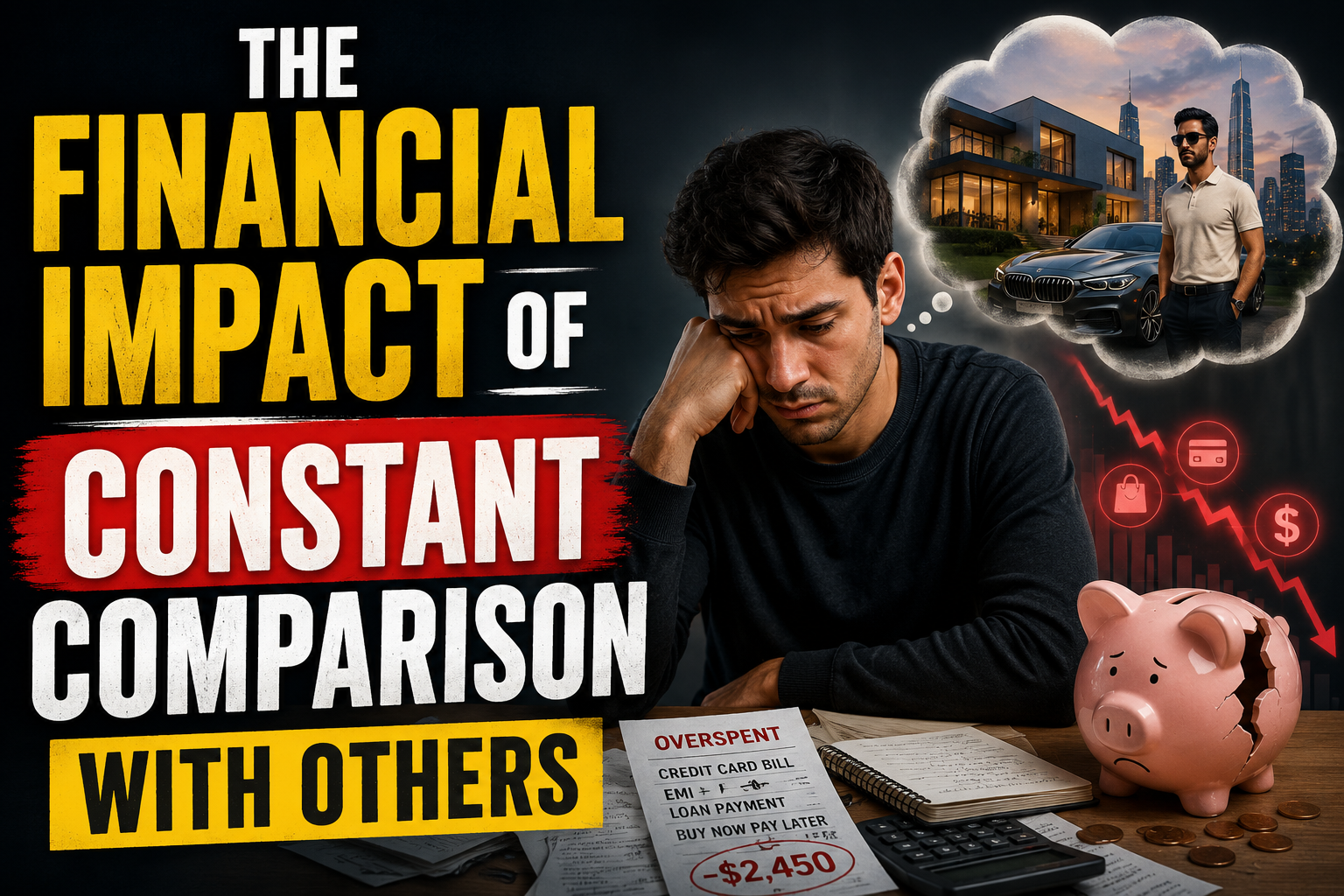
The Financial Impact of Constant Comparison With Others
One of the most underestimated forces shaping people’s financial lives today is not inflation, not lack of opportunities, and not even low income. It is comparison. The habit of constantly measuring yourself against others has become so normal that many people no longer realize how deeply it influences their spending decisions, lifestyle choices, debt levels, and long-term financial stability. In a world driven by social media highlights and curated lifestyles, comparison is no longer occasional. It is continuous. And when it becomes continuous, it stops being harmless observation and turns into a financial pressure system that quietly controls behavior.
At the surface level, comparison looks like motivation. People see someone driving a new car, wearing expensive clothes, traveling frequently, or living in a better apartment, and they feel inspired to improve their own lives. But underneath that inspiration is often a more dangerous emotion, inadequacy. Instead of asking how that person built their life, many people ask why they are not there yet. That question, when left unchecked, quickly turns into pressure to appear successful even before becoming successful. This is where financial damage begins.
The first major financial impact of constant comparison is unnecessary spending. People begin to buy things not because they need them or can afford them comfortably, but because others seem to have them. A phone upgrade that was not planned suddenly feels urgent. New clothes are purchased to match a perceived standard. Social outings become more expensive because no one wants to appear broke in front of friends or colleagues. Over time, these small decisions accumulate into a pattern of overspending that quietly erodes savings and creates financial instability.
Another major effect is lifestyle inflation driven by social pressure rather than real income growth. In an ideal financial progression, lifestyle improvements follow income increases in a controlled and intentional way. However, when comparison is the driver, the sequence is reversed. People upgrade their lifestyle first and hope their income will catch up later. This leads to a dangerous gap between earnings and expenses. Rent becomes too high, subscriptions multiply, transportation becomes more expensive, and maintenance costs increase. What appears as progress on the outside is often financial strain on the inside.
Debt is another silent consequence of comparison. Many people do not realize how often their financial obligations are shaped by what they see others doing. Loans are taken to match appearances. Credit cards are used to sustain lifestyles that are not supported by actual income. Borrowing becomes normalized because the goal is not financial stability but social acceptance. The problem is that debt created by comparison rarely feels urgent at first, but it grows steadily until it becomes a long term burden that limits freedom and options.
Constant comparison also distorts financial priorities. When people are focused on keeping up with others, they often neglect essential financial habits such as saving, investing, and emergency planning. Instead of building a safety net, they focus on maintaining an image. Instead of thinking about long term wealth, they focus on short term visibility. This shift in priorities creates a situation where people may appear successful but remain financially vulnerable to unexpected events such as job loss, illness, or economic downturns.
There is also a psychological dimension to this issue that directly affects financial behavior. Comparison creates a sense of urgency that is not based on real needs. When someone feels behind, they are more likely to make impulsive financial decisions. They are less patient with long term goals and more attracted to quick fixes or shortcuts. This is why many people fall into schemes, risky investments, or unsustainable financial commitments. The emotional pressure created by comparison reduces rational decision making and increases financial mistakes.
Social media has significantly amplified this problem. In earlier generations, comparison was limited to neighbors, colleagues, or relatives. Today, it extends to millions of curated lives displayed through screens. The problem is not just exposure but distortion. People rarely post financial struggles, unpaid debts, or failed investments. What is visible is success without context. When this becomes the benchmark, it creates unrealistic expectations and constant dissatisfaction with one’s own progress. Financial decisions begin to reflect this distorted reality rather than actual circumstances.
Another overlooked impact is the delay in wealth building. Wealth is built through consistency, patience, and discipline. However, comparison encourages distraction. Instead of sticking to a steady financial plan, people frequently change direction to match what others are doing. One person starts saving, then abandons it to try trading because someone else claimed success. Another starts investing, then stops to pursue a business trend. This constant switching prevents compounding, which is one of the most important principles of wealth creation.
Comparison also affects risk tolerance in unhealthy ways. Some people take excessive risks because they feel left behind, while others avoid necessary risks because they feel they are not ready compared to others. Both extremes are harmful. Healthy financial growth requires balanced risk based on personal capacity, not social pressure. When decisions are based on comparison, that balance is lost, and financial outcomes become unpredictable.
Over time, constant comparison creates a cycle that is difficult to break. It begins with observation, turns into desire, leads to spending, then results in financial stress. To cope with stress, people often return to comparison, hoping to find motivation or justification. This cycle repeats and deepens, making financial independence harder to achieve. Breaking it requires not just better money management, but a shift in mindset.
One of the most important realizations in personal finance is that wealth is not a competition. It is a personal journey with different starting points, goals, and timelines. Two people earning the same income can have completely different financial outcomes based on their habits, discipline, and priorities. When comparison is removed from the equation, financial decisions become clearer and more intentional. People begin to focus on their own progress rather than external validation.
A healthier approach is to replace comparison with evaluation. Instead of asking how you measure up against others, ask whether your financial choices are improving your situation compared to your past self. This shift changes the focus from competition to growth. It allows for learning from others without copying their lifestyle. It encourages inspiration without pressure. Most importantly, it restores control over financial decisions.
Financial stability is built quietly. It does not usually look impressive in the short term. It is often the result of repeated disciplined choices that are invisible to others. The problem with comparison is that it rewards visibility over substance. It makes people prioritize what can be seen over what actually matters. But true financial strength is not seen in appearances. It is seen in resilience, freedom, and the ability to make choices without financial fear.
In the end, the financial impact of constant comparison is not just about money lost. It is about time lost, opportunities missed, and peace of mind sacrificed. It affects how people think, how they spend, and how they plan their future. The most dangerous part is that it often feels normal. But once recognized, it becomes possible to change.
Choosing to step away from constant comparison does not mean ignoring ambition. It means redefining it. Instead of trying to match others, you build your own standard. Instead of rushing to appear successful, you focus on becoming financially stable. And instead of measuring your worth through external displays, you measure progress through real financial growth.
When that shift happens, money stops being a tool for comparison and becomes a tool for freedom.

EarnSmartOnline.com.ng is dedicated to helping readers make smarter financial decisions through practical guides on online income, personal finance, technology, digital business, and wealth creation. Our goal is to provide reliable, easy-to-understand, and actionable content that empowers individuals to earn smarter, build sustainable income streams and achieve long-term financial success.
Recommended: Start Earning Online
- Ultimate Affiliate Marketing Program — learn affiliate marketing with a done-for-you sales system ($15). Check it out
- The Newbie Affiliate Guide — the beginner-friendly starter guide (~$6.68). Check it out
- Easy Dollar Maker — earn in dollars uploading AI images and videos from your phone ($17). Check it out
Disclosure: These are affiliate links. If you buy through them, I may earn a commission at no extra cost to you.



