
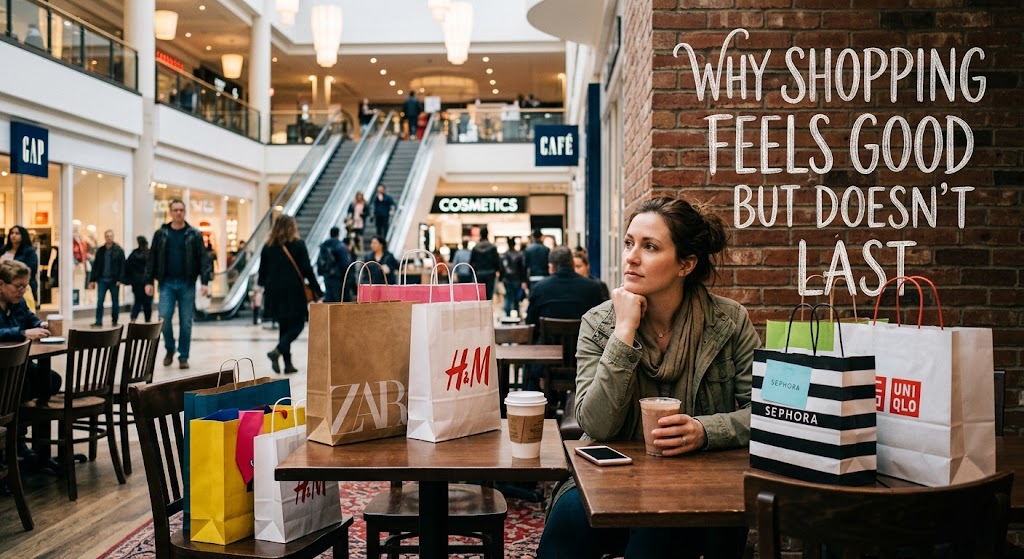
Why Shopping Feels Good but Doesn’t Last is a question that many people have experienced personally, even if they have never stopped to think about it. You see something you like, imagine yourself owning it, and suddenly your mood changes. Maybe you have had a difficult day, felt stressed about work, experienced disappointment, or simply become bored with your routine. Then you open an online shop, walk into a shopping centre, or see a product advertised on social media. You find something attractive, and within minutes, you feel excited. You buy it, receive it, open the package, wear it, use it, or admire it, and for a short while, everything feels better. But then something strange happens. The excitement disappears.
That is exactly why shopping can feel so good but does not always create lasting happiness. The pleasure is often connected less to the object itself and more to anticipation, novelty, emotional relief, personal reward, and the feeling that you have temporarily changed something about your life. Once the excitement of getting something new disappears, you are left with the product and the same life you had before the purchase. Understanding why shopping feels good but doesn’t last can completely change the way you think about money, consumption, happiness, and financial discipline.
Shopping is not inherently bad. Buying things we genuinely need or enjoy is a normal part of life. Clothes, food, electronics, books, furniture, experiences and countless other purchases can make life easier or more enjoyable. The problem begins when shopping becomes a substitute for something else. Some people shop because they are bored. Others shop when they are lonely, stressed, angry, disappointed or emotionally exhausted. Some people shop because they want to reward themselves after surviving a difficult week. Others shop because everyone around them appears to be upgrading their lifestyle.
The important thing is that the emotional experience of shopping often begins before the transaction itself. There is excitement in searching. There is anticipation when comparing products. There is imagination when picturing yourself using something new. There is satisfaction when you finally click the purchase button. There is another burst of excitement when the delivery arrives. All of these stages can create positive emotions, which is why shopping can become psychologically rewarding.
The problem is that anticipation is temporary. Novelty is temporary. The emotional high associated with receiving something new is temporary. Once the brain becomes accustomed to the new possession, the object becomes part of normal life. What once looked extraordinary can suddenly look ordinary.
Think about the phone you desperately wanted a few years ago. Before buying it, you probably watched videos, compared specifications, checked prices, read reviews and imagined how much better your life would be with it. When you finally got it, you may have felt genuinely excited. You wanted to show it to people. You enjoyed setting it up. You explored its features. You admired the camera. For a while, it felt special.
Then life happened.
After some time, it simply became your phone.
This process is one reason why shopping feels good but doesn’t last. Human beings are remarkably capable of adapting to new circumstances. What initially feels exciting eventually becomes familiar. The new shoes become normal shoes. The new phone becomes your phone. The new television becomes the television in your living room. The new handbag becomes another item in the wardrobe.
This does not mean the purchase was useless. It means the emotional benefit of novelty was never designed to remain at its original intensity forever.
Advertising understands this extremely well. Modern marketing rarely sells only products. It sells feelings, identities, lifestyles and possibilities. A car advertisement may not simply show you a vehicle. It may show you freedom, success, confidence and admiration. A clothing advertisement may not simply sell fabric. It may suggest attractiveness, status, confidence and belonging. A luxury watch may be presented as proof that you have achieved something significant.
The message is often subtle but powerful: your current life is incomplete, but this product could help complete it.
That message can become dangerous when you start believing that happiness is waiting inside the next purchase.
Social media makes this even more complicated. Every day, people are exposed to carefully selected images of other people’s lives. Someone buys a new car. Someone travels to another country. Someone renovates their house. Someone wears expensive clothes. Someone posts a new gadget. Someone celebrates a birthday in an expensive restaurant. Someone shows off a beautifully decorated apartment.
You see the finished picture, not the entire financial story behind it.
You do not see the debt. You do not see the anxiety. You do not see the unpaid bills. You do not see the arguments about money. You do not see the months of saving. You do not see whether the person can actually afford the lifestyle they are displaying.
Yet your brain compares your ordinary life with their carefully selected highlight.
That comparison can create dissatisfaction. Once dissatisfaction appears, shopping can feel like an easy solution. You buy something because you want to feel as though you are moving forward. You upgrade something because you feel behind. You purchase something because you want to look successful. You spend because you want to prove something to yourself or somebody else.
The purchase provides a temporary emotional reward, but the underlying insecurity remains.
This is one of the biggest reasons why shopping feels good but doesn’t last. If the real problem is loneliness, shopping does not create genuine connection. If the problem is exhaustion, shopping does not necessarily provide rest. If the problem is dissatisfaction with your career, a new outfit cannot automatically solve it. If the problem is low self confidence, expensive possessions may temporarily provide validation but cannot permanently establish a healthy sense of self worth.
You can buy something new without changing anything important about your life.
That distinction matters.
There is also a difference between buying something because you genuinely value it and buying something because you want to escape an emotion. Imagine that you need a new pair of shoes because your current pair is damaged. Buying the replacement is practical. Now imagine that you had a terrible day, opened an online shop at midnight and bought three pairs of shoes you never planned to purchase because you wanted to feel better.
The products may be identical, but the emotional reasons behind the purchases are completely different.
This is why emotional spending deserves attention. It is not simply about the amount of money being spent. It is about what the money is being asked to accomplish emotionally.
When you repeatedly use shopping to regulate your emotions, you can create a cycle. You feel uncomfortable. You shop. You experience excitement. You feel better temporarily. The excitement fades. The original emotional problem remains. You feel disappointed or guilty. You experience another uncomfortable emotion. Then you shop again.
Why Shopping Feels Good but Doesn’t Last
The cycle can continue for months or years without the person recognising what is happening.
Sometimes the biggest warning sign is not the purchase itself. It is the thought that comes immediately before it: “I deserve this.”
Of course, you deserve good things. You deserve rest. You deserve enjoyment. You deserve to celebrate your progress. But if every uncomfortable emotion becomes a reason to spend money, the phrase can quietly become an excuse for financial self sabotage.
There is nothing wrong with rewarding yourself. The problem is when the reward destroys the progress you were trying to celebrate.
Imagine working hard to save money for six months, reaching your target, and then spending a significant portion of it on things you did not need because you felt you deserved to treat yourself. The emotional reward may last a weekend. The financial consequences may last months.
This is another reason why shopping feels good but doesn’t last. The pleasure is immediate, while the financial consequences are delayed.
Humans naturally tend to place enormous importance on immediate rewards. Something you can enjoy today often feels more valuable than something that benefits you months or years from now. This is why saving can feel boring while spending feels exciting. Saving represents a future benefit. Shopping provides an immediate emotional experience.
You can see this conflict in everyday life. Saving money for an emergency fund is responsible, but it does not create the same excitement as receiving a new device. Investing for retirement is important, but it does not produce the same emotional reaction as buying something you have wanted for weeks. Paying down debt may improve your financial future, but there is rarely an unboxing video for it.
Yet the quiet financial decisions often create the most lasting freedom.
That is why it is important to stop asking only, “Can I afford this?” and begin asking, “What am I expecting this purchase to do for me?”
If the answer is that the item will solve a genuine practical problem, the decision becomes easier. If the answer is that the purchase will make you feel successful, attractive, important, less lonely or less stressed, pause for a moment.
You may still decide to buy it. But at least you will understand what you are actually purchasing.
Another useful question is, “Would I still want this if nobody could see me with it?”
That question can expose the influence of social pressure. If you would still buy something because you personally enjoy it, there is nothing wrong with that. But if your desire disappears when you imagine that nobody will ever know you own it, perhaps the purchase is more about recognition than usefulness.
The same applies to lifestyle upgrades. Sometimes people do not actually want a bigger house, more expensive car or designer wardrobe. They want the respect they believe these things will generate. They are not necessarily buying the object. They are buying the feeling of being perceived differently.
Unfortunately, external validation is one of the most expensive things you can purchase because there is no final price.
There will always be someone with a newer car, larger house, better phone, more expensive clothes or more exotic holiday. If your happiness depends on staying ahead of other people’s possessions, you have entered a competition that never ends.
The healthier alternative is to define what enough means to you.
Enough does not mean refusing to enjoy life. It means knowing when additional consumption stops adding meaningful value. It means recognising that the tenth pair of shoes may not improve your life as much as the first pair did. It means understanding that upgrading a perfectly functional phone may provide excitement but not necessarily greater happiness. It means being able to enjoy your money without allowing your money to control your emotions.
One of the most powerful ways to reduce unnecessary shopping is to create a waiting period. When you see something you want, you do not have to immediately reject it. Simply wait. For a small purchase, perhaps wait a day. For a larger purchase, wait a week or longer.
During that time, ask yourself whether you still want the item.
Sometimes the desire disappears completely.
That is useful information.
If you still want it after the waiting period and it fits your budget, the purchase may be more intentional. You are no longer responding purely to impulse. You are making a decision.
Another important strategy is to make your existing possessions visible. People often buy duplicates because they forget what they already own. A wardrobe full of clothes can somehow create the feeling that you have nothing to wear. A bookshelf full of unread books can somehow make another book feel necessary. A kitchen full of appliances can somehow make another gadget look essential.
Consumption can become easier when you stop noticing what you already have.
Gratitude can therefore play an important role in financial behaviour. Gratitude is not about pretending that you do not want anything else. It is about recognising the value of what already exists in your life.
There is a profound difference between wanting something and believing you need it to be happy.
You can want a better car while appreciating the car you currently drive. You can want a larger house while appreciating the shelter you currently have. You can want better clothes while appreciating the clothes already in your wardrobe. You can want more money while still recognising the progress you have already made.
That mindset creates space between desire and desperation.
It also helps to remember that experiences often have a different emotional pattern from possessions. A possession can become ordinary through familiarity, while meaningful experiences can remain valuable because of the memories attached to them. This does not mean every experience is automatically better than every product. It simply means that spending money on something that strengthens relationships, creates memories, develops skills or contributes to personal growth can sometimes provide more lasting satisfaction than accumulating more things.
The goal should not be to eliminate shopping.
The goal should be to make shopping serve your life rather than allowing your emotions to serve shopping.
There is nothing wrong with enjoying a beautiful shirt, buying a new laptop, treating yourself to a nice meal or purchasing something you have wanted for a long time. The danger begins when the purchase becomes your primary method of coping with life.
If every stressful day ends at an online shop, the problem is not the shopping cart.
There is probably something deeper that needs attention.
Maybe you need rest. Maybe you need meaningful relationships. Maybe you need a change in routine. Maybe you need to address a financial problem. Maybe you need to have an honest conversation with yourself about what is making you unhappy.
No product can permanently fill an emotional gap that it was never designed to fill.
Understanding why shopping feels good but doesn’t last can therefore become a powerful financial lesson. It teaches us that the emotional high of spending is not the same thing as lasting satisfaction. It reminds us that novelty fades. It exposes the difference between genuine needs and emotional impulses. It helps us recognise the influence of advertising and social comparison. Most importantly, it gives us the opportunity to make more intentional decisions with our money.
The next time you feel the sudden urge to buy something, pause before reaching for your wallet. Ask yourself what you are feeling. Ask yourself why you want the item. Ask whether you would still want it tomorrow. Ask whether it solves a real problem or simply provides a temporary escape. Ask what else you could do with the same money.
You may still decide to buy it.
And that is perfectly fine.
The difference is that you will be buying because you chose to, rather than because an emotion pushed you into it.
Money is too valuable to spend entirely on temporary emotional highs. Your financial life is built through thousands of small decisions, including the decision to walk away from something you do not genuinely need.
Shopping can provide pleasure. New things can make life enjoyable. Treating yourself can be healthy. But lasting happiness rarely comes from endlessly acquiring more possessions.
Eventually, the excitement fades.
The packaging goes in the bin. The new item becomes familiar. The advertisement disappears from your screen. The trend changes. Something newer arrives. And if you have built your happiness around constantly buying the next thing, you will find yourself standing at the beginning of another shopping cycle.
That is the uncomfortable truth behind why shopping feels good but doesn’t last.
Sometimes what you are searching for is not another product.
Sometimes you are searching for peace.
Sometimes you are searching for confidence.
Sometimes you are searching for connection.
Sometimes you are searching for progress.
And sometimes you are simply searching for a moment when life feels better.
The good news is that those things can be pursued without constantly opening your wallet.
Real financial freedom is not the ability to buy everything you want. It is the ability to want something without immediately needing to buy it. It is having enough discipline to delay gratification. It is knowing that you can walk away from a purchase and still feel complete.
The most powerful purchase you can sometimes make is no purchase at all.
Because when you learn to separate happiness from consumption, you stop chasing temporary excitement and start building something far more valuable: a life that does not require constant spending to feel meaningful.
That is when shopping becomes what it was always meant to be: a tool for improving your life, not a substitute for living it.

EarnSmartOnline.com.ng is dedicated to helping readers make smarter financial decisions through practical guides on online income, personal finance, technology, digital business, and wealth creation. Our goal is to provide reliable, easy-to-understand, and actionable content that empowers individuals to earn smarter, build sustainable income streams and achieve long-term financial success.
Recommended: Start Earning Online
- Ultimate Affiliate Marketing Program — learn affiliate marketing with a done-for-you sales system ($15). Check it out
- The Newbie Affiliate Guide — the beginner-friendly starter guide (~$6.68). Check it out
- Easy Dollar Maker — earn in dollars uploading AI images and videos from your phone ($17). Check it out
Disclosure: These are affiliate links. If you buy through them, I may earn a commission at no extra cost to you.



