
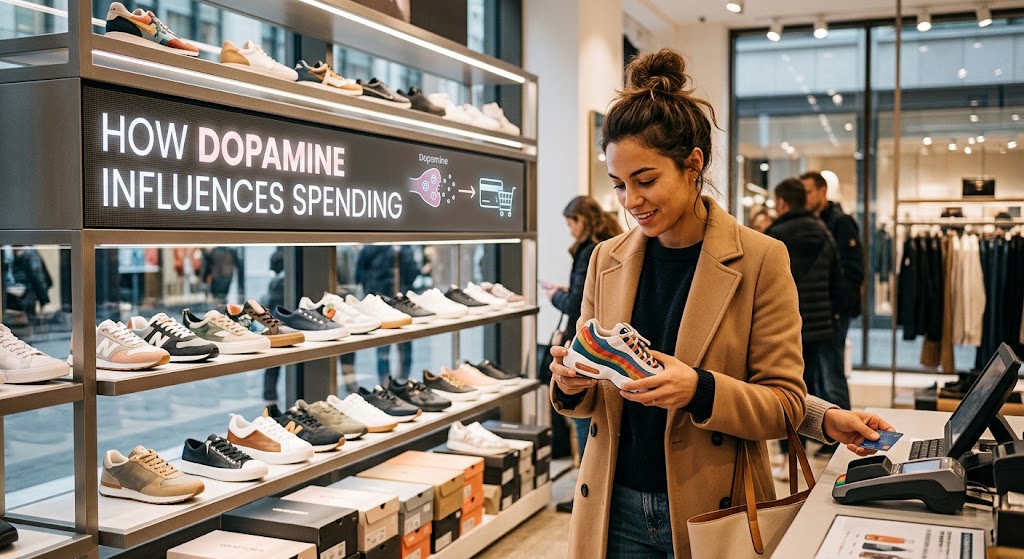
How Dopamine Influences Spending is a fascinating subject because many of our financial decisions are influenced by something that has nothing to do with mathematics, budgets or income. We often think we spend money because we need something, want something or can afford something. However, the human brain is far more complicated than that. Sometimes we spend because the anticipation of getting something feels exciting. Sometimes we buy something simply because a discount makes us feel as though we are winning. Sometimes we keep scrolling through an online shop even though we had no intention of buying anything when we started. Behind many of these behaviours is dopamine, a neurotransmitter strongly involved in motivation, reward, learning and anticipation.
Understanding How Dopamine Influences Spending can help people recognise why certain purchases feel almost irresistible. Dopamine is often described as the brain’s pleasure chemical, but that description is incomplete. Dopamine is more closely associated with motivation, reward prediction and the drive to seek something potentially rewarding. It can become active when we anticipate a reward, not merely when we receive it. This distinction is extremely important when it comes to shopping and personal finance because the excitement of buying something can begin long before the transaction actually happens.
Imagine that you are casually browsing your favourite online store. You see a new smartphone, a pair of shoes, a watch, a laptop or perhaps something completely unnecessary but attractive. You start imagining what it would feel like to own it. You look at the pictures, read reviews and compare colours. Then you notice that the product is supposedly on sale. Suddenly, the purchase feels urgent. You may tell yourself that you are saving money because the price has been reduced. You may even begin imagining how much better your life will be after buying it. The transaction has not happened yet, but your brain is already responding to the possibility of receiving a reward.
This is one of the reasons How Dopamine Influences Spending matters so much in modern consumer culture. Businesses understand that purchasing is not simply an economic activity. It is also an emotional and psychological experience. Modern marketing is designed to create anticipation, curiosity, urgency and excitement. Limited time offers, countdown timers, personalised recommendations, exclusive products, loyalty rewards, flash sales and free delivery thresholds can all encourage consumers to remain engaged with the purchasing process.
The more exciting the buying process becomes, the easier it can be to confuse wanting something with needing it. A person might enter an online shop intending to buy one affordable item and leave having purchased five things. The individual may not have consciously decided that all five items were necessary. Instead, each additional purchase created another small moment of anticipation and reward. The brain can learn to associate shopping with excitement, novelty and emotional relief.
This helps explain why impulse spending can be so powerful. An impulse purchase is often not the result of careful financial planning. It can happen when an immediate emotional desire overwhelms a longer term financial objective. Someone may know that they should be saving money for rent, school fees, an emergency fund, a business project or a future investment, yet still spend on something unnecessary because the immediate reward feels more compelling than the distant benefit.
The problem becomes even more interesting when spending is connected to emotions. People do not always shop when they are happy. Some people spend when they are stressed, bored, lonely, frustrated or disappointed. Shopping can provide temporary stimulation and distraction. Finding something interesting, placing it in a basket and completing a purchase can create a sense of movement and achievement. The emotional state that existed before the purchase may temporarily change.
This does not mean that everyone who shops is addicted to dopamine or that dopamine itself is responsible for poor financial decisions. Dopamine is a normal and necessary part of human brain function. It helps us learn from rewards, pursue goals and respond to opportunities. The problem arises when environments repeatedly encourage immediate rewards while making long term consequences feel distant and abstract.
Consider the difference between saving £100 and spending £100 on something exciting. Saving may be financially beneficial, but the reward is delayed. You may not feel anything immediately after transferring the money into a savings account. Spending the same amount on something you have been thinking about may produce an immediate emotional response. The purchase arrives, the packaging is opened and the experience feels tangible. This creates a psychological imbalance between immediate gratification and delayed financial security.
This is one reason financial discipline can be difficult even for people who understand personal finance. Knowing what you should do does not automatically make doing it emotionally satisfying. A person can understand compound interest, emergency funds and investment principles while still struggling to resist unnecessary purchases. Financial behaviour is influenced not only by knowledge but also by habits, emotions, environment and the brain’s reward system.
How Dopamine Influences Spending becomes particularly relevant in an age dominated by smartphones and social media. Shopping is no longer restricted to physical shops that require travel. A person can purchase almost anything from a phone within minutes. Social media platforms can expose users to products while they are watching entertainment, communicating with friends or consuming educational content. Advertising can therefore become integrated into everyday life rather than appearing as a separate shopping experience.
Influencers can also contribute to this process by turning products into lifestyle symbols. A person may not simply see a watch. They may see success, confidence, status and belonging represented through that watch. They may not simply see a new phone. They may see productivity, sophistication or social acceptance. When products become connected to identity, purchasing decisions can become much more emotional.
Scarcity is another powerful factor. Messages such as limited stock, final hours, only a few remaining or offer ends tonight can create urgency. Urgency reduces the amount of time available for rational evaluation. Instead of asking whether the product is actually needed, the consumer may start asking whether they can afford to miss the opportunity.
Discounts can produce a similar effect. A product reduced from £100 to £70 can feel like an opportunity to save £30. But if you did not need the product in the first place, spending £70 is not the same as saving £30. You have still spent £70. This simple distinction is incredibly important for anyone trying to control unnecessary spending.
How Dopamine Influences Spending
The dopamine driven excitement surrounding discounts can also encourage people to buy more than they originally intended. Retailers sometimes use thresholds such as spend £50 and receive free delivery or spend £100 and receive a gift. The customer may increase the size of the order simply to unlock the reward. What appears to be a saving can therefore become a reason to spend more.
Another important element is novelty. Human beings are naturally attracted to new experiences and new information. A new product can feel more exciting than something familiar, even when the existing item still performs perfectly well. This can contribute to upgrade culture, where consumers replace functioning phones, clothes, gadgets, furniture and other possessions simply because a newer version has appeared.
The cycle can become repetitive. A person sees something new, becomes interested, anticipates owning it, purchases it and experiences an emotional reward. After some time, the excitement fades because the product becomes familiar. Another new product then appears and the cycle begins again. This does not mean every purchase follows this exact pattern, but understanding the cycle can help consumers recognise when novelty is influencing their behaviour.
One of the most effective ways to manage dopamine driven spending is to introduce a pause between desire and purchase. Instead of buying something immediately, create a waiting period. For inexpensive purchases, you might wait 24 hours. For expensive purchases, you could wait several days or even a few weeks. The purpose is not to prevent yourself from buying things you genuinely need or value. The purpose is to allow the emotional intensity of the moment to settle.
During that waiting period, ask yourself several simple questions. Would I still want this if it were not on sale? Did I plan to buy it before I saw the advertisement? Do I already own something that performs the same function? What financial goal could this money support instead? If I waited a week and the product disappeared, would my life genuinely be worse?
These questions can interrupt automatic behaviour. They move the decision from emotional reaction towards deliberate thinking.
Another useful strategy is to make saving more rewarding. If spending receives immediate emotional feedback while saving feels invisible, saving can lose the psychological competition. One way to change this is to set visible financial milestones. Celebrate reaching savings targets, reducing unnecessary expenses or making progress towards a meaningful goal. The objective is to make financial progress feel real rather than treating it as something that only matters in the distant future.
Budgeting can also help because it creates boundaries before emotions become involved. If you decide in advance how much money is available for entertainment, shopping and discretionary spending, you do not have to make the entire financial decision at the moment of temptation. A budget gives your future self instructions from your calmer present self.
It is also worth examining your shopping environment. If certain apps, websites or social media accounts repeatedly trigger unnecessary purchases, reducing exposure can make financial discipline easier. You do not necessarily need extraordinary willpower if you can remove some of the triggers that repeatedly demand it. Unsubscribe from promotional emails you never need. Remove saved payment details where appropriate. Avoid browsing shopping platforms simply because you are bored. Turn off unnecessary notifications. These small changes can create meaningful friction.
The goal should not be to eliminate pleasure from spending. Money is meant to serve human purposes, and responsible spending can absolutely include entertainment, comfort, hobbies, travel, gifts and experiences. The problem is not spending money. The problem is allowing temporary emotional impulses to repeatedly sabotage important financial objectives.
How Dopamine Influences Spending ultimately teaches an important lesson about personal finance. Financial decisions are not made by calculators. They are made by human beings with emotions, habits, memories, desires and expectations. This means that improving your finances requires more than learning how to calculate percentages or create a spreadsheet. You also need to understand your own behavioural triggers.
The next time you feel an intense urge to buy something, pay attention to what happens before you reach for your wallet. Are you genuinely solving a problem, or are you chasing a feeling? Are you purchasing an item, or are you purchasing the anticipation associated with owning it? Are you taking advantage of a genuine opportunity, or has a marketing message convinced you that you will regret walking away?
There is nothing inherently wrong with enjoying a purchase. In fact, spending money on things that genuinely improve your life can be worthwhile. The key is to make sure that your spending reflects your values rather than simply responding to whatever captures your attention.
A financially intelligent person is not necessarily someone who never spends money impulsively. Nobody makes perfectly rational decisions all the time. Financial intelligence is increasingly about recognising patterns, correcting mistakes and creating systems that make good decisions easier.
Understanding How Dopamine Influences Spending can therefore become a practical financial advantage. Once you recognise the relationship between anticipation, novelty, emotional stimulation and purchasing behaviour, you become better equipped to question your impulses. You begin to notice when a discount is encouraging unnecessary spending. You recognise when scarcity is creating artificial urgency. You become more aware of how social media influences your desires. Most importantly, you begin to understand that the strongest urge to buy something does not always mean that buying it is the right decision.
Your money represents more than the things you purchase today. It represents choices you could make tomorrow. Every amount you spend is an amount that cannot simultaneously be saved, invested, used to build a business, pay down debt or support another financial goal. This does not mean you should feel guilty every time you spend. It means you should become intentional about where your money goes.
Dopamine will continue to influence human behaviour because it is part of how the brain learns, seeks rewards and responds to possibilities. Modern businesses will continue to develop sophisticated ways of capturing attention and encouraging purchases. Consumers therefore need something equally powerful: awareness.
The more aware you become of the psychological forces behind your spending, the less likely you are to confuse excitement with necessity. You can enjoy shopping without allowing shopping to control you. You can appreciate a good deal without assuming every discount deserves your money. You can want something without immediately buying it.
Ultimately, How Dopamine Influences Spending is not a story about blaming the brain or avoiding pleasure. It is a story about becoming more conscious of the decisions we make with our money. When you understand why a purchase feels irresistible, you gain an opportunity to pause before acting. And sometimes, that small pause between wanting and buying can be the difference between spending money for a temporary feeling and using money to build a better financial future.

EarnSmartOnline.com.ng is dedicated to helping readers make smarter financial decisions through practical guides on online income, personal finance, technology, digital business, and wealth creation. Our goal is to provide reliable, easy-to-understand, and actionable content that empowers individuals to earn smarter, build sustainable income streams and achieve long-term financial success.
Recommended: Start Earning Online
- Ultimate Affiliate Marketing Program — learn affiliate marketing with a done-for-you sales system ($15). Check it out
- The Newbie Affiliate Guide — the beginner-friendly starter guide (~$6.68). Check it out
- Easy Dollar Maker — earn in dollars uploading AI images and videos from your phone ($17). Check it out
Disclosure: These are affiliate links. If you buy through them, I may earn a commission at no extra cost to you.



