
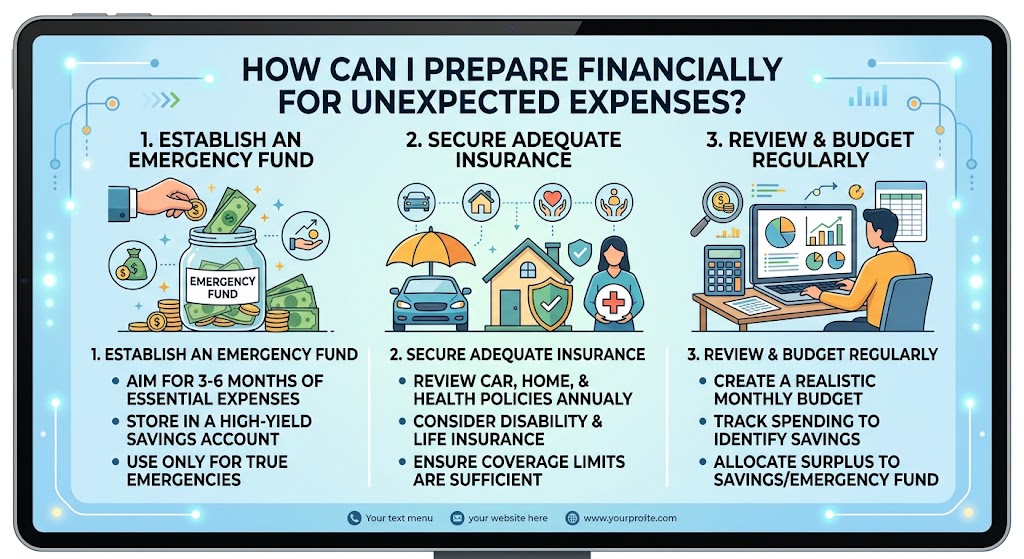
How can I prepare financially for unexpected expenses?
How can I prepare financially for unexpected expenses? It is a question that almost everyone eventually has to confront because life rarely follows the financial plan we create for ourselves. You can have a carefully prepared monthly budget, pay your bills on time, avoid unnecessary spending and still encounter an expense that you never saw coming. A vehicle can suddenly require an expensive repair. A household appliance can stop working. Your income can be interrupted. A family member may need urgent assistance. A business can experience an unexpected setback. Even a relatively small emergency can become financially stressful when there is no money available to deal with it.
The good news is that preparing for unexpected expenses does not necessarily require earning a huge income. It requires awareness, planning, discipline and a system that allows you to absorb financial shocks without completely destroying your normal budget. The objective is not to predict every emergency that could happen. That would be impossible. The objective is to create enough financial flexibility that an unexpected expense becomes a problem you can manage rather than a crisis that forces you into expensive debt.
One of the biggest mistakes people make with personal finance is assuming that an unexpected expense is something that happens to other people. When everything is going well, it is easy to believe that next month will look exactly like this month. You receive your income, pay your bills, buy food, handle transportation costs, save a little money and continue with your normal routine. But financial emergencies do not wait for a convenient moment. They arrive when you are least prepared for them.
That is why the first step towards answering the question “How can I prepare financially for unexpected expenses?” is accepting that unexpected expenses are actually a normal part of life. The specific expense may be unpredictable, but the existence of unexpected expenses is predictable.
Once you understand this, your approach to money begins to change. Instead of treating emergency expenses as rare disasters, you begin to treat financial preparedness as part of normal money management.
An emergency fund is one of the most important tools for preparing for unexpected expenses. It is money deliberately set aside for genuine financial emergencies rather than everyday spending. The purpose of an emergency fund is to create a financial buffer between an unexpected expense and your normal income.
Imagine that your car suddenly needs a major repair and the mechanic gives you a bill that is several times larger than your normal weekly spending. Without savings, you may have to borrow the money, use a credit facility, sell an investment or ask someone else for help. With an emergency fund, you may be able to handle the expense without disrupting everything else.
How much should you save? There is no single amount that works for everyone because financial circumstances differ. Someone with a stable income and low monthly expenses may require a different emergency reserve from someone with irregular income and significant financial responsibilities.
A useful starting point is to build enough savings to cover several months of essential living expenses. This does not mean you have to create the entire fund immediately. If your income is limited, start with a smaller target and gradually increase it.
The first goal could simply be to create a small emergency buffer. After reaching that target, continue building until the fund can provide more substantial protection.
This approach is psychologically important because a large financial goal can feel impossible. If you tell yourself that you need to save a very large amount before you are financially prepared, you may become discouraged and save nothing. A smaller initial target creates momentum.
Saving your first emergency reserve may not completely protect you from every financial emergency, but it gives you something extremely valuable: options.
Another important step is to separate emergency savings from your everyday spending money. If emergency funds sit in the same account you use for shopping, entertainment, food and other daily expenses, it becomes easier to spend them accidentally.
The purpose of separating the money is not to make it inaccessible when there is a genuine emergency. It is to create a psychological barrier between money meant for emergencies and money meant for ordinary spending.
You should also define what actually qualifies as an emergency. Without clear rules, an emergency fund can quickly become an ordinary spending account.
A genuine emergency could include an urgent medical expense, an essential home repair, an unexpected loss of income, a necessary vehicle repair or another significant expense that could not reasonably have been planned for.
A discounted phone, a holiday, a new outfit or an impulse purchase is not an emergency simply because you did not budget for it.
This distinction is extremely important because financial preparedness depends not only on having savings but also on protecting those savings from unnecessary withdrawals.
Another powerful strategy is to create a separate sinking fund for predictable irregular expenses. This may sound contradictory because the discussion is about unexpected expenses, but many expenses people describe as emergencies are actually predictable.
Annual insurance payments, school related costs, vehicle maintenance, property repairs, birthdays, holidays, professional fees and certain household expenses may not occur every month, but they can often be anticipated.
Instead of allowing these costs to become financial emergencies, you can save for them gradually.
For example, if you know that a particular annual expense normally costs a certain amount, divide that expected cost across the months leading up to it. By the time the expense arrives, the money is already available.
This leaves your emergency fund available for genuinely unexpected situations.
One of the most effective ways to prepare financially for unexpected expenses is to know exactly where your money goes. You cannot build financial resilience if you do not understand your own cash flow.
Track your income and expenses for several months. Look at recurring bills, food, transport, entertainment, subscriptions, debt payments, family support and other regular costs.
The goal is not to eliminate every enjoyable expense. The goal is to understand which expenses are essential, which are flexible and which can be reduced when circumstances change.
This information becomes extremely useful during a financial emergency because you already know where adjustments can be made.
For example, if your income suddenly falls, you may know immediately which expenses can be paused or reduced. If you have never examined your spending, you may waste valuable time trying to figure out where your money is going.
Reducing unnecessary recurring expenses can also strengthen your emergency preparedness. Subscriptions are a good example. Individually, a subscription may appear inexpensive. Several recurring payments, however, can consume a meaningful amount of money over a year.
If you discover that you are paying for services you rarely use, cancelling them can redirect that money towards emergency savings.
The same principle applies to other recurring expenses. Small financial leaks may not feel significant individually, but eliminating several of them can create room for savings.
Another important consideration is debt. High interest debt can make unexpected expenses considerably more dangerous because you may already have a large portion of your future income committed to repayments.
If an emergency occurs while you are carrying expensive debt, you may have to borrow even more money to solve the problem.
This is why building emergency savings and reducing costly debt should often happen alongside each other. The exact priority depends on your circumstances, interest rates, income stability and existing savings, but ignoring either problem can increase your financial vulnerability.
You should also avoid relying entirely on credit as your emergency plan. A credit card or loan can provide temporary access to money, but borrowed money eventually has to be repaid, often with additional costs.
Using credit for a genuine emergency can sometimes be unavoidable. The danger is treating available credit as if it were savings.
They are not the same thing.
Savings give you access to your own money. Credit gives you access to someone else’s money that you are obligated to repay.
Another way to prepare financially for unexpected expenses is to protect your income. Your ability to earn money is one of your most valuable financial assets.
If your income suddenly disappears, even a well constructed budget can become difficult to maintain. That is why building valuable skills, maintaining professional relationships and developing additional sources of income can strengthen your financial resilience.
This does not mean everyone needs five side hustles. Sometimes the best strategy is simply becoming more valuable in your current profession. For others, a small additional income stream may provide useful protection.
The important point is that financial preparedness is not only about saving money. It is also about strengthening your ability to generate money when circumstances change.
Insurance can also play an important role in protecting against certain financial shocks. Insurance cannot prevent an emergency from happening, but it can reduce the financial consequences of events covered by a policy.
Depending on your circumstances and location, relevant forms of insurance may include health, vehicle, property, life or other types of protection.
The purpose of insurance is particularly important for expenses that would be financially devastating if paid entirely from your savings.
However, insurance should not be viewed as a replacement for an emergency fund. Insurance policies have terms, exclusions, deductibles and limits. An emergency fund provides more general financial flexibility.
You should also consider the possibility of income interruptions. People often prepare for unexpected bills but forget to prepare for unexpected reductions in income.
Ask yourself what would happen if your income stopped for one month, three months or longer. How would you pay for housing, food, transportation, utilities and other essentials?
Thinking about these scenarios may feel uncomfortable, but it can reveal weaknesses in your financial plan while you still have the opportunity to address them.
Another useful technique is to create a bare bones budget. This is a simplified version of your normal budget that includes only essential expenses.
Knowing your bare bones monthly cost gives you a much clearer picture of how much money you would need during a financial emergency.
Suppose your normal lifestyle costs a certain amount each month, but after removing nonessential expenses, you discover that your essential costs are significantly lower. That information can help you determine how large your emergency fund should be.
It also provides a roadmap for what to cut if your income suddenly falls.
Preparing for unexpected expenses also requires emotional discipline. Financial emergencies can trigger fear, embarrassment and panic. When people panic, they may make decisions that create even bigger financial problems.
Someone may take an extremely expensive loan, sell an important asset unnecessarily or make impulsive financial decisions simply because they want the problem solved immediately.
Having a financial emergency plan can reduce this pressure.
Write down what you would do if an unexpected expense occurred. Identify your emergency savings, essential expenses, insurance coverage, potential spending cuts and possible sources of additional income.
You do not need to predict the exact emergency. You simply need a framework for responding to financial shocks.
It is also wise to review your emergency fund regularly. Your financial situation changes over time. Your rent or mortgage may increase. Your family responsibilities may change. Your income may rise or fall. Your essential expenses may become more expensive.
An emergency fund that was adequate several years ago may no longer provide the same level of protection.
Reviewing your finances periodically ensures that your emergency strategy remains relevant.
When you use emergency savings, remember that the goal is not to feel guilty about using them. The fund exists precisely because unexpected expenses happen.
The important part is rebuilding it after the emergency has passed.
For example, if an unexpected repair consumes a significant portion of your savings, return to your normal financial routine and gradually replenish the fund.
This is where consistency becomes more important than perfection.
You do not need to build your emergency fund overnight. You need a system that consistently moves money towards financial security.
Automating savings can make this easier. If your banking system allows it, you can arrange for a specific amount to move into savings regularly. This reduces the need to make a fresh decision every time you receive income.
The amount does not have to be enormous. What matters initially is developing the habit.
As your income increases, you can increase the amount you save.
You should also avoid comparing your emergency fund with someone else’s. Personal finance is personal because income, responsibilities, costs and financial goals differ.
Someone may have six months of expenses saved because they have a high income and relatively low obligations. Another person may be building their first emergency reserve while dealing with significant responsibilities.
Progress should be measured against your own financial position.
Perhaps the most important lesson when asking “How can I prepare financially for unexpected expenses?” is that financial preparedness is built during peaceful periods, not during the emergency itself.
You cannot wait until your car breaks down to start saving for car repairs. You cannot wait until your income disappears to begin thinking about financial resilience. You cannot wait until a major expense arrives before deciding whether you have enough protection.
Preparation happens before the problem.
The goal is not to eliminate financial uncertainty because that is impossible. The goal is to become financially strong enough that uncertainty does not automatically become catastrophe.
Unexpected expenses will happen. Some will be small. Some will be frustrating. Others may be genuinely serious. But your response to them can be very different depending on the financial foundation you have built beforehand.
An emergency fund gives you breathing room. A realistic budget gives you visibility. Insurance can reduce certain financial risks. Lower debt gives you greater flexibility. Multiple income possibilities can strengthen your earning capacity. A clear emergency plan can prevent panic.
Together, these strategies create financial resilience.
So, how can I prepare financially for unexpected expenses? Start by accepting that unexpected expenses are inevitable. Build an emergency fund gradually. Separate emergency savings from everyday spending. Track your expenses. Prepare for predictable irregular costs. Reduce unnecessary recurring expenses. Manage expensive debt. Protect your income. Consider appropriate insurance. Know your minimum monthly survival budget and review your financial plan regularly.
Most importantly, do not wait until you earn more money before you start preparing. A higher income can make preparation easier, but financial resilience is ultimately built through behaviour.
You can start with whatever amount is realistic for your circumstances.
The first amount may look small. The first emergency fund may seem insignificant. The first few months of disciplined saving may not feel life changing.
But financial security is rarely created by one dramatic decision.
It is usually created by thousands of small decisions repeated consistently.
And when the unexpected finally arrives, the money you quietly set aside during the good months may become one of the most valuable decisions you ever made.

EarnSmartOnline.com.ng is dedicated to helping readers make smarter financial decisions through practical guides on online income, personal finance, technology, digital business, and wealth creation. Our goal is to provide reliable, easy-to-understand, and actionable content that empowers individuals to earn smarter, build sustainable income streams and achieve long-term financial success.
Recommended: Start Earning Online
- Ultimate Affiliate Marketing Program — learn affiliate marketing with a done-for-you sales system ($15). Check it out
- The Newbie Affiliate Guide — the beginner-friendly starter guide (~$6.68). Check it out
- Easy Dollar Maker — earn in dollars uploading AI images and videos from your phone ($17). Check it out
Disclosure: These are affiliate links. If you buy through them, I may earn a commission at no extra cost to you.



