
What is compound interest?
What is compound interest? This is one of the most important questions anyone interested in saving, investing and building long term wealth should understand. Compound interest is often described as one of the most powerful forces in personal finance because it allows money to generate returns, while those returns can then generate additional returns over time. The longer the process continues, the more significant the effect can become.
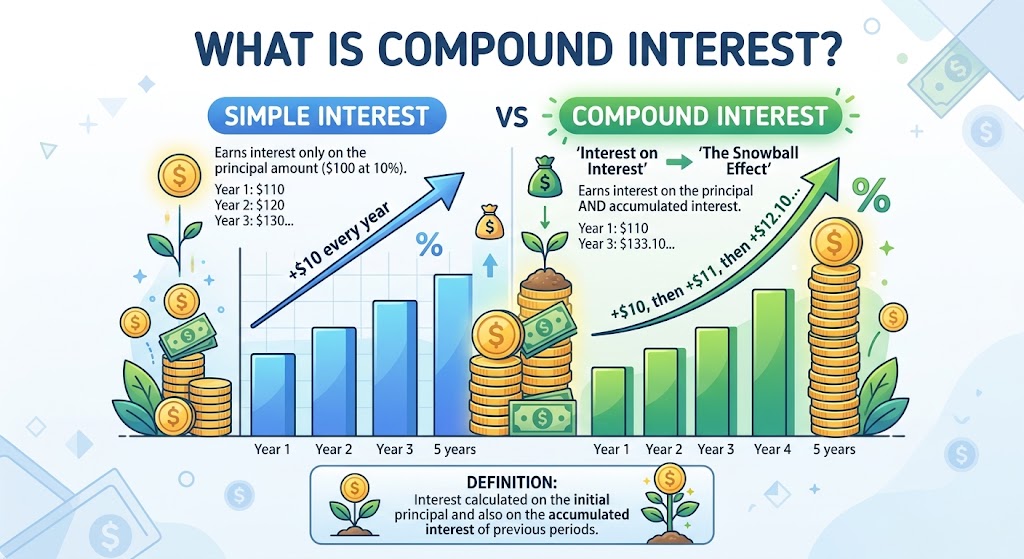
In simple terms, compound interest means earning interest not only on the money you originally put into an account or investment, but also on the interest that has already accumulated. Instead of calculating returns only on the original amount, compound interest allows previously earned interest to become part of the amount that can generate future returns.
This sounds like a small difference, but over many years it can produce a dramatic difference in the growth of money. That is why understanding what is compound interest is not just a mathematical exercise. It is a practical financial skill that can influence how you save, invest, borrow and plan for the future.
Imagine you put £1,000 into an account that earns 5 percent interest annually. If the account used simple interest and you never added another penny, you would earn £50 each year based on the original £1,000. The calculation would remain tied to that original amount.
With compound interest, the first year could produce £50, bringing the balance to £1,050. During the second year, the 5 percent return would be calculated on £1,050 rather than the original £1,000. That means the second year’s interest would be £52.50. Your balance would then become £1,102.50.
The following year, the calculation would be based on £1,102.50. The interest would therefore continue increasing as the balance grows.
This is the basic idea behind compounding. Your money begins producing returns, those returns are added to your balance, and the larger balance produces additional returns.
The formula above represents one common way of calculating the future value of a lump sum when returns compound periodically. In the formula, PV represents the starting amount, r represents the rate of return per period, n represents the number of periods and FV represents the resulting future value.
You do not need to become a mathematician to understand compound interest. The most important idea is that time allows returns to build upon previous returns.
This is why people often say that compound interest rewards patience. A person who gives their money enough time to grow may eventually see growth that is much larger than the original contributions alone would suggest.
Consider someone who invests £10,000 and earns an average annual return of 7 percent, assuming the returns are reinvested and ignoring taxes, fees and changes in investment value. After one year, the money could grow to approximately £10,700. After another year, the 7 percent would apply to the larger balance rather than only the original £10,000.
Over a long period, the difference becomes increasingly noticeable.
The same principle applies to smaller amounts. You do not need to start with thousands of pounds to benefit from compounding. Regular contributions can also take advantage of the same principle because each contribution gets an opportunity to grow, and the returns generated by those contributions can themselves generate further returns.
This is one reason starting early can be so valuable.
Someone who begins investing at age 20 may have several decades for their money to compound. Someone who waits until age 40 may still build substantial wealth, but they have fewer years available for compounding to work.
The difference is not necessarily about who invests more money. Time itself becomes an important part of the equation.
For example, imagine two people. One begins investing £200 every month at age 25. Another begins investing the same amount at age 40. If both achieve the same average rate of return and remain invested for the same period after starting, the earlier investor has a significant advantage because their first contributions have had an additional fifteen years to grow.
This is why compound interest is often connected with the idea that starting early can matter more than trying to make up for lost time later.
However, compound interest does not mean that money automatically doubles quickly. The result depends on the interest rate or investment return, the frequency of compounding, the amount invested, whether additional contributions are made, fees and taxes, and how long the money remains invested.
Another important question is how often interest compounds.
Interest can compound annually, semi annually, quarterly, monthly or according to other schedules depending on the financial product. When interest is compounded more frequently, the balance can grow somewhat faster than it would under less frequent compounding, assuming the stated rate and other conditions are comparable.
For consumers, this is one reason it is important to understand the difference between an advertised interest rate and the actual effective annual return.
When comparing savings products, do not look only at the headline percentage. Pay attention to how the rate is calculated, how frequently interest is credited, whether the rate is fixed or variable, whether fees apply and whether there are conditions attached.
The phrase compound interest is also commonly used when discussing debt. This is an important distinction because compounding can work in your favour when you are earning returns, but it can work against you when you owe money and interest accumulates.
Credit card debt provides a useful example.
If you carry a balance and interest is charged, the amount you owe can grow. If you then fail to make sufficient payments, the growing balance can result in additional interest charges. Depending on the terms of the account, fees and other charges may also increase the amount owed.
This creates the opposite experience from investing.
When you invest and earn returns, you want your balance to grow. When you have expensive debt, you generally want the amount you owe to shrink.
This is why understanding what is compound interest can help with both wealth building and debt management.
A person who understands compounding may become more motivated to pay expensive debt down quickly because they recognise how a balance can grow when left unattended.
The concept is also important when thinking about inflation. Earning interest does not automatically mean that you are becoming wealthier in real terms. If the rate at which your money grows is lower than the rate at which prices rise, your purchasing power may decline even though the numerical balance in your account increases.
Suppose your savings earn 3 percent while inflation averages 5 percent over a particular period. Your account balance is increasing, but the purchasing power of that money may not be keeping pace with rising prices.
This is why personal finance involves more than simply asking how much interest you can earn. You should also consider inflation, taxes, fees, risk and your financial goals.
Compound interest is particularly powerful when returns are reinvested. Reinvestment means that instead of taking the interest or investment income out, you leave it in the account or investment so that it can potentially generate further returns.
This creates a cycle.
Your original money generates returns. Those returns remain invested. The enlarged balance generates more returns. Those returns are reinvested. The process continues.
This is sometimes described as earning returns on returns.
However, it is important to understand that investment returns are not guaranteed. The examples commonly used to explain compound growth often assume a constant annual rate, but real investments can rise and fall.
For example, the value of shares can increase dramatically during one year and decline during another. An investment portfolio might experience several strong years followed by a significant market decline.
Therefore, compound growth illustrations should not be interpreted as promises of future investment performance.
Savings accounts can provide a simpler illustration because the interest rate is usually clearly stated, although rates can still change depending on the account and financial institution.
One of the most important lessons from compound interest is that consistency matters.
A person who invests a small amount regularly may eventually accumulate a meaningful portfolio because every contribution has time to potentially grow. The combination of regular contributions and compounding can become considerably more powerful over long periods.
This is why automating savings and investments can be useful. Instead of relying entirely on motivation every month, you can establish a routine where money is transferred automatically according to your financial plan.
Automation does not guarantee financial success, but it can reduce the number of decisions required to maintain consistency.
Another reason people struggle with compound interest is that human beings often prefer immediate results.
If you invest £100 today and see only a small increase after a month, it can be tempting to conclude that the strategy is not working. But compounding is a long term process.
The early years may appear relatively slow.
Then, as the balance becomes larger, the same percentage return produces larger monetary gains.
For example, a 10 percent return on £1,000 is £100. A 10 percent return on £10,000 is £1,000. A 10 percent return on £100,000 is £10,000.
The percentage has not changed. The amount of money exposed to that percentage has changed.
This is one reason building the initial capital can feel difficult. The early stage often requires discipline because the financial rewards may not appear dramatic.
Over time, however, accumulated capital can make the same percentage growth increasingly meaningful.
This also explains why fees deserve serious attention. A small annual fee might appear insignificant, but over decades it can reduce the amount of money available to compound.
Suppose two investment portfolios have similar performance but one charges substantially higher fees. The difference may seem small in the beginning. Over a long period, however, the money paid in fees is money that is no longer available to potentially generate future returns.
The effect can become particularly significant when fees are charged repeatedly.
Therefore, understanding compound interest should also encourage people to understand compound costs.
Compounding is not automatically good or bad. It is a mathematical process. What matters is whether it is working for you or against you.
If your savings and investments are generating returns that are reinvested, compounding can help accelerate growth. If expensive debt continues accumulating interest, compounding can increase the financial burden.
This is why personal finance decisions should be viewed through a long term lens.
A person might focus heavily on finding a way to make an extra £20 today while ignoring a recurring expense that costs £20 every month. Another person might focus on earning a slightly higher investment return while carrying expensive debt.
Understanding compounding encourages a different way of thinking. Instead of looking only at today’s financial result, you begin asking what today’s decision could mean several years from now.
That shift in thinking can be incredibly valuable.
The question what is compound interest therefore has an answer that goes far beyond a dictionary definition.
Compound interest is the process through which interest or returns are added to an existing balance, allowing future returns to be calculated on an increasingly larger amount. Over time, this can create accelerating growth, particularly when money is left invested and returns are reinvested.
But perhaps the most important lesson is that time is an asset.
You cannot save yesterday. You cannot invest last year. You cannot recover every year you postponed learning about money.
You can, however, make better decisions today.
Someone who starts with a modest amount, contributes consistently, avoids unnecessary fees, manages debt responsibly and gives their money sufficient time can potentially benefit enormously from compounding.
This is also why financial education matters. Understanding concepts such as compound interest can change the way you think about saving and spending.
Instead of asking only, “Can I afford this today?” you might begin asking, “What could this money become if I saved or invested it instead?”
That does not mean you should never spend money. Money exists to provide security, opportunities and enjoyment. The goal is not to turn every financial decision into an exercise in deprivation.
The goal is to understand opportunity cost.
Every pound, dollar or naira you spend today is money that cannot simultaneously be saved or invested for tomorrow. Likewise, every amount you save or invest today has the potential to grow over time.
Compound interest gives time a financial multiplier effect.
It can turn modest beginnings into substantial results when the underlying conditions are favourable and the process continues for long enough.
But there is one final lesson worth remembering.
Compounding does not reward perfection. It rewards time and consistency.
You do not need to make every financial decision perfectly. You need to understand the principles, avoid destructive financial mistakes and keep making sensible decisions repeatedly.
If you are still wondering what is compound interest, remember the simplest explanation: it is when your money earns returns and those returns are allowed to earn returns of their own.
The first few years may not look spectacular. That is precisely why patience matters.
The real power of compounding often becomes visible only after enough time has passed.
Start early when you can. Contribute consistently when possible. Reinvest returns when appropriate. Keep unnecessary costs under control. Understand the risks involved. Manage expensive debt. Most importantly, give your money time to work.
Because when it comes to building wealth, the biggest advantage may not always be having more money.
Sometimes, it is simply giving the money you already have enough time to grow.

EarnSmartOnline.com.ng is dedicated to helping readers make smarter financial decisions through practical guides on online income, personal finance, technology, digital business, and wealth creation. Our goal is to provide reliable, easy-to-understand, and actionable content that empowers individuals to earn smarter, build sustainable income streams and achieve long-term financial success.
Recommended: Start Earning Online
- Ultimate Affiliate Marketing Program — learn affiliate marketing with a done-for-you sales system ($15). Check it out
- The Newbie Affiliate Guide — the beginner-friendly starter guide (~$6.68). Check it out
- Easy Dollar Maker — earn in dollars uploading AI images and videos from your phone ($17). Check it out
Disclosure: These are affiliate links. If you buy through them, I may earn a commission at no extra cost to you.



