
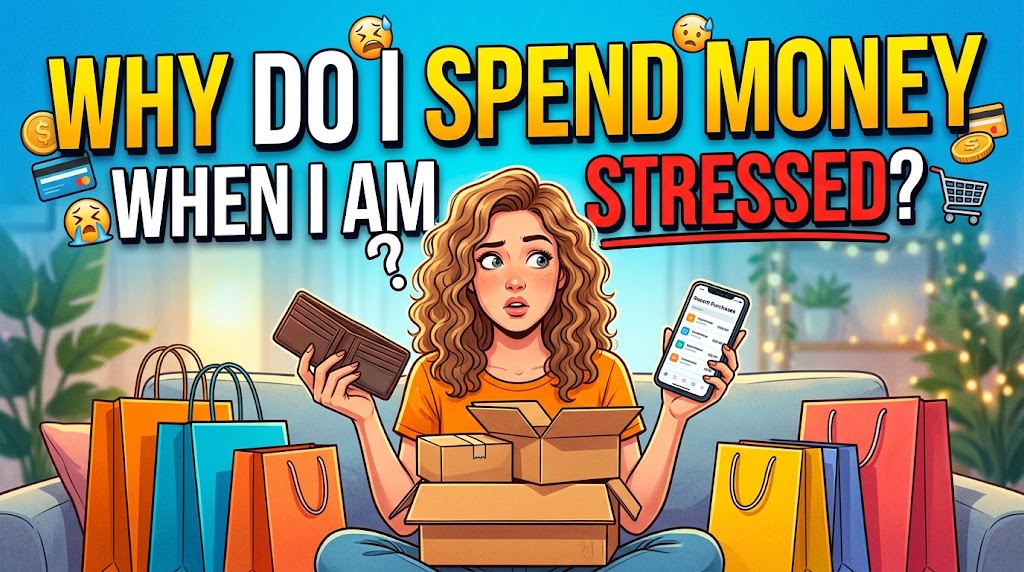
Why do I spend money when I am stressed?
Why do I spend money when I am stressed? It is a question many people ask themselves after making an unnecessary purchase, ordering food they did not really need, buying something online late at night or spending money simply because they wanted to feel better for a few minutes. The frustrating part is that the purchase can feel completely reasonable at the moment, yet the same person may regret it once the stress has disappeared. If this happens to you, the problem may not simply be that you lack financial discipline. Your spending may be connected to the way your brain responds to stress, discomfort, uncertainty and the desire for immediate relief.
Stress affects more than your mood. It can influence your judgement, attention, motivation and decision making. When you are stressed, your mind naturally searches for ways to reduce the unpleasant feeling. Sometimes that solution is healthy, such as taking a walk, talking to someone, exercising, praying, sleeping or taking a break. Other times, the brain chooses something that produces immediate pleasure, and spending money can become one of those shortcuts.
This is one of the reasons why understanding the answer to “Why do I spend money when I am stressed?” is important for anyone trying to improve their personal finances. If you only focus on the money you spent, you may miss the emotional trigger that caused the spending in the first place. You may create a budget, promise yourself that you will stop shopping and then repeat the same behaviour when another stressful situation appears. The financial problem keeps returning because the underlying emotional pattern has not been addressed.
When you make a purchase, especially something you enjoy, your brain can experience a temporary sense of reward. Finding something you like, placing an order and anticipating its arrival can provide excitement and distraction. For someone experiencing stress, that temporary emotional lift can be attractive because it changes what they are thinking about, even if only for a short period.
The purchase does not necessarily solve the problem that created the stress. It simply gives the mind something else to focus on.
Imagine someone has had a difficult day at work. They feel exhausted, frustrated and unappreciated. On the way home, they order an expensive meal because they think they deserve a treat. The meal may provide genuine enjoyment, but the underlying workplace problem remains. The next stressful day can therefore produce the same urge to spend again.
This creates an important distinction between spending because you need something and spending because you need to change how you feel.
Emotional spending can happen with almost anything. It might involve clothes, food, electronics, entertainment, beauty products, travel, online shopping, subscriptions or even gifts for other people. The specific item is often less important than the emotional state surrounding the purchase.
Some people spend when they are sad. Others spend when they are angry. Some spend when they feel lonely, bored, overwhelmed or anxious. Others spend after experiencing success because they want to reward themselves. Stress is only one of several emotional conditions that can trigger spending.
Another reason people spend when stressed is that shopping can create a temporary sense of control. Stress often comes from situations that feel outside your control. You may not control your employer, the economy, another person’s behaviour, unexpected bills or the outcome of an important decision. But you can control whether you buy something. Why do I spend money when I am stressed?
That small decision can create a feeling of independence.
You choose the product. You choose the payment method. You choose when to place the order. For a brief moment, you are making a decision that produces an immediate result.
The irony is that this sense of control can eventually create another source of stress if the spending damages your finances.
This is why emotional spending can become a cycle. Stress creates a desire for relief. Spending provides temporary relief. The purchase is followed by financial regret. The regret creates additional stress. The new stress creates another desire for relief, which can lead to more spending.
Breaking that cycle requires recognising the pattern before the purchase happens.
Another important factor is instant gratification. Human beings naturally value immediate rewards. When you are stressed, the attraction of an immediate reward can become even stronger because your mind wants relief now rather than later.
Saving money is often psychologically difficult because the reward is delayed. You put money aside today for an emergency that may happen months from now. You invest money today for a financial goal that may take years to achieve. You reduce spending today so that you can have greater financial security in the future.
Stress, however, can make the future feel less important than the present moment.
A stressed person may think, “I will worry about the money later.” The purchase provides pleasure now, while the financial consequences remain in the future.
This is one reason emotional spending can undermine otherwise sensible financial plans.
Stress can also reduce mental energy. When you are mentally exhausted, you may have less patience for comparing prices, evaluating alternatives and questioning whether you genuinely need something. Convenience becomes more attractive.
You may order food instead of cooking. You may buy a product rather than researching cheaper alternatives. You may subscribe to a service because cancelling later seems easier than making the decision now.
The problem is that convenience has a price, and repeated convenience spending can quietly become expensive.
Digital technology has made emotional spending even easier. A person no longer needs to travel to a physical shop to buy something. With a smartphone, an internet connection and a saved payment method, a purchase can happen within seconds.
This creates very little time between the emotional impulse and the financial action.
Traditional shopping sometimes contains natural barriers. You may need to travel, carry cash, stand in a queue or physically examine the product. Online shopping can remove many of those barriers.
That convenience is useful when you are making deliberate purchases. It becomes dangerous when you are using shopping as an emotional coping mechanism.
Another reason people spend when stressed is self reward. Modern life can be demanding. People work long hours, deal with family responsibilities, manage financial pressure and navigate uncertainty. After enduring a difficult experience, it can feel natural to tell yourself that you deserve something.
There is nothing inherently wrong with rewarding yourself. The problem arises when the reward repeatedly exceeds what your finances can comfortably support.
You can reward yourself without sabotaging your financial goals. The key is to distinguish between intentional enjoyment and emotional escape.
If you have deliberately included entertainment money in your budget, spending some of it on something enjoyable is not necessarily irresponsible. But if you repeatedly spend money whenever you feel uncomfortable, the behaviour deserves closer attention.
One of the most useful questions you can ask yourself before making a purchase is, “What am I actually trying to feel right now?”
If the honest answer is happiness, relief, excitement, control, comfort or distraction, you may be dealing with emotional spending rather than ordinary purchasing.
Another useful question is, “Would I still want this if I were having a completely normal day?”
If the answer is no, wait.
Waiting is one of the simplest tools for controlling stress related spending because it creates distance between the emotion and the decision.
You could create a personal rule that non essential purchases must wait for a certain period before you buy them. The exact period can depend on the purchase. A small purchase might require a few hours. A more expensive purchase might require twenty four hours or several days.
The goal is not to make spending impossible. The goal is to prevent temporary emotions from making permanent financial decisions.
Creating a separate amount for guilt free spending can also help. If your budget allows it, you can set aside money specifically for entertainment, hobbies, eating out or personal treats.
This can reduce the feeling that budgeting means depriving yourself of everything enjoyable.
A realistic financial plan should make room for life. If a budget is so restrictive that you feel trapped by it, you may eventually rebel against it. Sustainable money management requires both discipline and flexibility.
Tracking emotional spending can also reveal patterns. Instead of simply recording what you bought, record how you felt before making the purchase.
Were you stressed after work? Were you lonely? Were you bored late at night? Were you arguing with someone? Were you worried about money? Were you celebrating something?
After several weeks, patterns may become obvious.
You may discover that most unnecessary spending happens after difficult workdays. Or perhaps you spend more when you are awake late at night. Maybe social media triggers your purchases. Maybe certain websites or promotional emails consistently lead to impulsive spending.
Once you know the trigger, you can change the environment around it.
If late night shopping is a problem, remove saved payment information from shopping websites. If promotional emails encourage unnecessary purchases, unsubscribe from them. If social media constantly exposes you to products you want, reduce your exposure to shopping related content.
Financial discipline is not always about having stronger willpower. Sometimes it is about creating an environment where poor decisions require more effort.
This is especially important because stress can make willpower unreliable.
Another useful strategy is replacing the behaviour rather than simply eliminating it. If spending provides emotional relief, removing spending without replacing the relief mechanism can leave a gap.
Find inexpensive or free activities that create a similar emotional shift. Take a walk. Listen to music. Exercise. Call a friend. Watch something you already have access to. Read. Cook. Rest. Journal. Spend time with people you care about. Work on a hobby.
The objective is to teach your brain that relief does not have to come from spending money.
For some people, stress spending is also connected to deeper emotional difficulties. If spending has become uncontrollable, creates serious financial problems or feels impossible to stop despite repeated attempts, it may be useful to seek professional support. Financial behaviour can sometimes be connected to broader emotional or psychological challenges, and addressing those challenges can make financial improvement easier.
It is also important not to shame yourself. Shame can make the cycle worse. If you spend money when stressed and then attack yourself for doing it, you create another negative emotional experience. That negative experience can become another reason to seek comfort through spending.
Instead, treat the purchase as information.
Ask what happened before it.
Ask what you were feeling.
Ask what you were trying to achieve emotionally.
Ask what the purchase actually changed.
Ask whether there is a healthier and cheaper way to achieve the same emotional result next time.
This turns a financial mistake into a learning opportunity.
The answer to “Why do I spend money when I am stressed?” is therefore not simply that you are careless with money. You may be using spending as a short term emotional regulation strategy. Your brain may have learned that purchasing something produces a temporary reward, distraction or sense of control.
The good news is that learned patterns can be changed.
You do not need to become someone who never enjoys spending money. You need to become someone who understands why they are spending before they spend.
There is a major difference between saying, “I want this, so I will buy it,” and saying, “I am stressed, and buying this will make me feel better.”
The first is a purchasing decision. The second is an emotional response disguised as a purchasing decision.
Once you can identify that difference, your financial behaviour becomes easier to manage.
Personal finance is often presented as a mathematical subject involving income, expenses, savings, debt and investments. But money is deeply connected to human psychology. People do not make financial decisions based purely on spreadsheets. They make decisions based on emotions, habits, experiences, beliefs, fears and desires.
Understanding your emotional relationship with money can therefore be just as important as understanding your budget.
If stress is repeatedly causing you to spend, do not simply tell yourself to stop. Start by identifying what the spending is doing for you emotionally.
Perhaps it gives you comfort.
Perhaps it gives you control.
Perhaps it helps you escape.
Perhaps it rewards you after a difficult day.
Perhaps it temporarily distracts you from a problem.
Once you understand the function of the behaviour, you can begin finding healthier alternatives.
The ultimate goal is not to eliminate every emotional purchase. Humans are not machines, and enjoying something you buy is not automatically a financial mistake. The goal is to prevent temporary emotional states from repeatedly controlling long term financial decisions.
Your money represents time, effort and opportunity. Every amount you spend is money that cannot simultaneously be saved, invested, used to reduce debt or directed towards another goal.
That does not mean you should never spend. It means your spending should reflect your priorities rather than your temporary emotional state.
So, why do I spend money when I am stressed?
You may be seeking relief, reward, control, distraction or comfort. You may be responding to a habit your brain has learned over time. You may simply be exhausted and looking for the fastest way to feel better.
Understanding the reason is the first step.
The next time you feel stressed and suddenly want to buy something, pause before opening your banking app or clicking the checkout button. Take a moment and ask yourself what you are actually trying to solve.
If the purchase solves a genuine need, make the decision based on your budget and priorities.
If the purchase is mainly an attempt to escape an emotion, give yourself another option first.
You might discover that what you really needed was not another product, another meal or another subscription.
You simply needed a moment to breathe.
And sometimes, protecting your money begins with giving yourself that moment.

EarnSmartOnline.com.ng is dedicated to helping readers make smarter financial decisions through practical guides on online income, personal finance, technology, digital business, and wealth creation. Our goal is to provide reliable, easy-to-understand, and actionable content that empowers individuals to earn smarter, build sustainable income streams and achieve long-term financial success.
Recommended: Start Earning Online
- Ultimate Affiliate Marketing Program — learn affiliate marketing with a done-for-you sales system ($15). Check it out
- The Newbie Affiliate Guide — the beginner-friendly starter guide (~$6.68). Check it out
- Easy Dollar Maker — earn in dollars uploading AI images and videos from your phone ($17). Check it out
Disclosure: These are affiliate links. If you buy through them, I may earn a commission at no extra cost to you.



