
Should I pay off debt before investing?
Should I pay off debt before investing? This is one of the most common personal finance questions people ask when they begin taking control of their money. Whether you are carrying credit card debt, a personal loan, student debt, a car loan or any other financial obligation, the decision between eliminating debt and investing for the future can feel confusing. On one hand, debt can create financial stress and reduce your monthly cash flow. On the other hand, investing is often presented as the key to building wealth and achieving financial freedom. The challenge is that most people do not have unlimited money available to do both aggressively at the same time.
The question, should I pay off debt before investing, does not have a universal answer because every financial situation is different. However, understanding the advantages and disadvantages of each option can help you make a more informed decision that aligns with your goals, risk tolerance and financial circumstances.
Many people assume that investing should always come first because they hear stories about stock market gains, compound interest and long term wealth creation. Others believe that all debt should be eliminated before a single pound, dollar or naira is invested. The reality is that personal finance is rarely black and white. The smartest approach often depends on the type of debt you have, the interest rate attached to it, your emergency savings, your income stability and your long term objectives.
One of the strongest arguments in favour of paying off debt first is the guaranteed return it provides. When you pay off a debt with a high interest rate, you are effectively earning a return equal to the interest rate you are no longer paying. For example, if you have a credit card charging twenty percent annual interest, eliminating that debt is similar to earning a risk free twenty percent return on your money. Very few investments can consistently guarantee such a result.
This is why high interest debt is often considered a financial emergency. Credit card balances, payday loans and other forms of expensive borrowing can grow rapidly if left unpaid. Even if your investments perform well, the gains may be cancelled out by the interest accumulating on your debt. In such cases, paying off debt before investing is often the financially sensible choice.
The psychological benefits of becoming debt free should not be underestimated either. Debt can create anxiety, stress and a constant feeling of financial pressure. Many people find it difficult to focus on building wealth when they are worried about monthly repayments. Paying off debt can provide peace of mind and improve overall financial confidence. The emotional relief that comes from no longer owing money can be just as valuable as the mathematical benefit.
Another reason people choose debt repayment first is improved cash flow. Every debt payment represents money that could potentially be used elsewhere. Once a loan is fully repaid, the monthly amount previously allocated to repayments becomes available for savings, investing or other financial goals. This increased flexibility can make future investing easier and more sustainable.
However, there are also compelling arguments in favour of investing before all debt is completely eliminated. One of the biggest is the power of compound growth. Investing allows your money to grow over time, and the earlier you start, the longer your investments have to compound. Time is one of the most valuable assets an investor possesses. Delaying investing for many years while focusing exclusively on debt repayment could mean missing out on significant growth opportunities.
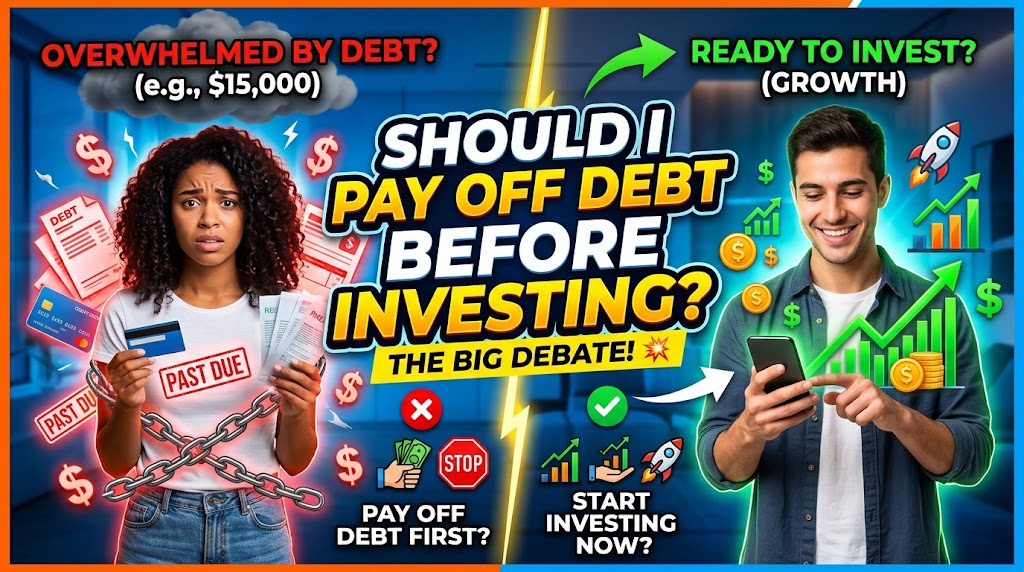
Imagine two individuals with identical incomes. One begins investing immediately while gradually paying down low interest debt. The other waits until every debt is eliminated before investing. Depending on the circumstances, the first individual may end up with a larger investment portfolio simply because their money had more time to grow.
This is especially relevant when dealing with low interest debt. Not all debt carries the same financial burden. A mortgage with a relatively low interest rate is very different from a high interest credit card balance. If the expected long term return from investing exceeds the interest rate on the debt, some people choose to invest while continuing to make regular debt payments.
For example, if a person has a loan charging four percent interest and expects their diversified investment portfolio to generate a higher average return over the long term, investing may potentially provide greater overall financial benefits. Of course, investment returns are never guaranteed, and market performance can fluctuate significantly. This uncertainty is an important factor to consider.
Risk plays a central role in the debate surrounding should I pay off debt before investing. Paying off debt offers a guaranteed outcome. You know exactly how much interest you are avoiding. Investing, however, involves uncertainty. Markets can rise, fall and remain volatile for extended periods. While long term investing has historically rewarded patient investors, there are no guarantees.
Some individuals are comfortable accepting this uncertainty because they understand that investing is a long term process. Others prefer the certainty and security of debt elimination. Neither perspective is inherently right or wrong. Personal finance decisions often involve balancing mathematics with emotional comfort.
An important factor that is frequently overlooked in this discussion is the existence of an emergency fund. Before aggressively paying off debt or investing heavily, many financial experts recommend building a cash reserve for unexpected expenses. Emergencies can occur at any time. Medical bills, car repairs, home maintenance issues, job loss or family emergencies can quickly create financial strain.
Without an emergency fund, people often end up relying on credit cards or loans when unexpected expenses arise. This can create a cycle where debt continues to grow despite efforts to eliminate it. A modest emergency fund can provide financial stability and reduce the likelihood of accumulating additional debt.
For many people, the ideal sequence may involve building an emergency fund, eliminating high interest debt and then increasing investment contributions. This approach creates a strong financial foundation while balancing short term security and long term growth.
The question should I pay off debt before investing also depends on the type of investment being considered. Some investment opportunities carry substantial risk, while others are more conservative. Chasing speculative investments while carrying significant high interest debt can be particularly dangerous. The potential rewards may appear attractive, but the risks can be substantial.
The rise of social media has contributed to unrealistic expectations about investing. Stories of individuals making large profits from stocks, cryptocurrencies or other assets can create the impression that investing is a shortcut to wealth. In reality, successful investing usually involves patience, discipline and a long term perspective. It is not a guaranteed solution to financial problems.
Another consideration is employer sponsored retirement plans or workplace investment schemes. In some cases, employers match employee contributions up to a certain amount. This effectively provides an immediate return on investment that can be difficult to ignore. If an employer offers matching contributions, participating enough to receive the full match may be beneficial even while paying down debt. The employer contribution represents additional money that would otherwise be left on the table.
Taxes can also influence the decision. Certain investment accounts offer tax advantages that can enhance long term returns. Depending on local regulations and available investment vehicles, these benefits may make investing more attractive even while some debt remains outstanding.
Behavioural factors often play a larger role than people realise when deciding whether to pay off debt before investing. Human beings are not purely rational financial calculators. Emotions, habits and personal experiences shape financial decisions.
Some individuals find motivation in watching their debt balances decrease. Each repayment feels like progress and encourages continued discipline. Others become motivated when they see their investment portfolio growing. Understanding your own behavioural tendencies can help you choose a strategy you are more likely to maintain consistently.
Consistency is one of the most important factors in personal finance success. The best financial plan is often not the mathematically perfect one but the one you can follow for years without abandoning. A strategy that looks excellent on paper but causes constant stress may not be the right fit for your situation.
There is also a middle ground that many people overlook. The choice between debt repayment and investing does not always have to be an either or decision. Some individuals choose to divide their available funds between both goals. They allocate a portion of their income towards accelerated debt repayment while simultaneously making regular investment contributions.
This balanced approach allows them to reduce debt, benefit from investment growth and maintain financial momentum in multiple areas. While progress in each category may be slower compared to focusing exclusively on one objective, the psychological benefits of advancing both goals can be significant.
When evaluating whether to pay off debt before investing, it can be useful to compare interest rates and expected investment returns. High interest debt often deserves priority because the guaranteed savings from repayment can exceed the likely benefits of investing. Low interest debt may be less urgent, especially when long term investment opportunities are available.
However, interest rates are only part of the equation. Financial security, emotional wellbeing and personal preferences also matter. A person who sleeps better knowing they are debt free may place greater value on debt elimination. Another person may prioritise wealth accumulation and feel comfortable carrying manageable low interest debt while investing.
The stage of life you are in can also influence the decision. Younger individuals may have a longer investment horizon, giving them more time to recover from market downturns and benefit from compound growth. Older individuals approaching retirement may place greater emphasis on reducing liabilities and preserving financial stability.
Income stability is another crucial factor. Someone with a secure job, predictable income and strong emergency savings may feel more comfortable investing while carrying some debt. Someone with variable income or uncertain employment prospects may prioritise debt reduction to improve financial resilience.
It is important to avoid viewing debt and investing as enemies. Debt is a financial tool that can be used wisely or poorly. Investing is a wealth building strategy that requires patience and discipline. The goal is not simply to eliminate debt or maximise investments. The goal is to improve your overall financial position and move closer to your long term objectives.
Many people who ask should I pay off debt before investing are looking for a simple answer. Unfortunately, personal finance rarely provides simple answers because circumstances vary so widely. What works perfectly for one person may be inappropriate for another.
The most effective approach is often to evaluate your complete financial picture. Consider your debt balances, interest rates, emergency savings, income stability, investment opportunities and personal comfort level. Examine both the mathematical and emotional aspects of the decision.
If you have high interest debt, prioritising repayment is often a wise choice because the guaranteed savings can outweigh potential investment gains. If your debt carries a low interest rate and you have a strong financial foundation, investing while making regular debt payments may make sense. If you are uncertain, a balanced approach can provide progress in both areas.
Ultimately, the question should I pay off debt before investing is not really about choosing one side forever. It is about determining which action creates the greatest benefit for your current financial situation. Financial priorities can evolve over time. What makes sense today may change as your income, debts and goals change.
The journey towards financial freedom is rarely achieved through a single decision. It is built through hundreds of consistent actions taken over many years. Whether you choose to focus on debt repayment, investing or a combination of both, the most important step is taking action and remaining committed to your plan.
The truth is that neither paying off debt nor investing alone will automatically solve every financial challenge. Success comes from developing healthy financial habits, living within your means, maintaining discipline and making informed decisions. By understanding the strengths and limitations of each approach, you can create a strategy that supports both your immediate financial wellbeing and your long term wealth building goals.
So, should I pay off debt before investing? The answer depends on your circumstances, but one principle remains constant. The best financial decision is the one that improves your overall financial health, reduces unnecessary risk and helps you build a stronger future. Whether that means eliminating high interest debt, starting your investment journey today or balancing both priorities, the key is to make intentional choices that align with your goals and remain consistent enough to let those choices work in your favour over time.

EarnSmartOnline.com.ng is dedicated to helping readers make smarter financial decisions through practical guides on online income, personal finance, technology, digital business, and wealth creation. Our goal is to provide reliable, easy-to-understand, and actionable content that empowers individuals to earn smarter, build sustainable income streams and achieve long-term financial success.
Recommended: Start Earning Online
- Ultimate Affiliate Marketing Program — learn affiliate marketing with a done-for-you sales system ($15). Check it out
- The Newbie Affiliate Guide — the beginner-friendly starter guide (~$6.68). Check it out
- Easy Dollar Maker — earn in dollars uploading AI images and videos from your phone ($17). Check it out
Disclosure: These are affiliate links. If you buy through them, I may earn a commission at no extra cost to you.



