
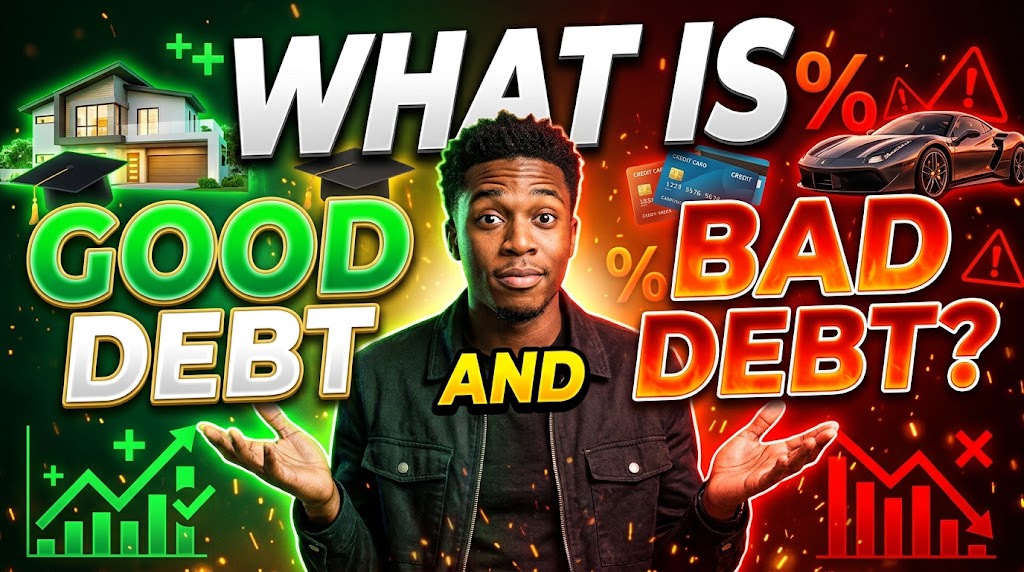
What is good debt and bad debt?
For a long time, I used to think that debt was simply debt. If you borrowed money, you owed somebody, and that was enough reason to consider the situation dangerous. I did not spend much time thinking about why the money was borrowed, what it was used for, or whether it had the potential to produce something valuable in the future. To me, the safest financial position was simply to avoid debt completely.
As I became more interested in business, personal finance, investing, and the way people build wealth, I discovered that the conversation was not that simple. I started asking a more important question: What is good debt and bad debt? That question changed the way I looked at borrowing money.
The truth is that not every debt has the same financial effect. Some debt can help you acquire an asset, develop a productive business, improve your earning capacity, or finance something that has the potential to generate future income. Other debt can become a financial burden because it is used mainly to pay for consumption, lifestyle, impulse purchases, or things that lose value quickly.
Understanding the difference between good debt and bad debt does not mean that borrowing money automatically becomes a good idea. Debt always comes with an obligation to repay, and interest can make the total cost much higher than the amount originally borrowed. The real lesson is that you need to understand what the debt is doing to your finances before you take it.
When I began thinking about debt this way, I realised that the question should not simply be, “How much am I borrowing?” A better question is, “What will this borrowed money accomplish?”
That distinction is extremely important.
Imagine two people each borrow ₦1 million. The first person uses the money to purchase equipment for a small business that already has customers and a realistic plan for generating revenue. The second person uses the same ₦1 million to finance an expensive lifestyle, buy things they do not need, and maintain an appearance they cannot comfortably afford.
Both people owe ₦1 million, but the financial consequences could be completely different.
The first person has used debt to acquire something potentially productive. If the business performs well, the equipment may contribute to revenue and eventually help generate enough money to repay the loan. The second person has converted borrowed money into consumption. Once the money is spent, there may be nothing productive left to generate income from, yet the repayment obligation remains.
This is one of the simplest ways I understand the difference between good debt and bad debt.
Good debt is generally debt that is used for a productive purpose and has a reasonable possibility of improving your financial position over time. It can be associated with acquiring an asset, building a business, developing a valuable skill, or financing an investment that has a realistic path towards generating income or increasing in value.
Bad debt, on the other hand, is generally debt that creates a financial obligation without providing a corresponding productive benefit. It is often used to finance consumption, unnecessary lifestyle expenses, impulse purchases, or depreciating items that do not generate enough value to justify the cost of borrowing.
However, I have also learned that the words “good” and “bad” can sometimes be misleading.
A type of debt that can be productive for one person can become destructive for another person.
For example, taking a business loan does not automatically make the debt good. If the business has no customers, no realistic business model, no cash flow plan, and no clear understanding of how the loan will be repaid, the debt can become a serious problem.
Similarly, taking a mortgage does not automatically make the debt good simply because property can appreciate. The borrower still has to consider the interest rate, repayment period, maintenance costs, taxes where applicable, income stability, and whether the property is genuinely affordable.
This is why I now believe that the purpose of the debt matters, but the numbers matter too.
One of the biggest mistakes people make is focusing only on what they are going to receive and forgetting what they are going to repay.
If someone tells you, “I can give you ₦2 million today,” it can sound attractive. But the important question is not simply how much you receive. You need to know how much you will eventually pay back, how frequently you must make repayments, what happens if your income drops, and whether the thing you are purchasing with the money can realistically support those repayments.
Interest changes everything.
A loan that looks affordable when viewed from the amount borrowed can become expensive when you calculate the total repayment. This is especially important with high interest debt. When interest accumulates quickly, the borrower can find themselves working primarily to service old financial decisions.
I remember becoming more conscious of this when I started looking at money differently. I realized that earning money and building wealth are not exactly the same thing.
You can earn a reasonable income and still struggle financially if large portions of your income are committed to debt repayments.
You can also have access to significant credit and still not be financially strong.
Credit gives you purchasing power, but purchasing power is not the same thing as wealth.
This distinction is particularly important when people use debt to purchase things simply because they want to appear successful.
There is a dangerous temptation in modern society to use borrowed money to create an appearance of financial success. Someone may have an expensive phone, designer clothing, a flashy car, impressive photographs, or an extravagant lifestyle, while quietly struggling with repayments behind the scenes.
I have come to realize that an item being expensive does not necessarily make it an asset.
A luxury item purchased with borrowed money may provide temporary satisfaction, but the debt remains after the excitement disappears.
This is one reason consumer debt can become dangerous.
Credit cards, personal loans, buy now pay later arrangements, salary advances, and other forms of consumer borrowing can be useful in certain circumstances, but they can also encourage people to spend tomorrow’s income today.
The problem becomes even greater when someone repeatedly borrows money to cover previous debt.
At that point, debt can become a cycle.
You borrow because you are short of money. You repay the loan using future income. Your available income becomes smaller because of the repayment. Then another unexpected expense appears, and you borrow again.
Eventually, the person may discover that they are not necessarily earning too little. They are simply carrying too many financial commitments from previous decisions.
This is why I believe understanding what is good debt and bad debt is not just about learning financial terminology. It is about learning to think before borrowing.
One question I would now ask before taking on debt is, “What exactly am I buying with this money?”
If the answer is something productive, I would continue asking questions.
Will it generate income?
Will it increase my ability to earn?
Will it help me acquire an asset?
Will it reduce a significant future expense?
Can I comfortably repay the debt?
What happens if my income decreases?
What is the total cost of borrowing?
How long will I remain responsible for the repayment?
These questions are much more useful than simply asking whether the lender has approved the loan.
Another question that changed my thinking is, “Would I still want this if I had to pay for it entirely with my own money?”
That question can expose unnecessary borrowing very quickly.
If I desperately want something only because I can borrow money for it, perhaps I do not actually need it.
There is nothing wrong with wanting nice things. The problem begins when lifestyle becomes dependent on borrowed money.
I also learned that productive debt requires discipline.
Suppose someone borrows money to start a website business. The person might believe that owning a website automatically means money will start coming in. It does not.
The website may require hosting, domain registration, content creation, marketing, search engine optimisation, technical maintenance, and consistent work. There may be months when the website produces little or no income.
If the person borrowed money to build the website, the loan repayment does not necessarily wait for the website to become profitable.
That is why I would never tell someone that debt is good simply because it is connected to a business.
The business must make financial sense.
The same principle applies to education.
Borrowing money to acquire a qualification or skill can potentially increase future earning capacity. But the borrower still needs to consider the cost, the quality of the programme, the likely opportunities afterward, and whether the expected financial benefit justifies the debt.
A qualification is not automatically a financial asset simply because it is called an investment in yourself.
The numbers still matter.
Property is another interesting example.
People often say that property debt is good debt because real estate can appreciate and potentially generate rental income. There can be truth in that idea, but it is not a universal rule.
A property purchased with excessive debt, poor financing terms, unrealistic rental expectations, or inadequate consideration of maintenance and other costs can become a financial burden.
The lesson I take from this is simple: an asset does not automatically make every loan associated with it good.
You have to examine the entire transaction.
I have also become more careful about confusing an emergency with an opportunity.
There are times when borrowing may be necessary because life does not always follow a financial plan. Medical emergencies, urgent repairs, family responsibilities, and unexpected disruptions can happen.
But after the emergency, there still needs to be a plan for repayment.
Sometimes the most financially responsible decision is not to borrow at all. Other times, borrowing may be the only practical way to handle an urgent situation. The important thing is to understand the consequences rather than pretending that every loan is harmless.
One of the most valuable financial habits I have developed is looking at debt from the perspective of future cash flow.
If I borrow today, what will happen to my income tomorrow?
If I commit ₦100,000 every month to repayments, that ₦100,000 cannot simultaneously be used for savings, investment, business development, household expenses, or other priorities.
Debt does not only affect the money you have today. It can affect the money available to you months or years from now.
That is why debt can reduce financial flexibility.
When too much income is committed to repayments, even a small unexpected expense can become a major problem.
This is also why I believe financial education is important.
People sometimes learn how to make money before they learn how to manage money.
They learn how to increase their income but not how to control expenses.
They learn how to access credit but not how interest works.
They learn how to buy assets but not how to calculate whether an asset can actually support the financing used to acquire it.
Making money is important, but keeping, managing, and deploying money intelligently are also important.
So, what is good debt and bad debt?
My understanding is that good debt is generally borrowing that has a clear productive purpose, a manageable repayment structure, and a reasonable potential to contribute to future financial value.
Bad debt is generally borrowing that is expensive, difficult to repay, primarily supports unnecessary consumption, or places a significant financial burden on the borrower without creating enough corresponding value.
But there is no magic category that can replace proper financial analysis.
The same loan can be manageable for one person and overwhelming for another.
The same business opportunity can make financial sense for one person and be completely unsuitable for someone else.
The same property can be affordable for one buyer and financially dangerous for another.
This is why I no longer look at debt only through the question of whether it is good or bad.
I ask what the debt is being used for, how much it costs, what it produces, how it affects cash flow, and what happens if things do not go according to plan.
That way of thinking has made me more cautious about borrowing, but it has also made me more open minded about productive uses of money.
The goal should not necessarily be to become terrified of all debt.
The goal should be to understand debt well enough to avoid allowing it to control your financial life.
Before borrowing money, calculate the total repayment. Understand the interest. Read the terms. Consider your income stability. Build room for unexpected expenses. Have a realistic repayment plan. Most importantly, do not allow pressure, comparison, social media, or the desire to impress people to make financial decisions for you.
Money borrowed for something productive should still be treated with respect.
Money borrowed for consumption should also be approached with caution.
And sometimes the smartest financial decision is simply to wait, save, and buy something when you can genuinely afford it.
Looking back, one of the biggest lessons I have learned is that debt itself is not the entire story.
The story is what the debt does after the money enters your hands.
Does it help you build something?
Does it improve your earning capacity?
Does it acquire something productive?
Or does it simply allow you to consume today while sending the bill to your future self?
That is the question I now think about whenever the subject of borrowing comes up.
If you have ever wondered, “What is good debt and bad debt?” do not stop at memorising a definition. Look at your own financial decisions. Look at what you are borrowing for, how much the borrowing really costs, and what it is likely to do to your future cash flow.
Debt can become a tool when it is carefully planned and responsibly managed. It can also become a burden when it is used without considering the consequences.
The difference often begins with one simple habit: thinking beyond the money you receive today and considering the financial life you will have to live after you borrow it.
That is the perspective I wish I had developed much earlier.
Because when it comes to debt, the most important question is not simply, “Can I borrow this money?”
It is, “What will this debt do to my future?”

EarnSmartOnline.com.ng is dedicated to helping readers make smarter financial decisions through practical guides on online income, personal finance, technology, digital business, and wealth creation. Our goal is to provide reliable, easy-to-understand, and actionable content that empowers individuals to earn smarter, build sustainable income streams and achieve long-term financial success.
Recommended: Start Earning Online
- Ultimate Affiliate Marketing Program — learn affiliate marketing with a done-for-you sales system ($15). Check it out
- The Newbie Affiliate Guide — the beginner-friendly starter guide (~$6.68). Check it out
- Easy Dollar Maker — earn in dollars uploading AI images and videos from your phone ($17). Check it out
Disclosure: These are affiliate links. If you buy through them, I may earn a commission at no extra cost to you.



