
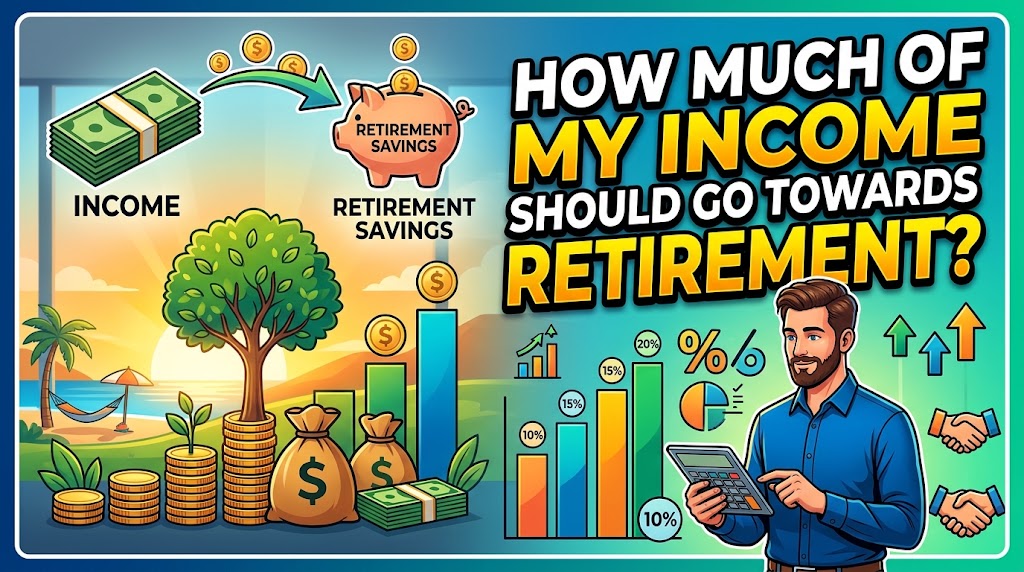
How much of my income should go towards retirement?
I still remember the moment I realized that retirement was not something that happened to other people. For years, I treated retirement as a distant event that belonged to an older version of myself. It was easy to focus on immediate expenses, monthly bills, family responsibilities, business goals, and the constant need to improve my quality of life. Saving for retirement felt important, but it never felt urgent. How much of my income should go towards retirement?
Then one day I sat down and did a simple calculation. I estimated how much money I would need to maintain my lifestyle if I stopped working. The numbers shocked me. For the first time, retirement stopped being a vague concept and became a financial reality. That experience completely changed the way I thought about money and long term planning.
One question kept coming to mind repeatedly: How much of my income should go towards retirement?
It is a question many people ask, regardless of whether they are employees, business owners, freelancers, or self employed professionals. The answer is not always straightforward because every person’s circumstances are different. However, understanding the principles behind retirement planning can help anyone make better financial decisions and build a more secure future.
When I first started researching retirement planning, I discovered that many financial experts recommend saving between 10% and 20% of your income for retirement. Some suggest starting with at least 15% of your gross income if possible. At first, that figure sounded overwhelming. Like many people, I already had numerous financial obligations competing for attention. Setting aside such a significant percentage seemed unrealistic.
The more I learned, however, the more I understood the reasoning behind these recommendations. Retirement savings work best when they benefit from time. The earlier money is invested, the longer it has to grow through compound returns. A person who starts saving at age twenty five often needs to contribute far less than someone who begins at age forty five. Time becomes one of the most valuable assets in retirement planning.
This was one of the biggest lessons I learned. Most people focus on the amount of money they invest, but few appreciate the value of consistency and time. Even relatively modest contributions can grow substantially when given enough years to compound.
When considering the question, How much of my income should go towards retirement?, I realized there is no universal percentage that works perfectly for everyone. Several factors influence the ideal amount.
Age is one of the most important factors. Someone who starts saving in their twenties has a significant advantage over someone who delays retirement planning until their forties or fifties. Younger individuals often have more time to benefit from investment growth. As a result, they may achieve their retirement goals while contributing a smaller percentage compared to someone who starts later.
Income level also plays a role. A person earning a higher income may be able to save a larger percentage without compromising their current lifestyle. On the other hand, someone earning a modest income may need to balance retirement savings with essential living expenses. What matters most is developing a habit of consistent contributions rather than waiting for the perfect financial situation.
Lifestyle expectations during retirement are equally important. Some people dream of traveling extensively, pursuing hobbies, supporting family members, or maintaining a luxurious lifestyle. Others prefer a simpler retirement focused on financial independence and basic comfort. The lifestyle you envision will significantly influence how much you need to save.
Debt is another factor that cannot be ignored. I have met people who struggle to decide whether to pay off debt or save for retirement. While every situation is unique, high interest debt often deserves immediate attention because it can quickly erode financial progress. Finding a balance between reducing debt and contributing towards retirement is usually the most sustainable approach.
One practical strategy that helped me was treating retirement contributions like a mandatory expense rather than an optional activity. Instead of saving whatever remained after spending, I reversed the process. I allocated a percentage of my income towards retirement first and adjusted my spending around that commitment.
This simple mindset shift made an enormous difference. It removed the temptation to postpone saving until a future date that never seemed to arrive. The money was set aside automatically, making consistency much easier.
I also learned that retirement planning is not solely about percentages. It is about creating a financial system that supports long term goals. For some individuals, contributing 10% may be appropriate. Others may need to save 20% or more depending on their circumstances. The key is understanding your destination and working backwards to determine the required contribution level.
Many people underestimate the cost of retirement. They assume expenses will disappear once they stop working. While certain costs may decrease, others can increase. Healthcare expenses, inflation, housing maintenance, and daily living costs continue to exist. In some cases, retirees discover they need more income than expected to maintain their desired lifestyle.
Inflation is particularly important to consider. A lifestyle that costs a certain amount today may require significantly more money decades from now. This reality reinforced the importance of investing rather than simply storing retirement savings in low yielding accounts. While investing involves risks, long term growth potential often helps retirement savings keep pace with inflation over time.
Another lesson I learned involved the psychological side of retirement planning. Many people avoid thinking about retirement because it feels distant or uncertain. Human beings naturally prioritize immediate rewards over future benefits. Buying something today provides instant satisfaction, while saving for retirement offers a benefit that may not be realized for decades.
Understanding this tendency helped me become more intentional with my financial decisions. I began viewing retirement contributions not as money I was losing but as money I was paying to my future self. That perspective transformed saving from a sacrifice into an investment in long term freedom.
The question, How much of my income should go towards retirement?, becomes easier to answer when viewed through the lens of future independence. Retirement savings are not merely about accumulating money. They are about creating options. They provide the ability to choose how to spend your later years without depending entirely on employment income or external support.
One approach I found useful was increasing retirement contributions gradually. Instead of trying to jump immediately from zero savings to a high percentage, I increased my contributions whenever my income increased. Salary raises, bonuses, additional business income, or freelance earnings became opportunities to strengthen my retirement plan.
This gradual approach felt less painful and more sustainable. Over time, the percentage allocated to retirement grew significantly without creating major disruptions to my lifestyle.
Emergency savings should also be considered alongside retirement planning. Before aggressively investing for retirement, it is generally wise to establish a financial safety net for unexpected expenses. Emergencies can happen at any time. Without adequate savings, individuals may be forced to withdraw retirement funds prematurely, potentially incurring penalties and reducing future growth.
Balancing retirement contributions with emergency savings taught me the importance of financial stability. Both goals support long term security, and neither should be ignored.
For self employed individuals and business owners, retirement planning often requires even greater discipline. Without employer sponsored retirement programmes, the responsibility falls entirely on the individual. This can be challenging, especially during periods of fluctuating income.
As someone interested in entrepreneurship and digital business, I understand how easy it is to prioritize business reinvestment over personal retirement planning. Many entrepreneurs believe their business will eventually become their retirement plan. While a successful business can certainly contribute to retirement security, relying exclusively on one asset can be risky.
Diversification remains important. Building retirement savings alongside business growth can create a stronger financial foundation and reduce dependence on a single source of future income.
I also discovered that retirement planning should be reviewed regularly. Life changes constantly. Income levels rise and fall. Family responsibilities evolve. Economic conditions shift. Investment performance varies. A retirement strategy that made sense five years ago may need adjustments today.
Conducting periodic reviews helped me stay aligned with my goals. It allowed me to identify gaps, increase contributions when possible, and make informed decisions about my financial future.
One mistake many people make is assuming it is too late to start. I have spoken with individuals in their forties, fifties, and even sixties who feel discouraged because they believe they should have started earlier. While starting young offers advantages, taking action today is always better than continuing to delay.
Every contribution matters. Every year of growth matters. Every financial decision has the potential to improve future outcomes. Regret about the past should never prevent progress in the present.
The truth is that retirement planning is not about achieving perfection. It is about making consistent progress over time. Few people follow a flawless financial journey. Unexpected expenses, economic downturns, career changes, and personal challenges are all part of life. What matters most is maintaining commitment to long term goals despite occasional setbacks.
Whenever someone asks me, How much of my income should go towards retirement?, I encourage them to focus on two principles. First, start as early as possible. Second, save as much as you reasonably can while maintaining a sustainable lifestyle. Whether that percentage is 10%, 15%, 20%, or more, consistency often matters more than chasing an ideal number.
Retirement planning is ultimately an act of self respect. It is a recognition that the future version of yourself deserves financial security, dignity, and freedom. Every contribution made today represents a promise to that future self.
Looking back, I am grateful that I stopped treating retirement as a distant problem and started viewing it as an ongoing responsibility. The peace of mind that comes from knowing I am actively preparing for the future is difficult to describe. It does not eliminate uncertainty, but it provides confidence that I am moving in the right direction.
If you are still wondering, How much of my income should go towards retirement?, begin by assessing your current situation. Examine your income, expenses, debts, goals, and desired retirement lifestyle. Choose a realistic percentage you can commit to consistently. If possible, aim for at least 10% to 15% and gradually increase contributions as your financial circumstances improve.
Remember that retirement planning is not reserved for the wealthy. It is a habit, a strategy, and a long term commitment that can benefit people across different income levels. The most important step is not finding the perfect percentage. The most important step is starting.
Years from now, your future self may look back and thank you for the decision you make today. The money you save now has the potential to provide freedom, security, and opportunities that would otherwise be difficult to achieve. Retirement may seem far away, but every contribution brings it closer to becoming a financially comfortable and rewarding chapter of life.
The answer to the question, How much of my income should go towards retirement?, will vary from person to person, but one principle remains universal. The sooner you begin, the more options you create for yourself in the future. Retirement is not simply about reaching a certain age. It is about reaching a stage of life where your money works hard enough to support the life you want to live, even when you choose to stop working.

EarnSmartOnline.com.ng is dedicated to helping readers make smarter financial decisions through practical guides on online income, personal finance, technology, digital business, and wealth creation. Our goal is to provide reliable, easy-to-understand, and actionable content that empowers individuals to earn smarter, build sustainable income streams and achieve long-term financial success.
Recommended: Start Earning Online
- Ultimate Affiliate Marketing Program — learn affiliate marketing with a done-for-you sales system ($15). Check it out
- The Newbie Affiliate Guide — the beginner-friendly starter guide (~$6.68). Check it out
- Easy Dollar Maker — earn in dollars uploading AI images and videos from your phone ($17). Check it out
Disclosure: These are affiliate links. If you buy through them, I may earn a commission at no extra cost to you.



