
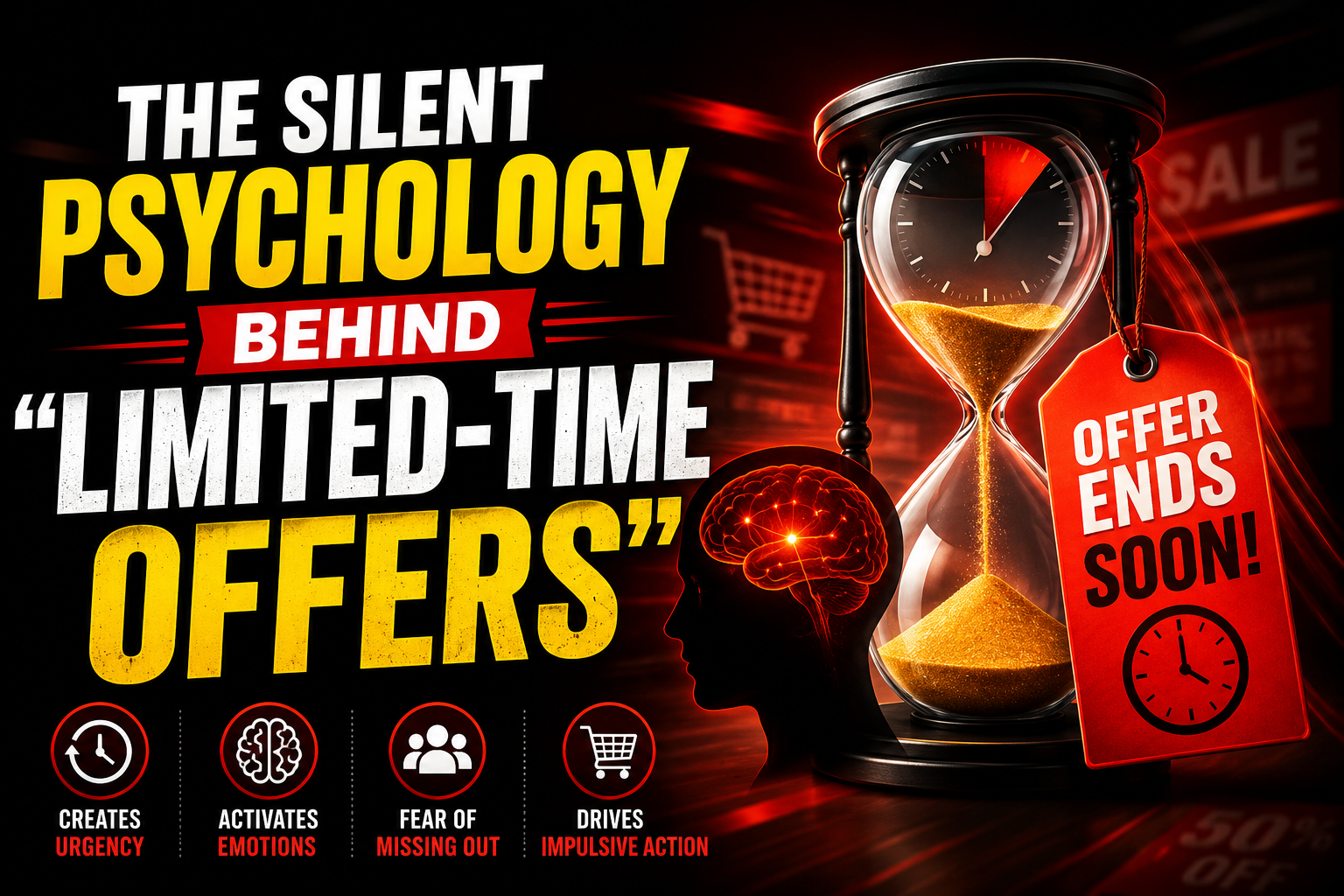
The Silent Psychology Behind “Limited-Time Offers
Have you ever bought something you were not planning to buy simply because a countdown timer told you there were only a few hours left? Perhaps you have rushed to complete an online order because a website warned that only three items remained in stock. Maybe you have walked into a supermarket intending to buy one product but left with several more because the bright red sign read “Today Only” or “Offer Ends Tonight.” If you have experienced any of these situations, you are far from alone. Millions of people around the world make purchasing decisions every day based not on actual need, but on carefully designed psychological triggers that make time appear to be running out. Among the most powerful of these marketing techniques is the limited time offer.
The silent psychology behind limited time offers is one of the most fascinating aspects of consumer behaviour because it influences people without them fully recognising what is happening. It operates quietly beneath conscious awareness, changing how products are perceived, increasing emotional urgency, and encouraging immediate action before logic has a chance to catch up. Businesses have understood this principle for decades, and in the digital age it has become even more sophisticated. From online shopping platforms to streaming services, airline tickets, hotel bookings, software subscriptions, fashion retailers and food delivery apps, limited time offers appear almost everywhere people spend money.
The reason this strategy continues to work is surprisingly simple. Human beings naturally place greater value on things they believe they might lose. The possibility of missing an opportunity creates emotional discomfort that many people seek to eliminate as quickly as possible. Buying the product often feels like the easiest way to remove that discomfort. The purchase provides emotional relief long before the customer evaluates whether the item was actually necessary.
Scarcity has always influenced human decision making throughout history. Long before modern marketing existed, food shortages, limited resources and seasonal availability shaped survival. Our ancestors learned that waiting too long often meant going without essential resources. Those instincts remain deeply embedded within human psychology even though today’s marketplace is dramatically different. Instead of worrying about running out of food before winter, modern consumers worry about missing discounts, exclusive products or once in a lifetime deals. The brain often responds in remarkably similar ways.
One reason limited time offers are so effective is that they reduce the amount of thinking people do before making a purchase. Under normal circumstances, consumers compare prices, read reviews, evaluate alternatives and carefully consider whether they truly need a product. Introducing a ticking clock interrupts this rational process. Suddenly, every minute spent thinking appears to increase the risk of losing the opportunity. Instead of asking whether the product is valuable, people begin asking whether they can afford to let the opportunity disappear.
This subtle shift is incredibly important because it changes the question inside the buyer’s mind. Rational buying focuses on value, usefulness and long term satisfaction. Emotional buying focuses on immediate consequences. A customer who was originally evaluating quality begins worrying about regret. Nobody enjoys the feeling of discovering that they could have saved money if only they had acted sooner. Marketers understand this emotional vulnerability and build entire promotional campaigns around it.
Fear of missing out, commonly known as FOMO, plays an enormous role in this process. Although many people associate FOMO with social media, it is equally powerful in shopping. The possibility that someone else might obtain a better price, exclusive access or limited edition product creates anxiety that encourages immediate action. Consumers often imagine future disappointment more vividly than present financial responsibility. This explains why many purchases occur even when buyers had no previous intention of spending money.
Online retailers have refined this strategy with remarkable precision. Countdown clocks, stock indicators, flash sales, early bird pricing and expiring discount codes all create the perception that hesitation carries a cost. Every second displayed on the screen becomes a psychological reminder that opportunities disappear. Even highly educated consumers who understand these marketing techniques frequently respond to them emotionally rather than rationally.
Interestingly, the effectiveness of limited time offers does not always depend on whether the deadline is genuine. Research into consumer behaviour has repeatedly demonstrated that perceived scarcity often influences buying decisions more strongly than actual scarcity. When people believe something is becoming unavailable, they naturally assign greater value to it regardless of whether the supply is truly limited. This explains why phrases such as “while stocks last,” “today only,” “exclusive release,” and “offer ends soon” remain so common across industries.
Loss aversion provides another important explanation. Behavioural economists have long observed that people experience the pain of losing something more intensely than the pleasure of gaining something of equal value. Losing a £100 opportunity often feels emotionally stronger than gaining £100 unexpectedly. Limited time offers exploit this psychological imbalance by framing inactivity as a loss rather than portraying purchase as a gain. Instead of thinking, “I can save money by buying this,” consumers begin thinking, “I will lose this discount forever if I wait.”
This difference may appear small, but it dramatically changes behaviour. Human beings work much harder to avoid losses than they do to pursue equivalent rewards. Businesses that understand this principle can influence purchasing decisions without changing the actual value of their products. Simply changing how an offer is presented often increases sales significantly.
Social proof frequently strengthens the impact of limited time offers. Consumers rarely make decisions in complete isolation. Seeing messages that hundreds of people have already purchased the same item or that dozens of customers are viewing the product simultaneously creates additional urgency. The buyer unconsciously assumes that if many other people want the item before time runs out, there must be genuine value in acting quickly. Scarcity and popularity combine to create an emotional pressure that becomes difficult to resist.
The digital marketplace has made these psychological triggers even more sophisticated. Artificial intelligence now personalises promotions based on browsing history, shopping habits and previous purchases. Two people visiting the same website may receive completely different offers designed specifically to maximise their likelihood of making an immediate purchase. One customer might see free shipping that expires tonight while another receives a discount code valid for only thirty minutes. These personalised deadlines make marketing increasingly effective because they target individual behavioural patterns rather than treating every customer identically.
Limited time offers also create what psychologists describe as cognitive narrowing. Under pressure, people focus almost exclusively on avoiding immediate loss while paying less attention to broader financial considerations. Questions about affordability, future needs or alternative options gradually fade into the background. The countdown dominates attention, making every other consideration appear less important. This explains why buyers sometimes experience regret shortly after completing purchases that initially felt urgent.
Retail environments are carefully designed to reinforce these psychological responses. Bright colours, prominent countdown displays, bold promotional language and strategic product placement all work together to maintain emotional momentum. The environment constantly communicates that delay carries consequences. Consumers may believe they are making independent decisions, but their attention is being guided in highly predictable ways.
Holiday shopping seasons provide some of the clearest examples of this phenomenon. Events such as Black Friday, Cyber Monday and seasonal clearance sales generate enormous excitement because they combine scarcity, social proof, media coverage and limited availability into a single buying environment. Consumers who would normally spend weeks comparing products often complete purchases within minutes simply because they believe the opportunity may never return.
Interestingly, satisfaction after purchasing through limited time offers is not always higher than satisfaction following ordinary purchases. In fact, some studies suggest the opposite. Once urgency disappears, buyers often evaluate products more objectively. Without the pressure of expiring deadlines, they begin questioning whether the purchase was genuinely necessary or merely emotionally driven. This delayed reflection explains why impulse buying frequently leads to buyer’s remorse.
Businesses continue using limited time offers because they reliably increase conversion rates across countless industries. Restaurants introduce daily specials. Airlines advertise limited seat availability. Hotels promote discounted rooms for bookings completed before midnight. Software companies offer introductory pricing that expires within days. Streaming platforms provide free trials available only for a short period. Even charitable organisations sometimes encourage donations by emphasising matching contributions available only before a specified deadline. Each example relies on the same psychological foundation.
The remarkable aspect of this strategy is that it rarely requires deception. A business may genuinely have limited inventory, seasonal pricing or promotional budgets that cannot continue indefinitely. When scarcity is authentic, communicating that reality is perfectly reasonable. Ethical concerns arise primarily when artificial urgency is manufactured repeatedly despite products remaining continuously available. Consumers gradually lose trust when every week becomes the “last chance” to purchase the same item at the same price.
Trust plays an increasingly important role in modern marketing because today’s consumers are more informed than ever before. Online reviews, price comparison tools and consumer forums make it easier to identify manipulative sales tactics. Businesses that repeatedly misuse limited time offers may achieve short term sales increases while damaging long term credibility. Sustainable brands recognise that psychological persuasion should strengthen customer relationships rather than undermine them.
From the consumer’s perspective, understanding the silent psychology behind limited time offers creates an important advantage. Awareness alone does not eliminate emotional influence, but it introduces a valuable pause between stimulus and response. Instead of reacting automatically to countdown timers or expiring discounts, informed buyers can ask themselves a series of simple questions. Would I still want this product tomorrow if the offer disappeared? Was I planning to buy it before seeing the promotion? Am I purchasing because I need it or because I fear missing out? These questions restore rational thinking to a decision that emotional urgency attempts to dominate.
Another useful habit involves recognising that genuine opportunities usually survive careful thinking. Truly valuable purchases often remain worthwhile after twenty four hours of reflection. If waiting one day completely destroys the attractiveness of an offer, the urgency itself may have been the primary selling point rather than the product’s actual value. Wise consumers understand that protecting long term financial health is usually more important than capturing every temporary discount.

EarnSmartOnline.com.ng is dedicated to helping readers make smarter financial decisions through practical guides on online income, personal finance, technology, digital business, and wealth creation. Our goal is to provide reliable, easy-to-understand, and actionable content that empowers individuals to earn smarter, build sustainable income streams and achieve long-term financial success.
Recommended: Start Earning Online
- Ultimate Affiliate Marketing Program — learn affiliate marketing with a done-for-you sales system ($15). Check it out
- The Newbie Affiliate Guide — the beginner-friendly starter guide (~$6.68). Check it out
- Easy Dollar Maker — earn in dollars uploading AI images and videos from your phone ($17). Check it out
Disclosure: These are affiliate links. If you buy through them, I may earn a commission at no extra cost to you.



