
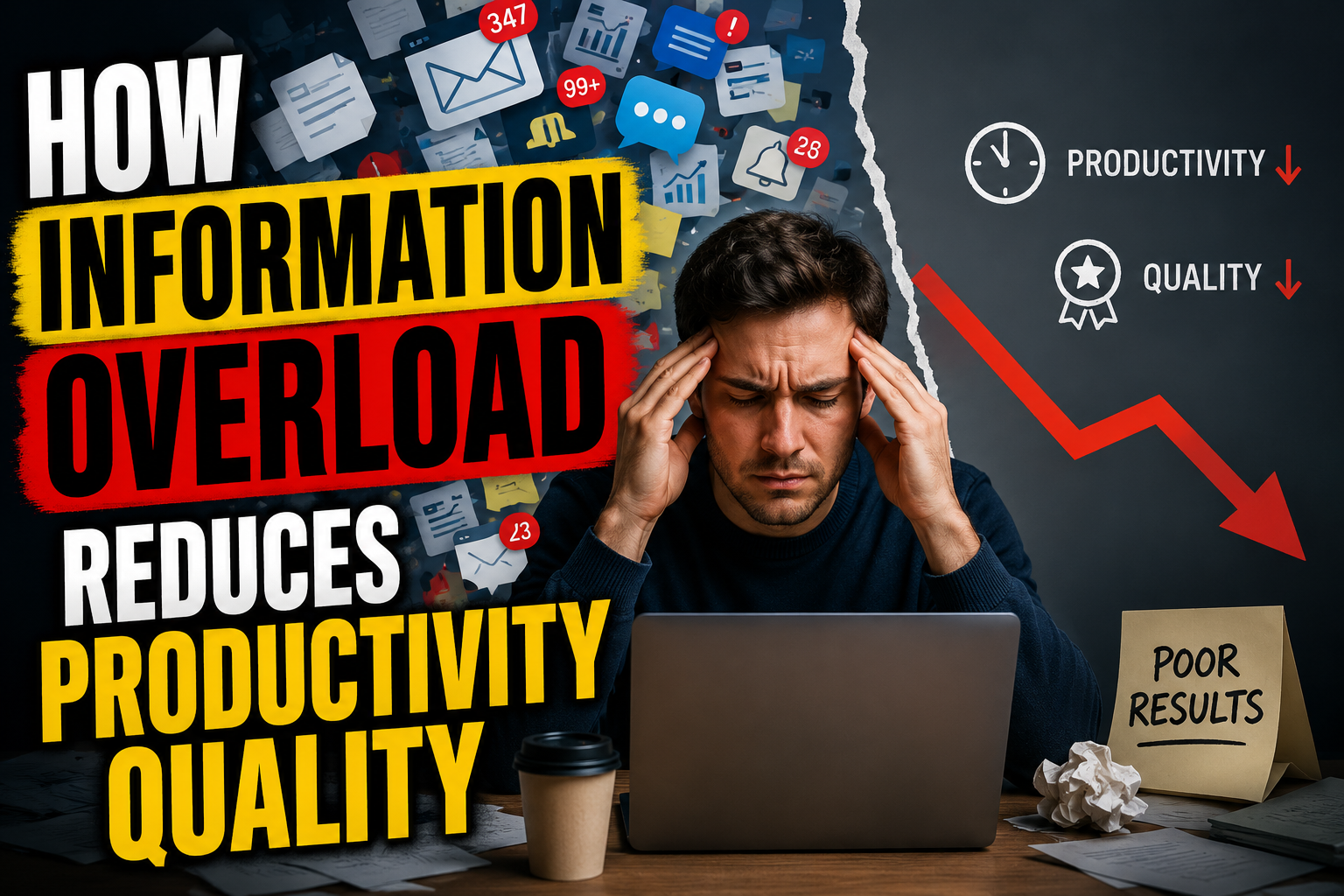
How Information Overload Reduces Productivity Quality
In today’s world, information is no longer scarce. If anything, the real challenge has become filtering what matters from what does not. Every second, people are exposed to messages, notifications, articles, videos, opinions, alerts, and updates competing for attention. What was once a tool for productivity has quietly turned into a constant stream of interruption. The result is not just distraction but a deeper problem that most people do not immediately recognize. Information overload is steadily reducing the quality of human productivity, not by stopping people from working, but by weakening the clarity, focus, and depth behind the work they produce.
At first glance, having access to more information seems like an advantage. After all, knowledge is power, and more knowledge should theoretically lead to better decisions. However, the human brain was not designed to process unlimited streams of data at once. When too many inputs arrive simultaneously, the mind begins to struggle with prioritization. Instead of focusing deeply on one task, attention becomes fragmented across multiple competing ideas. This fragmentation creates the illusion of activity without producing meaningful progress. People feel busy, but the quality of their output declines because their mental resources are constantly being divided.
One of the most damaging effects of information overload is decision fatigue. Every piece of information requires a micro decision, whether to read it, ignore it, save it, or act on it. Over time, these small decisions accumulate and drain mental energy. By the time a person reaches their most important tasks, their cognitive strength is already reduced. This leads to rushed thinking, shallow execution, and poor prioritization. Instead of working with clarity, individuals begin to rely on shortcuts, often choosing what feels easiest rather than what delivers the highest value.
Another major issue is the decline of deep focus. High quality productivity depends on sustained concentration, where the mind stays engaged with a single task long enough to reach a state of depth and flow. Information overload destroys this process by constantly pulling attention away. A notification breaks concentration, a new message interrupts thought, and a quick check of updates resets mental momentum. Each interruption may seem small, but the cost is significant. Research and experience both show that it can take several minutes to regain deep focus after even a brief distraction. When this happens repeatedly, the mind never fully settles into high performance mode.
As focus declines, so does the quality of thinking. Complex problems require uninterrupted mental space. They need reflection, comparison, and synthesis of ideas. But when the mind is overloaded with information, it becomes reactive instead of reflective. People begin to think in fragments rather than in systems. Instead of forming deep understanding, they collect surface level insights that are quickly replaced by new information. This creates a cycle where knowledge is constantly consumed but rarely processed into wisdom or useful output.
There is also a subtle psychological effect that information overload creates. It gives the impression that more input automatically leads to better outcomes. This belief encourages constant consumption of content under the assumption that it will improve performance. However, consuming information without applying it does not improve productivity. In fact, it often does the opposite. The more time spent consuming, the less time remains for execution. Over time, this imbalance leads to a gap between knowledge and action, where individuals know a lot but produce very little.
Another overlooked consequence is reduced creativity. Creativity does not come from constant input but from mental space. It emerges when the mind has time to connect ideas, reflect, and imagine new possibilities. When information is constantly flowing in, there is little room for internal processing. Instead of creating original thoughts, people begin to recycle existing ideas they have recently consumed. This leads to predictable thinking patterns and reduces innovation. The mind becomes a mirror of external content rather than a generator of new insight.
Information overload also affects emotional stability, which indirectly impacts productivity quality. When the mind is constantly exposed to updates, comparisons, and opinions, it becomes harder to maintain emotional balance. People start reacting emotionally to information that may not even be relevant to their immediate goals. This emotional noise interferes with rational thinking and makes it harder to maintain consistent output. Productivity is not just a matter of skill but also of mental stability, and overload disrupts both.
Another important dimension is the erosion of prioritization skills. When everything feels urgent due to constant exposure to new information, it becomes harder to distinguish between what is important and what is simply loud. This leads to a situation where attention is distributed equally across tasks of unequal value. High impact work gets delayed while low value activities receive unnecessary attention. Over time, this reduces overall effectiveness even if the number of tasks completed remains high.
The workplace and digital environment have amplified this problem significantly. Modern tools are designed to maximize engagement rather than focus. Emails, messaging apps, news feeds, and productivity platforms all compete for attention. While each tool individually offers value, collectively they create a fragmented attention economy. Without deliberate control, individuals become reactive users of information rather than intentional users. This shift changes the nature of productivity from deep work to constant switching, which reduces the quality of outcomes.
To reverse the effects of information overload, the solution is not necessarily to consume less information but to consume it more intentionally. The key is developing the discipline to filter inputs based on relevance and timing. Not all information deserves immediate attention, and not all updates are necessary for performance. By creating boundaries around consumption, the mind regains its ability to focus deeply on fewer things that matter more. This allows for higher quality thinking and more meaningful output.
Ultimately, productivity is not determined by how much information a person can access, but by how effectively they can process and apply it. In a world overflowing with data, clarity has become more valuable than knowledge accumulation. Those who learn to manage information wisely gain a significant advantage, not because they know more, but because they can think better, act more decisively, and produce higher quality results with less mental noise.

EarnSmartOnline.com.ng is dedicated to helping readers make smarter financial decisions through practical guides on online income, personal finance, technology, digital business, and wealth creation. Our goal is to provide reliable, easy-to-understand, and actionable content that empowers individuals to earn smarter, build sustainable income streams and achieve long-term financial success.
Recommended: Start Earning Online
- Ultimate Affiliate Marketing Program — learn affiliate marketing with a done-for-you sales system ($15). Check it out
- The Newbie Affiliate Guide — the beginner-friendly starter guide (~$6.68). Check it out
- Easy Dollar Maker — earn in dollars uploading AI images and videos from your phone ($17). Check it out
Disclosure: These are affiliate links. If you buy through them, I may earn a commission at no extra cost to you.



