
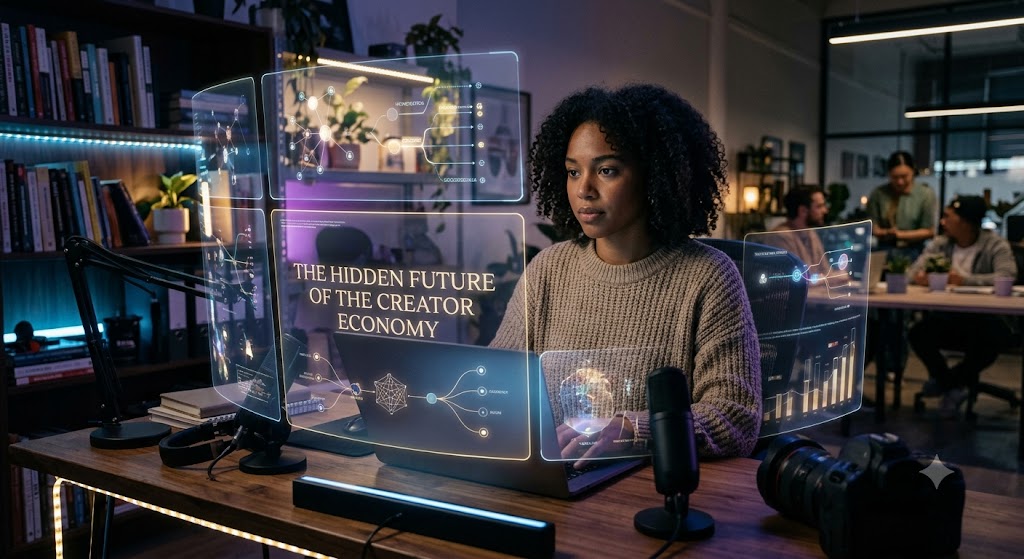
The Hidden Future of the Creator Economy
The hidden future of the creator economy is one of the most fascinating conversations taking place in today’s digital world. Just a decade ago, very few people believed that creating videos, writing blog posts, recording podcasts, designing graphics, publishing newsletters, or sharing educational content online could become a full-time career. Today, millions of people around the world earn a living by creating valuable content for audiences across multiple digital platforms. What was once considered a hobby has become a multi-billion-dollar global industry, changing how people work, learn, shop, communicate, and build businesses.
The creator economy is far more than social media influencers posting entertaining videos. It is an ecosystem where individuals transform knowledge, creativity, experience, personality, and skills into products, services, communities, and businesses. Every educational YouTube channel, every successful blogger, every podcast host, every online teacher, every newsletter writer, every digital artist, every game streamer, and every independent musician represents a different branch of this rapidly expanding economy.
The most interesting part is that we are still at the beginning. Many people assume the creator economy has already reached its peak because social media feels crowded. In reality, the hidden future of the creator economy suggests exactly the opposite. The biggest opportunities may belong to those who start today rather than those who started yesterday.
One reason for this optimism is that technology continues to lower the barriers to entry. Years ago, building an audience required expensive equipment, broadcasting licences, or access to large publishing companies. Today, anyone with a smartphone, internet connection, and valuable ideas can reach millions of people. Artificial intelligence tools now assist with editing, research, design, subtitles, translations, scheduling, and even brainstorming, allowing creators to focus more on originality and less on repetitive tasks.
However, easier access also creates greater competition. Thousands of new creators enter the market every day. This means success is no longer determined simply by showing up online. The future belongs to creators who solve real problems, educate clearly, entertain consistently, and build genuine trust with their audiences.
Trust is quietly becoming the most valuable currency in the creator economy. Followers can be purchased. Views can sometimes be manipulated. Viral moments come and go. Trust cannot be faked for long. Audiences are becoming increasingly skilled at recognising authenticity. They quickly identify creators who genuinely care about helping people and those who exist only to chase trends or advertising revenue.
This shift is changing how businesses think about marketing. Instead of spending enormous budgets on traditional advertising, companies increasingly partner with creators who have built loyal communities. A creator with fifty thousand highly engaged followers often delivers better business results than a celebrity with millions of passive followers. Engagement is replacing raw numbers as the true measure of influence.
The hidden future of the creator economy also points toward ownership rather than dependence. Many creators made the mistake of building their entire careers on a single platform. When algorithms changed or accounts were suspended, years of work disappeared overnight. Future creators are becoming more strategic. They build websites, email lists, private communities, online courses, digital products, membership platforms, podcasts, books, and businesses that they control.
Ownership creates stability. Renting attention on social media can produce quick growth, but owning direct relationships with an audience creates long-term security. Email subscribers, website visitors, community members, and paying customers remain valuable regardless of changes made by technology companies.
Another major transformation involves the rise of niche creators. In the past, people believed success required appealing to everyone. Today’s digital landscape proves the opposite. Some creators build highly successful businesses by focusing on extremely specific audiences. Whether it is sustainable farming, vintage watches, personal finance for students, website development, African entrepreneurship, or home coffee brewing, specialised knowledge attracts dedicated followers who actively seek expertise.
This trend will continue because the internet rewards relevance more than general popularity. As search engines and recommendation systems become smarter, they increasingly connect users with content that precisely matches their interests. A creator serving a focused audience can often generate more income than someone chasing mass appeal.
Education represents another hidden engine driving the creator economy. More people now learn practical skills online than through traditional classrooms. Individuals searching for ways to build websites, start businesses, improve financial literacy, learn programming, master photography, or understand digital marketing frequently turn to independent creators instead of formal institutions.
This creates enormous opportunities for knowledgeable individuals. Expertise no longer needs to remain inside universities or corporations. Professionals, entrepreneurs, skilled workers, and experienced hobbyists can package their knowledge into educational content that benefits people worldwide while generating sustainable income.
Artificial intelligence will undoubtedly reshape the creator economy, but perhaps not in the way many people fear. Some worry that AI will replace creators completely. A more realistic future suggests AI will replace repetitive tasks while increasing the value of human originality, personal experience, emotional intelligence, storytelling, humour, and authentic perspective.
People rarely follow creators simply because they provide information. Information is now widely available. They follow personalities they trust, stories they relate to, experiences they admire, and communities where they feel understood. AI can assist creation, but genuine human connection remains difficult to automate.
The future will likely reward creators who combine technology with authenticity. Those who use AI to improve efficiency while preserving their unique voice will outperform those who either reject technology entirely or depend on it completely.
Monetisation methods are also expanding rapidly. Advertising revenue alone no longer defines success. Modern creators earn through digital products, online courses, consulting, coaching, affiliate marketing, memberships, sponsorships, premium newsletters, software, templates, merchandise, books, licensing, live events, speaking engagements, and subscription communities.
Diversification reduces financial risk. When one income stream slows, others continue supporting the business. This financial resilience will become increasingly important as digital platforms evolve.
The hidden future of the creator economy also includes stronger personal brands. Employers, investors, clients, and business partners increasingly research individuals online before making important decisions. Every article published, every helpful video uploaded, every insightful podcast recorded, and every valuable social media post contributes to an individual’s digital reputation.
A strong personal brand creates opportunities that traditional résumés often cannot. Invitations to conferences, consulting contracts, partnership offers, investment opportunities, media appearances, and business collaborations frequently originate from consistent online visibility.
Another emerging trend involves community-first businesses. Successful creators no longer focus solely on audience size. They prioritise building communities where members interact with one another, share ideas, solve problems together, and develop lasting relationships.
Communities create loyalty that algorithms cannot easily disrupt. They encourage recurring revenue through memberships while strengthening emotional connections between creators and their audiences.
Global accessibility further strengthens the creator economy. Geographic location matters less than ever before. A writer in Nigeria can teach readers in Canada. A designer in Kenya can sell templates to customers in Australia. A programmer in India can educate entrepreneurs in the United Kingdom. Digital borders continue disappearing as internet access expands worldwide.
This democratisation of opportunity allows talented individuals from developing economies to compete internationally without relocating. Knowledge, creativity, and consistency increasingly outweigh physical location.
The future also favours creators who develop intellectual property rather than producing disposable content. Evergreen articles, educational courses, digital books, software applications, design assets, research reports, and premium resources continue generating value long after publication. Temporary trends may deliver quick attention, but intellectual property builds lasting wealth.
Search engine optimisation remains essential within this future. While viral content captures immediate attention, search-driven content delivers consistent long-term traffic. People continuously search for solutions to recurring problems. Creators who answer these questions clearly establish reliable streams of visitors for years.
Long-form content is also experiencing renewed importance. Short videos dominate entertainment, but detailed articles, comprehensive tutorials, podcasts, documentaries, and educational videos continue attracting audiences seeking deeper understanding. Attention spans have not disappeared; people simply reserve extended attention for genuinely valuable content.
Data ownership will become increasingly significant. Creators who understand audience behaviour, preferences, purchasing patterns, and engagement metrics make better business decisions. Analytics provide insight into what truly serves audiences rather than relying on assumptions.
Another hidden development involves collaboration replacing competition. Instead of viewing every creator as a rival, many recognise the advantages of partnerships. Joint webinars, podcast interviews, collaborative courses, shared newsletters, and cross-promotional campaigns expand audiences while delivering greater value.
The creator economy also encourages entrepreneurship. Many creators eventually evolve beyond content production into business ownership. They launch software companies, agencies, educational institutions, publishing businesses, consulting firms, product lines, and investment ventures. Content becomes the engine driving broader commercial opportunities.
This transition demonstrates that successful creators are not merely entertainers. They become educators, marketers, entrepreneurs, community leaders, researchers, innovators, and business builders.
Financial literacy will become increasingly important for creators. Rapid income growth without proper financial management often leads to instability. Future success requires budgeting, investing, tax planning, business structures, legal protection, and long-term wealth creation alongside creative excellence.
The hidden future of the creator economy is also deeply connected to credibility. Audiences reward consistency, honesty, transparency, and expertise. Clickbait may generate temporary traffic, but sustainable businesses depend upon delivering genuine value repeatedly over many years.
Ethics will therefore become a competitive advantage. Creators who disclose partnerships honestly, recommend products responsibly, respect intellectual property, and prioritise audience interests cultivate stronger reputations than those pursuing short-term profits.
The next generation of creators will likely think less like influencers and more like media companies. They will employ teams, develop systems, produce multiple content formats simultaneously, expand into international markets, and create scalable businesses capable of operating beyond the founder’s direct involvement.
This professionalisation increases the overall quality of digital content while opening employment opportunities for editors, designers, researchers, marketers, developers, producers, writers, analysts, and community managers.
Consumers also benefit tremendously. Competition encourages higher-quality educational resources, better entertainment, more specialised knowledge, faster innovation, and greater accessibility. Audiences gain access to information that once required expensive courses or exclusive professional networks.
One overlooked aspect of the creator economy involves legacy. Unlike many traditional jobs where contributions disappear after retirement, creators often leave digital assets that continue educating, inspiring, and helping future generations. Articles remain searchable. Videos continue receiving views. Books remain available. Courses continue teaching students. Intellectual property extends impact beyond active working years.
The creator economy is not without challenges. Burnout, platform dependence, changing algorithms, misinformation, content theft, market saturation, and inconsistent income remain genuine concerns. However, creators who approach their work strategically rather than emotionally position themselves to overcome these obstacles.
Building sustainable systems, protecting mental health, diversifying income, maintaining realistic expectations, and continuously improving skills all contribute to long-term success.
Ultimately, the hidden future of the creator economy belongs to individuals who understand that creating content is only one part of the journey. The real opportunity lies in creating value, building trust, developing assets, nurturing communities, solving meaningful problems, and transforming attention into lasting businesses.
Technology will continue evolving. Platforms will rise and fall. Algorithms will change. Consumer behaviour will adapt. Yet one principle remains remarkably consistent. People will always seek trustworthy individuals who can educate them, inspire them, entertain them, or help them solve important problems.
For anyone willing to learn, remain adaptable, and consistently serve an audience with integrity, the creator economy offers possibilities that previous generations could scarcely imagine. Its hidden future is not simply about becoming famous online. It is about building ownership, creating meaningful impact, establishing financial independence, and leaving behind digital assets that continue producing value long after they are created. Those who recognise this distinction today will be among the people shaping the next chapter of the digital economy tomorrow.

EarnSmartOnline.com.ng is dedicated to helping readers make smarter financial decisions through practical guides on online income, personal finance, technology, digital business, and wealth creation. Our goal is to provide reliable, easy-to-understand, and actionable content that empowers individuals to earn smarter, build sustainable income streams and achieve long-term financial success.
Recommended: Start Earning Online
- Ultimate Affiliate Marketing Program — learn affiliate marketing with a done-for-you sales system ($15). Check it out
- The Newbie Affiliate Guide — the beginner-friendly starter guide (~$6.68). Check it out
- Easy Dollar Maker — earn in dollars uploading AI images and videos from your phone ($17). Check it out
Disclosure: These are affiliate links. If you buy through them, I may earn a commission at no extra cost to you.



