
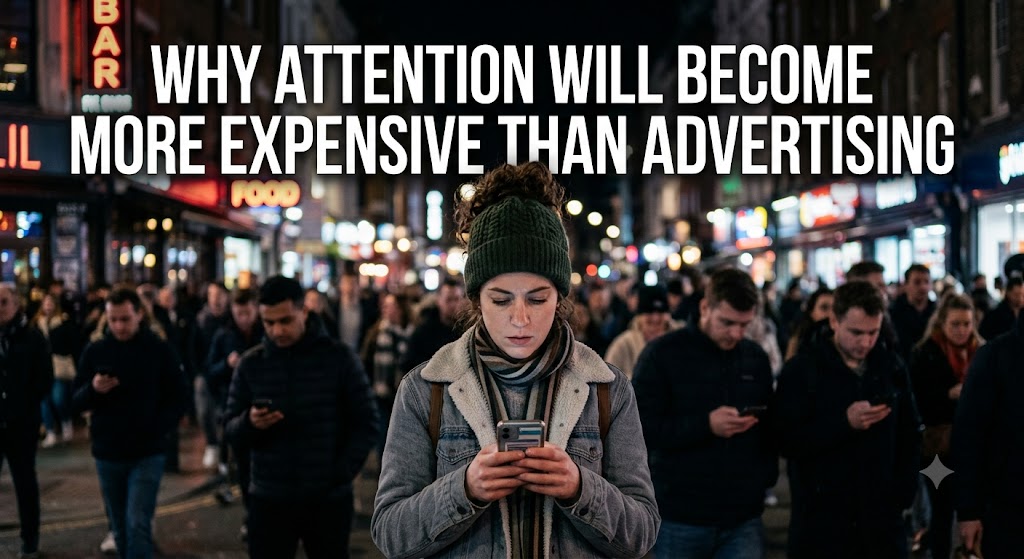
Why Attention Will Become More Expensive Than Advertising
For decades, businesses believed that advertising was the most valuable investment they could make. Companies competed to buy television commercials, newspaper spaces, radio airtime, billboards, magazine pages, and eventually digital advertisements. Whoever spent the most money often enjoyed the greatest visibility. Advertising became the engine that drove sales, shaped public opinion, and introduced new products to millions of people. It was simple. If people saw your message enough times, there was a good chance they would eventually buy your product.
That era is rapidly changing. Today, the real challenge is no longer finding places to advertise. Instead, it is finding people who are actually paying attention. The internet has made advertising cheaper, faster, and more accessible than ever before. Anyone with a smartphone can launch an advertising campaign within minutes. Social media platforms allow businesses of every size to reach audiences across the world without owning television stations or newspapers. While this sounds like an advantage, it has created an unexpected problem. Advertising has become abundant, but genuine human attention has become incredibly scarce.
Every day, the average person wakes up to dozens of notifications before even getting out of bed. Emails compete for immediate responses. Messaging applications constantly vibrate. News alerts interrupt conversations. Social media feeds refresh endlessly with new videos, photographs, opinions, advertisements, and entertainment. Streaming services recommend more content than anyone could possibly consume. Search engines produce millions of results within seconds. Every application, website, and platform is competing for the same limited resource. That resource is not money. It is attention.
Unlike money, attention cannot be borrowed, printed, manufactured, or expanded. Every human being receives exactly twenty four hours each day. Sleep consumes a large portion of those hours. Work, family, education, commuting, eating, and personal responsibilities consume most of the rest. Whatever remains becomes the battleground where companies, creators, influencers, media organisations, educators, politicians, and advertisers compete relentlessly. Since time itself cannot be increased, attention becomes more valuable every year.
This explains why businesses are beginning to change the way they think about marketing. Instead of asking how much advertising they can buy, they are asking how much genuine attention they can earn. These are two completely different questions. Buying advertising space does not guarantee that anyone will actually notice it. A person can scroll past hundreds of advertisements within minutes without consciously remembering a single one. The advertisement technically reached the audience, but it never captured their attention.
Human psychology has always favoured novelty. Our brains naturally notice things that are surprising, emotional, useful, entertaining, or personally relevant. In earlier generations, these moments were relatively rare. Today they are everywhere. Every platform is filled with creators trying to produce something more shocking than the last person. Every headline competes to become more dramatic. Every thumbnail becomes brighter. Every video becomes faster. Every advertisement attempts to interrupt rather than simply inform. As competition intensifies, attention becomes increasingly difficult to capture.
This growing scarcity explains why successful businesses are investing heavily in understanding consumer behaviour rather than simply increasing advertising budgets. They recognise that people are becoming experts at ignoring promotional messages. Banner blindness has become common. Many internet users automatically overlook anything that resembles an advertisement. Others install software specifically designed to block advertisements entirely. Subscription services increasingly remove advertisements in exchange for monthly payments. Consumers are literally paying money to avoid advertising. This simple fact demonstrates how dramatically the market has shifted.
The companies that continue to thrive are those that understand the difference between interruption and attraction. Interruption forces itself into someone’s experience. Attraction earns permission to be noticed. Educational videos, useful articles, entertaining stories, practical tools, engaging communities, and memorable customer experiences all attract attention rather than interrupting it. Businesses that consistently create value become destinations instead of distractions.
This transformation has given rise to what many economists describe as the attention economy. In this economy, success depends less on producing information and more on becoming the information that people willingly choose to consume. Information itself is no longer scarce. Every topic imaginable already exists somewhere online. Millions of articles explain personal finance. Thousands of videos teach photography. Countless podcasts discuss business, health, technology, and relationships. Since information has become abundant, attention naturally becomes the scarce commodity.
The implications of this shift extend far beyond marketing departments. Entire industries are reorganising themselves around attention. Technology companies measure user engagement more carefully than ever before. Social media platforms continuously refine algorithms designed to maximise viewing time. Streaming services analyse viewing habits to recommend increasingly personalised content. Online retailers study browsing behaviour to improve customer experiences. Every second of attention becomes measurable, valuable, and highly contested.
Content creators have recognised this reality as well. Years ago, simply publishing information online was enough to attract readers. Today, quality alone is often insufficient. Excellent content that nobody notices creates little value. This does not mean quality has become unimportant. Instead, quality must now be combined with effective communication, strong storytelling, emotional connection, and strategic distribution. Attention rarely arrives automatically. It must be earned through relevance and consistency.
Businesses frequently misunderstand this principle by assuming louder messages automatically produce better results. They increase advertising budgets, publish more content, and flood social media with promotional material. Unfortunately, volume often creates diminishing returns. Consumers become overwhelmed and begin ignoring everything. The result is more spending with lower effectiveness. This explains why some small businesses with modest budgets consistently outperform much larger competitors. They focus on building genuine relationships instead of merely increasing exposure.
Trust plays a central role in this new environment. Attention follows credibility. When people trust a brand, they willingly spend time listening to it. When trust disappears, even expensive advertising campaigns struggle to generate meaningful engagement. Reputation therefore becomes an invisible asset that compounds over time. Every positive customer experience increases future attention. Every broken promise reduces it.
The rise of personal branding demonstrates this principle perfectly. Many entrepreneurs have discovered that audiences increasingly connect with individuals rather than corporations. People enjoy following authentic personalities who consistently share valuable insights, experiences, and ideas. Over time, these individuals accumulate something far more valuable than advertising reach. They build sustained attention based on trust. Whenever they launch a product, publish a book, recommend a service, or introduce a business, people are already paying attention because the relationship has been established long before any transaction occurs.
Education has also become one of the most powerful methods of attracting attention. Consumers appreciate businesses that help them solve problems before asking for purchases. Articles, tutorials, webinars, podcasts, newsletters, and practical guides position organisations as trusted advisors rather than aggressive salespeople. By consistently providing value, businesses gradually earn the attention that traditional advertising increasingly struggles to purchase.
Another important factor driving attention scarcity is technological convenience. Artificial intelligence can now generate articles, videos, images, advertisements, and marketing campaigns within minutes. Content production, once expensive and time consuming, has become dramatically easier. As production costs continue falling, the amount of available content will increase exponentially. However, human attention will not increase alongside it. The imbalance between content supply and available attention will continue widening, making attention even more expensive.
This creates an interesting paradox. The easier it becomes to create content, the harder it becomes for any individual piece of content to stand out. Businesses may celebrate lower production costs, but they must also recognise that competitors enjoy the same advantages. When everyone can publish instantly, publishing itself no longer creates competitive advantage. Distinction comes from originality, credibility, usefulness, consistency, and emotional resonance.
Consumer expectations are evolving as well. People increasingly expect personalised experiences. Generic advertising messages often fail because they speak to everyone and therefore resonate with almost no one. Audiences prefer recommendations tailored to their interests, behaviours, and circumstances. Businesses capable of delivering personalised value earn deeper attention than those relying on mass communication alone.
Perhaps the most overlooked aspect of attention is that it cannot be permanently owned. Every day begins with a fresh competition. Yesterday’s viral campaign guarantees nothing today. Last year’s successful product launch does not ensure future relevance. Even globally recognised brands must continually earn public interest. Attention is temporary, fragile, and constantly shifting. This reality forces businesses to prioritise continuous value creation rather than relying on past achievements.
History provides countless examples of once dominant companies that assumed public attention would remain indefinitely. Many failed to adapt as consumer behaviour changed. Others underestimated new competitors who understood emerging platforms better than established organisations. The lesson remains consistent across industries. Attention follows relevance, not reputation alone.
As younger generations become the dominant consumer demographic, this trend will accelerate even further. Digital natives have grown up surrounded by unlimited information. They possess remarkable abilities to filter irrelevant content almost instantly. They quickly recognise insincere marketing, exaggerated claims, and repetitive promotional tactics. Winning their attention requires authenticity, transparency, entertainment, education, and genuine value rather than sheer advertising expenditure.
The companies that understand this shift are already changing how they measure success. Instead of focusing only on impressions, clicks, or advertising reach, they are paying closer attention to engagement, retention, customer loyalty, referral rates, repeat purchases, and community growth. These measurements reveal something far more valuable than temporary visibility. They reveal whether people actually care. Attention without interest disappears quickly, but attention combined with trust often develops into long term relationships that produce value for both businesses and customers.
This is why communities have become one of the strongest competitive advantages in the modern economy. A loyal community voluntarily gives its attention because it feels connected to a shared purpose, identity, or mission. Whether it is a technology company, a sports club, a musician, a financial educator, or an online entrepreneur, communities create an environment where attention is earned rather than purchased. Members return repeatedly because they receive value beyond products or services. They feel seen, heard, and included.
The creator economy illustrates this transformation remarkably well. Many independent creators now compete successfully against large media organisations with enormous advertising budgets. They do not necessarily have more money, but they possess something more valuable. They have the consistent attention of audiences who willingly watch their videos, read their newsletters, listen to their podcasts, or follow their recommendations. That attention eventually becomes revenue through sponsorships, digital products, memberships, consulting, merchandise, affiliate partnerships, and direct customer support. The attention came first. The money followed afterwards.
This pattern repeats itself across nearly every successful digital business. People rarely buy from strangers immediately. They buy from people or organisations that have earned their confidence over time. Every helpful article, every informative video, every thoughtful email, every useful social media post, and every excellent customer interaction becomes another small investment in future attention. Eventually those small investments accumulate into a reputation that advertising alone could never purchase.
Attention also influences innovation. Businesses that truly understand their audiences are better positioned to recognise emerging needs before competitors. By paying attention to conversations, complaints, preferences, and behaviours, they discover opportunities that traditional market research sometimes misses. Listening becomes just as important as speaking. Companies that spend all their resources broadcasting messages while ignoring customer feedback often find themselves disconnected from the market they hope to serve.
Another reason attention will continue becoming more expensive is the increasing sophistication of consumers. Modern buyers conduct extensive research before making important decisions. They compare reviews, watch demonstrations, seek recommendations, read testimonials, and investigate brands across multiple platforms. This means businesses must maintain credibility everywhere customers might look. A single advertisement is no longer enough. Every interaction contributes to the overall impression that determines whether attention is maintained or lost.
Artificial intelligence will make this challenge even greater. As AI tools become more accessible, the internet will experience an unprecedented explosion of content. Articles, videos, images, podcasts, newsletters, and advertisements will be produced at a speed that was unimaginable only a few years ago. Quantity will no longer be impressive because almost everyone will have access to similar production capabilities. Authentic human insight, original experiences, trustworthy opinions, and genuine expertise will become increasingly valuable because they cannot be mass produced in the same way.
This future places greater importance on authenticity than ever before. Consumers are becoming increasingly skilled at recognising content that exists purely to attract clicks without delivering meaningful value. Sensational headlines may capture a moment of curiosity, but disappointment quickly destroys trust. Businesses that repeatedly overpromise and underdeliver gradually lose the attention they worked so hard to gain. In contrast, organisations that consistently meet or exceed expectations create a positive cycle where satisfied customers voluntarily recommend them to others.
Word of mouth has always been powerful, but digital communication has multiplied its influence dramatically. One positive experience can be shared with thousands of people within minutes. One negative experience can spread just as quickly. Every customer therefore becomes a potential advertiser, whether intentionally or not. Businesses that invest in remarkable experiences effectively transform their customers into ambassadors who attract new attention without additional advertising expenditure.
Attention also affects recruitment. Talented professionals increasingly want to work for organisations they respect and admire. Companies with strong reputations attract higher quality applicants because they already possess public attention and credibility. This reduces hiring costs, improves organisational culture, and strengthens long term performance. Once again, attention proves valuable far beyond marketing alone.
Investors have also begun recognising attention as an economic asset. Businesses with highly engaged audiences often receive stronger valuations because investors understand that sustained attention creates future revenue opportunities. An organisation that consistently commands public interest possesses flexibility. It can introduce new products, expand into new markets, launch new services, or form strategic partnerships more easily because people are already listening.
The education industry provides another excellent example. Traditional educational institutions once controlled access to knowledge. Today, countless experts teach online through courses, newsletters, videos, live events, and communities. Students increasingly choose educators who have earned their attention through consistent value rather than institutional prestige alone. This demonstrates how attention can reshape even industries that seemed stable for generations.
Small businesses should find this trend encouraging rather than intimidating. Attention does not always favour the largest organisation. It often rewards the most relevant one. A local business that genuinely understands its customers may earn stronger loyalty than an international corporation relying solely on advertising. Personal relationships, responsive communication, and authentic service frequently outperform expensive promotional campaigns.
Entrepreneurs should therefore think differently about every piece of content they publish. Instead of asking whether it will generate immediate sales, they should ask whether it deserves someone’s limited attention. Does it solve a problem? Does it answer an important question? Does it educate, inspire, entertain, or simplify life in some meaningful way? Content created with these questions in mind is more likely to build lasting trust than content designed only to promote products.
The same principle applies to individuals building careers. In today’s professional world, attention often precedes opportunity. People who consistently demonstrate expertise through thoughtful writing, public speaking, educational videos, research, or meaningful contributions become visible to employers, clients, collaborators, and investors. Their reputation travels ahead of them, creating opportunities that may never appear on traditional job boards or recruitment platforms.
The future will almost certainly reward people who become trusted sources rather than constant advertisers. Trust reduces uncertainty, and reducing uncertainty has immense economic value. Whether someone is purchasing software, hiring an employee, choosing a consultant, selecting a financial adviser, or buying everyday products, trust simplifies decisions. Attention naturally follows trusted voices because they reduce the effort required to evaluate countless alternatives.
There is also an ethical dimension to the attention economy that deserves consideration. Businesses face an important choice. They can design strategies that manipulate human psychology to maximise screen time regardless of personal wellbeing, or they can use attention responsibly by creating genuinely beneficial experiences. The organisations that balance commercial success with customer wellbeing are more likely to enjoy sustainable growth because trust remains intact over many years.
Looking ahead, attention may become one of the world’s most expensive economic resources. Businesses will continue spending billions of pounds and dollars attempting to capture it, yet only a small percentage will succeed consistently. Those that understand human behaviour, prioritise value creation, communicate honestly, and build meaningful relationships will possess advantages that cannot easily be copied by competitors with larger advertising budgets.
Advertising itself will not disappear. It will continue playing an important role in introducing products, announcing innovations, and reaching new audiences. However, advertising will increasingly serve as an invitation rather than the entire strategy. Once attention has been captured, businesses must justify it through quality, integrity, usefulness, and exceptional customer experiences. The advertisement opens the door, but sustained attention determines whether people choose to stay.
Ultimately, the future belongs to organisations and individuals who recognise that every moment of someone’s attention is a privilege rather than an entitlement. People are surrounded by endless choices, constant interruptions, and unlimited information. The brands that succeed will be those that respect this reality by creating experiences worth remembering instead of simply demanding to be noticed.
The question is no longer who can spend the most on advertising. The more important question is who can consistently earn the trust, curiosity, loyalty, and attention of people living in an increasingly distracted world. Those who answer that question successfully will possess one of the most valuable competitive advantages of the twenty first century. As technology continues to make content easier to produce and advertising easier to buy, genuine human attention will only become rarer, more valuable, and ultimately more expensive than advertising itself.

EarnSmartOnline.com.ng is dedicated to helping readers make smarter financial decisions through practical guides on online income, personal finance, technology, digital business, and wealth creation. Our goal is to provide reliable, easy-to-understand, and actionable content that empowers individuals to earn smarter, build sustainable income streams and achieve long-term financial success.
Recommended: Start Earning Online
- Ultimate Affiliate Marketing Program — learn affiliate marketing with a done-for-you sales system ($15). Check it out
- The Newbie Affiliate Guide — the beginner-friendly starter guide (~$6.68). Check it out
- Easy Dollar Maker — earn in dollars uploading AI images and videos from your phone ($17). Check it out
Disclosure: These are affiliate links. If you buy through them, I may earn a commission at no extra cost to you.



