
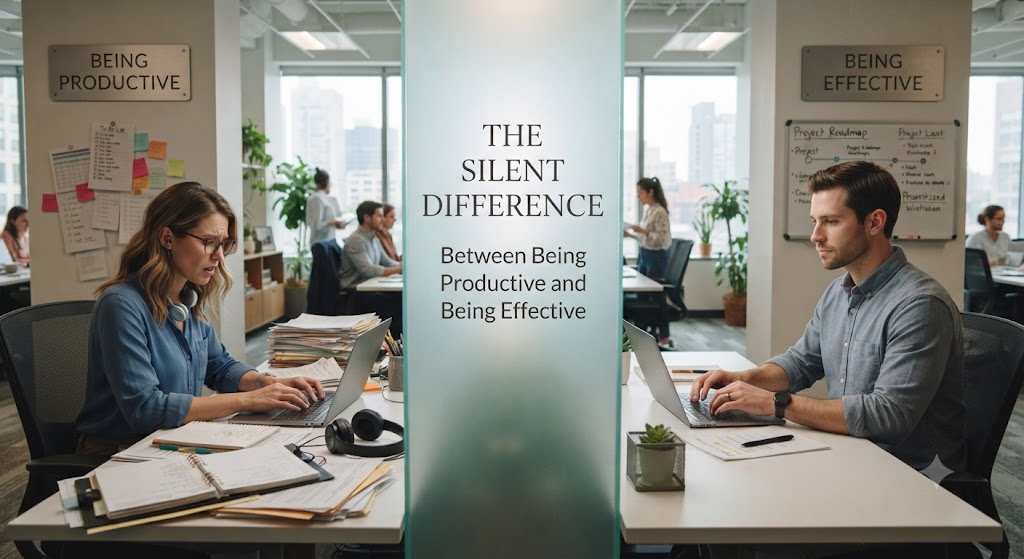
The Silent Difference Between Being Productive and Being Effective
The Silent Difference Between Being Productive and Being Effective is one of the most overlooked concepts in personal development, career growth, and business success. Many people proudly describe themselves as productive because they stay busy throughout the day. Their schedules are packed with meetings, emails, phone calls, errands, and endless tasks. By the time they go to bed, they are exhausted and convinced they have accomplished a great deal. Yet when they look back after several months or even years, they realize that very little has actually changed. Their income remains the same, their business has not grown significantly, and the goals they set for themselves remain untouched. This is where the silent difference between being productive and being effective begins to reveal itself.
Productivity is often measured by the amount of work completed. Effectiveness, on the other hand, is measured by the value and impact of the work completed. A person can answer one hundred emails in a single day and still fail to secure a single new client. Another person may answer only five carefully selected emails that lead to profitable partnerships worth thousands of dollars. The first person was productive, while the second person was effective. The difference may seem small in the moment, but over time it creates completely different results.
Modern society often rewards visible activity. People admire those who appear constantly busy because busyness has become a symbol of importance. Many professionals wear long working hours like a badge of honor, believing that the more time they spend working, the more successful they will become. Unfortunately, this belief has caused countless individuals to confuse movement with progress. Being constantly occupied does not necessarily mean you are moving closer to your goals. In many cases, it simply means you have become skilled at staying busy.
One of the biggest reasons people struggle with effectiveness is the endless stream of distractions competing for their attention. Smartphones vibrate every few minutes, social media platforms constantly demand engagement, emails arrive every hour, and messaging applications interrupt concentration repeatedly throughout the day. Each interruption may seem harmless, but together they fragment attention and make it difficult to focus on meaningful work. A person may complete dozens of small tasks without making meaningful progress on the one project capable of transforming their career or business.
The silent difference between being productive and being effective also becomes obvious when priorities are examined. Productive people usually create long to-do lists filled with tasks of varying importance. They feel satisfied each time another item is checked off. Effective people ask a different question before they begin any task. They ask whether completing that activity will move them significantly closer to their desired outcome. If the answer is no, they either postpone it, delegate it, automate it, or eliminate it altogether. This simple habit allows them to invest more time where it produces the greatest return.
Consider two entrepreneurs launching online businesses. The first spends weeks perfecting logos, choosing fonts, redesigning websites, changing color schemes, and tweaking every visual detail. The second focuses on understanding customer needs, creating valuable products, building marketing systems, and attracting paying clients. Both appear busy, but only one is directing effort toward activities that generate revenue. Months later, the second entrepreneur has a thriving business while the first is still making cosmetic improvements. Productivity without effectiveness creates the illusion of progress without the reality of success.
This pattern extends far beyond business. Students often spend countless hours highlighting textbooks, rewriting notes, and organizing study materials without truly understanding the subject. Meanwhile, another student practices solving problems, reviews mistakes, and focuses on concepts most likely to appear during examinations. Both students invest time, but only one uses time effectively. The outcome usually reflects this difference.
The workplace offers another clear example. Employees frequently measure performance by how many hours they spend in the office. Some arrive early, leave late, and rarely take breaks. Yet much of that time disappears into unnecessary meetings, repetitive administrative tasks, and constant interruptions. Another employee may work fewer hours but concentrates intensely on projects that directly improve revenue, customer satisfaction, or operational efficiency. Managers who understand effectiveness recognize that results matter far more than appearances.
One reason effectiveness is difficult to master is that meaningful progress often feels less exciting than constant activity. Deep work requires concentration, patience, and sustained effort. It involves saying no to distractions and resisting the temptation to chase every new opportunity. Busy work provides immediate satisfaction because tasks are completed quickly and visibly. Effective work often takes longer before results become noticeable, but the eventual rewards are significantly greater.
Technology has made this challenge even more complex. Productivity apps, digital calendars, task managers, and collaboration platforms promise to help people accomplish more. While these tools can certainly improve organization, they cannot decide which tasks deserve attention. An organized schedule filled with low-value activities remains a low-value schedule. Technology amplifies existing habits rather than replacing thoughtful decision-making. Effectiveness always begins with choosing the right work before attempting to complete it efficiently.
Another silent trap is the tendency to equate effort with achievement. Many people believe working harder automatically guarantees better results. While effort remains important, direction determines whether that effort produces meaningful outcomes. Walking ten miles in the wrong direction requires tremendous energy but never brings you closer to your destination. Similarly, investing countless hours in activities that do not contribute to your long-term objectives simply wastes valuable time and resources.
Highly successful individuals often appear surprisingly selective with their time. They understand that every commitment carries an opportunity cost. Saying yes to one activity automatically means saying no to something else. Because time cannot be recovered once spent, effective people guard it carefully. They recognize that their greatest asset is not money but attention. Wherever attention consistently flows, results eventually follow.
The silent difference between being productive and being effective ultimately shapes every area of life. Careers, businesses, finances, relationships, and personal growth all depend not merely on how much work is completed but on whether that work truly matters. Those who learn to distinguish between activity and impact gain an enormous advantage because they stop measuring success by exhaustion and begin measuring it by meaningful progress. Instead of asking how much they accomplished today, they ask a far more powerful question: did today’s work bring me closer to the future I want to create? That single question has the power to transform ordinary effort into extraordinary results.
Many people discover this lesson only after years of frustration. They work harder than everyone around them, sacrifice weekends, skip vacations, and spend countless late nights chasing success. Despite their commitment, the breakthrough never comes. Eventually, they begin to question their abilities when the real problem was never a lack of effort. It was a lack of effectiveness. Hard work without direction is like pouring water into a bucket full of holes. No matter how much is added, very little remains.
One of the clearest signs that someone is productive but not effective is the constant feeling of being overwhelmed. Their calendar is packed, their inbox is overflowing, and their task list never seems to get shorter. Every completed task is immediately replaced by three more. They live in a cycle of endless activity that leaves them mentally exhausted but emotionally unfulfilled. Effective people also experience busy seasons, but they regularly pause to evaluate whether their daily actions still align with their long-term vision. They understand that stopping to think is often more valuable than rushing to act.
Successful organizations understand this principle exceptionally well. Companies that survive for decades rarely try to do everything. Instead, they identify the few activities that produce the greatest value and devote most of their resources to those priorities. Businesses that attempt to serve everyone often end up serving no one particularly well. The same principle applies to individuals. Trying to master every skill, attend every event, follow every trend, and seize every opportunity usually leads to average results across the board. Excellence often requires deliberate exclusion.
Another overlooked aspect of effectiveness is the willingness to measure outcomes honestly. Productive people frequently celebrate completing tasks without asking whether those tasks produced meaningful results. Effective people evaluate performance differently. They ask whether the work increased revenue, improved customer satisfaction, strengthened relationships, expanded knowledge, or moved them measurably closer to a clearly defined objective. If the answer is no, they are willing to change their approach instead of repeating the same routine.
This mindset requires courage because effectiveness often demands letting go of familiar habits. Many routines feel comfortable simply because they are familiar, not because they are useful. A professional may spend hours attending meetings that contribute little to decision making because that has always been the company culture. An entrepreneur may spend every morning checking social media statistics instead of improving products or serving customers because instant feedback feels rewarding. These habits create an illusion of accomplishment while quietly stealing time from truly valuable work.
Learning to distinguish between important work and urgent work can dramatically improve effectiveness. Urgent tasks demand immediate attention, but they are not always significant. Important tasks contribute to meaningful long-term outcomes even if they lack immediate deadlines. Writing a business plan, learning a valuable skill, investing in personal development, strengthening family relationships, or improving physical health may not seem urgent today, yet neglecting them often produces serious consequences in the future. Effective people consistently make time for important activities before they become emergencies.
Another characteristic of effective individuals is their willingness to delegate. Many people believe they must personally handle every responsibility to ensure quality. While this mindset may appear responsible, it often limits growth. Time spent performing low-value tasks cannot be invested in high-value thinking, planning, innovation, or leadership. Delegation is not about avoiding work. It is about ensuring that each person focuses on activities where they create the greatest impact.
Reflection also separates effectiveness from mere productivity. At the end of each week, highly effective individuals often review their progress. They examine what worked well, what wasted time, what unexpected opportunities appeared, and what should change moving forward. This simple practice prevents them from repeating ineffective patterns for months or years. Productivity without reflection easily becomes repetition, while effectiveness grows stronger through continuous learning.
Patience is another essential ingredient. Meaningful achievements rarely happen overnight. Building a successful business, developing expertise, earning trust, or creating financial independence requires consistent effort directed toward worthwhile objectives. Many people abandon effective strategies simply because visible results take time. They return to busy work because it provides immediate gratification. Unfortunately, immediate gratification rarely produces lasting success.
The silent difference between being productive and being effective becomes even more important in an age where information is unlimited. Every day people consume articles, videos, podcasts, online courses, newsletters, and social media content. Learning is valuable, but knowledge alone creates little change. Effectiveness begins when information is transformed into consistent action. A single lesson applied consistently often produces greater results than hundreds of ideas stored in notebooks and never used.
Relationships also benefit from this principle. Spending hours with family while constantly checking a phone is productive in the sense that time was technically spent together. Giving complete attention during a meaningful conversation is effective because it strengthens trust and emotional connection. Quality frequently outweighs quantity. The same truth applies to friendships, leadership, parenting, and professional networking.
Financial success offers another powerful illustration. Some people constantly search for new ways to earn more money while ignoring unnecessary spending, poor investment decisions, or the absence of long-term planning. They remain busy chasing additional income without addressing the behaviors preventing wealth from accumulating. Others focus on building systems that increase value, protect assets, and create sustainable financial growth. Both groups expend effort, but only one consistently moves toward lasting prosperity.
Ultimately, effectiveness is less about doing more and more about doing what matters most. It demands clarity, discipline, self-awareness, and the humility to admit when current methods are not producing desired results. It requires resisting distractions, protecting attention, and focusing energy where it creates the greatest return. These habits may appear ordinary on a daily basis, but over the course of years they separate those who merely stay busy from those who build meaningful lives.
The silent difference between being productive and being effective is not always visible in a single day, a single week, or even a single month. Its power reveals itself through time. Small decisions made consistently compound into extraordinary outcomes. Every meaningful accomplishment begins with choosing the right priorities before investing effort. Once that distinction becomes clear, work takes on a different purpose. Success is no longer measured by the number of tasks completed but by the significance of the results achieved. Those who master this principle stop chasing the satisfaction of being busy and begin experiencing the fulfillment that comes from making genuine progress. In the end, effectiveness is not about working less or working more. It is about making every hour count toward a future that truly matters.

EarnSmartOnline.com.ng is dedicated to helping readers make smarter financial decisions through practical guides on online income, personal finance, technology, digital business, and wealth creation. Our goal is to provide reliable, easy-to-understand, and actionable content that empowers individuals to earn smarter, build sustainable income streams and achieve long-term financial success.
Recommended: Start Earning Online
- Ultimate Affiliate Marketing Program — learn affiliate marketing with a done-for-you sales system ($15). Check it out
- The Newbie Affiliate Guide — the beginner-friendly starter guide (~$6.68). Check it out
- Easy Dollar Maker — earn in dollars uploading AI images and videos from your phone ($17). Check it out
Disclosure: These are affiliate links. If you buy through them, I may earn a commission at no extra cost to you.



