
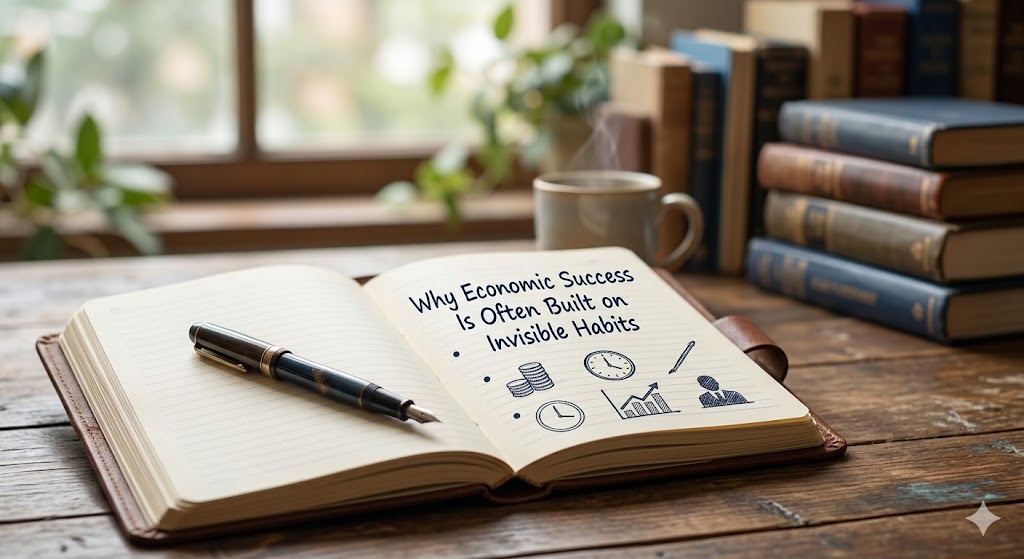
Why Economic Success Is Often Built on Invisible Habits
Most people look at economic success and assume it is something loud, visible, and dramatic. They imagine sudden breakthroughs, big opportunities, viral moments, or lucky connections that change everything overnight. What they rarely consider is that the real foundation of economic success is usually quiet. It is built in routines that do not look impressive, decisions that do not feel significant at the time, and behaviors so ordinary that they are easy to ignore. Yet over time, these invisible habits compound into outcomes that look like luck from the outside.
Invisible habits are the small patterns of behavior you repeat without thinking. They are not the things you announce or post about. They are the things you do when nobody is watching, when there is no pressure to perform, and when there is no immediate reward. Economic success is deeply tied to these patterns because money responds more to consistency than intensity. A single powerful action might create attention, but it is repeated behavior that creates stability and growth.
One of the most powerful invisible habits behind economic success is how people manage their attention. Attention is the first currency before money ever appears. Where you consistently focus your mind determines what skills you develop, what problems you notice, and what opportunities you are even capable of seeing. People who eventually become economically successful often have a habit of directing their attention toward useful things even when it is uncomfortable. They read when others scroll endlessly. They observe systems instead of just outcomes. They ask questions instead of accepting assumptions. Over time, this habit quietly separates them from those who are always distracted but never directed.
Another invisible habit is how people respond to discomfort. Economic progress almost always requires doing things that feel slightly difficult at first. Learning new skills, improving financial discipline, or building something valuable all involve moments of resistance. Many people avoid this resistance automatically. But those who succeed financially often develop a subtle habit of staying with discomfort just a little longer than everyone else. They do not necessarily enjoy it, but they tolerate it without immediately escaping into distraction. This tolerance slowly expands their capacity for growth, and over time, their capacity becomes an economic advantage.
There is also the invisible habit of delayed gratification. This is not just about saving money. It is about training the mind to prioritize future stability over immediate comfort. People who build long-term economic success often make small daily sacrifices that seem insignificant in the moment. They choose to reinvest instead of spending. They choose to improve a skill instead of seeking entertainment. They choose to build something that takes time instead of chasing something that gives quick satisfaction. None of these decisions feel dramatic individually, but together they reshape their financial trajectory.
Another habit that operates quietly is how people handle information. Some individuals consume information randomly based on entertainment or emotional triggers. Others develop the habit of consuming information with intention. They look for knowledge that improves decision-making, not just content that fills time. Over years, this habit creates a difference in thinking quality. Better thinking leads to better decisions, and better decisions naturally lead to better economic outcomes. The gap between people is not always in intelligence but often in the quality of information they repeatedly expose themselves to.
Economic success is also strongly influenced by the invisible habit of execution speed. Many people have ideas, but very few develop the habit of acting on those ideas quickly and consistently. Execution is not about rushing blindly. It is about reducing the delay between thought and action. People who build economic momentum often do small things immediately instead of postponing them. They send the message, start the project, test the idea, or make the call without overthinking for too long. This habit builds a bias toward action, and over time, that bias produces more results than hesitation ever could.
There is also a quiet habit around how people treat money itself. Some people see money as something emotional, something to be enjoyed or feared depending on circumstances. Others develop the habit of treating money as a tool that must be managed with structure. They track it, understand it, and assign it purpose. They do not necessarily obsess over it, but they do not ignore it either. This subtle habit of awareness creates clarity. And financial clarity reduces mistakes that silently destroy wealth over time.
Another invisible habit is how people evaluate opportunities. Many people react emotionally to opportunities, focusing on excitement or urgency. But those who achieve economic success often develop the habit of pausing just enough to assess value properly. They ask what problem is being solved, what the long term return looks like, and whether the opportunity aligns with their skills or direction. This does not mean they never take risks, but their risks are informed rather than impulsive. Over time, this habit reduces costly errors and increases the probability of meaningful gains.
The habit of consistency is perhaps the most underestimated invisible force. Most people can perform well occasionally, but economic success tends to reward those who perform adequately on a consistent basis. Consistency builds trust, skill, and momentum. A person who improves even slightly every day eventually becomes significantly different from who they were at the beginning. But consistency is rarely glamorous. It does not feel exciting in the moment. That is why it is often invisible, yet it shapes everything in the long run.
Another important habit is how people deal with failure. Many individuals see failure as a stopping point or a sign to quit. But economically successful people often develop a habit of treating failure as feedback. They analyze what went wrong, adjust their approach, and continue. This does not mean they enjoy failure, but they do not allow it to define their direction. Over time, this habit builds resilience, and resilience is one of the strongest predictors of long-term economic progress.
Invisible habits also show up in how people communicate. Those who succeed economically often develop the habit of clear and purposeful communication. They learn to express ideas in ways that others can understand easily. They avoid unnecessary complexity and focus on clarity. This improves relationships, builds trust, and opens doors to collaboration and opportunity. Communication skill is not always loud or obvious, but it quietly determines how far ideas can travel.
Another subtle habit is how people manage their environment. Some individuals unconsciously place themselves in environments that reinforce distraction and short-term thinking. Others gradually develop the habit of structuring their environment to support growth. They surround themselves with people who think differently, they reduce exposure to constant distraction, and they place themselves in situations that encourage better decisions. Over time, environment shapes behavior, and behavior shapes outcomes.
Economic success is also tied to the invisible habit of learning from observation. Many people go through life reacting to events, but not studying them. Those who become successful often develop the habit of watching patterns carefully. They notice what works in their field, what fails, and why certain people succeed. This observational habit allows them to avoid repeating common mistakes and to identify opportunities earlier than others.
There is also the habit of self-accountability. Some people constantly shift responsibility outward, blaming circumstances or others for their situation. Others quietly develop the habit of looking inward first. They ask what they could have done differently, what they can improve, and what role they played in the outcome. This habit is powerful because it creates control. And control, even in small amounts, is the foundation of economic progress.
Over time, all these invisible habits begin to stack. At first, the difference between someone who practices them and someone who does not may seem small. But compounding does not respect short-term perception. It rewards repetition. After a few years, the gap becomes noticeable. After a decade, it becomes significant. And eventually, what once looked like external success is revealed to be the result of internal patterns that were repeated quietly for a long time.
What makes invisible habits so powerful is that they do not require extraordinary circumstances. They do not depend on luck or timing. They depend on repetition, awareness, and small decisions made consistently over time. This means anyone can begin building them, but very few people actually do, because the rewards are not immediate.
Economic success is often misunderstood as something that happens to people. In reality, it is something people slowly build without fully realizing it. The building blocks are not always visible, but they are always present. They exist in how you think, how you respond, how you act, and how you persist when nothing seems to be happening.
In the end, what separates those who achieve economic success from those who struggle is not a single breakthrough moment. It is the accumulation of invisible habits that quietly shape direction long before results become visible.

EarnSmartOnline.com.ng is dedicated to helping readers make smarter financial decisions through practical guides on online income, personal finance, technology, digital business, and wealth creation. Our goal is to provide reliable, easy-to-understand, and actionable content that empowers individuals to earn smarter, build sustainable income streams and achieve long-term financial success.
Recommended: Start Earning Online
- Ultimate Affiliate Marketing Program — learn affiliate marketing with a done-for-you sales system ($15). Check it out
- The Newbie Affiliate Guide — the beginner-friendly starter guide (~$6.68). Check it out
- Easy Dollar Maker — earn in dollars uploading AI images and videos from your phone ($17). Check it out
Disclosure: These are affiliate links. If you buy through them, I may earn a commission at no extra cost to you.



