
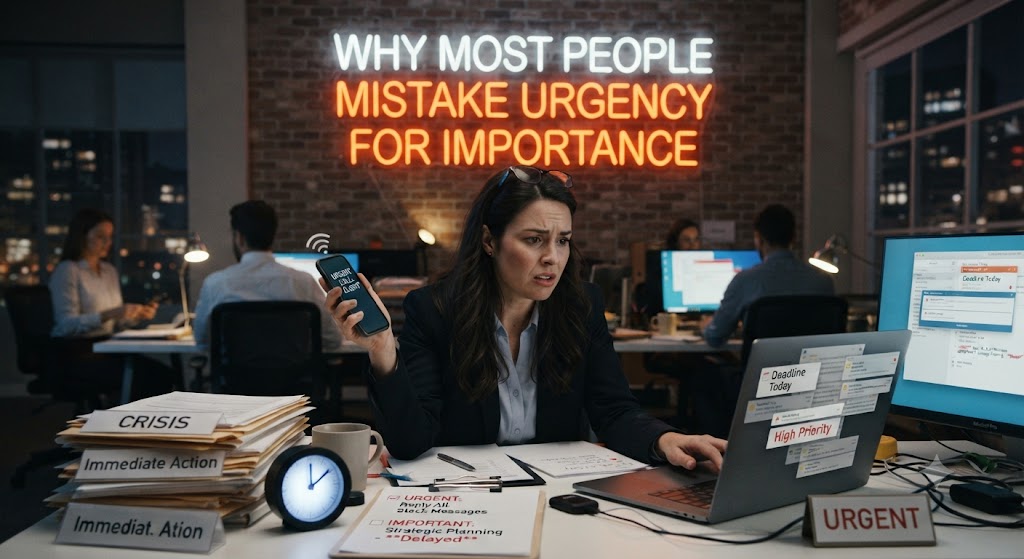
Why Most People Mistake Urgency for Importance
Have you ever ended a busy day feeling exhausted yet strangely unfulfilled? You answered dozens of messages, attended meetings, responded to emails, handled unexpected requests, and solved countless small problems, yet the one thing that truly mattered remained untouched. This experience is far more common than most people realize, and it highlights a dangerous habit that quietly steals productivity, peace of mind, and long term success. Why most people mistake urgency for importance is rooted in the way the human brain reacts to immediate demands. We naturally respond to whatever appears loudest, fastest, and closest, often without questioning whether it deserves our attention.
Urgency and importance are not the same thing, even though they frequently appear together. Urgent tasks demand immediate attention. They come with ringing phones, blinking notifications, approaching deadlines, and people asking for quick answers. Important tasks, on the other hand, contribute to your long term goals, personal growth, financial stability, health, relationships, and overall success. While urgent matters scream for attention, important matters often whisper. They rarely create panic, but they quietly determine the direction of your life.
One of the greatest mistakes people make is assuming that everything requiring immediate action is automatically valuable. This misunderstanding creates a cycle where people spend their lives reacting instead of creating. Every day becomes a race against the clock, leaving little room for planning, learning, improving, or building something meaningful. Eventually, they become experts at solving today’s emergencies while unknowingly creating tomorrow’s problems.
Modern technology has amplified this confusion. Smartphones, social media platforms, instant messaging applications, and constant email notifications have conditioned people to respond instantly. Every vibration feels important. Every notification appears urgent. Every incoming message interrupts concentration. Yet very few of these interruptions actually change the quality of your future. Most simply steal your attention for a few moments before disappearing, leaving behind fragmented focus and unfinished work.
Many workplaces unintentionally reward urgency over importance. Employees who answer emails within seconds may appear more productive than those who spend uninterrupted hours solving critical business challenges. Managers often praise quick responses while overlooking strategic thinking. As a result, people begin measuring productivity by how busy they appear rather than by the value they create. They confuse movement with progress and activity with achievement.
This mindset also affects personal life. Someone may spend hours replying to every message while postponing exercise, reading, family conversations, financial planning, or learning a valuable skill. The urgent tasks provide immediate satisfaction because they are completed quickly. Important tasks usually require patience, consistency, and delayed gratification. Since the human brain naturally enjoys quick rewards, it gravitates toward urgency even when importance deserves greater attention.
The difference becomes even clearer when examining successful individuals. People who consistently achieve remarkable results are rarely the busiest people in the room. Instead, they carefully protect their time. They understand that every yes to an unimportant urgent task often means saying no to something that truly matters. Their calendars reflect priorities rather than interruptions.
Imagine two business owners. The first spends every day answering phone calls, responding to every customer complaint personally, attending every meeting, and constantly putting out fires. The second invests time improving systems, training employees, analyzing market trends, strengthening customer relationships, and developing future products. The first appears incredibly busy, but the second is building a stronger business. Years later, the difference becomes obvious. One remains trapped inside daily emergencies while the other enjoys sustainable growth because importance received consistent attention.
The same principle applies to personal finances. Many people urgently seek ways to earn quick money whenever bills become overwhelming. Very few invest consistent time learning financial literacy, budgeting, investing, or building multiple income streams before emergencies arise. Because financial education rarely feels urgent, it gets postponed until circumstances force attention. Unfortunately, by then the consequences of neglect have already become expensive.
Health follows a similar pattern. Visiting a hospital after serious illness feels urgent. Exercising regularly, eating nutritious meals, sleeping well, and attending preventive medical checkups feel less urgent even though they are infinitely more important. People often ignore these simple habits until their bodies create an emergency they can no longer postpone. The lesson is painful but predictable. Importance ignored eventually transforms into urgency.
Relationships also suffer from this misunderstanding. Many people immediately answer work emails during family dinners but postpone meaningful conversations with loved ones because they believe there will always be another opportunity. Years pass quickly. Children grow older. Friendships weaken. Marriages become distant. Suddenly repairing damaged relationships becomes urgent because important moments were repeatedly sacrificed for temporary demands.
The psychology behind urgency is fascinating. Urgent situations activate the brain’s stress response. They create adrenaline, making people feel energized and productive. Completing urgent tasks provides immediate emotional satisfaction because the pressure disappears. Important work often lacks this emotional intensity. Writing a book, learning a language, exercising, studying, investing, building a business, or strengthening relationships may not provide instant excitement. Their rewards appear slowly through consistent effort over months or years.
This explains why procrastination frequently targets important work rather than urgent work. Students delay studying until examinations become urgent. Entrepreneurs postpone marketing until sales decline. Individuals ignore retirement planning until old age approaches. Homeowners neglect maintenance until expensive repairs become unavoidable. In each case, importance was visible from the beginning, but urgency eventually forced action.
Another reason people confuse urgency with importance is social pressure. Society often celebrates busyness. Saying “I am extremely busy” sometimes sounds impressive, suggesting ambition or success. Yet constant busyness may simply indicate poor prioritization. Truly productive people often appear calmer because they intentionally eliminate unnecessary distractions and protect time for meaningful work.
Learning to distinguish urgency from importance requires conscious effort. Every task should be evaluated by asking a simple question. Will this matter next week, next month, or next year? If the answer is yes, it is probably important. If the task merely demands immediate attention without contributing to long term goals, it may only be urgent. This small mental exercise gradually transforms decision making.
Planning ahead is one of the most effective ways to prevent important tasks from becoming urgent crises. People who schedule regular financial reviews rarely experience unexpected money emergencies. Those who consistently maintain their vehicles face fewer costly breakdowns. Businesses that regularly innovate avoid desperate attempts to survive changing markets. Prevention almost always costs less than emergency response.
The world’s greatest achievements were rarely accomplished through constant reaction. Scientific discoveries, successful companies, bestselling books, meaningful relationships, healthy lifestyles, and financial independence all emerged because someone consistently invested time in important work long before external pressure demanded it. Great success usually grows quietly beneath the surface before becoming visible to everyone else.
The challenge is that important activities often produce invisible progress during their early stages. Saving a small amount every month does not immediately create wealth. Reading ten pages each day does not instantly produce expertise. Exercising for one week does not dramatically transform physical health. Because results appear slowly, many people abandon these habits in favor of urgent activities that provide instant feedback. Yet the slow accumulation of important actions eventually produces extraordinary outcomes that urgent reactions alone can never achieve.
Every day presents a choice between reacting to whatever demands attention and intentionally investing in what truly matters. The choice may seem insignificant in the moment, but repeated thousands of times over many years, it determines the quality of your career, finances, health, relationships, and personal fulfillment. The people who consistently choose importance over urgency gradually build lives that appear effortless from the outside, even though their success was created through disciplined priorities rather than frantic activity.
The habit of prioritizing importance over urgency does not develop overnight. It requires changing the way you think about time itself. Most people see time as something to be filled, while successful people see time as something to be invested. Filling your day with tasks may make you feel accomplished, but investing your day in meaningful activities creates results that continue paying dividends long into the future. This subtle shift in perspective changes everything.
One practical way to develop this mindset is to begin every morning by identifying the few tasks that will have the greatest impact on your long term objectives. These tasks may not be the easiest, the quickest, or the most exciting, but they are the ones that move your life forward. Completing them before allowing yourself to be distracted by less important demands ensures that your highest priorities receive your best energy rather than whatever time remains at the end of the day.
It is also important to understand that not every urgent request deserves an immediate response. Many people have developed the habit of saying yes to every favor, every invitation, every meeting, and every request simply because they do not want to disappoint others. Unfortunately, every unnecessary commitment consumes time that could have been invested in something far more meaningful. Learning to politely decline activities that do not align with your goals is not selfish. It is responsible stewardship of your most valuable resource.
Another overlooked aspect of importance is preparation. Most emergencies are not completely unexpected. They often leave small warning signs that people ignore because dealing with them does not seem urgent. A leaking roof becomes a collapsed ceiling. A neglected budget becomes overwhelming debt. A minor disagreement becomes a broken relationship. A small health concern becomes a serious medical condition. Paying attention to these early warning signs allows you to solve problems while they are still manageable instead of waiting until they become crises.
History repeatedly demonstrates the power of focusing on important work before it becomes urgent. The strongest businesses prepare for economic downturns while profits are still high. The most successful athletes train intensely before competitions arrive. Wise investors build wealth long before retirement approaches. Exceptional students develop study habits throughout the school year rather than cramming the night before examinations. Preparation is rarely exciting, but it consistently separates those who thrive from those who merely survive.
There is also an emotional cost to constantly living in urgent mode. People who spend every day reacting to emergencies often experience chronic stress, anxiety, mental exhaustion, and burnout. Their minds never have an opportunity to slow down because another problem is always waiting. Over time, this reactive lifestyle damages creativity, weakens decision making, and reduces overall happiness. In contrast, people who prioritize important work often experience greater peace because they have reduced the number of preventable emergencies in their lives.
Social media has further complicated this issue by encouraging instant reactions. Trending stories, breaking news, viral videos, and endless notifications create the illusion that everything deserves immediate attention. Hours disappear scrolling through information that will have little or no impact on your future. Meanwhile, reading a valuable book, developing a professional skill, strengthening your business, or spending quality time with family receives far less attention because those activities rarely feel urgent. Yet years later, the difference between these choices becomes impossible to ignore.
One useful habit is conducting regular personal reviews. At the end of each week, ask yourself whether most of your time was spent reacting to immediate demands or investing in meaningful progress. Did your activities move you closer to your goals, or did they simply keep you busy? Honest reflection helps identify patterns that may otherwise go unnoticed. Small adjustments made consistently can completely transform your productivity over time.
Successful organizations understand this principle as well. Companies that focus only on today’s sales while neglecting innovation eventually lose their competitive advantage. Businesses that ignore employee development eventually struggle with poor performance and high turnover. Organizations that fail to maintain quality eventually lose customer trust. In every case, important work was postponed until urgent problems appeared. By then, recovery became far more difficult and expensive.
The same lesson applies to families. Parents often become consumed by work responsibilities, household chores, and financial obligations while unintentionally neglecting meaningful conversations with their children. Years later, when communication becomes difficult, they desperately search for ways to reconnect. The relationship did not suddenly become broken. It slowly weakened because important moments were repeatedly replaced by urgent responsibilities.
Education provides another powerful example. Learning does not become valuable only during examinations. Reading, practicing, asking questions, and developing curiosity are important every day. Students who understand this rarely panic before tests because they have invested consistently in preparation. Those who ignore important learning until deadlines arrive often experience unnecessary stress and disappointing results.
The truth is that life rewards consistency more than intensity. Small important actions performed daily usually produce greater results than occasional bursts of urgent effort. Reading a few pages every day builds knowledge. Saving a little money every month builds financial security. Exercising regularly builds health. Showing kindness consistently builds strong relationships. None of these activities feel dramatic, but together they shape an extraordinary life.
Understanding why most people mistake urgency for importance can completely change how you approach every decision. Instead of asking what demands your attention right now, begin asking what deserves your attention most. That simple question encourages thoughtful living instead of automatic reaction. It reminds you that the loudest voice is not always the wisest guide.
Ultimately, your future is not determined by the emergencies you respond to but by the priorities you consistently protect. Anyone can spend an entire day putting out fires, but building a meaningful life requires something more. It requires the courage to focus on what truly matters, even when it is quiet, difficult, and offers no immediate reward.
The next time your phone rings, your inbox fills, or another unexpected request appears, pause for a moment before reacting. Ask yourself whether this task is genuinely important or merely urgent. That brief moment of reflection may seem insignificant, but repeated every day, it has the power to reshape your habits, improve your productivity, strengthen your relationships, protect your health, grow your finances, and bring greater purpose to your life.
The people who achieve lasting success are rarely those who respond the fastest to every interruption. They are the ones who consistently invest their best time, energy, and attention in activities that continue creating value long after the urgency of the moment has disappeared. When you learn to distinguish urgency from importance, you stop allowing circumstances to control your schedule and begin intentionally designing the future you truly want. That is the real secret behind sustainable success, and it is a lesson that becomes more valuable with every passing year.

EarnSmartOnline.com.ng is dedicated to helping readers make smarter financial decisions through practical guides on online income, personal finance, technology, digital business, and wealth creation. Our goal is to provide reliable, easy-to-understand, and actionable content that empowers individuals to earn smarter, build sustainable income streams and achieve long-term financial success.
Recommended: Start Earning Online
- Ultimate Affiliate Marketing Program — learn affiliate marketing with a done-for-you sales system ($15). Check it out
- The Newbie Affiliate Guide — the beginner-friendly starter guide (~$6.68). Check it out
- Easy Dollar Maker — earn in dollars uploading AI images and videos from your phone ($17). Check it out
Disclosure: These are affiliate links. If you buy through them, I may earn a commission at no extra cost to you.



