
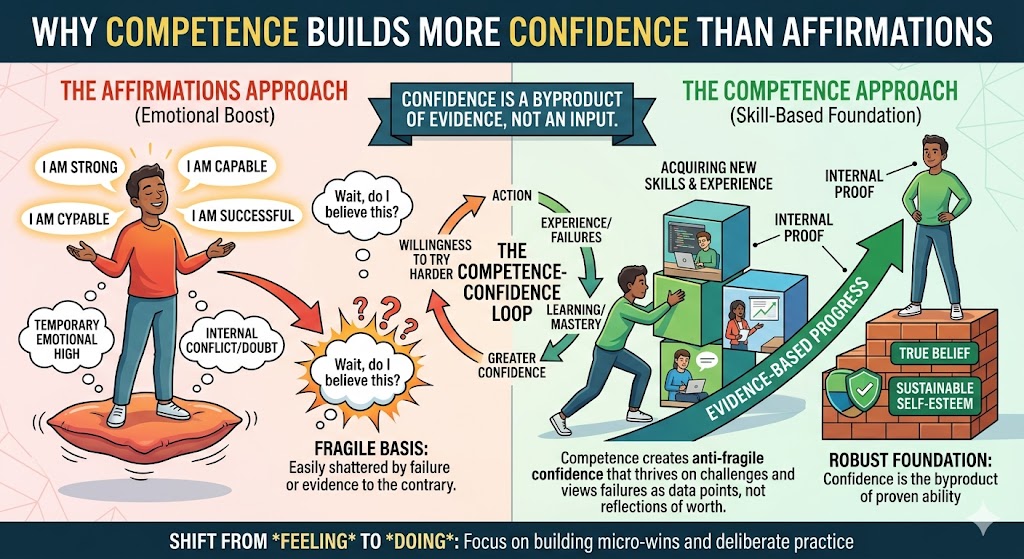
Why Competence Builds More Confidence Than Affirmations
Confidence is one of the most desired qualities in modern life. People want confidence in their careers, relationships, businesses, finances, and personal development. As a result, an entire industry has emerged around motivational quotes, positive thinking, and daily affirmations. Many people begin their mornings by looking into a mirror and repeating statements such as “I am successful,” “I am confident,” or “I can achieve anything.” While positive affirmations can have some psychological benefits, they often fail to create lasting confidence when they are not supported by real competence.
The truth is that confidence built on words alone is fragile. Confidence built on competence is durable. One can disappear the moment challenges appear, while the other grows stronger under pressure. This is why competence builds more confidence than affirmations.
Competence is the ability to perform a task effectively through knowledge, skill, experience, and practice. It is earned through effort and repetition. Confidence, on the other hand, is the belief in one’s ability to handle situations successfully. When confidence is based on competence, it has a solid foundation. When it is based solely on positive statements, it can easily collapse when reality tests it.
Imagine two people preparing for a public speaking event. The first person spends weeks studying the topic, practicing presentations, refining delivery techniques, and preparing for possible questions. The second person spends the same period repeating affirmations about being an excellent speaker but does little actual preparation. When both individuals step onto the stage, it becomes clear who possesses genuine confidence. The prepared speaker feels calm because competence provides reassurance. The unprepared speaker may initially appear confident, but uncertainty often emerges once difficult moments arise.
This example highlights a simple principle that applies across every area of life. Real confidence comes from evidence. The human brain responds more strongly to proven ability than to repeated words. When you know you have prepared, practiced, and developed your skills, confidence becomes a natural consequence.
One reason affirmations alone often fail is that the mind constantly seeks proof. If someone repeatedly tells themselves they are financially successful while struggling with debt and poor money management, their subconscious mind notices the contradiction. The gap between words and reality creates doubt. However, when that same person learns financial literacy, develops budgeting skills, increases income, and improves financial habits, confidence naturally increases because there is evidence supporting the belief.
Competence removes uncertainty. Many fears exist because people do not feel capable of handling a situation. Students fear examinations because they have not studied enough. Employees fear presentations because they have not practiced enough. Entrepreneurs fear competition because they have not developed enough expertise. In many cases, fear is not the enemy. Fear is information. It often points to areas where competence needs improvement.
This does not mean affirmations are completely useless. Positive self-talk can encourage persistence, improve mood, and reduce negative thinking. However, affirmations work best when combined with action. Telling yourself that you are capable is helpful when you are also actively developing the skills that make capability real. Words can inspire action, but action creates evidence. Evidence creates competence. Competence creates confidence.
Many of the world’s most successful individuals did not become confident because they repeatedly told themselves they were great. They became confident because they invested thousands of hours developing their abilities. Athletes train relentlessly before competing. Surgeons spend years studying and practicing before performing complex procedures. Pilots undergo extensive training before flying aircraft. Their confidence is not based on motivational slogans. It is based on competence developed through consistent effort.
Another reason competence creates stronger confidence is that it survives failure. Confidence built solely on praise or affirmations can disappear after one setback. However, competence-based confidence remains intact because skills do not vanish after a single mistake. A skilled entrepreneur may experience a failed business venture but still retain confidence because experience and knowledge remain. A competent writer may receive criticism yet continue writing because their abilities have been proven repeatedly through practice.
This resilience is important because life inevitably includes setbacks. People who depend entirely on external validation often struggle when approval disappears. Those who rely on competence possess an internal source of confidence that cannot easily be taken away. They trust their ability to learn, adapt, and improve.
Competence also eliminates the need to constantly convince others of your worth. Truly skilled individuals rarely need to announce how talented they are because their work speaks for itself. Results become their evidence. Confidence becomes quiet rather than loud. It becomes steady rather than dramatic. Genuine confidence often looks less impressive than people expect because it is grounded in reality rather than performance.
In today’s world, social media often promotes the illusion of confidence. People are encouraged to project success, certainty, and achievement even when those qualities have not been earned. This creates a culture where appearance sometimes receives more attention than competence. Yet appearances are difficult to maintain when real challenges arise. Eventually, reality demands results. At that point, competence becomes more valuable than image.
Consider the workplace. Employees who continuously develop their skills tend to gain confidence over time. They become comfortable solving problems, making decisions, and taking on greater responsibilities. Their confidence grows because they repeatedly demonstrate capability. In contrast, individuals who focus only on appearing confident may struggle when complex tasks require actual expertise.
The same principle applies to business. Entrepreneurs often begin with uncertainty because they lack experience. However, each challenge they overcome builds competence. They learn marketing, sales, customer service, operations, and financial management. As competence grows, confidence follows naturally. The confidence they develop is not artificial. It is supported by real-world experience.
Competence also improves decision-making. When people understand a subject deeply, they can evaluate risks more effectively and make informed choices. This reduces anxiety because decisions are based on knowledge rather than guesswork. Confidence increases because uncertainty decreases.
An interesting aspect of competence-based confidence is that it often leads to humility. Truly competent people understand the complexity of their field. They know how much there is still to learn. Their confidence comes from capability, not arrogance. In contrast, individuals with little competence sometimes display excessive confidence because they are unaware of their limitations. This phenomenon appears in many areas of life where ignorance creates overconfidence while expertise creates balanced self-awareness.
Building competence requires effort, patience, and persistence. It is not as exciting as repeating positive affirmations. Learning new skills, practicing consistently, making mistakes, and improving gradually can feel slow. However, the confidence that emerges from this process is far more powerful. It does not depend on mood, motivation, or external encouragement. It becomes part of who you are.
For anyone seeking greater confidence, the most effective strategy is often surprisingly simple. Instead of asking how to feel more confident, ask how to become more competent. Identify the skills required for success in your chosen area. Study them. Practice them. Improve them. Seek feedback. Learn from mistakes. Repeat the process consistently.
Over time, confidence will emerge naturally. You will not need to force it. You will not need to convince yourself through endless affirmations. Your experiences will provide the evidence your mind needs. Every skill mastered becomes another brick in the foundation of self-belief.
Confidence is not something that magically appears one morning. It is usually the byproduct of preparation, learning, and growth. The student gains confidence by studying. The athlete gains confidence by training. The entrepreneur gains confidence by solving problems. The professional gains confidence by developing expertise. In every case, competence comes first.
The world often encourages people to focus on feeling confident before taking action. In reality, action usually comes before confidence. People become confident because they repeatedly do difficult things and gradually become better at them. Confidence is earned through experience. It is built through competence.
Ultimately, affirmations may help you start the journey, but competence helps you finish it. Positive words can motivate you to take the first step, but skills give you the ability to keep moving forward. If you want confidence that lasts through challenges, criticism, uncertainty, and setbacks, invest less energy in convincing yourself you are capable and more energy in becoming capable.
That is the enduring truth behind personal growth, professional success, and lasting self-belief. Competence builds more confidence than affirmations because competence provides proof. And when confidence is supported by proof, it becomes one of the strongest forces a person can possess.

EarnSmartOnline.com.ng is dedicated to helping readers make smarter financial decisions through practical guides on online income, personal finance, technology, digital business, and wealth creation. Our goal is to provide reliable, easy-to-understand, and actionable content that empowers individuals to earn smarter, build sustainable income streams and achieve long-term financial success.
Recommended: Start Earning Online
- Ultimate Affiliate Marketing Program — learn affiliate marketing with a done-for-you sales system ($15). Check it out
- The Newbie Affiliate Guide — the beginner-friendly starter guide (~$6.68). Check it out
- Easy Dollar Maker — earn in dollars uploading AI images and videos from your phone ($17). Check it out
Disclosure: These are affiliate links. If you buy through them, I may earn a commission at no extra cost to you.



