
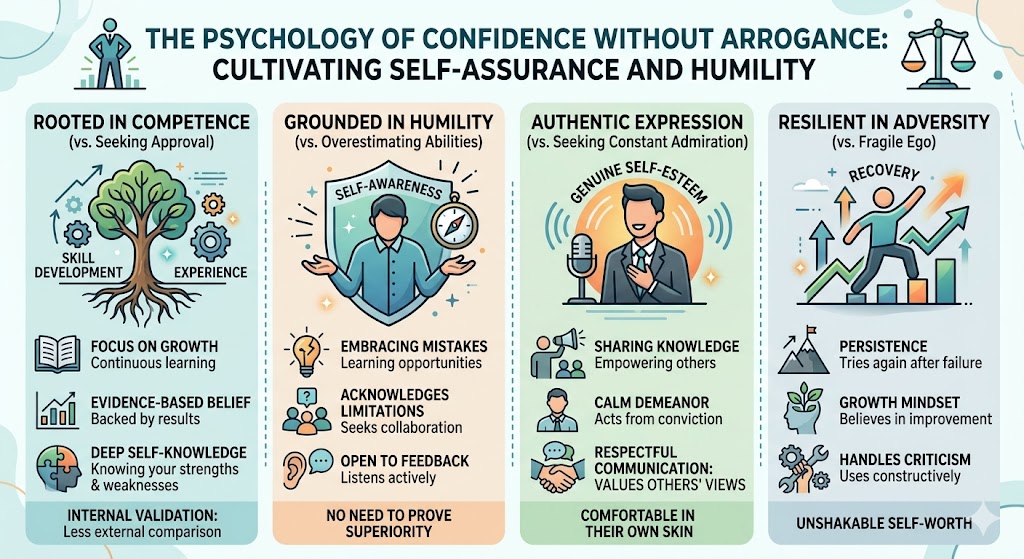
The Psychology of Confidence Without Arrogance
Confidence is one of the most admired qualities a person can possess. It helps individuals pursue opportunities, overcome challenges, communicate effectively, and achieve goals that might otherwise seem impossible. Yet confidence often gets confused with arrogance. Many people fear appearing arrogant, so they hold themselves back. Others mistake arrogance for confidence and unknowingly damage their relationships, careers, and personal growth. Understanding the psychology of confidence without arrogance is essential for anyone who wants to succeed while maintaining humility, respect, and strong connections with others.
At its core, confidence is the belief in one’s abilities, skills, and capacity to handle life’s challenges. It is an internal sense of trust that allows a person to move forward even when outcomes are uncertain. Arrogance, on the other hand, is an exaggerated sense of self-importance that often seeks validation through superiority over others. While confidence comes from self-assurance, arrogance frequently comes from insecurity disguised as strength.
The psychology of confidence without arrogance begins with self-awareness. Truly confident individuals understand both their strengths and weaknesses. They recognize what they do well without pretending to be perfect. This balanced perspective allows them to acknowledge areas where improvement is needed. Arrogant people often struggle with self-awareness because admitting weaknesses threatens the image they want to project. As a result, they may ignore feedback, reject criticism, and overestimate their abilities.
One of the most interesting aspects of confidence is that it does not require constant proof. A confident person does not need to win every argument, dominate every conversation, or seek approval from everyone around them. Their confidence exists independently of external validation. They know who they are and what they can do. Arrogance, however, often relies heavily on external recognition. An arrogant individual may constantly seek praise, attention, or admiration because their self-worth depends on it.
Research in psychology suggests that genuine confidence develops through competence. People become confident when they repeatedly face challenges, learn new skills, overcome obstacles, and gain experience. Confidence is not something that magically appears overnight. It is built through action. Every problem solved, every lesson learned, and every setback overcome contributes to a stronger sense of self-belief. Arrogance often skips this process and assumes competence without earning it.
Another key difference lies in how people respond to mistakes. Confident individuals view mistakes as opportunities for growth. They understand that failure is part of learning and does not define their worth. Because their self-esteem is stable, they can admit errors without feeling threatened. Arrogant individuals often struggle to acknowledge mistakes because doing so challenges their self-image. They may blame others, make excuses, or deny responsibility altogether.
The psychology of confidence without arrogance also involves emotional security. Emotionally secure people do not feel the need to compete with everyone around them. They can celebrate the success of others without feeling diminished. They understand that another person’s achievement does not reduce their own value. Arrogant individuals often view success as a competition and may become jealous or defensive when others excel.
Humility plays a crucial role in maintaining confidence without crossing into arrogance. Humility does not mean thinking less of yourself. It means thinking of yourself accurately. Humble individuals recognize their accomplishments while understanding that there is always more to learn. They appreciate the contributions of others and acknowledge that success is rarely achieved alone. This mindset creates a healthy balance between self-respect and respect for others.
Many people mistakenly believe that confidence requires loudness, dominance, or constant self-promotion. In reality, some of the most confident individuals are remarkably calm and composed. They do not need to prove themselves because they are secure in their abilities. Their confidence is visible through their actions, decisions, and consistency rather than through boasting or attention-seeking behavior.
Listening is another powerful indicator of confidence without arrogance. Confident people are comfortable hearing different perspectives because they do not feel threatened by disagreement. They understand that learning often comes from listening. Arrogant individuals may interrupt, dismiss opposing views, or assume they already know everything worth knowing. Their need to appear superior limits their ability to grow.
The relationship between confidence and self-esteem is also important. Healthy self-esteem provides a stable foundation for confidence. Individuals with strong self-esteem believe they have value regardless of external circumstances. They do not need constant validation to feel worthy. This internal stability allows them to approach challenges with courage while remaining humble. Low self-esteem, on the other hand, can sometimes contribute to arrogant behavior as people attempt to compensate for feelings of inadequacy.
Confidence without arrogance also improves relationships. People naturally gravitate toward individuals who are secure, respectful, and authentic. Confident people inspire trust because they are comfortable being themselves. They do not need to exaggerate achievements or diminish others to feel important. Their presence often makes others feel valued and respected. Arrogance tends to have the opposite effect by creating distance, resentment, and tension.
In professional settings, confidence without arrogance is particularly valuable. Employers, leaders, and colleagues appreciate individuals who can express ideas clearly, take initiative, and handle responsibility without becoming difficult to work with. Confident professionals contribute to team success while remaining open to feedback and collaboration. Arrogant professionals may struggle because their need to appear superior can damage teamwork and communication.
One reason confidence is so attractive is that it signals competence and reliability. People are more likely to trust someone who demonstrates calm assurance during uncertain situations. Confidence reassures others that challenges can be handled effectively. However, when confidence turns into arrogance, trust often declines because people perceive the individual as self-centered or unwilling to learn.
The development of confidence requires a growth mindset. People who believe abilities can improve through effort are more likely to take risks, learn from mistakes, and persist through difficulties. They understand that confidence grows through experience. Arrogance often reflects a fixed mindset in which individuals feel compelled to protect an image of superiority rather than continue learning.
Gratitude is another psychological factor that helps prevent confidence from becoming arrogance. Grateful individuals recognize the role that opportunities, mentors, family members, colleagues, and even luck may have played in their success. This awareness creates humility and perspective. Instead of viewing achievements as proof of superiority, they see them as the result of effort combined with support and circumstances.
The ability to remain teachable is one of the strongest signs of confidence without arrogance. Truly confident people understand that knowledge is limitless. No matter how much they know, there is always more to learn. They ask questions, seek feedback, and remain curious. Their confidence allows them to admit when they do not know something because their identity is not threatened by gaps in knowledge.
Another important aspect is resilience. Confident individuals recover more quickly from setbacks because their self-worth is not tied to a single outcome. They understand that failure is temporary and often valuable. Arrogant individuals may experience setbacks more intensely because their identity is built around appearing successful at all times.
Social media has created new challenges in maintaining confidence without arrogance. Platforms often reward self-promotion, comparison, and image management. As a result, many people struggle to distinguish genuine confidence from attention-seeking behavior. Developing authentic confidence requires focusing on personal growth rather than external approval. It means measuring progress against your own potential instead of comparing yourself constantly to others.
The psychology of confidence without arrogance ultimately comes down to balance. It is the ability to recognize your value without believing you are better than others. It is trusting your abilities while remaining open to learning. It is celebrating achievements without becoming consumed by them. It is having the courage to speak confidently and the wisdom to listen carefully.
In a world where people often confuse confidence with ego, understanding this distinction can transform every area of life. Genuine confidence creates stronger relationships, better opportunities, improved decision-making, and greater emotional stability. It allows individuals to pursue ambitious goals while remaining grounded in humility and self-awareness.
The most confident people are not those who constantly tell the world how great they are. They are the ones who quietly demonstrate competence, integrity, and resilience through consistent actions. They do not need to prove their worth because they already know it. Their confidence empowers them to grow, contribute, and lead without diminishing anyone else. That is the true psychology of confidence without arrogance, and it remains one of the most powerful qualities a person can develop.

EarnSmartOnline.com.ng is dedicated to helping readers make smarter financial decisions through practical guides on online income, personal finance, technology, digital business, and wealth creation. Our goal is to provide reliable, easy-to-understand, and actionable content that empowers individuals to earn smarter, build sustainable income streams and achieve long-term financial success.
Recommended: Start Earning Online
- Ultimate Affiliate Marketing Program — learn affiliate marketing with a done-for-you sales system ($15). Check it out
- The Newbie Affiliate Guide — the beginner-friendly starter guide (~$6.68). Check it out
- Easy Dollar Maker — earn in dollars uploading AI images and videos from your phone ($17). Check it out
Disclosure: These are affiliate links. If you buy through them, I may earn a commission at no extra cost to you.



