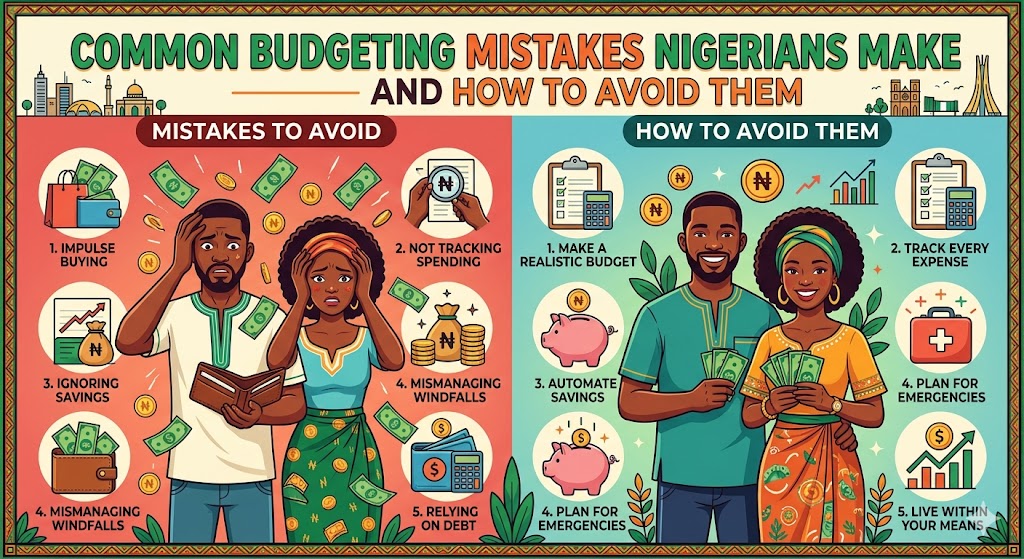
Common Budgeting Mistakes Nigerians Make and How to Avoid Them
Managing money can be difficult, especially when income does not always grow at the same speed as expenses. For many Nigerians, budgeting is not simply about deciding how much to spend on food, transport, rent, electricity, data, school fees, family responsibilities and entertainment. It is about making difficult choices in an environment where prices can change quickly and unexpected expenses can appear without warning. This is why understanding the common budgeting mistakes Nigerians make and how to avoid them is essential for anyone who wants to gain better control over their finances.
A budget is simply a plan for how you intend to use your money before the money disappears. It does not mean refusing to enjoy life or becoming unnecessarily restrictive. A good budget helps you understand where your money is going, identify waste, prepare for emergencies and make progress towards important financial goals. Unfortunately, many people create budgets that look good on paper but fail to work in real life because they do not reflect their actual circumstances.
One of the most common budgeting mistakes Nigerians make is creating a budget based on an ideal lifestyle instead of their real spending habits. Someone may decide that they will spend only a certain amount on food every month because that figure looks reasonable, even though their actual grocery and food expenses have consistently been much higher. Another person may underestimate transportation costs because they calculate based on normal days without considering traffic, unexpected journeys, fare increases or occasional trips.
A budget becomes useful when it is realistic. Instead of guessing your expenses, track them for several weeks or an entire month. Record your spending on food, transport, airtime, data, electricity, subscriptions, household items, social activities and other regular expenses. Once you know where your money actually goes, you can begin making informed decisions.
Another major mistake is failing to budget for irregular expenses. Many Nigerians prepare for monthly expenses but forget about costs that occur only occasionally. School fees, house rent, vehicle repairs, medical bills, festive celebrations, professional fees, annual subscriptions and family obligations can create serious financial pressure when they arrive unexpectedly.
The solution is to treat irregular expenses as part of your regular financial planning. If you know that rent or school fees will be due in several months, divide the expected amount by the number of months available and save towards it gradually. This approach turns a large future expense into smaller contributions that are easier to manage.
Another common budgeting mistake Nigerians make is spending before saving. Many people receive their salary or business income, pay bills, spend on necessities and entertainment, assist relatives and then decide to save whatever remains. Unfortunately, there is often little or nothing left at the end of the month.
Saving should not always depend on what remains after spending. If building savings is one of your financial priorities, include it in your budget from the beginning. Even when the amount is small, consistency matters. Someone who regularly saves a manageable amount is developing a financial habit that can become increasingly valuable as income improves.
Impulse spending is another major problem. Nigerians are constantly exposed to promotions, online shopping, social media trends, restaurants, entertainment and lifestyle content. Seeing someone buy a new phone, designer clothing, expensive shoes or travel packages can create pressure to spend money simply to keep up.
The problem with impulse spending is that individual purchases may appear harmless. A small food order here, a spontaneous outing there and an unnecessary online purchase can eventually consume a significant portion of monthly income. One effective way to reduce impulse spending is to introduce a waiting period before purchasing non essential items. Give yourself time to decide whether you genuinely need the item or simply want it because it is currently attractive.
Another mistake is failing to separate needs from wants. Food, housing, basic transportation, essential utilities and necessary healthcare generally belong among core expenses. New gadgets, expensive outings, luxury clothing and frequent entertainment may be wants rather than necessities.
This does not mean Nigerians should never spend money on enjoyment. Life should not become a punishment because you are budgeting. The important thing is to know the difference between what you must pay for and what you would simply like to have. Once that distinction is clear, you can enjoy discretionary spending without allowing it to destroy your financial priorities.
Family responsibilities also deserve careful consideration when creating a Nigerian budget. Supporting parents, siblings, relatives or friends can be an important part of life. However, giving money without limits can make it difficult to meet your own financial obligations.
One of the most difficult lessons in personal finance is that you cannot sustainably help everyone by destroying your own financial stability. If you consistently give away money that you need for rent, food, debt repayment, emergency savings or other essential responsibilities, you may eventually become dependent on someone else yourself.
A better approach is to create a specific amount for family support and assistance. Once that amount has been allocated, you can help within your financial capacity. This makes generosity more sustainable and prevents every unexpected request from completely disrupting your budget.
Another mistake is ignoring small expenses because they appear insignificant. Many people pay close attention to major expenses such as rent, school fees and large purchases but ignore frequent smaller payments. Yet spending a modest amount repeatedly can add up to a substantial figure over a month.
For example, daily snacks, unnecessary transport choices, frequent data purchases, small online transactions and regular entertainment can collectively become a major expense. The solution is not necessarily to eliminate every small pleasure. Instead, identify which small expenses provide genuine value and which ones are simply habits.
A particularly serious budgeting mistake is failing to prepare for emergencies. Without emergency savings, a broken phone, unexpected repair, temporary loss of income or urgent family need can force someone to borrow money.
An emergency fund provides a financial buffer. The ideal amount depends on your circumstances, income stability and responsibilities, but the basic principle is simple: build a reserve gradually. Do not wait until you can save a huge amount. Start with what you can afford and increase your contribution when your income improves.
Another problem is budgeting with uncertain income as though income were guaranteed. This is particularly important for freelancers, traders, business owners, contractors, commission based workers and people with irregular earnings. When income changes from month to month, using the highest income you recently received as the foundation for your lifestyle can be dangerous.
If your income is inconsistent, consider building your basic budget around a conservative income estimate. During stronger months, direct additional income towards savings, business reinvestment, debt reduction and future expenses instead of immediately increasing your lifestyle.
Lifestyle inflation is another mistake that can quietly destroy financial progress. When income increases, people often increase their spending at almost the same speed. Someone who previously lived comfortably on a modest income may receive a raise and immediately upgrade their phone, apartment, clothing, transportation and social lifestyle.
There is nothing wrong with enjoying increased income, but every income increase does not need to become a spending increase. If your income rises, consider increasing savings and investments before significantly increasing your lifestyle. This is one of the ways people can turn higher income into genuine financial progress.
Another mistake is relying heavily on credit and borrowing to maintain a lifestyle. Borrowing can sometimes be useful when carefully managed, but constantly using loans, overdrafts or borrowed money to finance ordinary consumption can create a cycle that becomes difficult to escape.
Before borrowing, ask yourself what the money is for, whether the expense is necessary and how the repayment will affect future income. A budget should show not only what you plan to spend but also what future income has already been committed to debt repayment.
Many Nigerians also make the mistake of failing to review their budgets. Creating a budget once does not mean the job is finished. Prices, income, responsibilities and priorities change. A budget that worked several months ago may no longer reflect reality.
Set aside time regularly to review your financial plan. Compare what you planned to spend with what you actually spent. If transportation costs were higher than expected, investigate why. If food spending was consistently lower, determine whether the difference can be redirected towards another financial goal. A budget should be flexible enough to adapt while still protecting your priorities.
Another common mistake is trying to copy somebody else’s budget. Personal finance is personal. A budget that works for a single person may not work for a married couple with children. A budget suitable for someone earning a fixed salary may be completely inappropriate for a business owner with irregular income.
Your budget should reflect your income, responsibilities, location, lifestyle, financial goals and obligations. There is no universal percentage that will perfectly fit every Nigerian household. The important thing is to build a system that reflects your actual circumstances.
Another mistake is failing to budget for inflation and rising costs. Nigerians have experienced significant changes in the prices of everyday necessities, meaning that an amount that was sufficient for a particular expense in the past may no longer be enough today. A rigid budget that never changes can quickly become unrealistic.
Review important expense categories regularly and adjust your estimates when necessary. At the same time, rising prices should not automatically become an excuse for uncontrolled spending. When costs increase, look for areas where you can reduce waste, compare alternatives and prioritise essentials.
People also sometimes confuse budgeting with deprivation. They create extremely strict budgets that leave no room for enjoyment, social activities or personal needs. After maintaining the plan for a short period, they become frustrated and abandon it completely.
A sustainable budget should contain some room for enjoyment. The purpose is not to prevent you from living. The purpose is to make sure today’s enjoyment does not destroy tomorrow’s stability. When you deliberately allocate money for entertainment and personal spending, you can enjoy it without constantly feeling guilty.
Another important budgeting mistake is failing to set financial goals. A budget without goals can feel like a collection of restrictions. When you have a clear objective, however, every naira you save can have a purpose.
Your goals might include building an emergency fund, paying school fees, starting a business, buying equipment, reducing debt, paying rent in advance, investing or saving towards a major purchase. Write down your goals and attach realistic amounts and timelines to them. A specific goal is easier to work towards than the vague intention to simply “save money.”
Technology can also make budgeting easier. Nigerians can use spreadsheets, banking records, budgeting applications, notes or simple notebooks to monitor income and expenses. The best system is not necessarily the most sophisticated one. It is the system you will actually use consistently.
Another mistake is failing to discuss money with household members. If one person is carefully budgeting while another person spends without considering the family’s financial priorities, the entire plan can collapse.
Couples and families should have honest conversations about income, expenses, debt, savings and financial goals. Children can also gradually learn basic money management principles appropriate to their age. Financial discipline becomes easier when the household understands the direction it is trying to move towards.
It is also important to avoid budgeting based entirely on social pressure. Nigerian society can sometimes place significant emphasis on appearances, celebrations and public demonstrations of success. Weddings, birthdays, religious events, parties and other social occasions can create pressure to spend more than one can comfortably afford.
You do not have to prove your financial success through every event you attend. It is possible to celebrate people while remaining within your means. True financial progress is often less visible than expensive clothes, cars, parties or gadgets. Someone quietly building savings and reducing debt may be in a stronger financial position than someone whose lifestyle looks impressive online.
One of the most effective ways to avoid common budgeting mistakes Nigerians make and how to avoid them is to give every major portion of your income a purpose. Before spending, know what your money is supposed to accomplish. Allocate money towards essential expenses, savings, financial obligations, personal spending and future goals.
Most importantly, do not become discouraged when your budget fails occasionally. Budgeting is a skill that improves with practice. You will make mistakes. You may underestimate an expense, spend more than planned or face an emergency that disrupts everything. The goal is not perfection. The goal is to become increasingly aware and intentional about your money.
Financial discipline is not about earning a huge income before you start managing money properly. In fact, learning to manage a smaller income can prepare you to manage a larger one. If someone cannot control spending when earning a modest income, a higher income may simply create opportunities for more expensive mistakes.
The Nigerian economic environment makes financial planning especially important. When prices rise, income changes and unexpected responsibilities appear, people who understand their finances are better positioned to make informed decisions. A realistic budget cannot eliminate financial challenges, but it can reduce the confusion that comes from not knowing where your money is going.
Ultimately, the solution to common budgeting mistakes Nigerians make and how to avoid them is not complicated mathematics. It is awareness, discipline, flexibility and consistency. Know your income. Track your expenses. Separate needs from wants. Prepare for irregular costs. Save before unnecessary spending consumes your income. Control impulse purchases. Set boundaries around financial assistance. Prepare for emergencies. Review your budget regularly and adjust it when circumstances change.
Your financial future is influenced by the decisions you repeat. One good financial decision may not transform your life overnight, but hundreds of sensible decisions made consistently can create a completely different financial reality.
Budgeting is therefore not simply about restricting spending. It is about giving your money direction. Every naira has a destination, whether you choose that destination deliberately or allow circumstances and impulse to choose it for you. The sooner you begin paying attention to your financial habits, the sooner you can start making your income work more effectively for the life you want to build.

EarnSmartOnline.com.ng is dedicated to helping readers make smarter financial decisions through practical guides on online income, personal finance, technology, digital business, and wealth creation. Our goal is to provide reliable, easy-to-understand, and actionable content that empowers individuals to earn smarter, build sustainable income streams and achieve long-term financial success.
Recommended: Start Earning Online
- Ultimate Affiliate Marketing Program — learn affiliate marketing with a done-for-you sales system ($15). Check it out
- The Newbie Affiliate Guide — the beginner-friendly starter guide (~$6.68). Check it out
- Easy Dollar Maker — earn in dollars uploading AI images and videos from your phone ($17). Check it out
Disclosure: These are affiliate links. If you buy through them, I may earn a commission at no extra cost to you.