
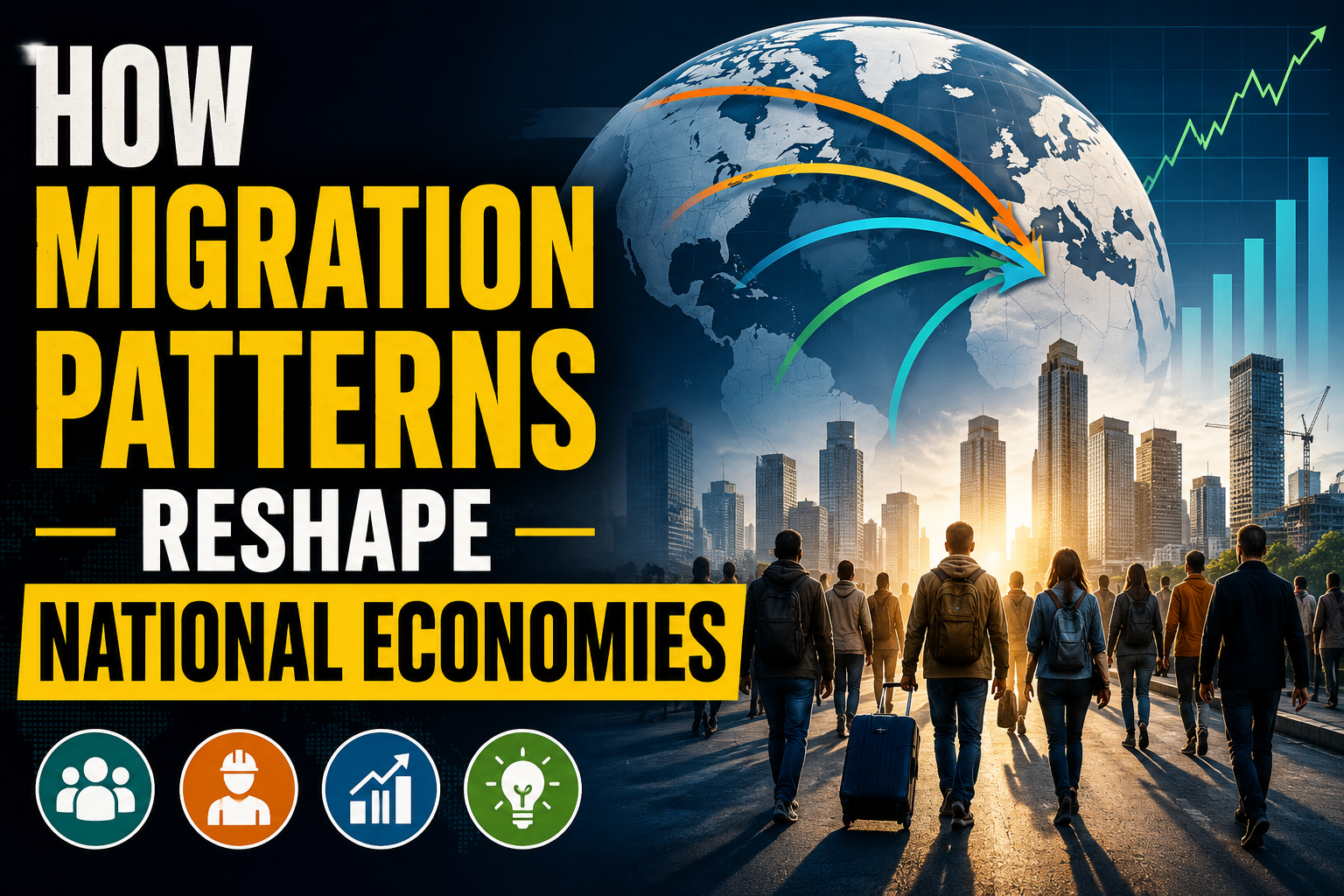
How Migration Patterns Reshape National Economies
Migration is often discussed as a social or political issue, but its deeper and more lasting impact is economic. When people move across borders or within countries, they do not just change their location, they change the flow of labor, skills, consumption, innovation, and even long-term national productivity. Over time, these movements reshape entire economies in ways that are sometimes visible in rising cities and sometimes hidden in slow decline of regions that lose population. Understanding migration patterns is therefore not just about people movement, but about understanding how economies are built, strengthened, or weakened.
At the core of every economy is labor. The number of people available to work, the type of skills they bring, and the industries they serve determine how productive a country can be. When migration increases the supply of labor, especially in specific sectors, it can fill critical gaps that would otherwise slow economic growth. Many developed economies, for example, rely heavily on migrant workers in healthcare, agriculture, construction, and technology. Without this inflow, certain industries would struggle to maintain output, wages would rise sharply due to scarcity, and inflationary pressure would increase. Migration, in this sense, acts as a balancing mechanism that stabilizes labor markets.
However, migration does not only add labor, it also redistributes it. When skilled workers leave one country for another, the sending country experiences what is often called brain drain. This is not just the loss of individuals, but the loss of years of training, education investment, and potential innovation. A country that loses a large portion of its doctors, engineers, or tech professionals may find itself trapped in a cycle where public services weaken and economic development slows further. At the same time, the receiving country benefits from an instant injection of skills without bearing the full cost of training those individuals. This uneven distribution of human capital is one of the most powerful ways migration reshapes national economies.
Migration also has a strong influence on consumer markets. Every person who moves brings consumption demand with them. Housing, food, transportation, education, and healthcare services all expand when populations grow. Cities that attract migrants often experience rapid economic expansion because demand rises faster than infrastructure can adjust. This creates opportunities for business growth, real estate development, and service expansion. On the other hand, regions that experience population decline often face shrinking markets, closing businesses, falling property values, and reduced tax revenues. Over time, this creates a widening gap between growing urban centers and declining rural areas.
Another major economic effect of migration is wage dynamics. When large numbers of workers enter a labor market, wages in certain low skill sectors can stabilize or grow slowly due to increased supply. At the same time, sectors that depend on specialized skills may experience wage growth if migration fills complementary roles that increase productivity. For example, when migrant workers take on essential support roles, highly skilled workers can focus on higher value tasks, increasing overall economic efficiency. This interaction between different skill levels creates a layered economic effect that cannot be understood simply by looking at total population numbers.
Remittances also play a significant role in shaping national economies. Migrants often send money back to their home countries, and in many developing nations, these inflows represent a major source of foreign income. Remittances can support household consumption, fund education, improve healthcare access, and stimulate local business activity. In some economies, they even exceed foreign direct investment or aid. While remittances can stabilize local economies, they can also create dependency if not accompanied by productive investment. This dual effect makes migration a powerful but complex economic force.
Beyond immediate financial flows, migration influences innovation and entrepreneurship. Migrants often bring diverse perspectives, new skills, and different approaches to problem solving. In many advanced economies, a significant portion of startups and technological innovation is driven by migrants or their descendants. This is because migration often selects for individuals willing to take risks, adapt, and seek better opportunities. These traits align closely with entrepreneurial success. As a result, countries that attract migrants frequently benefit from increased innovation, which drives long term productivity growth and global competitiveness.
Urban development patterns are also deeply shaped by migration. Cities that become migration hubs often expand rapidly, both horizontally and vertically. Housing demand increases, infrastructure is stretched, and governments are forced to invest in transportation, utilities, and public services. While this can create short term pressure, it also drives long term economic expansion by concentrating talent and resources. Economic history shows that many of the world’s most powerful cities grew through repeated waves of migration, each adding new layers of labor, culture, and economic activity.
At the national level, migration can influence fiscal systems. Migrants contribute taxes through income, consumption, and social contributions. When balanced correctly, they can help sustain aging populations by supporting pension systems and reducing dependency ratios. Many developed countries face aging populations that strain public finances, and migration helps offset this imbalance by introducing younger workers into the system. However, if integration is poorly managed, or if migrants are excluded from formal employment, the fiscal benefits may be reduced.
It is also important to recognize that migration patterns are not random. They are shaped by economic inequality, political stability, conflict, climate conditions, and global demand for labor. People tend to move from low opportunity environments to high opportunity environments. This natural flow of labor from lower productivity regions to higher productivity regions increases global efficiency but also creates uneven development. Some countries become economic magnets while others struggle with population loss and reduced economic dynamism.
Technology has amplified these migration effects. In a globalized world, information about opportunities travels instantly, making migration decisions faster and more widespread. Digital platforms also allow migrants to remain economically connected to their home countries while contributing to their destination economies. This creates hybrid economic networks where value flows in multiple directions at once, rather than a simple one way movement of people.
Despite its economic benefits, migration also creates challenges. Rapid population inflows can strain infrastructure, public services, and housing markets if not managed properly. Cultural integration, labor market competition, and political tensions can also arise. These challenges do not negate the economic benefits of migration, but they highlight the need for policy frameworks that ensure balanced development. Economies that successfully integrate migrants tend to experience stronger long term growth than those that restrict or poorly manage migration flows.
Another important dimension is regional inequality within countries. Migration often concentrates economic activity in major cities while leaving rural or less developed regions behind. This internal migration can boost national productivity but also deepen regional disparities. Governments often face the challenge of balancing growth with equity, ensuring that migration driven urban expansion does not completely hollow out rural economies.
In the long run, migration patterns act as a force that continuously reshapes economic geography. They determine where industries grow, where capital flows, where innovation emerges, and where decline sets in. Countries are not economically static entities; they are constantly being rebuilt by the movement of people within and across their borders. The flow of human capital is as important as the flow of money or goods, and in many cases even more influential.
Ultimately, migration is not just about relocation, it is about reallocation of human potential. Every migration decision changes both the place left behind and the place arrived at. Economies that understand this dynamic can position themselves to benefit from it by creating systems that attract talent, integrate workers effectively, and convert population movement into productivity growth. Those that fail to understand it risk falling behind in a world where economic strength is increasingly shaped by the movement of people and the ideas they carry.

EarnSmartOnline.com.ng is dedicated to helping readers make smarter financial decisions through practical guides on online income, personal finance, technology, digital business, and wealth creation. Our goal is to provide reliable, easy-to-understand, and actionable content that empowers individuals to earn smarter, build sustainable income streams and achieve long-term financial success.
Recommended: Start Earning Online
- Ultimate Affiliate Marketing Program — learn affiliate marketing with a done-for-you sales system ($15). Check it out
- The Newbie Affiliate Guide — the beginner-friendly starter guide (~$6.68). Check it out
- Easy Dollar Maker — earn in dollars uploading AI images and videos from your phone ($17). Check it out
Disclosure: These are affiliate links. If you buy through them, I may earn a commission at no extra cost to you.



