
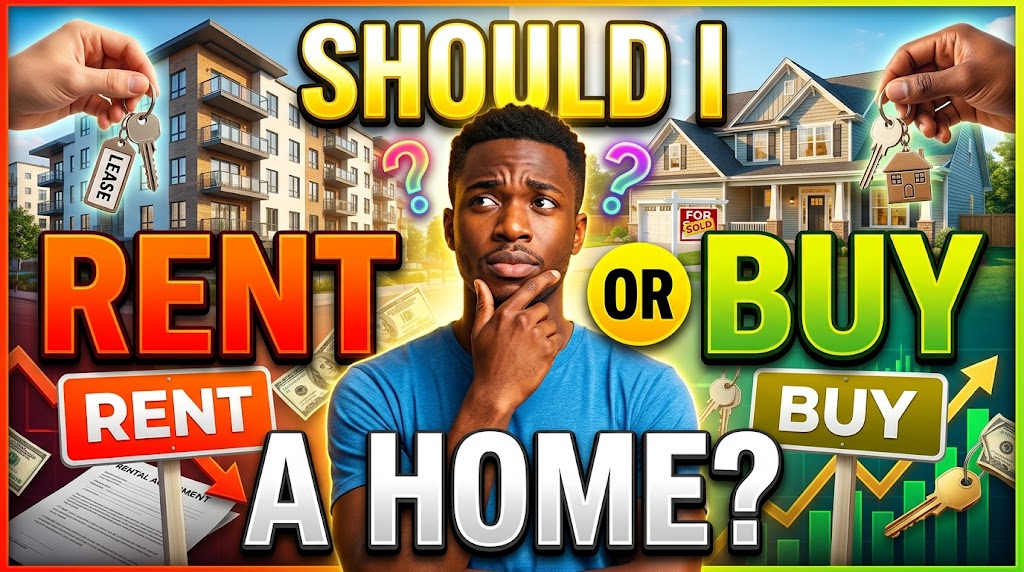
Should I rent or buy a home?
There was a time when I found myself asking a question that looks simple on the surface but becomes surprisingly complicated when you start looking at the numbers, responsibilities and long term consequences involved. The question was, “Should I rent or buy a home?”
At first, I thought the answer was obvious. Owning a home sounded like the smarter financial decision. After all, why should I continue paying rent to a landlord when I could use that same money to gradually build ownership of my own property? That was the way I had always understood the argument. Rent was seen as money that disappeared, while buying a home was seen as an investment that would eventually belong to me.
But the more I thought about it, the more I realized that the decision was not simply about whether renting was good or buying was good. It was about my income, financial stability, plans for the future, location, lifestyle, responsibilities and ability to handle unexpected expenses.
That was when the question became more serious.
Should I rent or buy a home?
I discovered that there is no universal answer that works for everyone. What makes sense for one person can create unnecessary financial pressure for another. Someone with a stable income, sufficient savings and a strong reason to remain in one location for many years may approach home ownership differently from someone whose career, business or family situation is still changing.
The first thing I had to understand was that renting is not necessarily throwing money away.
This is something I think many people misunderstand. When you rent a home, you are paying for somewhere to live. You are also paying for flexibility. Depending on the rental agreement and local laws, you may be able to move when your circumstances change without having to sell a property. You are not necessarily responsible for every major structural problem in the building, and you do not have to commit a huge amount of capital to one physical asset.
That flexibility can have real financial value.
Imagine someone who has recently started a new job in another city. Buying a house immediately might sound impressive, but what happens if the person gets a better opportunity somewhere else two years later? Selling property can take time, and there may be transaction costs, taxes, legal expenses, agency fees and other costs depending on the location and circumstances.
Renting may give that person the freedom to make the move without first figuring out what to do with a property.
This was one of the things that changed how I looked at the question.
Should I rent or buy a home?
I stopped looking at renting as simply paying someone else’s mortgage and started looking at it as a financial decision that can provide flexibility.
At the same time, I also began to understand why buying can be attractive.
There is something psychologically powerful about knowing that you own the place where you live. Instead of renewing a tenancy agreement every few years, you are building ownership of an asset. Depending on the property and the market, the value of that property may increase over time. If you have a mortgage, part of your payments may also contribute towards building equity in the property.
There is another important consideration. Rent can increase over time.
A person who has been renting for many years may eventually discover that the amount required to maintain the same standard of housing has increased significantly. The increase may be caused by inflation, demand, location, improvements to the property or other market conditions.
Owning a home does not automatically eliminate housing expenses, but it can change the nature of those expenses.
You may still have maintenance costs, property taxes where applicable, insurance, service charges, utilities, repairs and other expenses. If you financed the property, you may also have mortgage payments and interest. However, the long term financial structure is different from renting because you are acquiring an ownership interest in the property.
That distinction matters.
I also learned that buying a home requires much more money than the price displayed on the property advertisement.
This is one of the biggest mistakes people can make when considering the question, “Should I rent or buy a home?”
They see the purchase price and immediately begin calculating whether they can afford it.
But buying a home can involve many additional costs.
There can be legal expenses, documentation, inspections, valuation, registration, taxes, agency fees, renovation, moving costs, furnishing and repairs. The exact expenses vary depending on the country, state, property type and transaction.
This means that someone who has just enough money to pay the purchase price may still not be financially ready to own the property.
I would rather have money left after buying a property than spend every available naira acquiring the property and then discover that I cannot afford to maintain it.
That became one of my biggest lessons.
Buying a home should not leave you financially helpless.
A home is supposed to provide stability, not turn every unexpected expense into a crisis.
This is particularly important for people who earn irregular income. If you are a business owner, freelancer, contractor or someone whose monthly income changes significantly, you may need a larger financial cushion before committing to home ownership.
The question should not only be, “Can I buy this house?”
A better question is, “Can I comfortably afford to own this house?”
Those are two completely different questions.
I also realised that the location of the property matters almost as much as the property itself.
A beautiful house in the wrong location may not be the great opportunity it appears to be.
Before buying, I would want to consider accessibility, security, transportation, employment opportunities, schools, healthcare, shopping, infrastructure and future development in the area. I would also want to understand the property’s documentation and confirm that the person selling it has the legal right to sell it.
This is especially important when buying land or property in markets where documentation and ownership verification can be complicated.
A house is not simply a building.
It is a long term financial commitment attached to a particular location.
If you rent, you can potentially move when the location stops working for you. If you buy, leaving can be more complicated.
That is why I would never make the decision based purely on emotion.
I understand why people become emotionally attached to the idea of owning a home. There is a certain satisfaction that comes with saying, “This is my house.”
But emotions should not be allowed to completely control a financial decision.
I have seen people become so focused on owning property that they ignore their current financial reality. They take on enormous obligations because they are afraid of being left behind while friends, relatives or colleagues are buying houses.
That can become dangerous.
Someone else’s home ownership journey is not a measurement of your own financial progress.
Maybe your friend bought a house at 30. That does not mean you have failed because you are still renting at 32.
Maybe your colleague owns three properties. That does not mean you should immediately borrow money to purchase one.
Personal finance is personal.
The question “Should I rent or buy a home?” should therefore be answered based on your circumstances rather than social pressure.
One of the most useful things I learned was to consider how long I expected to stay in one place.
If I knew that I would probably move within a short period, renting could make more sense because it would provide flexibility.
If I expected to remain in the same location for many years and had the financial capacity to purchase without destroying my savings, buying could become more attractive.
There is no magic number of years that automatically makes buying the correct decision for everyone because property prices, rent, financing costs, taxes, maintenance and transaction expenses differ from one market to another.
That is why online rules such as “always buy” or “always rent” can be misleading.
Personal circumstances matter.
Another thing I would consider is what I could do with the money required to buy the property.
This is where the conversation becomes more interesting.
Suppose I have a substantial amount of money available for a house. Buying immediately means putting a large portion of my financial resources into one asset.
That may be perfectly reasonable if home ownership is my priority and the purchase does not compromise my other financial goals.
But what if I could use some of that money to build a business, develop my skills, invest in other assets or maintain a strong emergency fund?
The opportunity cost matters.
Money used to purchase a house cannot simultaneously be used elsewhere.
This does not mean buying a home is a bad use of money. It simply means that the decision should be considered within the bigger picture of personal wealth.
I also learned to separate the idea of a home from the idea of an investment.
A home can be an asset, but that does not mean every house is automatically a great investment.
If I buy an expensive property that consumes most of my income and requires significant maintenance, I may own an asset while still experiencing financial stress.
On the other hand, a reasonably priced property in a desirable and growing location may potentially provide both housing benefits and long term financial value.
The difference is in the details.
Another question I would ask myself is whether I have an emergency fund.
This may sound unrelated to buying a home, but it is extremely important.
Life does not always follow the plan.
A business can experience a slow period. A job can disappear. A major family expense can suddenly appear. A vehicle can break down. A medical expense can arise. A property can require an unexpected repair.
If all my available money goes into buying a house, I could become asset rich and cash poor.
That is not necessarily financial security.
I would rather approach home ownership with some financial breathing room.
The same principle applies when considering a mortgage.
A mortgage can make home ownership possible without requiring the entire purchase price upfront, but borrowing does not make a property cheaper. Interest and other financing costs can significantly affect the total amount paid over the life of the loan.
Anyone considering a mortgage should understand the interest rate, repayment period, fees, penalties where applicable and the total repayment obligation before committing.
The monthly payment is only one part of the equation.
I would also ask myself whether my income is stable enough to support that obligation during difficult periods.
This is where the answer to “Should I rent or buy a home?” becomes personal.
For one person, buying may provide a sense of stability and long term ownership.
For another person, renting may provide the flexibility needed to build a career, grow a business or save enough money to purchase later under better circumstances.
Neither decision automatically makes someone more financially responsible.
The real mistake is making a major housing decision without understanding the consequences.
I also realised that waiting can sometimes be a legitimate financial strategy.
There is a tendency to think that if you cannot buy a house today, you are falling behind.
I disagree with that mindset.
If I am not financially prepared to buy, I can use the period of renting to strengthen my financial position. I can increase my income, reduce unnecessary debt, build savings, research locations, understand property documentation and learn about the real estate market.
Renting does not have to be the end of the story.
It can be part of the journey towards ownership.
At the same time, I would not want someone to rent indefinitely simply because they are afraid of making a decision.
If someone has stable income, sufficient savings, understands the costs involved, has a strong reason to stay in the area and finds a property that fits their financial capacity, buying may deserve serious consideration.
The important thing is to calculate rather than assume.
Compare the expected cost of renting with the realistic cost of owning.
Look beyond the monthly payment.
Consider the initial cash required, maintenance, insurance, taxes, service charges, financing costs, property appreciation uncertainty and the opportunity cost of tying up your money.
Then compare those factors with the rent you would pay, the flexibility renting provides and what you could potentially do with the money you are not putting into a property.
The answer may become clearer.
For me, the biggest lesson from asking “Should I rent or buy a home?” was that the decision is not really about choosing between being a renter and being a homeowner.
It is about choosing the housing arrangement that fits my current financial reality and future plans.
Buying a home can be a wonderful achievement, but ownership comes with responsibilities. Renting can provide flexibility, but it does not build ownership of the property you live in.
Both have advantages and disadvantages.
The right choice depends on income, savings, debt, location, family circumstances, expected length of stay, property prices, rental prices, financing options and personal goals.
I would never tell someone to buy a house simply because society says renting is a waste of money.
I would also never tell someone to rent forever simply because buying requires a large financial commitment.
Instead, I would encourage anyone facing this decision to slow down and ask better questions.
Can I afford the purchase without exhausting my savings?
How stable is my income?
How long do I expect to live in this location?
What other financial goals would buying affect?
What additional costs will I face after purchasing?
Have I properly verified the property and its documentation?
What happens if my income falls?
What could I do with the money if I continued renting?
What would happen if I bought the property and later needed to move?
These questions may not produce an exciting answer immediately, but they can prevent an expensive mistake.
In the end, the question “Should I rent or buy a home?” does not have one answer that applies to everybody.
For some people, renting may be the sensible choice at a particular stage of life.
For others, buying may fit their financial position and long term plans.
And for some people, the best decision today may be to rent while preparing financially for ownership tomorrow.
That is the part I wish more people understood.
You do not have to prove your financial success by rushing into home ownership.
You also do not have to convince yourself that renting is always the better option because buying feels expensive.
Your home is one of the biggest financial decisions you may ever make, so it deserves more thought than a simple comparison between monthly rent and a mortgage payment.
Take your time. Understand the numbers. Research the property. Consider your future. Keep enough financial room to deal with unexpected circumstances.
Most importantly, make the decision based on what you can genuinely afford and the life you are trying to build, rather than what everyone around you is doing.
Because when I think about the question again, “Should I rent or buy a home?” I no longer see it as a question that demands a quick yes or no.
I see it as a financial question that deserves an honest look at where I am today, where I want to be tomorrow and what I can realistically afford to do without putting my entire financial future under unnecessary pressure.

EarnSmartOnline.com.ng is dedicated to helping readers make smarter financial decisions through practical guides on online income, personal finance, technology, digital business, and wealth creation. Our goal is to provide reliable, easy-to-understand, and actionable content that empowers individuals to earn smarter, build sustainable income streams and achieve long-term financial success.
Recommended: Start Earning Online
- Ultimate Affiliate Marketing Program — learn affiliate marketing with a done-for-you sales system ($15). Check it out
- The Newbie Affiliate Guide — the beginner-friendly starter guide (~$6.68). Check it out
- Easy Dollar Maker — earn in dollars uploading AI images and videos from your phone ($17). Check it out
Disclosure: These are affiliate links. If you buy through them, I may earn a commission at no extra cost to you.



