
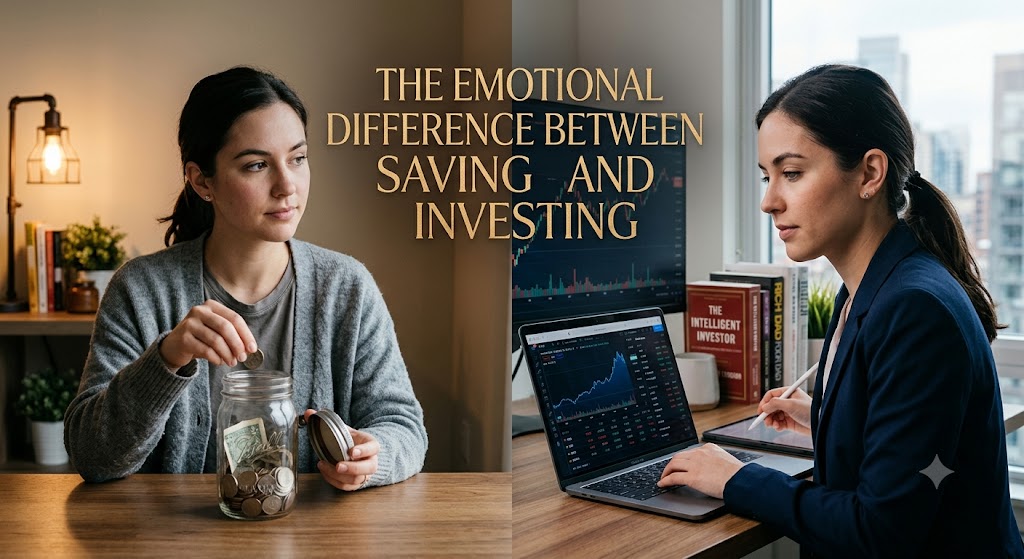
Saving and investing are often discussed as if they are simply two different financial techniques. Save your money in a bank account, invest some of it in assets, build wealth and repeat the process. On paper, the difference appears straightforward. In reality, saving and investing create completely different emotional experiences, and understanding that difference can have a major influence on the financial decisions you make throughout your life.
Money is not just numbers sitting inside a bank account or figures displayed on an investment app. Money is connected to security, fear, freedom, family, status, memories, disappointment, ambition and even identity. This is why two people can earn the same amount of money, face similar financial circumstances and still make completely different decisions with their money. Their financial behaviour is often influenced by what money means to them emotionally.
Saving generally feels safe. Investing often feels uncertain. Saving can give you the comfort of knowing that your money is available when you need it. Investing can force you to accept that the value of your money may rise and fall before you eventually achieve your financial objective. That emotional distinction is one of the most important reasons why some people find it easy to save but extremely difficult to invest, while others invest aggressively but struggle to maintain adequate cash savings.
When you save, you are often buying peace of mind. When you invest, you are often buying future possibilities. The emotional reward of saving is immediate because you can see your balance increasing. The emotional reward of investing is usually delayed because meaningful investment growth requires patience and the willingness to tolerate temporary uncertainty. The Emotional Difference Between Saving and Investing
Imagine someone who has spent years living from one payday to another. Every unexpected bill has created anxiety. A medical expense, rent increase, school fees, family emergency or broken appliance can quickly disrupt their finances. Eventually, they manage to save enough money to cover several months of essential expenses. The psychological transformation can be enormous. They no longer feel completely exposed to every financial emergency. Their savings become a protective barrier between themselves and uncertainty.
This is one reason saving can feel emotionally satisfying. Every deposit can reinforce the belief that you are becoming more financially secure. You can watch the balance grow from ₦100,000 to ₦300,000, then ₦500,000 and eventually ₦1 million. Even if the money is not producing substantial returns, the growing balance can create a powerful sense of progress.
Investing can feel very different.
Suppose the same person puts ₦500,000 into an investment and the value temporarily falls to ₦450,000. Rationally, they may understand that market fluctuations are normal. Emotionally, however, the experience can feel like failure. The person has not necessarily lost their investment permanently, but seeing a lower number can trigger fear, regret and the urge to sell.
This is where the emotional difference between saving and investing becomes particularly important.
Saving tends to reward emotional control through certainty. Investing requires emotional control through uncertainty.
A saver often asks, “How much money do I have?”
An investor must frequently ask, “How much can I tolerate this value changing while I remain focused on my long term goal?”
Those are very different psychological questions.
The Emotional Difference Between Saving and Investing
For many people, saving feels responsible while investing feels risky. Yet this perception can be misleading. Keeping every naira in cash can also involve risk because inflation can gradually reduce purchasing power. If prices rise faster than your savings grow, the amount of goods and services your money can buy may decline over time.
This means that financial security is not simply about protecting the number displayed in your account. It is also about protecting what that money can actually do for you in the future.
A person may feel extremely safe because they have ₦5 million sitting in a savings account. But if inflation continues to reduce purchasing power while the money earns little interest, their emotional sense of security may be greater than their actual long term financial security.
Investing introduces another emotional challenge because investments are not guaranteed to move upwards every day, every month or every year. Markets can experience periods of rapid growth followed by periods of decline. Watching an investment lose value can trigger emotions that do not appear when money is simply sitting in a savings account.
Fear is one of the strongest emotions affecting investment decisions. When markets fall, people may become convinced that the situation will get worse. They may sell because they cannot tolerate watching their portfolio decline. Ironically, selling during panic can turn a temporary decline into a permanent loss.
Greed creates the opposite problem. When investments are rising rapidly, people may become overconfident. They begin to believe that prices will continue rising indefinitely. They may invest money they cannot afford to lose, borrow money to invest or chase assets simply because everybody else appears to be making money.
Both fear and greed can destroy a sensible financial strategy.
Saving has emotional traps too. One of the biggest is the illusion that more cash automatically means more financial security. Saving money is important, but excessive fear of investing can prevent people from building wealth over the long term.
Someone might spend twenty years accumulating cash because they are terrified of losing money. They may congratulate themselves for never experiencing an investment loss. Yet they may overlook the fact that inflation has been quietly reducing the purchasing power of their money.
There is therefore a psychological balance that every financially responsible person eventually needs to understand. You need money that protects you from immediate emergencies and money that has the potential to grow over the long term.
Your emergency savings serve one emotional purpose. Your investments serve another.
Savings can tell your mind, “I am prepared.”
Investments can tell your future, “I am building.”
Neither message should necessarily replace the other.
One of the biggest mistakes people make is investing money that should have remained available for short term needs. When an emergency occurs, the investor may be forced to sell assets at an unfavourable time. This creates a painful emotional experience because the person is not only dealing with the emergency itself but also watching an investment potentially lose value.
A properly structured emergency fund can reduce this emotional pressure. When unexpected expenses arise, you do not necessarily have to touch your long term investments. Your savings can absorb the immediate financial shock while your investments remain focused on the future.
This separation can dramatically improve your psychological relationship with investing.
The emotional benefit of having an emergency fund is not simply that you have cash. It is that you can afford to be patient.
Patience is one of the most valuable characteristics an investor can develop.
Long term investing often requires you to sit through periods when nothing exciting happens. There may be months when your portfolio barely moves. There may be periods when it declines. There may even be years when the results are disappointing. The investor who expects instant gratification may become frustrated and abandon a strategy before it has had sufficient time to work.
Saving, on the other hand, can provide frequent emotional reinforcement. You transfer money into your account and immediately see your balance increase. This creates a visible connection between your behaviour and your financial progress.
That immediate feedback can make saving addictive in a positive sense. Every successful saving milestone can encourage you to continue.
But investing often requires a different mindset. You may contribute money today and see little obvious difference tomorrow. The real benefit may become visible years or decades later.
This is why people who understand compound growth often describe investing as a long game. Your money needs time to potentially generate returns, and those returns can themselves generate further returns.
The emotional challenge is that the human brain tends to value immediate rewards more strongly than distant rewards. Saving therefore feels psychologically easier because the result is visible. Investing requires you to sacrifice some immediate certainty for a potentially greater future outcome.
This is closely connected to delayed gratification.
A person who spends every available naira today may experience immediate pleasure but struggle to build financial security. A person who saves everything may experience security but potentially miss opportunities for long term growth. A person who invests without maintaining sufficient savings may experience excitement but become vulnerable when life produces an unexpected financial problem.
Healthy financial behaviour therefore requires balance rather than extremes.
Another important emotional difference is control.
Saving can create a strong sense of control because you determine exactly how much money you put aside. If you save ₦50,000 every month, you can easily observe your progress. Investing introduces variables that are outside your immediate control. Market movements, economic conditions, interest rates, company performance and global events can all influence investment values.
For people who strongly dislike uncertainty, this lack of control can be uncomfortable.
This does not mean they are bad with money. It simply means their emotional tolerance for financial uncertainty may be lower.
Understanding your own emotional reaction to money can therefore be just as important as understanding financial products.
Ask yourself what happens when your bank balance decreases unexpectedly. Do you panic? Do you immediately stop spending? Do you borrow money? Do you become angry? Do you ignore the problem?
Now consider what happens when an investment loses value. Do you remain calm? Do you immediately check your investment account repeatedly? Do you sell? Do you start searching for someone to blame? Do you invest more because you believe the asset has become cheaper?
Your answers reveal something about your financial psychology.
A person who constantly checks their investment portfolio may unintentionally increase their anxiety. Daily price movements can become emotionally exhausting, especially when the investment was intended to be held for many years.
Long term investors often need to learn how to separate information from emotional noise. Knowing what is happening in the market can be useful, but constantly reacting to every movement can encourage impulsive decisions.
Saving can also become emotionally unhealthy when it turns into extreme financial anxiety. Someone may have substantial savings but still feel poor because they are terrified of spending anything. They may refuse reasonable experiences, delay necessary purchases or constantly worry that one unexpected event will destroy everything they have built.
This is an important distinction. Financial discipline should create freedom, not permanent fear.
Money is supposed to serve a purpose. Saving is not about collecting numbers indefinitely. Investing is not about watching charts all day. Both are tools for helping you achieve financial objectives.
Perhaps you are saving for a house deposit, education, relocation, business opportunity, emergency fund or a major purchase. Perhaps you are investing for retirement, long term wealth creation, financial independence or your family’s future. The Emotional Difference Between Saving and Investing
The emotional meaning of the goal can influence your behaviour significantly.
If you are saving for something emotionally important, you may find it easier to resist unnecessary spending. If you are investing for a distant goal that feels abstract, staying motivated may be harder.
This is why connecting financial decisions to meaningful life goals can improve discipline.
Instead of thinking, “I cannot spend this ₦100,000,” you might think, “This money is helping me build the financial freedom I want.”
That psychological shift can change how financial sacrifice feels.
Another major emotional difference involves regret.
People often regret losses more intensely than they appreciate equivalent gains. This is known as loss aversion, and it can influence financial decisions in powerful ways.
Imagine investing ₦1 million and watching it temporarily fall to ₦900,000. The emotional pain of seeing ₦100,000 disappear may feel stronger than the excitement you would experience if the investment later rose from ₦1 million to ₦1.1 million.
This emotional imbalance can cause people to make poor decisions. They may become excessively conservative because they want to avoid ever experiencing a loss.
But avoiding every possibility of loss can also mean avoiding opportunities for growth.
The goal is not to eliminate financial risk completely. That is generally impossible. The goal is to understand the risks you are taking and make sure they are appropriate for your circumstances, objectives and time horizon.
Your time horizon is especially important emotionally.
Money you may need next month should generally not be treated psychologically like money you do not expect to need for twenty years. The shorter your time horizon, the more important accessibility and stability may become. The longer your time horizon, the more capacity you may have to tolerate temporary fluctuations, depending on the investment and your circumstances.
This is why separating short term savings from long term investments can provide tremendous psychological clarity.
Your savings can be your financial shock absorber.
Your investments can be your long term growth engine.
When those roles become confused, financial stress can increase.
There is also a social dimension to investing that does not exist to the same extent with traditional saving. Investors are constantly exposed to stories about people making extraordinary amounts of money. Social media can make this even more intense.
Someone posts that they turned a small amount of money into a fortune. Another person claims to have found the next big investment. Someone else shows screenshots of impressive returns. Suddenly, your sensible long term strategy feels boring.
This can create financial FOMO, or fear of missing out.
The danger is that you begin investing because you are emotionally uncomfortable with the possibility that somebody else may become wealthier than you.
That is not necessarily investing. It can be emotional chasing.
Saving can also be affected by social pressure. Friends may be travelling, buying expensive phones, driving new cars or organising elaborate celebrations. You may feel behind because your money is sitting in a savings account instead of being displayed through possessions.
This is where financial maturity becomes important.
Your financial life does not need to look impressive to other people.
Someone may appear wealthy because they own expensive things while having very little savings or investments. Another person may appear ordinary while quietly building substantial financial assets.
The emotional difference between saving and investing becomes easier to manage when you stop using other people’s visible lifestyles as a measurement of your financial success.
Ultimately, saving and investing require two different emotional strengths.
Saving requires discipline, consistency and the ability to delay spending.
Investing requires patience, risk awareness and the ability to tolerate uncertainty.
Both require self control.
Neither is automatically superior to the other.
A person who only saves may struggle to grow wealth fast enough over a long period. A person who only invests may struggle when an emergency arrives. Financially healthy behaviour often comes from understanding what each tool is designed to accomplish. The Emotional Difference Between Saving and Investing
Perhaps the most powerful way to think about the difference is this: saving protects your present, while investing is designed to help build your future.
Your savings can give you the confidence to handle tomorrow’s unexpected problem. Your investments can give your future self a chance to benefit from long term growth.
The emotional goal should therefore not be to choose between saving and investing as though only one is responsible. The goal is to create a financial system where both can work together.
When you have adequate savings, you may feel less pressure to sell investments during difficult periods. When you invest appropriately for long term objectives, you may feel less pressure to accumulate every future naira entirely through saving.
The greatest financial transformation may happen when you stop viewing money purely as something to protect or something to grow and start viewing it as something that should be given different jobs.
Some money needs to be accessible.
Some money needs to be protected.
Some money needs to have the opportunity to grow.
The emotional maturity comes from knowing which is which.
Saving can make you feel safe today. Investing can make you uncomfortable today while potentially improving your financial position tomorrow. Neither feeling should automatically determine your decision.
The smartest financial choices are rarely based solely on how you feel at a particular moment. They are based on understanding your goals, your circumstances, your time horizon and your ability to tolerate uncertainty.
If you are frightened of investing, that fear deserves to be understood rather than mocked. Perhaps you have experienced financial losses before. Perhaps your family taught you that money should always be kept in cash. Perhaps you have seen people lose money through poor investments. Perhaps you simply do not understand how investing works yet.
Likewise, if you are obsessed with investing and uncomfortable holding cash, that behaviour deserves examination too. Perhaps you are chasing financial independence so aggressively that you have forgotten the importance of financial stability. Perhaps market excitement has become emotionally rewarding. Perhaps you are trying to become wealthy quickly because you feel behind.
Money decisions become healthier when you understand the emotion behind them.
The real difference between saving and investing is therefore much deeper than where you put your money. Saving often satisfies the human desire for certainty, control and immediate security. Investing challenges you to accept uncertainty, practise patience and focus on a future that cannot be guaranteed.
Once you understand this emotional difference, you can begin making financial decisions with greater clarity.
You do not have to become fearless to become financially successful. You simply need to become better at recognising when fear, greed, impatience, envy or excitement is influencing your decisions.
Your savings should give you breathing room.
Your investments should support your long term ambitions.
And your financial plan should allow you to sleep at night while still giving your future a chance to become better than your present.
Because building wealth is not merely a mathematical exercise. It is a psychological journey. The numbers matter, but the person making decisions about those numbers matters just as much.
The person who understands money but does not understand their emotions can still make terrible financial decisions. The person who understands both can develop something far more valuable than a growing bank balance: financial confidence.
And perhaps that is the ultimate emotional difference between saving and investing. Saving teaches you that you can protect yourself from some of life’s uncertainties. Investing teaches you that you can tolerate some uncertainty in pursuit of a bigger future. When those two lessons work together, money stops being something you constantly fear and starts becoming something you intentionally use to build the life you want.

EarnSmartOnline.com.ng is dedicated to helping readers make smarter financial decisions through practical guides on online income, personal finance, technology, digital business, and wealth creation. Our goal is to provide reliable, easy-to-understand, and actionable content that empowers individuals to earn smarter, build sustainable income streams and achieve long-term financial success.
Recommended: Start Earning Online
- Ultimate Affiliate Marketing Program — learn affiliate marketing with a done-for-you sales system ($15). Check it out
- The Newbie Affiliate Guide — the beginner-friendly starter guide (~$6.68). Check it out
- Easy Dollar Maker — earn in dollars uploading AI images and videos from your phone ($17). Check it out
Disclosure: These are affiliate links. If you buy through them, I may earn a commission at no extra cost to you.



