
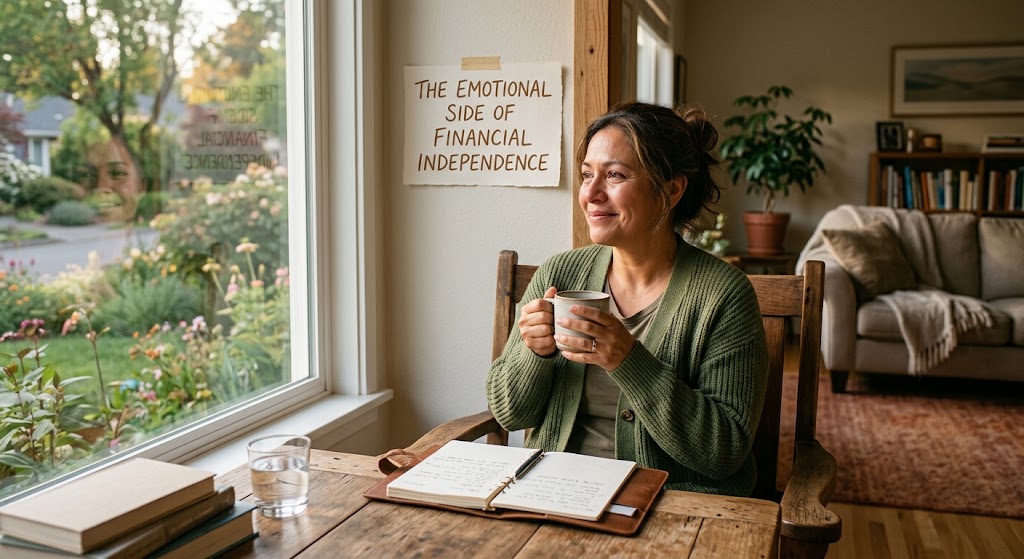
Financial independence is often presented as a numbers game. Save more money, reduce your expenses, increase your income, invest consistently, eliminate debt and eventually reach a point where your money can support the life you want without depending entirely on a salary. These principles are important, but they do not tell the whole story. Behind every financial decision is a human being with emotions, fears, memories, desires, insecurities and expectations. This is why understanding the emotional side of financial independence is just as important as understanding budgets, investments and savings.
Many people believe that becoming financially independent will automatically make them happy. They imagine waking up one morning without worrying about bills, debt, rent, school fees, emergencies or the next salary payment. They picture themselves finally breathing freely because money is no longer controlling every decision. There is some truth in this picture. Financial stability can reduce enormous amounts of stress. However, money can solve certain problems without automatically solving the emotional problems attached to money.
The emotional side of financial independence begins with recognising that money is rarely just money. For many people, money represents safety. For others, it represents freedom, status, success, respect, power, love or even personal worth. Someone who grew up watching their parents struggle financially may develop a deep fear of ever becoming poor. Another person may have experienced embarrassment because they could not afford what their friends had, leading them to associate money with social acceptance. Someone else may have learned that being financially successful is the only way to prove that they are valuable.
These experiences can influence financial behaviour for years without the person realising it.
You may think you are saving because you are disciplined when, deep down, you are terrified of losing everything. You may think you are spending because you enjoy life when, in reality, you are trying to compensate for years of deprivation. You may believe you want a luxury lifestyle because it genuinely makes you happy, when what you actually want is recognition from people who once underestimated you.
Understanding these emotional motivations is essential because financial independence is not simply about accumulating money. It is about developing a healthier relationship with money.
One of the biggest emotional challenges on the journey towards financial independence is fear. Fear can be useful because it can encourage you to prepare for emergencies and avoid reckless financial decisions. But excessive fear can become a prison. Someone can have enough money saved and still feel poor because their mind is constantly imagining financial disaster.
They may have six months of living expenses saved but still worry that one unexpected event will destroy everything. They may have investments growing steadily but remain obsessed with checking their balances every day. They may earn more than enough but refuse to enjoy anything because they are constantly afraid of losing what they have built.
Financial independence requires learning the difference between being financially responsible and being financially terrified.
There is nothing wrong with wanting security. In fact, building an emergency fund, controlling unnecessary spending and investing for the future are signs of responsibility. The problem begins when preparation becomes permanent anxiety. If you spend your entire life preparing for a future that never allows you to enjoy the present, you may eventually discover that you accumulated financial freedom without actually experiencing freedom.
Another powerful emotion connected to money is comparison. Modern society has made comparison almost unavoidable. Social media constantly exposes people to other people’s holidays, cars, houses, businesses, clothes, investments, weddings and lifestyles. You can be perfectly satisfied with your financial progress until you open your phone and see someone your age seemingly living a completely different life.
Suddenly, your progress feels inadequate.
You start asking why you are not earning as much. You wonder why someone else bought a house before you. You feel behind because another person launched a successful business. You begin increasing your spending simply to appear successful. You may even take on debt to maintain an image that your actual finances cannot support.
This is one of the greatest enemies of financial independence because comparison can make a person financially successful on paper but emotionally miserable.
Financial independence requires learning how to measure your progress against your own goals rather than someone else’s lifestyle. The person you envy online may have completely different circumstances, responsibilities, income, family support, debts and priorities. You are seeing their visible results without seeing the invisible costs behind them.
Your financial journey does not become a failure simply because somebody else appears to be moving faster.
Another important emotional issue is delayed gratification. Building wealth often requires saying no to things you could afford today because you have a bigger goal tomorrow. This sounds simple until you actually have to practise it.
You may want the new phone, but your savings goal matters more. You may want the expensive holiday, but you have decided to eliminate your debt first. You may want to upgrade your car, but you recognise that your current vehicle still works. You may want to spend every increase in your salary, but you choose to invest part of it instead.
These decisions can create emotional tension because humans naturally respond to immediate rewards. The future is uncertain, while today’s pleasure is guaranteed.
The key is not to turn financial independence into a life of constant deprivation. Extreme restriction can eventually create resentment. If every financial decision feels like punishment, you may eventually abandon your plan completely.
Healthy financial independence requires balance. You should be able to enjoy your money while still protecting your future. Saving should not mean refusing yourself every pleasure. Investing should not mean living like a prisoner. Frugality should not become an identity that prevents you from spending money on things that genuinely improve your life.
Money is a tool. The purpose of financial independence is not to become the richest person in the room. It is to gain greater control over your time, choices and future.
This brings us to another emotional challenge: identity.
What happens when your financial situation changes but your identity does not?
A person who spent years struggling financially may continue behaving as though they are permanently one emergency away from disaster even after their circumstances improve. Another person who becomes successful may begin identifying so strongly with wealth that losing money feels like losing themselves.
This is dangerous because net worth is not the same thing as self worth.
You are not your bank balance.
You are not your investment portfolio.
You are not your salary.
You are not the car you drive or the house you live in.
Money can influence your circumstances, but it should not determine your entire identity.
When your sense of worth depends on financial success, every financial setback can feel like a personal failure. A failed business becomes evidence that you are a failure. A bad investment becomes evidence that you are stupid. Losing a job becomes evidence that you are worthless. A period of low income becomes a source of shame.
The Emotional Side of Financial Independence
A healthier relationship with money allows you to separate your financial circumstances from your personal value. You can make a bad financial decision without being a bad person. You can lose money and still possess wisdom, character, skills and the ability to rebuild.
This emotional resilience is one of the most valuable assets you can develop.
Financial independence also changes relationships. When one person becomes financially independent while friends or family members are still struggling, complicated emotions can emerge. You may feel guilty about having more. You may feel pressured to constantly help relatives. You may struggle to say no when someone asks for money. You may even feel that achieving financial independence means abandoning people who helped you along the way.
Generosity is admirable, but financial independence requires boundaries.
Helping others should not require destroying your own financial stability. If you continuously sacrifice your financial future to rescue everyone around you, you may eventually become resentful. Worse, you may create a situation where people become dependent on you instead of developing their own financial strength.
There is nothing cruel about having financial boundaries. Sometimes the most responsible thing you can say is, “I cannot afford to do that.”
Learning to say no is an emotional skill as much as a financial one.
Another emotional challenge is the loss of external motivation. When you are struggling financially, survival can provide a powerful reason to work harder. You wake up because bills need to be paid. You chase opportunities because you need money. You tolerate an unpleasant job because you need the income.
But what happens when you finally have enough?
Some people discover that they do not know what to do with themselves.
Financial independence can remove financial pressure without automatically giving you purpose. This is why it is important to build a life that is meaningful beyond money.
If your entire life has been organised around making money, you may eventually reach your financial goal and ask yourself a difficult question: “Now what?”
That question is not a failure. It is an invitation to build a deeper life.
Financial independence can give you the freedom to spend more time with family, pursue meaningful work, learn new skills, create something, travel, volunteer, mentor others or simply live at a slower pace. The objective is not merely to escape work. It is to gain the freedom to choose how your time is used.
Time is one of the greatest emotional rewards of financial independence.
Imagine no longer accepting every opportunity because you desperately need the money. Imagine being able to leave a toxic workplace because your survival does not depend entirely on your next salary. Imagine having enough savings to handle an emergency without immediately panicking. Imagine being able to spend a day with your family without constantly thinking about overtime.
That freedom can be more valuable than material possessions.
However, reaching financial independence does not mean you will never worry about money again. Life remains unpredictable. Markets rise and fall. Businesses fail. Expenses appear unexpectedly. Economic conditions change. Family responsibilities evolve.
The goal is not to eliminate every financial fear. The goal is to become emotionally strong enough that financial uncertainty does not control your entire life.
This is why financial independence should include emotional preparedness.
You need to know how you behave when markets fall. You need to understand your spending triggers. You need to recognise when comparison is influencing your decisions. You need to know whether you spend money to impress people, comfort yourself or escape uncomfortable emotions. You need to understand how your childhood experiences influence your financial decisions.
Self awareness can save you from expensive mistakes.
Sometimes the best financial decision is not another investment strategy. Sometimes it is dealing with the emotional reason you keep overspending. Sometimes it is learning to stop comparing yourself to people online. Sometimes it is having an honest conversation with your partner about money. Sometimes it is accepting that you cannot afford a particular lifestyle yet.
Financial independence becomes easier when you stop treating money problems as purely mathematical problems.
Consider someone who repeatedly overspends despite knowing exactly how much they earn. Giving that person another spreadsheet may not solve the problem. The issue may be emotional. Perhaps spending provides temporary relief from stress. Perhaps buying things creates a sense of achievement. Perhaps they grew up without much and now feel entitled to enjoy everything they missed.
Until the emotional trigger is addressed, the financial behaviour may continue.
This is why budgeting should not only ask, “Where did my money go?” It should also ask, “Why did I spend it?”
That second question can be uncomfortable, but it can be transformative.
The emotional side of financial independence also involves patience. Wealth creation rarely happens as quickly as social media suggests. There will be periods when you feel like nothing is happening. Your savings may grow slowly. Your investments may appear boring. Your income may remain stagnant for a while. Other people may seem to be achieving more.
You will be tempted to abandon your plan and chase something faster.
Patience becomes a financial advantage because it protects you from emotional decisions. When you understand that meaningful wealth often requires time, you become less vulnerable to every new financial trend promising instant riches.
You stop needing every investment to make you rich quickly.
You stop believing every success story.
You stop feeling like you have failed simply because your results are not dramatic.
You begin appreciating consistency.
There is also a psychological shift that happens when you start saving money consistently. At first, saving can feel like losing something. You see money entering your account and immediately think about what you could have bought.
Eventually, however, your perspective can change.
Your savings begin to represent choices.
A thousand pounds or a million naira saved is not merely money sitting somewhere. It can represent the ability to handle an emergency. It can represent time. It can represent reduced dependence on someone else. It can represent the ability to walk away from a bad situation.
The emotional value of money increases when you understand what that money gives you the power to do.
This is why financial independence is deeply connected to confidence.
Not the loud kind of confidence that comes from displaying wealth, but the quiet confidence that comes from knowing you are prepared.
You know what you earn.
You know what you spend.
You know what you owe.
You know what you are building.
You know what you are willing to sacrifice.
You know what matters to you.
You know that one financial setback will not necessarily destroy your entire life.
That knowledge produces a different kind of peace.
The journey also requires accepting that your definition of financial independence may change over time. At twenty five, you may define it as leaving your parents’ home and paying your own bills. Later, it may mean buying a home. At another stage, it may mean having enough investments to reduce your dependence on employment. For someone else, it may simply mean having enough income and savings to stop living from one payday to the next.
There is no universal number that automatically makes someone financially independent.
The emotional side of financial independence is therefore deeply personal.
Your goal should not be built entirely around impressing society. It should be connected to the life you genuinely want.
If you earn more money but become more stressed, more isolated and more obsessed with maintaining an image, you may have increased your wealth while decreasing your quality of life.
If you have less money than someone else but possess control over your time, manageable expenses, meaningful relationships and peace of mind, your financial position may be stronger than it appears.
This does not mean money is unimportant. Money matters tremendously. Financial problems can cause genuine hardship, and having enough resources can dramatically improve your options. But money works best when it supports your values instead of replacing them.
Ultimately, financial independence is not simply about reaching a number. It is about becoming the kind of person who can handle money without allowing money to control their emotions, identity and decisions.
You need discipline when you have little.
You need wisdom when you have more.
You need humility when you become successful.
You need resilience when things go wrong.
You need patience when progress is slow.
You need boundaries when people ask for more than you can give.
You need self awareness when your emotions influence your spending.
And perhaps most importantly, you need to remember why you wanted financial independence in the first place.
If you wanted freedom, do not become a slave to your investment portfolio.
If you wanted peace, do not spend your life obsessing over every financial fluctuation.
If you wanted more time, do not sacrifice every hour trying to accumulate more money than you actually need.
If you wanted security, build it.
If you wanted choices, protect them.
If you wanted a better life, make sure the process of building wealth does not prevent you from living that life.
The emotional side of financial independence is ultimately about freedom from fear, comparison, pressure and financial chaos. It is about reaching a point where money becomes something you manage rather than something that manages you.
The greatest sign of financial independence may not be the size of your bank account. It may be the peace you feel when you know that your life is no longer completely controlled by your next pay cheque.
You may still want more money. You may still have financial goals. You may still work hard. You may still invest and save aggressively. But your motivation changes.
You are no longer running endlessly because you are terrified of falling behind.
You are building because you understand what freedom means to you.
And perhaps that is the deepest lesson of all. Financial independence is not just about having enough money to survive without working. It is about creating enough financial strength, emotional maturity and personal clarity to decide how you want to live.
Money can buy options.
Money can reduce pressure.
Money can create opportunities.
But emotional freedom determines whether you actually know how to use those opportunities.
That is why anyone pursuing financial independence should pay attention not only to their bank account, but also to their mindset. Learn your financial numbers, but learn yourself too. Build your savings, but build your emotional resilience. Invest your money, but also invest in your ability to make rational decisions when fear, excitement, envy or pressure appears.
Because the ultimate goal is not simply to become wealthy.
The goal is to become free.

EarnSmartOnline.com.ng is dedicated to helping readers make smarter financial decisions through practical guides on online income, personal finance, technology, digital business, and wealth creation. Our goal is to provide reliable, easy-to-understand, and actionable content that empowers individuals to earn smarter, build sustainable income streams and achieve long-term financial success.
Recommended: Start Earning Online
- Ultimate Affiliate Marketing Program — learn affiliate marketing with a done-for-you sales system ($15). Check it out
- The Newbie Affiliate Guide — the beginner-friendly starter guide (~$6.68). Check it out
- Easy Dollar Maker — earn in dollars uploading AI images and videos from your phone ($17). Check it out
Disclosure: These are affiliate links. If you buy through them, I may earn a commission at no extra cost to you.



