
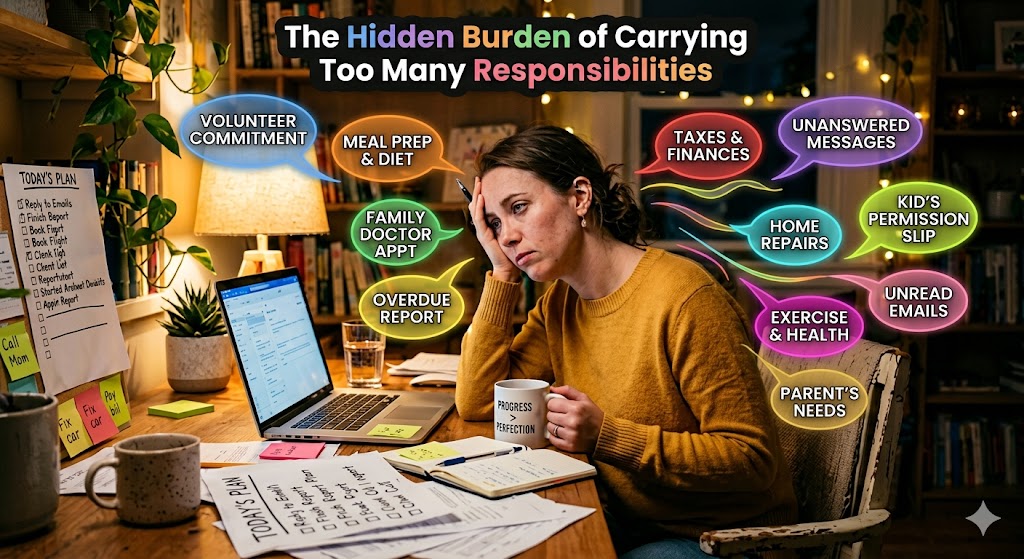
The Hidden Burden of Carrying Too Many Responsibilities
Most people assume that being responsible for many things at once is a sign of strength, maturity, or success. In reality, carrying too many responsibilities often becomes a hidden burden that quietly drains mental energy, reduces productivity, and slows down real progress in life. It does not always show up immediately as failure or breakdown. Instead, it shows up as constant fatigue, delayed goals, emotional irritation, and the feeling that no matter how hard you try, you are always behind. The modern world even encourages this overload by glorifying busyness as achievement, when in truth, busyness and effectiveness are not the same thing.
When a person takes on too many responsibilities, their attention becomes divided across multiple directions. The human mind is not designed for endless switching between unrelated tasks and obligations. Each time focus shifts, there is a mental cost, even if it seems small. Over time, this cost accumulates and creates what can be described as cognitive exhaustion. This is why someone can spend an entire day being “busy” yet feel like nothing meaningful was accomplished. The issue is not lack of effort but the fragmentation of attention across too many competing demands.
One of the most dangerous aspects of over-responsibility is that it often starts with good intentions. People want to help others, prove themselves, avoid disappointment, or meet expectations placed on them by family, work, or society. At first, saying yes feels like progress. It feels like being dependable and valuable. However, as more responsibilities are added without removing old ones, a silent imbalance begins to form. The person slowly transitions from being in control of their responsibilities to being controlled by them. This shift is subtle, but its impact is long lasting.
Emotionally, carrying too many responsibilities creates an invisible pressure that never fully goes away. Even during rest, the mind continues to process unfinished tasks, pending obligations, and future expectations. This reduces the quality of rest and prevents true recovery. Over time, this can lead to irritability, reduced patience, and a low threshold for stress. People in this state often do not realize that their emotional reactions are not caused by the present moment alone, but by accumulated mental overload that has not been addressed.
Another hidden burden is the decline in decision quality. When someone is managing too many responsibilities, they often make faster but poorer decisions simply because they do not have enough mental space to evaluate options properly. Important decisions are rushed, small decisions are ignored, and long-term thinking becomes replaced by short-term survival thinking. This is one of the main reasons why people with overloaded lives often feel stuck. They are constantly reacting instead of intentionally directing their lives.
There is also a financial and productivity cost attached to overcommitment. When attention is scattered, execution becomes inconsistent. Projects take longer to complete, mistakes become more frequent, and opportunities are missed due to lack of capacity. Even when income or output increases temporarily, it is usually not sustainable because the underlying system is stretched beyond its natural limit. In contrast, people who manage fewer but more meaningful responsibilities tend to produce higher quality results because their focus is concentrated and uninterrupted.
Relationships are also affected in subtle ways. When someone is overwhelmed, they may still be physically present but mentally absent. Conversations become shallow, emotional connection weakens, and patience within relationships decreases. This does not mean the person cares less, but rather that their mental bandwidth is already consumed by too many other obligations. Over time, this can create distance between partners, friends, and family members, even when no intentional harm is intended.
One of the clearest signs of carrying too many responsibilities is the constant feeling of urgency. Everything feels important, everything feels urgent, and nothing feels fully complete. This creates a cycle where the mind is always in a state of pressure. Even small tasks feel heavy because they are added on top of an already overloaded system. Instead of working with clarity, the individual operates in a state of mental noise, where priorities are unclear and energy is constantly being drained in multiple directions.
The long term consequence of this lifestyle is stagnation. It may appear externally that the person is active and engaged in many areas, but internally there is little deep progress in any single direction. Growth requires depth, not just activity. Depth requires time, focus, and the ability to stay committed to a limited number of meaningful responsibilities. Without this, life becomes a collection of unfinished efforts rather than completed achievements.
Interestingly, many people do not recognize the burden until they experience burnout or a major life disruption forces them to pause. At that point, the realization becomes clear that not all responsibilities were equally important. Some were essential, but many were simply inherited, assumed, or accepted without proper evaluation. This realization often leads to regret about how much energy was spent on things that did not significantly contribute to long term well-being or success.
A healthier approach involves learning the discipline of selective responsibility. This does not mean avoiding obligations or becoming irresponsible. Instead, it means understanding capacity limits and intentionally choosing what deserves attention. Every responsibility accepted has a cost, not just in time, but in mental energy, emotional stability, and long term focus. When this cost is understood, decision making becomes more strategic. Saying no becomes a form of protection rather than rejection.
Ultimately, life becomes more manageable and meaningful when responsibilities are aligned with capacity and priorities rather than external pressure. Reducing unnecessary burdens does not reduce value; it increases clarity. And clarity is what allows real progress to happen. When the mind is not overwhelmed, creativity improves, decisions become stronger, relationships deepen, and personal growth accelerates naturally.
The hidden burden of carrying too many responsibilities is not always visible from the outside, but it shapes almost every aspect of a person’s internal experience. Recognizing it is the first step toward regaining control. The goal is not to do everything, but to do the right things well. When responsibilities are chosen with awareness rather than accumulated by default, life becomes not only more productive but also significantly more peaceful and sustainable.

EarnSmartOnline.com.ng is dedicated to helping readers make smarter financial decisions through practical guides on online income, personal finance, technology, digital business, and wealth creation. Our goal is to provide reliable, easy-to-understand, and actionable content that empowers individuals to earn smarter, build sustainable income streams and achieve long-term financial success.
Recommended: Start Earning Online
- Ultimate Affiliate Marketing Program — learn affiliate marketing with a done-for-you sales system ($15). Check it out
- The Newbie Affiliate Guide — the beginner-friendly starter guide (~$6.68). Check it out
- Easy Dollar Maker — earn in dollars uploading AI images and videos from your phone ($17). Check it out
Disclosure: These are affiliate links. If you buy through them, I may earn a commission at no extra cost to you.



