
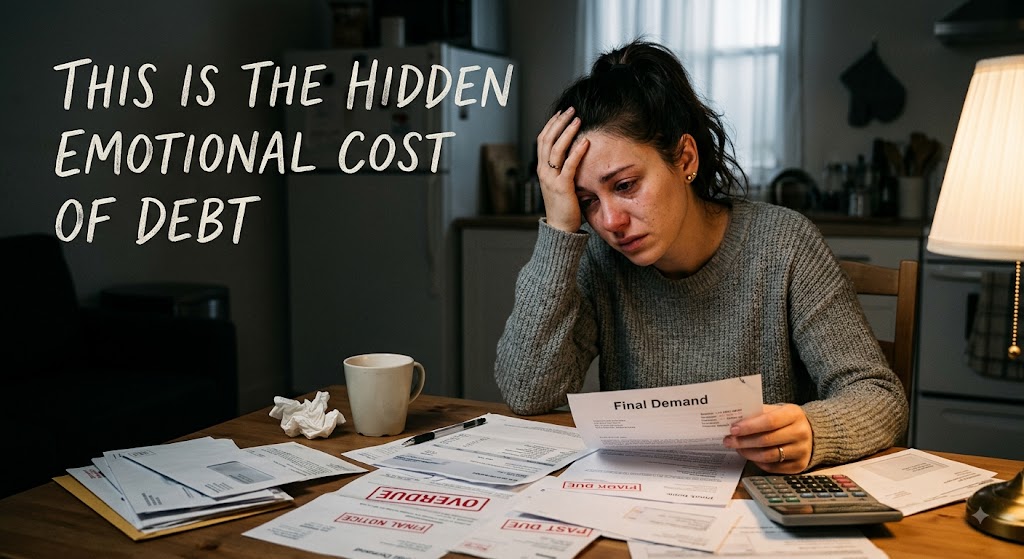
Debt is often discussed as a financial problem. People talk about interest rates, monthly repayments, credit scores, loan terms, income, budgeting and how quickly someone can become debt free. Yet there is another side of debt that receives far less attention. Behind every unpaid bill, overdue loan, credit card balance or borrowed amount is a human being carrying an emotional burden that may not appear on any financial statement. This is the hidden emotional cost of debt, and for many people, it can be more damaging than the money itself.
When people think about debt, they usually calculate what they owe. They rarely calculate what debt is taking from them emotionally. A person may owe ₦500,000, ₦2 million or ₦10 million, but the real cost can include sleepless nights, anxiety, shame, arguments, isolation, loss of confidence, constant worry and the feeling of being trapped. Two people can owe exactly the same amount and experience completely different emotional consequences depending on their income, circumstances, family responsibilities and personal relationship with money.
The hidden emotional cost of debt begins with the psychological pressure of knowing that money you have not yet earned has already been committed. When your salary arrives and a significant portion immediately belongs to someone else, your income can begin to feel smaller than it actually is. You may earn a reasonable amount of money, but instead of experiencing that income as freedom, you experience it as something that arrives already divided between lenders, bills and obligations.
This can create a constant feeling of financial suffocation. You begin calculating everything before spending anything. You think about transport before leaving home. You consider the price of food before ordering it. You hesitate before helping family members. You may even avoid answering certain phone calls because you suspect the person calling is asking about money. Your financial life becomes a series of calculations, and eventually those calculations begin occupying your mind even when you are supposed to be resting.
One of the most painful aspects of debt is that it can follow you into places where money should not be the main subject. You can be sitting with friends and still be thinking about repayment. You can attend a family celebration while worrying about an upcoming instalment. You can lie in bed at night and replay financial decisions you made months or years ago. You may wonder why you borrowed the money, why you trusted someone, why you spent what you did or why an emergency happened when you were already financially stretched.
This is where debt becomes more than a financial issue. It becomes a mental burden.
The hidden emotional cost of debt can also produce shame. Many people do not want others to know how much they owe. They may continue presenting an image of financial stability while privately struggling to meet basic obligations. Social media makes this problem even more complicated because people constantly see images of holidays, new cars, expensive restaurants, new phones, businesses, weddings and seemingly successful lifestyles. When someone is deeply indebted, seeing these images can intensify the feeling that everyone else is moving forward while they are falling behind.
The person may begin comparing their real life with someone else’s carefully selected public image. That comparison can produce embarrassment and self criticism. Instead of saying, “I am experiencing financial difficulty,” the person may begin thinking, “I am a failure.”
That difference matters.
Having debt does not automatically mean someone is irresponsible, unintelligent or unsuccessful. Debt can result from emergencies, unemployment, business problems, education, family responsibilities, medical expenses, poor financial decisions, economic conditions or simply trying to survive during a difficult period. Some people borrow because they want something they cannot afford. Others borrow because they have no other option at the time.
Unfortunately, society often judges the debt without knowing the story behind it.
The emotional consequences can become particularly severe when debt affects relationships. Money is already one of the subjects capable of creating tension between partners, family members and friends. Debt can amplify that tension. A spouse may become angry because loan repayments are consuming money that could have been used for household needs. A parent may feel guilty because they borrowed money to support their children. A young person may avoid conversations with relatives because they cannot repay money they borrowed.
The Hidden Emotional Cost of Debt
In some cases, debt can turn people who once trusted each other into people who constantly question one another. Every financial decision becomes an argument. Every purchase becomes suspicious. Every unexpected expense becomes a source of conflict.
The problem is not always the amount of money involved. Sometimes it is the uncertainty surrounding the money.
People can tolerate difficult situations more easily when they understand when the difficulty will end. Debt becomes emotionally exhausting when there is no clear exit. If someone owes money but has a realistic repayment plan, the burden may feel manageable. But when someone keeps borrowing to repay previous borrowing, the situation can feel like a tunnel with no visible end.
This is why debt can create hopelessness.
You may start thinking, “Even if I work hard, where will I get the money?” You may receive your salary and immediately realise that it will not cover everything. You may take another loan to handle an existing obligation, creating a temporary feeling of relief followed by even greater pressure later.
This cycle can be emotionally destructive because every solution becomes another problem.
The hidden emotional cost of debt can also affect productivity. A financially stressed person may struggle to concentrate at work. Their mind may constantly return to unpaid bills, repayment dates and difficult conversations. They may become distracted, irritable or mentally exhausted. Someone sitting at a desk for eight hours may technically be working, but a significant portion of their mental energy may be occupied by financial concerns.
This matters because financial stress can create a vicious cycle. Debt creates worry. Worry affects concentration. Reduced concentration can affect productivity. Lower productivity can affect income or career opportunities. Lower income then makes debt more difficult to manage.
The emotional burden can therefore influence the very financial recovery a person needs.
Another hidden cost is the loss of financial confidence. Someone who has made several financial mistakes may eventually stop trusting their own judgement. They may become afraid to invest, start a business, negotiate their salary or make necessary financial decisions because they are terrified of making another mistake.
This is particularly dangerous because financial recovery requires action. A person cannot build a healthier financial future if fear prevents them from making thoughtful decisions. The goal is not to eliminate every possibility of making mistakes. The goal is to learn from previous mistakes without allowing them to become a permanent definition of your identity.
Debt can also encourage secrecy. A person may hide bank messages, avoid opening financial statements or ignore calls from lenders. They may postpone looking at their actual balance because knowing the truth feels frightening. Unfortunately, avoiding financial information rarely makes the problem disappear. In many situations, it allows the problem to grow quietly.
Facing debt can be uncomfortable, but uncertainty is often more emotionally expensive than information.
Once you know exactly what you owe, whom you owe, the interest involved, the repayment dates and your available income, you can begin developing a strategy. The numbers may still be difficult, but at least they become visible. A visible problem can be planned for. An unknown problem can dominate your imagination.
Another emotional consequence of debt is the loss of freedom. Financial freedom is often described as having enough money to make choices without being controlled by financial pressure. Debt can produce the opposite experience. You may want to change jobs but cannot because you need the salary to maintain repayments. You may want to move to a cheaper home but feel trapped by other obligations. You may want to start saving but have no money left after repayments.
Even when nobody is physically forcing you to stay in a particular situation, debt can make you feel trapped.
This feeling can become particularly painful when someone sees opportunities around them but cannot take advantage of them. A business opportunity appears, but there is no capital. A training programme becomes available, but there is no spare money. A chance to relocate appears, but existing obligations make it impossible.
Debt can therefore cost more than money. It can cost options.
However, acknowledging the emotional cost of debt does not mean treating debt as something that cannot be overcome. In fact, understanding the emotional side can be an important part of recovery. If you only focus on the numbers while ignoring the psychological burden, you may create a technically correct repayment plan that you cannot emotionally sustain.
Debt recovery requires honesty, patience and realistic expectations.
The first step is to stop confusing your financial situation with your personal identity. You may be in debt, but you are not debt. You may have made a poor financial decision, but you are not a poor decision. You may have experienced financial failure, but that does not make you a failure as a human being.
That distinction is powerful because shame often encourages avoidance, while responsibility encourages action.
The next step is to understand your complete financial position. Write down what you owe and determine which debts carry the highest costs or consequences. Understand your income and essential expenses. Identify spending that can be reduced without creating another problem. If possible, communicate with lenders or people you owe rather than disappearing from the conversation.
Communication will not magically erase debt, but silence can make emotional pressure worse.
It is also important to stop taking on new debt simply to maintain an appearance of normality. One of the most dangerous emotional reactions to financial pressure is pretending everything is fine. Someone may continue spending because they do not want friends or family to realise they are struggling. They may continue participating in expensive social activities because saying no feels embarrassing.
But protecting an image can become extremely expensive.
There is no shame in saying, “I cannot afford that right now.” In fact, learning to say no can be one of the most financially powerful decisions a person makes. Your financial recovery may require temporary sacrifices that other people do not understand.
You do not need to explain every financial decision to everyone.
Another important part of managing the hidden emotional cost of debt is learning to separate needs from pressure. Sometimes we borrow money not because we genuinely need something but because we feel pressure to maintain a certain lifestyle. Society constantly tells people that success must be visible. A newer phone, better car, bigger celebration, designer clothing or more expensive lifestyle can become symbols of achievement.
But appearing wealthy while being financially overwhelmed is not wealth.
Real financial progress often looks boring from the outside. It can look like paying a debt instead of buying something unnecessary. It can look like staying in an older car because the payments are manageable. It can look like cooking at home, delaying a holiday or rebuilding an emergency fund.
Nobody may applaud these decisions, but they can fundamentally change someone’s financial future.
It is also important to understand that emotional recovery may take longer than financial recovery. You might pay off a debt and still feel anxious about money. You might become financially stable but continue expecting something to go wrong. If debt has occupied your mind for years, your brain may need time to adjust to a different financial reality.
This is why rebuilding financial confidence matters.
Set small financial goals that you can actually achieve. Celebrate progress without becoming careless. If you pay off one account, acknowledge the achievement. If you save your first emergency fund contribution, recognise the discipline involved. If you successfully avoid unnecessary borrowing for several months, understand that you are changing your financial behaviour.
Progress does not always look dramatic.
Sometimes progress is simply refusing to repeat the same mistake.
The hidden emotional cost of debt also teaches an important lesson about financial education. People need more than information about how to make money. They need to understand how money affects behaviour, relationships, confidence and decision making. Knowing how to earn money is valuable, but knowing how to manage pressure, delay gratification, plan for emergencies and distinguish genuine needs from emotional spending is equally important.
Financial literacy should not only teach people how to calculate interest. It should teach them how debt can influence their emotions and behaviour.
Debt itself is not always evil. Borrowing can sometimes be useful when it is carefully planned and connected to a productive purpose. The problem begins when borrowing becomes the default solution to every financial challenge. When every unexpected expense leads to another loan, the person may eventually lose the ability to handle ordinary financial shocks without borrowing.
The long term goal should therefore be more than simply paying today’s debt. It should be creating a financial structure that reduces the likelihood of returning to the same cycle.
That may involve building an emergency fund, increasing income, controlling lifestyle inflation, learning new skills, reducing unnecessary expenses, creating additional income streams or changing financial habits. The right solution will differ from person to person.
What matters is creating a path towards greater control.
Perhaps the most important lesson is that financial problems deserve to be treated with both numbers and compassion. A spreadsheet can show how much someone owes. It cannot show how many nights that person has spent worrying. A bank statement can show a balance. It cannot show the arguments that balance has caused at home. A repayment schedule can show dates and amounts. It cannot show the emotional exhaustion behind every payment.
That is the human side of money.
If you are currently dealing with debt, remember that your situation deserves attention, but it does not deserve to become your identity. Face the numbers. Stop hiding from the reality. Create a realistic plan. Seek trustworthy financial guidance when necessary. Communicate with the people involved. Make difficult decisions where necessary and give yourself enough time to recover.
And if someone you know is struggling with debt, consider asking how they are doing rather than simply asking when they will pay you back. Responsibility still matters, but so does humanity.
The hidden emotional cost of debt is real because money is never only about money. It affects how people sleep, think, communicate, work, love, plan and see themselves. That is why financial health should be treated as part of overall wellbeing.
Debt may take money from your future, but it should not be allowed to take your entire sense of hope.
There may be a long road between where you are today and where you want to be financially. The road may involve uncomfortable decisions, delayed gratification and periods when progress feels painfully slow. But every responsible financial decision is a step towards greater freedom.
You do not need to solve everything in one day.
You need to stop making the problem invisible, understand where you stand and begin moving in the right direction.
Because the real victory is not simply reaching a point where you owe nobody anything. The real victory is reaching a point where money no longer controls every thought, every decision and every conversation.
That is the freedom worth working towards.

EarnSmartOnline.com.ng is dedicated to helping readers make smarter financial decisions through practical guides on online income, personal finance, technology, digital business, and wealth creation. Our goal is to provide reliable, easy-to-understand, and actionable content that empowers individuals to earn smarter, build sustainable income streams and achieve long-term financial success.
Recommended: Start Earning Online
- Ultimate Affiliate Marketing Program — learn affiliate marketing with a done-for-you sales system ($15). Check it out
- The Newbie Affiliate Guide — the beginner-friendly starter guide (~$6.68). Check it out
- Easy Dollar Maker — earn in dollars uploading AI images and videos from your phone ($17). Check it out
Disclosure: These are affiliate links. If you buy through them, I may earn a commission at no extra cost to you.



