
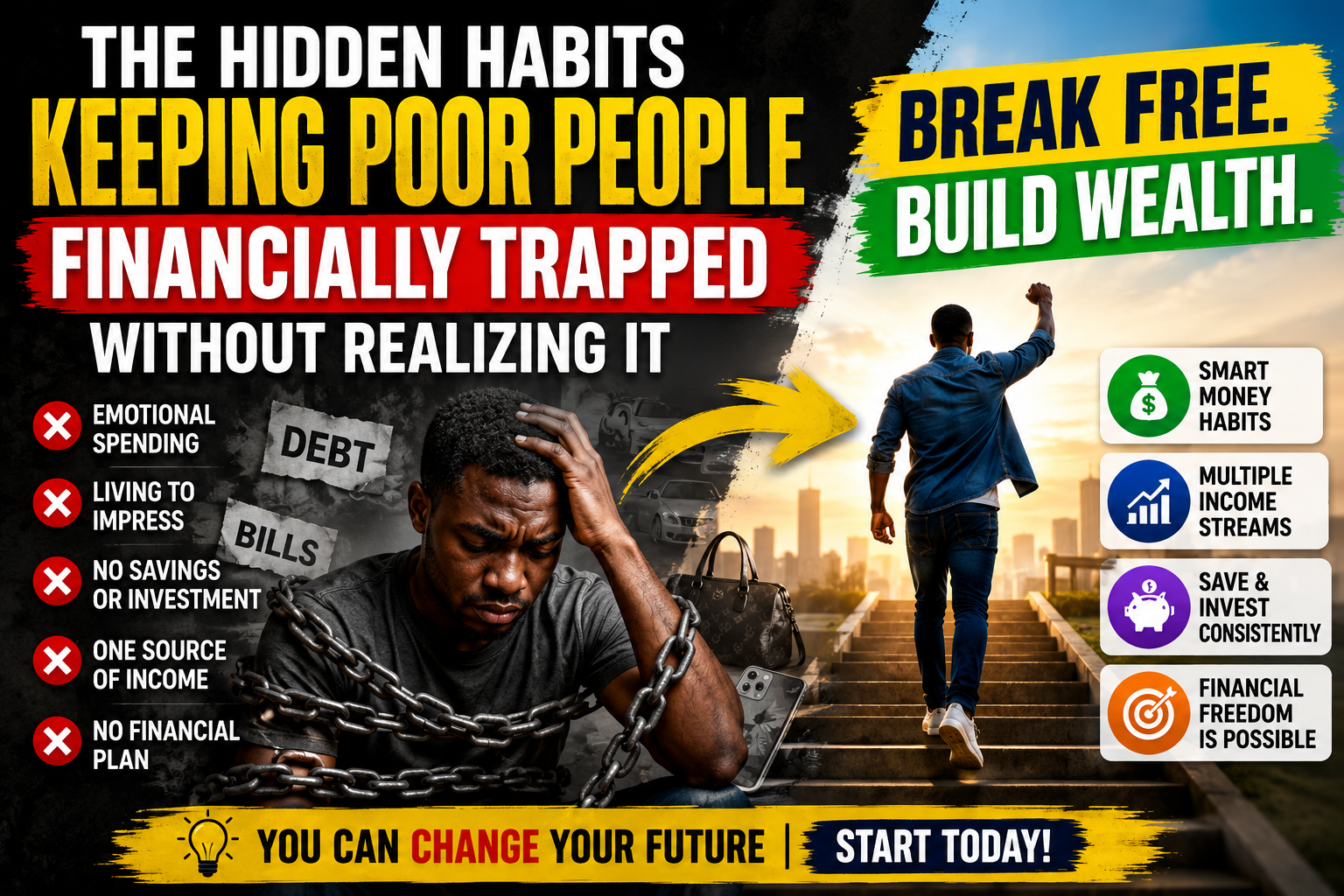
The Hidden Habits Keeping Poor People Financially Trapped
Money problems are rarely caused by one bad decision. More often, financial struggles develop through a combination of habits, beliefs, emotional reactions and repeated choices that seem harmless when viewed individually but become extremely expensive over time. This is why understanding The Hidden Habits Keeping Poor People Financially Trapped is so important. Many people are not financially struggling because they are unintelligent, lazy or incapable of becoming successful. In many cases, they are caught inside patterns that quietly consume their income, limit their opportunities and prevent them from building financial security.
It is also important to recognise that poverty is not simply a personal failure. Low wages, unemployment, poor access to quality education, family responsibilities, unexpected emergencies, inflation, economic instability, discrimination and limited access to capital can all make financial progress extraordinarily difficult. Two people can make similar financial decisions and experience completely different outcomes because their circumstances are different. However, even when circumstances are difficult, certain habits can make financial pressure significantly worse. Identifying those habits is not about blaming people for being poor. It is about discovering where change is possible.
One of the most damaging habits is spending money immediately after receiving it. For someone living from one income payment to another, payday can create a temporary feeling of relief. Bills have been waiting, family members need help, food needs to be purchased and personal needs have been postponed. Once the money arrives, spending can feel justified because so many things have been waiting for attention. Unfortunately, if every payment is consumed before the next one arrives, there is no opportunity to build savings, invest or create an emergency fund. The cycle repeats itself again and again.
Another hidden habit is treating every increase in income as permission to increase spending. Someone earns more money and immediately upgrades their phone, clothing, car, apartment, entertainment or lifestyle. The salary rises, but financial pressure remains exactly the same. This is lifestyle inflation, and it can quietly destroy the benefits of career advancement. Earning more money does not automatically create wealth if every additional amount is absorbed by additional expenses. Financial progress begins when income increases faster than lifestyle.
Many people also confuse looking wealthy with actually becoming wealthy. Expensive clothes, new phones, luxury cars, expensive restaurants and impressive social media posts can create the appearance of financial success without producing financial security. A person can look rich and have almost nothing saved. Another person can live modestly while quietly building assets worth far more than anyone around them realises.
The pressure to impress other people can therefore become financially destructive. Social media has made this problem even worse because people constantly see carefully selected images of holidays, cars, designer items, weddings, parties and luxurious lifestyles. What is rarely visible is the debt, family assistance, credit card balance, unpaid bills or financial anxiety behind the image. Trying to compete with appearances can lead people to spend money they desperately need for their future.
Another habit that keeps people financially trapped is failing to track where their money goes. Many people know how much they earn but cannot explain where their money disappears each month. Small purchases appear insignificant. A little food here, transportation there, subscriptions, data, entertainment, impulse purchases and frequent transfers to friends or relatives can gradually consume a substantial portion of income.
Money does not need to disappear through one massive purchase. It can disappear through hundreds of small decisions. Without tracking, it becomes almost impossible to identify the leaks. A person who believes they cannot save anything may discover that the problem is not necessarily that saving is impossible. The problem may be that the money has already been assigned to dozens of unnecessary expenses before they consciously decide what they want to do with it.
Impulse buying is another hidden habit with serious consequences. Emotional spending often happens when people are stressed, bored, frustrated, lonely or excited. Buying something can provide temporary satisfaction. Unfortunately, the emotional reward is usually short lived while the financial consequence remains. If someone repeatedly uses shopping as a way to regulate their emotions, their bank account eventually pays the price.
A powerful financial habit is learning to pause before spending. Not every desire deserves an immediate response. Asking whether something is necessary, whether it was planned, whether it creates long term value and whether the purchase will still seem important after a few days can prevent countless unnecessary expenses.
Another habit is relying too heavily on debt for ordinary living expenses. Debt itself is not always bad. Borrowing can sometimes help people acquire assets, finance education, start businesses or handle genuine emergencies. The problem begins when debt becomes a permanent substitute for insufficient income.
Using loans to pay bills, borrowing money to maintain appearances or repeatedly taking new loans to repay old ones can create a financial treadmill. The borrower works to earn money, but a significant portion of that income immediately goes towards obligations created in the past. The future income is effectively spent before it arrives.
High interest debt can be particularly dangerous because the longer it remains unpaid, the more expensive the original purchase becomes. Something bought for a relatively small amount can eventually cost dramatically more after interest and fees. This is one reason financial education matters. People need to understand not only how much they are borrowing but how much the borrowing will ultimately cost.
Another hidden habit is refusing to learn about money. Some people spend years saying that they are not good with finances. They avoid learning about budgeting, saving, investing, interest, insurance, taxes, pensions and asset building because these subjects appear complicated. Unfortunately, avoiding financial education does not protect anyone from financial consequences. The less a person understands about money, the easier it becomes for other people and systems to make money from their lack of knowledge.
Financial literacy does not require becoming an economist. It begins with understanding basic principles. Know what comes in. Know what goes out. Understand debt. Build an emergency reserve when possible. Avoid unnecessary interest. Increase earning power. Save consistently. Learn how investments work before putting money into them. Protect yourself against major financial risks. These simple principles can dramatically change the direction of a person’s financial life over time.
Another problem is postponing saving until there is more money. Many people say, “I will start saving when I earn more.” Then their income increases, expenses increase and saving is postponed again. The problem is not always the amount being saved. It is the absence of the habit.
Someone who cannot save a small amount consistently may struggle to save a large amount consistently later. Saving is partly a behavioural skill. Starting small can teach discipline and create a financial buffer. The amount can increase as income improves.
Another hidden habit is keeping all available money in a form that is easily spent. If every naira is sitting in an account used for everyday spending, temptation becomes easier to satisfy. Creating separation between spending money, emergency savings and long term investments can make financial discipline easier. The objective is not to make money inaccessible but to create enough friction to prevent every desire from becoming a purchase.
Poor financial boundaries with family and friends can also keep people trapped. Helping loved ones is important, particularly in communities where family responsibilities are strong. However, constantly rescuing other people while destroying your own financial stability can create a cycle in which everyone remains dependent.
There is a difference between generosity and financial self destruction. If helping someone means you cannot pay your own essential bills, cannot save anything and must borrow money afterwards, the situation needs to be reconsidered. Sustainable generosity requires boundaries. Sometimes the most responsible thing you can do for yourself and your family is to become financially stable enough that your assistance does not destroy you.
Another hidden habit is waiting for motivation instead of creating systems. People often promise themselves that they will become disciplined next month, after payday, after a new job or after a difficult period ends. But financial improvement rarely happens because someone suddenly becomes permanently motivated. It happens because systems make good decisions easier to repeat.
Automatic savings, spending limits, written budgets, scheduled bill payments and clearly defined financial goals can reduce the number of decisions that need to be made emotionally. The less frequently you have to negotiate with yourself, the easier it becomes to remain consistent.
There is also the habit of focusing exclusively on cutting expenses while ignoring income growth. Cutting unnecessary spending is important, but there is a limit to how much a person can save by reducing expenses. If someone earns very little, extreme frugality alone may not transform their financial situation.
Increasing earning power can be equally important. Learning a valuable skill, improving professional qualifications, developing a side business, negotiating better pay, offering services, building a digital product or finding additional legitimate income opportunities can create more room for financial progress. The strongest financial strategy often combines responsible spending with increasing income.
Another habit is staying financially loyal to a career, business model or income source that has stopped providing meaningful growth. Security matters, but so does adaptability. The economy changes. Technology changes. Industries change. Skills become more or less valuable. People who continually learn and adapt often create more opportunities for themselves than people who depend entirely on what worked ten years ago.
Fear can also become a financial trap. Some people know they need to change careers, learn a new skill, start a business or explore another opportunity, but fear prevents them from acting. Of course, reckless decisions can be dangerous. The answer is not to abandon stability blindly. It is to develop a strategy for moving towards something better while managing risk intelligently.
Another damaging habit is believing that wealth is reserved for other people. If someone repeatedly tells themselves that rich people are lucky, that investing is only for wealthy people or that financial success is impossible for someone from their background, they may unconsciously stop looking for opportunities. Beliefs influence behaviour.
A healthier mindset does not require pretending that everyone has equal opportunities. They do not. It simply means refusing to conclude that difficult circumstances make improvement impossible. Financial progress may be slow. It may require years rather than months. But slow progress is still progress.
One of the most expensive habits is failing to think long term. Poverty often demands immediate thinking because immediate problems are real. There is food to buy, rent to pay, school fees to handle and emergencies to solve. Long term planning can feel like a luxury when today’s problems are demanding attention.
Yet the future eventually becomes today. The person who consistently sacrifices every long term goal for short term comfort may eventually reach a point where they have no financial cushion, no meaningful assets and no alternative source of income. Even putting a small amount towards the future can create a different trajectory.
The opposite problem also exists. Some people become so obsessed with future wealth that they make life miserable in the present. Financial discipline should not mean refusing every reasonable pleasure. Money is a tool, not a punishment. The goal is to create a balance where today’s needs and happiness are considered without sacrificing tomorrow’s security.
Perhaps the most dangerous hidden habit is giving up after setbacks. A failed business, job loss, unexpected medical expense, bad investment or period of unemployment can make someone believe that financial improvement is pointless. But financial journeys rarely move in a straight line. Setbacks are part of reality.
What matters is the ability to learn, adjust and continue. A financial mistake does not have to become a permanent financial identity. Someone who made poor decisions five years ago can make dramatically different decisions today. The past can explain a person’s situation without permanently determining their future.
Breaking The Hidden Habits Keeping Poor People Financially Trapped begins with honesty. It requires looking at spending without excuses, debt without denial, income without fantasy and goals without embarrassment. It requires asking difficult questions. Where does my money actually go? What do I repeatedly buy that I do not need? Which debts are controlling my future income? What skill could increase my earning power? What financial behaviour would I be embarrassed to admit is hurting me? What am I doing today that my future self will regret?
The answers may not be comfortable, but discomfort can be useful. Awareness creates the possibility of change.
Financial freedom rarely arrives through one dramatic decision. It is usually built through ordinary decisions repeated for a long time. Spending less than you earn when possible. Saving consistently. Avoiding unnecessary debt. Increasing your skills. Protecting your income. Building assets. Setting boundaries. Learning about money. Resisting the pressure to impress people. Thinking beyond the next payday.
None of these actions guarantees wealth. Life contains circumstances that no budget can completely control. But they can improve the odds of financial stability and create greater control over the money that is available.
The biggest lesson is that being financially trapped does not always look like poverty. Sometimes it looks like earning a decent salary but having nothing left. Sometimes it looks like owning expensive possessions but carrying heavy debt. Sometimes it looks like receiving more income every year while somehow remaining just as financially stressed. Sometimes it looks like constantly borrowing from tomorrow to survive today.
Recognising these patterns is powerful because what remains invisible is difficult to change. Once a person sees the habit, they can question it. Once they question it, they can replace it. And once better financial behaviours are repeated long enough, they can gradually become a new normal.
The journey out of financial struggle is rarely glamorous. It may involve saying no when everyone else is saying yes. It may involve keeping an old phone when people expect a new one. It may involve learning a skill after work when you would rather relax. It may involve admitting that certain friendships, habits or spending patterns are damaging your finances. It may involve starting with a tiny savings balance and patiently building from there.
But financial progress does not need to impress anybody.
The person quietly building an emergency fund may look less successful than the person displaying expensive purchases online. The person learning a valuable skill may look behind today while preparing for a completely different future. The person paying off debt may appear to be doing nothing exciting while actually buying back their future income.
That is why understanding The Hidden Habits Keeping Poor People Financially Trapped matters. Financial change begins when people stop judging their lives only by what they can display and start measuring progress by what they are building.
Money is not the entire meaning of life, and wealth is not a guarantee of happiness. But financial stability can provide options, reduce unnecessary stress and create greater freedom to make important life decisions. Building that stability requires more than earning money. It requires developing habits that allow money to remain, grow and serve a purpose.
The goal should not simply be to earn more and spend more. The goal should be to create a financial life where every increase in income produces greater stability, greater opportunity and greater control.
Sometimes the first step towards a better financial future is not finding more money.
It is finally noticing where the money you already have has been going.

EarnSmartOnline.com.ng is dedicated to helping readers make smarter financial decisions through practical guides on online income, personal finance, technology, digital business, and wealth creation. Our goal is to provide reliable, easy-to-understand, and actionable content that empowers individuals to earn smarter, build sustainable income streams and achieve long-term financial success.
Recommended: Start Earning Online
- Ultimate Affiliate Marketing Program — learn affiliate marketing with a done-for-you sales system ($15). Check it out
- The Newbie Affiliate Guide — the beginner-friendly starter guide (~$6.68). Check it out
- Easy Dollar Maker — earn in dollars uploading AI images and videos from your phone ($17). Check it out
Disclosure: These are affiliate links. If you buy through them, I may earn a commission at no extra cost to you.



