
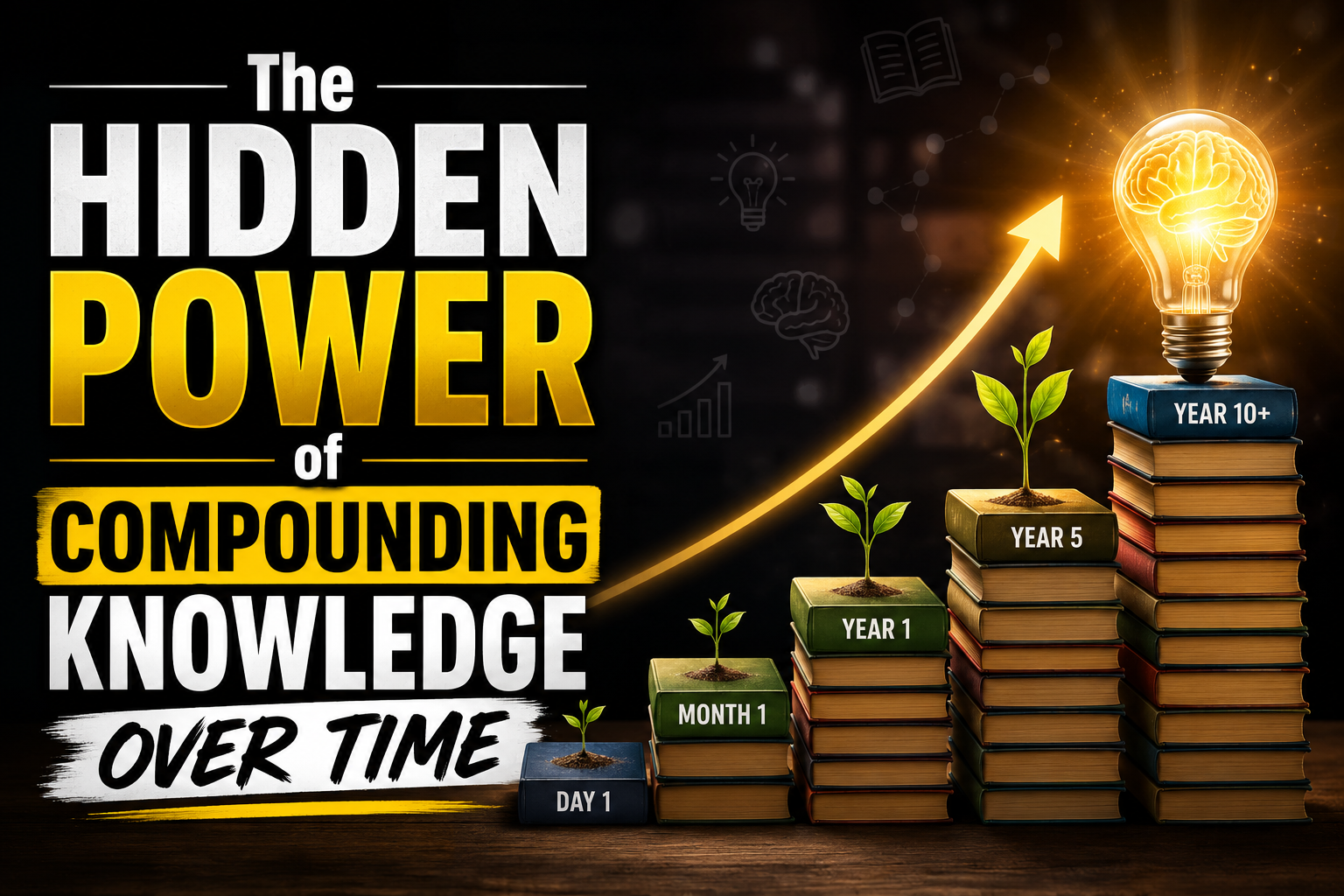
The Hidden Power of Compounding Knowledge Over Time
The hidden power of compounding knowledge over time is one of the most underestimated forces in personal growth, financial success, and long term achievement. Most people think learning is something you do in isolated moments, like studying for exams, watching a video, or reading a book and then moving on. But real knowledge does not work like that. It behaves more like an investment account that grows in value quietly, invisibly, and then suddenly changes everything when enough time has passed. The difference between people who stay average and those who become highly skilled or successful is rarely a single breakthrough moment. It is usually the result of small learning inputs that accumulate, connect, and multiply over years.
At the beginning, knowledge often feels slow and even disappointing. You read something new, and it seems like you understand it, but you cannot apply it well. You watch tutorials or listen to advice, and your life does not immediately change. This is where most people lose patience and assume learning is not working. What they fail to realize is that early knowledge is not meant to produce instant transformation. It is meant to build a foundation. Like laying bricks underground, nothing impressive is visible yet, but everything meaningful depends on it later.
As time continues, something subtle begins to happen. New information starts attaching itself to old information. Ideas stop existing in isolation and begin forming patterns. You no longer just know facts, you start recognizing structures. For example, someone who learns about money management once may forget it quickly, but someone who repeatedly learns about budgeting, saving, investing, and behavioral psychology starts to see money differently in daily life. They notice patterns in spending habits, emotional triggers behind purchases, and long term consequences of small decisions. That shift is not caused by one piece of knowledge. It is caused by accumulation.
This is where compounding becomes powerful. Each new idea you learn does not just add to your mind, it multiplies what is already there. A person who knows nothing about a topic gains linearly when they learn the first concept. But a person who already understands ten related concepts gains exponentially from the eleventh. This is because context increases absorption. The more connected your knowledge becomes, the faster you learn new things and the easier it is to understand complex ideas without extra effort.
Over time, compounding knowledge also changes your decision making speed. At first, every decision requires effort and uncertainty. You think slowly because you have little reference to rely on. But as your knowledge base grows, your brain begins to recognize similar situations automatically. You no longer analyze everything from scratch. Instead, you compare patterns, recall experiences, and eliminate poor choices faster. This is why experienced individuals often appear to make decisions effortlessly. It is not magic or intuition alone. It is accumulated learning working in the background.
Another powerful effect of compounding knowledge is improved filtering. In the beginning, everything feels important. Every opinion seems valid, every opportunity looks attractive, and every piece of advice feels equally useful. But as knowledge grows, you begin to filter information more effectively. You can quickly identify what is noise and what is valuable. This ability alone can save years of wasted effort. Many people stay stuck not because they do not learn, but because they consume too much irrelevant information without a system of filtering.
One of the most important aspects of this process is that knowledge compounds best when it is connected, not random. Random learning creates scattered understanding, while connected learning builds depth. Depth is what creates real expertise. For example, someone who learns about business, marketing, psychology, communication, and economics in a disconnected way may know many things but struggle to apply them together. On the other hand, someone who understands how these areas interact begins to see opportunities others cannot see. They understand not just individual ideas, but systems.
Over time, compounding knowledge also increases confidence, but not the superficial kind of confidence that comes from motivation. It creates quiet confidence based on clarity. When you understand how things work, you are less easily intimidated by complexity. Problems that once seemed overwhelming begin to feel manageable because you have seen similar patterns before. This reduces fear and increases action, which further accelerates learning. So the cycle strengthens itself.
There is also a long term financial dimension to compounding knowledge. People often focus on earning money directly, but knowledge indirectly determines earning capacity. Skills become more valuable when they are layered. A person who understands only one skill may have limited opportunities, but a person who combines multiple related skills becomes rare in the market. For example, combining writing with marketing knowledge, or combining technical skills with communication ability, creates leverage. This is why some people seem to grow faster financially even without drastically increasing their working hours.
Another important truth is that compounding knowledge rewards consistency more than intensity. Studying for ten hours in one day and then stopping for a month is far less effective than studying a small amount every day. This is because the brain strengthens connections through repetition and spacing. Each time you revisit an idea, it becomes more permanent. Over time, what once required effort becomes automatic understanding. This is how expertise is formed quietly over years without dramatic effort in any single moment.
However, compounding knowledge also has a hidden requirement, which is reflection. Simply consuming information is not enough. Knowledge compounds when it is processed, questioned, and applied. Without reflection, information enters and leaves the mind without creating deep structure. But when you pause to think about what you learn, connect it to previous ideas, or apply it in real situations, it becomes part of your thinking system. This is where transformation actually happens.
As the years pass, the effect becomes more visible. People who have consistently learned begin to operate on a different level of understanding. They see opportunities earlier. They make fewer avoidable mistakes. They understand consequences more deeply. And most importantly, they continue learning faster than others because their foundation keeps expanding. This creates a gap that becomes harder to close over time.
Eventually, compounding knowledge creates something more powerful than skill or intelligence alone. It creates perspective. Perspective is the ability to see beyond immediate situations and understand long term implications. It allows people to remain calm in uncertainty, strategic in chaos, and focused in distraction. This is why two people with similar intelligence can end up in completely different life outcomes. One has accumulated knowledge consistently over time, while the other has not.
The real hidden power of compounding knowledge is that it never stops working. Even when you are not actively learning, your past learning continues to shape your thinking, decisions, and actions. It becomes part of how you interpret the world. And unlike physical effort, which stops when you rest, knowledge continues to influence outcomes silently in the background.
In the long run, the advantage does not go to the smartest or the fastest learner. It goes to the person who keeps learning consistently, connects ideas deeply, and applies understanding repeatedly over time. Compounding knowledge is not dramatic in the short term, but it is decisive in the long term. It quietly transforms average effort into exceptional results, not through sudden breakthroughs, but through continuous accumulation that eventually becomes impossible to ignore.

EarnSmartOnline.com.ng is dedicated to helping readers make smarter financial decisions through practical guides on online income, personal finance, technology, digital business, and wealth creation. Our goal is to provide reliable, easy-to-understand, and actionable content that empowers individuals to earn smarter, build sustainable income streams and achieve long-term financial success.
Recommended: Start Earning Online
- Ultimate Affiliate Marketing Program — learn affiliate marketing with a done-for-you sales system ($15). Check it out
- The Newbie Affiliate Guide — the beginner-friendly starter guide (~$6.68). Check it out
- Easy Dollar Maker — earn in dollars uploading AI images and videos from your phone ($17). Check it out
Disclosure: These are affiliate links. If you buy through them, I may earn a commission at no extra cost to you.



