
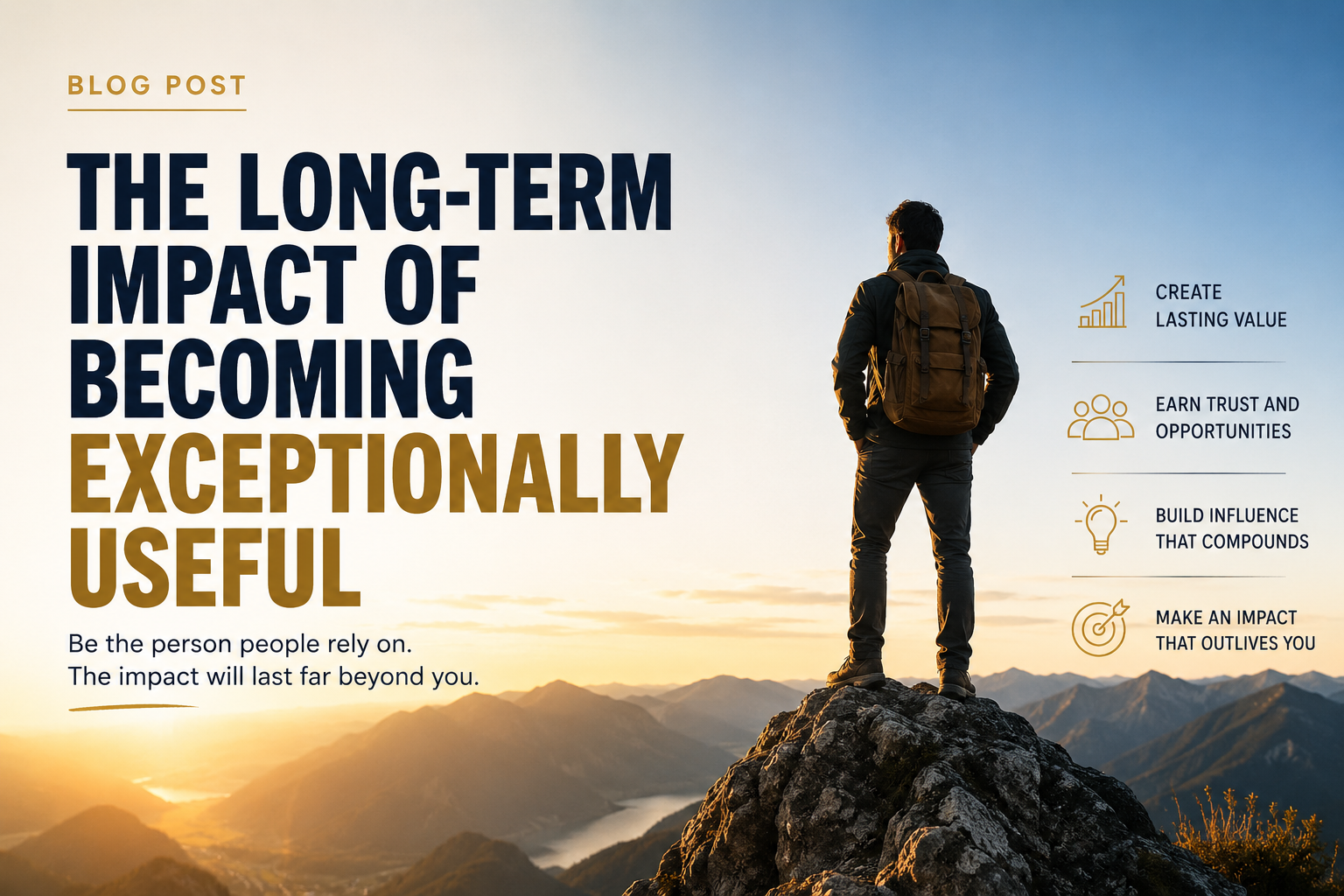
The Long-Term Impact of Becoming Exceptionally Useful
In a world where attention is scarce and competition is constant, one of the most powerful long-term advantages a person can develop is becoming exceptionally useful. Not occasionally helpful, not temporarily valuable, but consistently and undeniably useful in a way that others begin to rely on. This kind of usefulness does not announce itself loudly at first, but over time it becomes one of the most stable foundations for success, influence, and opportunity in any field of life.
Being exceptionally useful is not about being busy or doing more than others. It is about being the person who solves problems that actually matter. It is about developing the ability to reduce friction, remove confusion, create clarity, and produce outcomes that people genuinely need. In the beginning, this mindset may not seem immediately rewarding, because society often rewards visibility before depth. But over time, usefulness compounds in a way that visibility alone cannot match.
When someone becomes consistently useful, they start to occupy a different position in the minds of others. They are no longer seen as replaceable or optional. Instead, they become associated with reliability and problem solving. This perception changes everything. Opportunities begin to arrive not because they are actively chased, but because others recognize the value of having such a person involved. This is one of the most underestimated dynamics in personal and professional growth.
The long-term impact of usefulness is deeply tied to trust. Trust is not built through claims or promises, but through repeated evidence of value delivery. When people observe that someone can consistently solve problems without unnecessary complications, they begin to lower their resistance to relying on them. Over time, this trust becomes a form of currency. It opens doors that skill alone cannot unlock and creates pathways that effort alone cannot guarantee.
Another important dimension of being exceptionally useful is that it naturally reduces competition. Most people aim to be good at something, but far fewer aim to be indispensable within a specific context. When someone shifts from trying to be generally competent to becoming deeply useful in solving specific, meaningful problems, they step out of crowded spaces and into less contested territory. In these spaces, value is more visible and more rewarded because fewer people are capable of delivering it consistently.
Usefulness also has a compounding nature. Early in the process, the benefits may feel small. A problem solved here, a task completed there, a bit of recognition occasionally. But over time, each act of usefulness builds reputation, and reputation begins to attract more complex and higher value opportunities. These opportunities, in turn, allow for even greater usefulness. This cycle gradually escalates until the person finds themselves operating at a level that was not accessible at the beginning.
There is also a psychological transformation that comes with becoming exceptionally useful. People begin to shift their identity from someone who consumes opportunities to someone who creates them. Instead of waiting for external validation or permission, they begin to focus on contribution. This internal shift changes how decisions are made, how time is used, and how challenges are approached. Life becomes less about proving worth and more about expressing it through action.
One of the most overlooked aspects of usefulness is its stability during uncertainty. Markets change, industries evolve, technologies shift, but the need for people who can solve real problems never disappears. In fact, during periods of uncertainty, usefulness becomes even more valuable. When confusion increases, clarity becomes rare. When inefficiency spreads, effectiveness becomes premium. Those who can bring order to complexity often rise regardless of external conditions.
Being exceptionally useful also changes financial outcomes over time. While short-term income is often influenced by negotiation, timing, or external factors, long-term earning power is strongly tied to perceived value. And perceived value is shaped by usefulness. People are willing to pay more, offer more opportunities, and provide more access to those who consistently improve outcomes. This is why some individuals continue to grow financially even without dramatic changes in effort, simply because their usefulness has expanded.
Another long-term effect is the development of leverage. When someone becomes known for solving meaningful problems, they gain access to systems, tools, relationships, and platforms that amplify their impact. This means their usefulness is no longer limited to direct effort. Instead, it begins to scale. One decision can affect many outcomes. One solution can be applied in multiple contexts. This shift from linear effort to multiplied impact is one of the defining characteristics of long-term success.
However, becoming exceptionally useful requires a different mindset from the one most people naturally adopt. It requires moving away from self-centered thinking and toward problem-centered thinking. Instead of asking what is easiest or most comfortable, the focus shifts to what is most needed. Instead of seeking immediate reward, the focus shifts to long-term value creation. This shift is not always comfortable, but it is consistently rewarding over time.
Another critical element is consistency. Usefulness is not defined by occasional brilliance but by dependable contribution. Many people are capable of doing impressive things once in a while, but far fewer can do useful things repeatedly without losing quality. It is this consistency that builds reputation, and reputation is what sustains long-term impact. In many cases, people are not remembered for isolated achievements but for the reliability of their contribution over time.
As usefulness grows, so does influence. People naturally gravitate toward those who make their lives easier or their goals more achievable. Influence in this sense is not about manipulation or control, but about trust-based attraction. The more useful someone becomes, the more their opinions are valued, their presence is requested, and their input is sought. Influence becomes a natural byproduct of contribution rather than a forceful pursuit.
There is also a quiet form of security that comes from being exceptionally useful. In unstable environments, positions and titles can change quickly, but usefulness is harder to remove. Even when systems shift, those who can solve problems effectively tend to remain relevant. This creates a form of resilience that is not dependent on external validation but on internal capability.
Over time, usefulness reshapes how a person is perceived not only by others but also by themselves. Self-confidence becomes grounded in evidence rather than assumption. Instead of relying on affirmation, there is a deep understanding of one’s ability to contribute meaningfully. This creates emotional stability and reduces dependence on external approval.
It is also important to recognize that usefulness is not limited to professional environments. In personal relationships, communities, and social circles, those who bring clarity, support, and solutions naturally become central figures. They are trusted during difficult moments and valued during growth phases. This expands their impact far beyond financial or career-related outcomes.
One of the final long-term impacts of becoming exceptionally useful is legacy. People tend to remember those who made things better, easier, or more meaningful for them. Legacy is not built through intention alone but through consistent contribution. When someone spends years becoming genuinely useful, their impact continues even when they are no longer present in the immediate environment.
In conclusion, becoming exceptionally useful is not a short-term strategy but a long-term transformation. It changes how a person is perceived, how opportunities are received, how income is generated, and how influence is established. It reduces competition, increases trust, builds leverage, and creates stability in uncertain environments. Most importantly, it shifts identity from someone who seeks value to someone who creates it.
In a world that often rewards noise and speed, usefulness remains one of the few qualities that compounds quietly but powerfully over time. Those who commit to it consistently find that it not only improves their external circumstances but also strengthens their internal sense of purpose and direction.

EarnSmartOnline.com.ng is dedicated to helping readers make smarter financial decisions through practical guides on online income, personal finance, technology, digital business, and wealth creation. Our goal is to provide reliable, easy-to-understand, and actionable content that empowers individuals to earn smarter, build sustainable income streams and achieve long-term financial success.
Recommended: Start Earning Online
- Ultimate Affiliate Marketing Program — learn affiliate marketing with a done-for-you sales system ($15). Check it out
- The Newbie Affiliate Guide — the beginner-friendly starter guide (~$6.68). Check it out
- Easy Dollar Maker — earn in dollars uploading AI images and videos from your phone ($17). Check it out
Disclosure: These are affiliate links. If you buy through them, I may earn a commission at no extra cost to you.



