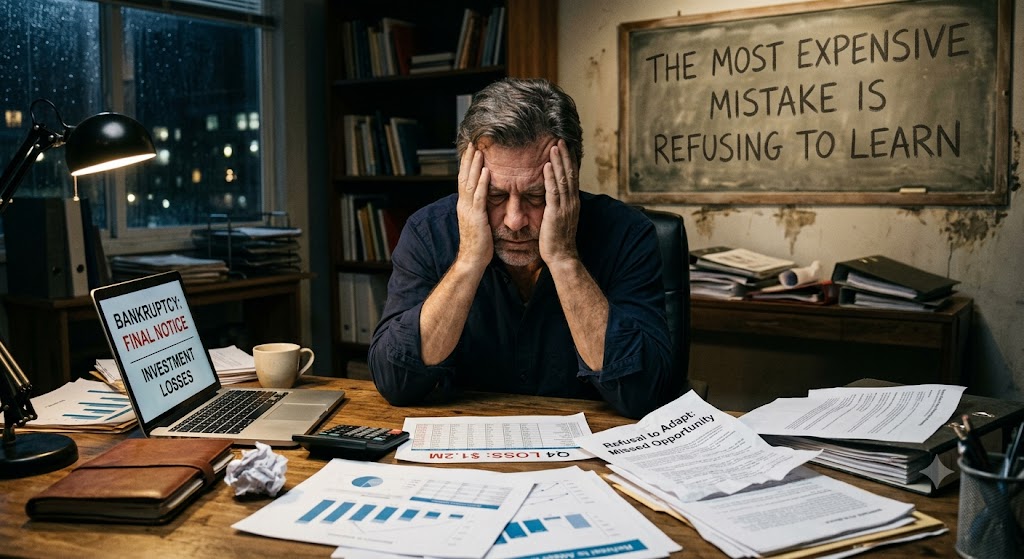
The Most Expensive Mistake Is Refusing to Learn
There is a common belief that the most expensive mistakes in life are failed businesses, bad investments, broken relationships, missed opportunities, or poor career decisions. While all of these can be costly, they often have one hidden cause that many people overlook. The real price is not paid when the mistake happens. The real price is paid when someone refuses to learn from it. The most expensive mistake is not failing. It is refusing to learn. Every successful person carries a collection of lessons gathered from disappointments, setbacks, criticism, rejection, and even embarrassment. Every unsuccessful person also has a collection of experiences, but the difference is that one group extracts wisdom while the other repeats the same errors.
Learning is the one investment that compounds throughout an entire lifetime. Money can disappear overnight. Businesses can collapse. Technology can become outdated. Careers can change without warning. Industries can rise and fall. Skills that were valuable yesterday may become irrelevant tomorrow. However, the willingness to learn creates an ability to adapt, grow, innovate, and recover regardless of changing circumstances. A person who continues learning can lose everything today and rebuild tomorrow because knowledge travels with them wherever they go.
Many people assume education ends after school. They proudly display certificates on their walls and believe that graduation was the finish line rather than the starting point. In reality, formal education only introduces the basics. The real education begins when life starts asking questions that classrooms never covered. No school can fully prepare someone for entrepreneurship, marriage, parenting, leadership, financial independence, or unexpected crises. These areas demand continuous learning, observation, humility, and personal growth.
The world rewards those who remain curious. Every major innovation in history happened because someone refused to accept that they already knew enough. Scientists continue researching because knowledge evolves. Doctors attend conferences because medicine changes. Software developers constantly update their skills because technology moves at incredible speed. Successful entrepreneurs study customer behaviour because markets never remain the same. Athletes improve because yesterday’s training is insufficient for tomorrow’s competition. Growth belongs to those who understand that learning never truly ends.
One of the greatest dangers in life is becoming comfortable with what you already know. Comfort creates confidence, but unchecked confidence often becomes arrogance. Arrogance closes the door that humility keeps open. Once someone believes they have nothing left to learn, they unknowingly begin falling behind. Progress does not stop because one individual has decided they know enough. The world keeps moving, competitors keep improving, industries keep changing, and opportunities continue favouring those who adapt.
History repeatedly proves that refusing to learn is incredibly expensive. Entire companies that once dominated global markets disappeared because they ignored changing trends. Businesses that laughed at new technologies eventually found themselves replaced by younger companies willing to innovate. Employees who refused to update their skills lost jobs to those who embraced change. Investors who ignored financial education watched their wealth disappear through avoidable mistakes. The pattern remains remarkably consistent. Those who stop learning eventually pay the highest price.
The internet has removed many excuses for ignorance. Never before has so much information been available at little or no cost. Books, podcasts, online courses, documentaries, tutorials, research papers, educational videos, webinars, and professional communities make learning more accessible than at any other point in human history. While previous generations travelled long distances to access libraries or mentors, today’s learner can gain world class knowledge from a smartphone connected to the internet. The challenge is no longer access to information. The challenge is the willingness to seek it.
Refusing to learn often disguises itself in subtle ways. Some people reject advice because it comes from someone younger. Others ignore criticism because it hurts their pride. Some avoid reading because they believe experience alone is enough. Others dismiss new ideas because they have always done things differently. Many refuse to ask questions because they fear appearing unintelligent. Ironically, pretending to know everything often reveals the greatest lack of wisdom.
The strongest people are rarely those who know the most. They are usually the ones most willing to admit what they do not know. They ask questions without shame. They seek mentors without insecurity. They read widely without assuming they have already mastered every subject. They remain students regardless of how much success they achieve. This mindset allows continuous improvement while others become trapped by their own assumptions.
Failure itself is not the enemy. Every mistake contains valuable information. Imagine two entrepreneurs whose businesses collapse. One blames the economy, competitors, employees, customers, and bad luck. The other carefully analyses financial records, marketing decisions, customer feedback, leadership mistakes, and operational weaknesses. Both experienced failure, but only one gained education from it. Years later, the second entrepreneur often builds something stronger because failure became a teacher instead of a permanent identity.
Learning requires humility because it forces people to confront uncomfortable truths. It reveals weaknesses that were previously hidden. It exposes flawed assumptions. It challenges long held beliefs. It demands patience while new skills develop. None of these experiences feel comfortable, yet they are necessary for meaningful growth. Personal development begins where pride ends.
Many people spend years defending mistakes instead of correcting them. They continue making poor financial decisions because admitting error feels embarrassing. They remain in unhealthy habits because change requires effort. They reject better opportunities because familiarity feels safer than growth. They repeat relationship patterns because self reflection is painful. Over time, these repeated decisions become incredibly expensive. The financial cost is significant, but the emotional cost is often even greater.
Knowledge without application has limited value. Learning is not simply collecting facts or memorising information. Real learning transforms behaviour. Reading books about discipline means little without becoming more disciplined. Studying business strategies means little without implementing them. Watching motivational videos changes nothing unless action follows inspiration. Information becomes valuable only when it produces practical results.
Many successful individuals dedicate significant time each day to learning despite demanding schedules. They read books during travel. They listen to educational podcasts while driving. They attend seminars. They invest in coaching. They analyse competitors. They ask thoughtful questions during conversations. They understand that consistent improvement eventually creates extraordinary advantages. Small daily lessons accumulate into remarkable expertise over several years.
Refusing to learn also limits creativity. Innovation rarely appears from nowhere. Creative thinking often results from combining ideas gathered from different experiences, industries, cultures, and disciplines. A person who continually learns expands their mental library. Every new concept becomes another building block for future solutions. Conversely, someone who refuses to learn repeatedly recycles old ideas while wondering why progress remains slow.
One reason some people avoid learning is fear of discovering how much they do not know. Ignorance can feel comfortable because it protects the ego. Learning removes that illusion. Every new subject reveals additional complexity. Every answered question generates several new ones. While this can seem overwhelming, it also creates endless opportunities for growth. Intelligent people become increasingly aware of the vastness of knowledge, while the uninformed often believe they have already mastered everything.
The workplace continues changing faster than ever before. Artificial intelligence, automation, digital transformation, remote collaboration, cybersecurity, cloud computing, renewable energy, biotechnology, and countless emerging technologies reshape industries every year. Employees who refuse to learn new skills may discover that their experience alone is no longer enough. Employers increasingly value adaptability alongside technical expertise because tomorrow’s challenges may require entirely different capabilities than today’s.
Entrepreneurs face similar realities. Customer expectations evolve constantly. Marketing platforms change algorithms. Consumer preferences shift rapidly. Economic conditions fluctuate. New competitors emerge from unexpected places. Business owners who refuse to study these changes gradually lose relevance. Those who embrace continuous learning identify opportunities before others even recognise them.
Learning also improves decision making. Poor decisions often result from incomplete information or outdated assumptions. Every book read, conversation held, course completed, or experience analysed adds another perspective. Better perspectives usually produce better decisions. Better decisions improve finances, relationships, careers, businesses, health, and overall quality of life. The cumulative effect becomes enormous over decades.
Parents who continue learning become better guides for their children. Relationships improve when individuals study communication, empathy, conflict resolution, and emotional intelligence. Leaders become more effective by learning psychology, management, negotiation, and strategic thinking. Financial stability improves when people understand budgeting, investing, debt management, taxation, and wealth creation. Almost every meaningful area of life benefits directly from intentional learning.
Some individuals believe talent alone guarantees success. While natural ability can create an early advantage, consistent learning eventually surpasses raw talent that refuses to improve. History repeatedly demonstrates this principle across sports, business, music, science, and countless other fields. The talented person who stops learning is eventually overtaken by the average person committed to continuous improvement.
Books remain among the most affordable sources of life changing knowledge. A single book may contain decades of experience from someone who spent years solving difficult problems. Reading allows people to borrow wisdom without personally paying every painful price. Instead of repeating avoidable mistakes, readers gain insights from those who have already travelled similar paths. This dramatically reduces the cost of learning.
Mentorship accelerates growth for similar reasons. Experienced mentors identify blind spots that beginners cannot yet recognise. They shorten learning curves by sharing practical experience rather than theoretical knowledge alone. Many costly mistakes become avoidable simply because someone else has already encountered them and willingly shares the lesson.
Learning from criticism may be one of the most difficult yet rewarding habits anyone can develop. Criticism often triggers emotional reactions because it challenges self perception. However, not every critic deserves dismissal. Some observations reveal weaknesses requiring attention. The mature individual separates useful feedback from destructive negativity. Instead of reacting defensively, they ask whether any truth exists within the criticism. This approach transforms painful moments into valuable opportunities.
People frequently underestimate the cost of repeated mistakes. Making the same financial error for ten years costs far more than making it once. Remaining in the wrong career for decades because of unwillingness to learn new skills creates enormous opportunity costs. Continuing ineffective business strategies gradually drains profits. Ignoring health education may eventually result in preventable illnesses. The longer learning is delayed, the greater the eventual price.
Curiosity fuels lifelong growth. Curious people naturally ask questions, explore unfamiliar subjects, test assumptions, and seek deeper understanding. They rarely settle for superficial explanations. This mindset keeps them adaptable in changing environments because curiosity consistently leads them toward fresh knowledge. In contrast, indifference slowly produces stagnation.
One powerful characteristic shared by exceptional performers is deliberate practice. They do not simply repeat familiar routines. They intentionally identify weaknesses and work specifically on improving them. This process requires honest evaluation, continuous feedback, and constant learning. Improvement becomes systematic rather than accidental.
Learning should not be limited to professional development alone. Emotional maturity requires learning. Financial wisdom requires learning. Physical health requires learning. Spiritual growth requires learning. Effective communication requires learning. Leadership requires learning. Every meaningful area of human life rewards those who intentionally pursue greater understanding.
Refusing to learn often begins with small excuses. There is no time. The information seems too difficult. Someone else can handle it. Things have always worked this way. The current method feels comfortable. Each excuse appears harmless individually, but together they create long term stagnation. Meanwhile, others invest those same hours in developing valuable skills that eventually transform their opportunities.
One fascinating reality about learning is that it increases confidence in healthy ways. Superficial confidence depends on pretending to know everything. Genuine confidence comes from knowing that whatever challenge appears, one possesses the ability to learn what is necessary. This creates resilience because uncertainty no longer becomes frightening. Instead, unfamiliar situations become invitations to grow.
Modern society often celebrates quick results while overlooking the slow process of mastery. Yet every expert was once a beginner. Every accomplished professional once struggled with basic concepts. Every respected leader once lacked experience. Learning bridges the gap between ignorance and competence through consistent effort over time.
Reading broadly across different subjects also strengthens critical thinking. Exposure to history, psychology, economics, philosophy, science, technology, literature, and business develops an ability to connect ideas across disciplines. These connections frequently produce innovative solutions because real world problems rarely fit neatly within a single category.
The financial value of learning is impossible to overstate. New knowledge frequently increases earning potential. Better negotiation skills improve salaries. Stronger communication attracts opportunities. Technical expertise creates specialised careers. Business education increases profitability. Investment knowledge protects wealth. Marketing skills expand customer reach. Leadership development improves organisational performance. Every valuable skill represents another asset capable of generating future returns.
Many regret opportunities they never pursued because they assumed learning would be too difficult. Years later they realise the time passed regardless. The only difference is that someone else invested those years acquiring valuable abilities. Time moves forward whether people learn or not. Choosing not to learn simply guarantees fewer options in the future.
Learning also strengthens adaptability during unexpected crises. Economic recessions, technological disruption, health emergencies, and personal setbacks often force rapid adjustments. Individuals with broad knowledge and flexible thinking usually recover faster because they possess multiple ways of solving problems. Their education becomes a reserve they can draw upon when circumstances change unexpectedly.
There is remarkable freedom in becoming teachable. Teachable individuals do not feel threatened by someone else’s expertise. Instead, they appreciate opportunities to expand their own understanding. They celebrate discovering better methods rather than defending outdated habits. This openness creates continuous progress throughout life.
Some of the wealthiest people in the world continue reading extensively despite already achieving extraordinary success. They recognise that success does not eliminate the need for learning. In many cases, greater success increases the importance of learning because larger responsibilities demand broader understanding. Remaining teachable becomes one of the hidden foundations of sustained achievement.
The pace of global change ensures that yesterday’s knowledge cannot fully solve tomorrow’s problems. Climate challenges, artificial intelligence, changing economies, evolving healthcare, digital security, global markets, and shifting consumer behaviour require ongoing education. Those who refuse to update their thinking risk becoming experts in a world that no longer exists.
Learning should never be viewed as an expense. It is an investment with extraordinary long term returns. Whether through books, courses, mentors, practical experience, workshops, conversations, or careful observation, every genuine lesson increases future capability. Even when learning requires financial investment, the cost is often insignificant compared to the price of remaining uninformed.
The greatest tragedy is not lacking knowledge today. Everyone begins somewhere. The true tragedy is deliberately rejecting opportunities to become wiser tomorrow. Ignorance that is recognised can be corrected. Ignorance that is defended becomes permanent. That distinction shapes the direction of countless lives.
Imagine two people standing at exactly the same starting point. They possess similar intelligence, similar backgrounds, similar resources, and similar opportunities. One commits to learning something valuable every single day, no matter how small. The other assumes existing knowledge is sufficient and makes little effort to improve. After one year the difference appears modest. After five years it becomes obvious. After ten years their lives may look completely unrelated. The gap was not created by luck alone. It was created by thousands of small learning decisions repeated consistently over time.
Ultimately, every person pays for education in one way or another. Some pay through disciplined learning, reading, listening, asking questions, accepting correction, and applying wisdom. Others pay through repeated failures, missed opportunities, financial losses, damaged relationships, declining relevance, and unnecessary regret. Both paths have costs, but one produces growth while the other produces limitation. The choice belongs to each individual.
The most expensive mistake is refusing to learn because every day spent resisting growth quietly accumulates hidden costs that only become visible years later. The good news is that it is never too late to become a student again. Every book opened, every thoughtful question asked, every mentor consulted, every mistake analysed, and every new skill developed represents another step towards a stronger future. Lifelong learning is not merely a strategy for professional success. It is one of the most reliable paths to personal fulfilment, resilience, wisdom, and lasting significance. Those who remain teachable never truly stop growing, and those who never stop growing continually discover opportunities that remain invisible to everyone else.

EarnSmartOnline.com.ng is dedicated to helping readers make smarter financial decisions through practical guides on online income, personal finance, technology, digital business, and wealth creation. Our goal is to provide reliable, easy-to-understand, and actionable content that empowers individuals to earn smarter, build sustainable income streams and achieve long-term financial success.
Recommended: Start Earning Online
- Ultimate Affiliate Marketing Program — learn affiliate marketing with a done-for-you sales system ($15). Check it out
- The Newbie Affiliate Guide — the beginner-friendly starter guide (~$6.68). Check it out
- Easy Dollar Maker — earn in dollars uploading AI images and videos from your phone ($17). Check it out
Disclosure: These are affiliate links. If you buy through them, I may earn a commission at no extra cost to you.