
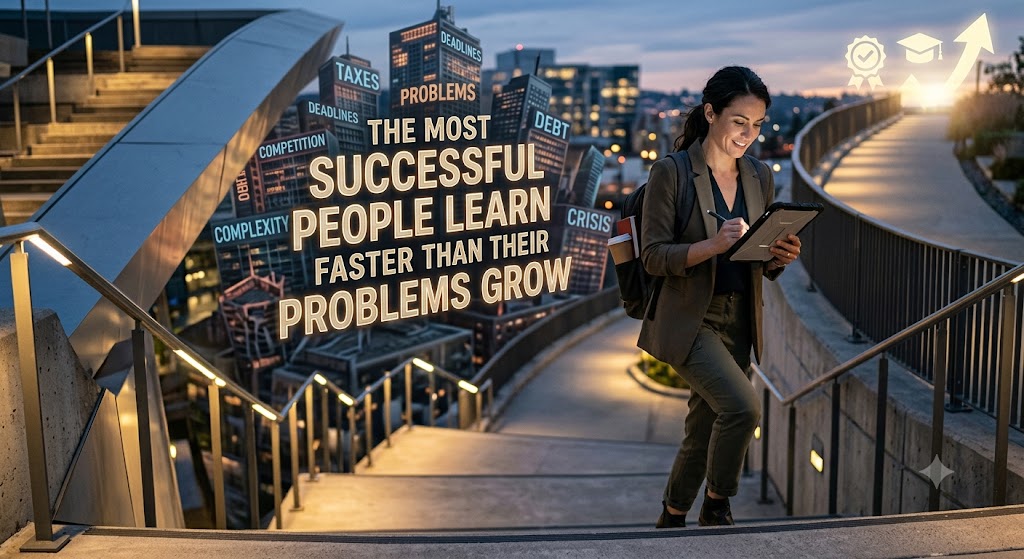
Success is often mistaken for talent, luck, connections, or perfect timing. Many people spend years believing that the richest entrepreneurs, the greatest innovators, and the most admired leaders were simply born different. While natural ability and opportunity can certainly play a role, there is one quality that consistently separates those who keep moving forward from those who remain stuck. The most successful people learn faster than their problems grow. They understand that every challenge introduces a lesson, every setback reveals a weakness that can be improved, and every obstacle becomes smaller when knowledge expands faster than difficulty. This simple principle explains why some individuals continue to rise despite facing enormous challenges while others remain trapped by the same problems year after year.
Life has a way of constantly presenting new challenges. Technology changes, industries evolve, economies fluctuate, and customer expectations shift. Personal relationships also require growth, communication, and understanding. Financial responsibilities increase, competition becomes stronger, and unexpected situations arise without warning. Problems never stop appearing. They simply change form. Waiting for a problem-free life is like waiting for the ocean to stop producing waves before deciding to swim. The difference between people who succeed and those who struggle is rarely the absence of problems. Instead, it is the speed at which they learn how to solve them.
Consider how quickly the world has transformed over the last decade. Businesses that once dominated entire industries disappeared because they failed to learn quickly enough. Individuals who embraced new skills found themselves with exciting career opportunities while others who resisted change watched their expertise become outdated. Artificial intelligence, automation, remote work, digital marketing, online education, and changing consumer habits have completely reshaped the professional landscape. Those who kept learning stayed relevant. Those who stopped learning often found themselves overwhelmed by problems they never anticipated.
Learning is not limited to classrooms, universities, or expensive courses. Real learning happens every day through observation, reading, listening, experimenting, asking questions, making mistakes, and reflecting on experiences. The most successful people treat every experience as an opportunity to become wiser. They do not simply work harder. They work smarter because they constantly update the way they think. Instead of repeating yesterday’s solutions for today’s problems, they search for better answers. Their greatest competitive advantage is not intelligence alone but the willingness to improve continuously.
The Most Successful People Learn Faster Than Their Problems Grow
Many people become discouraged the moment they encounter difficulty. They assume that problems are signs they are on the wrong path. Successful individuals see things differently. They recognise problems as indicators that they have reached the edge of their current knowledge. Instead of giving up, they ask better questions. What can I learn from this? What skill am I missing? Who has already solved this problem? What resources can help me improve? Every question opens the door to new understanding, and every answer reduces the size of the obstacle standing in front of them.
Think about the entrepreneur whose business begins losing customers. One response is to complain about the economy, competitors, or changing trends. Another response is to study customer behaviour, improve products, strengthen marketing, and adapt to new demands. The first approach allows the problem to grow faster than personal knowledge. The second ensures that knowledge grows faster than the challenge. Over time, the learning entrepreneur builds a stronger business while the other continues blaming external circumstances.
The same principle applies to personal finances. Financial problems rarely disappear on their own. Ignoring debt, avoiding budgeting, or refusing to learn about investing only allows small problems to become major crises. On the other hand, someone who actively studies money management, savings strategies, investing, and financial discipline gradually gains control over situations that once seemed impossible. Learning becomes the bridge between financial stress and financial stability.
Relationships also improve when people learn faster than conflicts grow. Many friendships, marriages, and family connections suffer because individuals repeat the same communication mistakes without seeking better ways to understand one another. Successful relationships require emotional intelligence, patience, empathy, forgiveness, and effective communication. These are learned skills, not natural gifts possessed by only a fortunate few. Every disagreement becomes easier to resolve when both people are committed to learning rather than simply proving themselves right.
One of the greatest dangers in modern society is believing that learning ends after formal education. Receiving a certificate does not mean education is complete. In reality, graduation simply marks the beginning of independent learning. The world moves far too quickly for anyone to rely solely on knowledge acquired years ago. Every profession experiences change. Doctors study new treatments. Engineers learn new technologies. Teachers adapt new teaching methods. Business owners embrace new strategies. Programmers master new programming languages. Designers explore new creative tools. Those who stop learning eventually discover that yesterday’s expertise is no longer enough for today’s opportunities.
History repeatedly proves this lesson. Companies that once dominated global markets disappeared because they assumed their past success guaranteed future survival. They ignored changing technology, underestimated new competitors, or dismissed shifting customer expectations. Meanwhile, smaller organisations willing to learn rapidly overtook them. This pattern continues today across every industry. Adaptability consistently outperforms complacency.
One reason learning creates such a powerful advantage is because problems grow automatically while knowledge requires intentional effort. Inflation increases whether people study economics or not. Technology advances whether workers upgrade their skills or not. Competition improves whether businesses innovate or not. Health changes whether individuals learn healthy habits or not. Problems have momentum. Learning requires discipline. Those who make learning a daily habit stay ahead because they refuse to allow challenges to gain too much distance.
Reading remains one of the simplest yet most effective ways to accelerate learning. A single book allows readers to benefit from years of someone else’s experience. Instead of repeating costly mistakes, they inherit valuable insights gathered through decades of experimentation. Successful people often credit books with transforming the way they think because books expose readers to perspectives they might never discover through personal experience alone.
Listening is another underrated skill. Many people enter conversations preparing to speak rather than preparing to understand. Yet every person possesses unique experiences capable of teaching valuable lessons. Humility allows learning to happen. Pride often blocks it. The individual convinced they already know everything rarely discovers anything new. Curiosity keeps the mind expanding while arrogance keeps it trapped.
Failure itself becomes one of the greatest teachers when approached correctly. Nobody enjoys making mistakes, but mistakes often provide clearer lessons than easy victories. Success can sometimes create overconfidence while failure demands reflection. Successful individuals examine what went wrong, identify weaknesses, adjust their approach, and try again with greater wisdom. They understand that failure only becomes permanent when learning stops.
This mindset explains why many successful entrepreneurs experienced multiple business failures before achieving remarkable success. Their earlier setbacks were not wasted years. They were educational investments. Each mistake improved judgement, strengthened resilience, and sharpened decision-making. By the time major opportunities appeared, they possessed the experience necessary to handle them effectively.
Learning also increases confidence because uncertainty decreases as understanding grows. Fear often thrives in ignorance. People fear investing because they lack financial knowledge. They fear public speaking because they have not developed communication skills. They fear starting businesses because they do not understand entrepreneurship. As knowledge increases, fear gradually loses its grip. Confidence becomes the natural result of competence rather than wishful thinking.
Modern technology has removed many traditional barriers to learning. Thousands of educational resources are available through online courses, podcasts, digital libraries, webinars, educational videos, forums, and professional communities. Information has never been more accessible. The challenge today is rarely finding knowledge. The real challenge is maintaining the discipline to consume quality information consistently while applying what is learned.
Application is where many people fall behind. Collecting information without implementation creates the illusion of progress. Reading ten books about leadership means little if no leadership habits develop. Watching hundreds of business videos changes nothing without taking action. Knowledge produces value only when transformed into behaviour. Successful people combine learning with execution. They study, experiment, evaluate results, improve, and repeat the cycle continuously.
Time becomes one of the greatest investments in learning. Every hour spent acquiring valuable skills compounds over future years. Unlike material possessions that depreciate, useful knowledge often appreciates because it improves earning potential, decision-making, relationships, creativity, and problem-solving ability. Skills accumulate like interest in a savings account. The earlier someone begins investing in personal growth, the greater the long-term rewards.
The workplace increasingly rewards adaptability over routine expertise. Employers seek individuals capable of learning new systems quickly rather than employees who only perform familiar tasks. Entrepreneurs value team members who solve problems independently instead of requiring constant instruction. Professionals who continuously develop themselves remain valuable regardless of changing economic conditions because they possess the ability to evolve alongside new demands.
Parents who encourage curiosity rather than memorisation prepare children for long-term success. Memorised facts may become outdated, but learning how to learn remains valuable throughout life. Asking thoughtful questions, researching answers, testing ideas, and embracing feedback develop minds capable of thriving in unpredictable environments. The future belongs less to those who know everything today and more to those who can learn anything tomorrow.
Emotional resilience also grows through learning. Every disappointment teaches patience. Every criticism teaches self-awareness. Every rejection teaches persistence. Every unexpected change teaches flexibility. Instead of viewing emotional pain as meaningless suffering, successful individuals search for lessons hidden within difficult experiences. This perspective transforms adversity into education rather than defeat.
Networking expands learning because every meaningful relationship introduces different perspectives. Surrounding yourself with ambitious, knowledgeable, and experienced people naturally accelerates personal growth. Conversations become opportunities for discovering new ideas, avoiding common mistakes, and identifying emerging trends. Success rarely happens in isolation. Learning flourishes through meaningful interaction with others willing to share experience generously.
One remarkable characteristic shared by high achievers is that they rarely claim to know everything. Despite enormous accomplishments, they continue reading, attending seminars, seeking mentors, asking questions, and exploring unfamiliar subjects. Their success never convinces them they have finished learning. Instead, greater achievement often increases awareness of how much more remains to be understood. This humility keeps them adaptable while others become rigid.
Every generation faces unique problems. Previous generations solved challenges related to industrialisation, manufacturing, transportation, and communication. Today’s generation faces cybersecurity, artificial intelligence, digital privacy, climate concerns, rapidly changing employment markets, and global competition. Tomorrow’s generation will encounter entirely different challenges. Since problems constantly evolve, continuous learning becomes the only sustainable strategy.
It is tempting to search for shortcuts that eliminate difficulty altogether. Unfortunately, no shortcut replaces growth. Every meaningful achievement requires becoming the kind of person capable of handling greater responsibility. Bigger dreams create bigger problems. Larger businesses create more complex decisions. Higher incomes introduce greater financial planning responsibilities. Leadership creates interpersonal challenges. Success itself generates new obstacles. Those who continue learning remain prepared for each new level.
Personal development should become a daily habit rather than an occasional event. Reading a few pages each day, listening to educational content while travelling, reflecting on lessons learned, practising new skills, and intentionally seeking constructive feedback gradually transform ordinary individuals into exceptional performers. Small improvements repeated consistently often outperform dramatic changes attempted once.
Many people underestimate how quickly tiny improvements accumulate. Learning one useful idea every day results in hundreds of valuable insights over a single year. Improving communication slightly each month strengthens relationships significantly over several years. Developing one new professional skill annually creates remarkable career advantages over a decade. Progress compounds quietly before becoming obvious.
The greatest investment anyone can make is not necessarily in property, stocks, businesses, or technology, although these may all produce substantial returns. The most valuable investment is developing the mind capable of managing every other investment wisely. Knowledge cannot guarantee success, but ignorance almost guarantees unnecessary struggle. Every lesson learned expands possibilities while reducing limitations.
Whenever problems appear, the natural response should not be panic but curiosity. Every challenge asks an important question. Are you willing to grow enough to solve me? Those who answer yes continue moving forward regardless of circumstances. Those who refuse learning often remain trapped by familiar difficulties that could have been overcome through growth.
Ultimately, the pace of your learning determines the pace of your progress. The world will continue changing whether you prepare for it or not. Problems will continue appearing whether you welcome them or avoid them. Opportunities will continue rewarding those ready to seize them. The choice is not whether change will happen but whether your knowledge will grow quickly enough to meet it. The most successful people understand this reality deeply. They refuse to let their problems become larger than their willingness to learn. Day after day, book after book, conversation after conversation, lesson after lesson, they quietly build minds capable of overcoming challenges that once seemed impossible. That is why their success continues to expand while others remain overwhelmed. They have mastered one of life’s most powerful principles: learn faster than your problems grow, and eventually your knowledge will become stronger than any obstacle standing in your way.

EarnSmartOnline.com.ng is dedicated to helping readers make smarter financial decisions through practical guides on online income, personal finance, technology, digital business, and wealth creation. Our goal is to provide reliable, easy-to-understand, and actionable content that empowers individuals to earn smarter, build sustainable income streams and achieve long-term financial success.
Recommended: Start Earning Online
- Ultimate Affiliate Marketing Program — learn affiliate marketing with a done-for-you sales system ($15). Check it out
- The Newbie Affiliate Guide — the beginner-friendly starter guide (~$6.68). Check it out
- Easy Dollar Maker — earn in dollars uploading AI images and videos from your phone ($17). Check it out
Disclosure: These are affiliate links. If you buy through them, I may earn a commission at no extra cost to you.



