
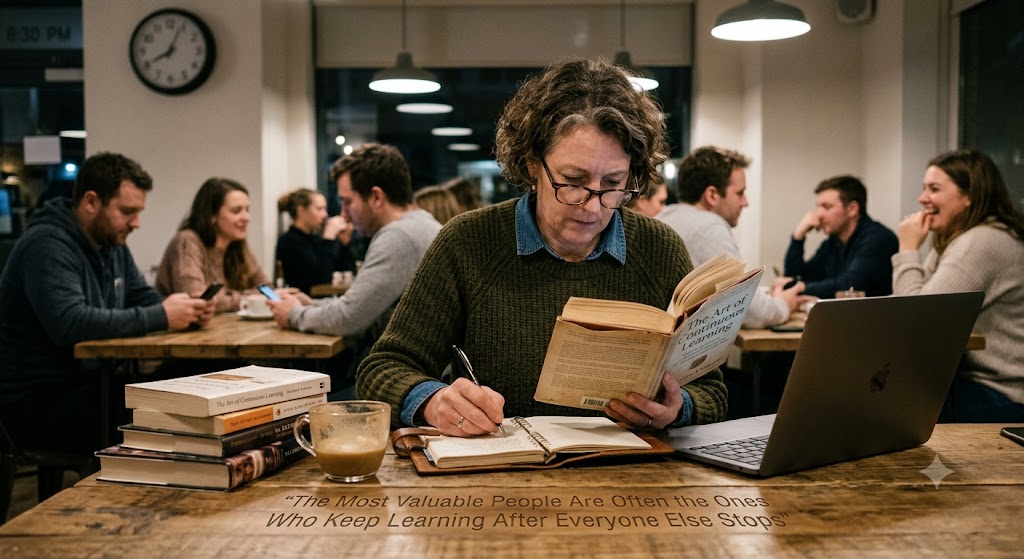
The Most Valuable People Are Often the Ones Who Keep Learning After Everyone Else Stops
There is a quiet habit that separates people who remain relevant from those who slowly fade into the background. It is not intelligence. It is not talent. It is not luck. It is not even opportunity. The difference often comes down to one simple decision that is repeated over and over again throughout life. Some people never stop learning, while others convince themselves that they already know enough. The Most Valuable People Are Often the Ones Who Keep Learning After Everyone Else Stops
The world has never stood still, and it never will. Industries evolve, technology changes, customer expectations shift, cultures transform, and entire careers disappear while new ones emerge. In such a world, the greatest risk is not ignorance. The greatest risk is believing that learning has an expiration date.
Many people unknowingly stop growing long before they stop breathing. They finish school and assume education is complete. They get a job and stop reading. They become comfortable with one skill and refuse to explore another. They rely on what worked yesterday without asking whether it will still work tomorrow. Over time, they become experts in an old version of reality while the world quietly moves on without them.
The people who become truly valuable think differently. They understand that learning is not something they did to pass examinations. It is something they do to remain useful. They see every experience as another opportunity to improve their thinking, sharpen their skills, and expand their understanding of how the world works.
This mindset creates an advantage that compounds over time. The gap between two people with similar abilities can become enormous after several years simply because one continued learning while the other remained comfortable. The difference may not be obvious in the beginning, but it eventually becomes impossible to ignore.
Continuous learning does something remarkable. It increases your ability to solve problems. Every new concept you understand becomes another tool in your mental toolbox. Every book you read gives you another perspective. Every conversation with knowledgeable people exposes you to ideas that might never have crossed your mind. Every mistake becomes a lesson instead of a permanent failure.
The modern economy rewards people who solve problems, not merely those who possess certificates. A certificate may open a door, but your ability to keep learning determines how long you remain inside the room. Employers, clients, customers, and business partners are constantly searching for individuals who can adapt, improve, and find better solutions.
Think about the professionals who remain in high demand for decades. They are rarely those who stopped learning after graduation. The best doctors continue studying new medical discoveries. The best engineers learn emerging technologies. The best writers refine their communication skills. The best entrepreneurs study markets, consumer behaviour, leadership, finance, and innovation. Their education never truly ends because excellence demands constant improvement.
Learning is not limited to formal education. Some of the most valuable lessons never appear inside a classroom. They come from observing successful people, analysing failures, experimenting with new ideas, listening carefully, travelling, building businesses, solving real-world problems, and asking better questions. Life itself becomes a university for those willing to pay attention.
Curiosity is often underestimated, yet it is one of the greatest competitive advantages anyone can possess. Curious people refuse to accept shallow answers. They ask why things happen. They explore different possibilities. They connect ideas across different fields. They remain intellectually alive even when others have become mentally comfortable.
This curiosity often leads to innovation. Many breakthroughs occur because someone questioned an assumption everyone else accepted. Every invention, business model, scientific discovery, and creative masterpiece began with someone who wanted to understand more than what was already known.
The danger of stopping learning is not immediate failure. It is gradual irrelevance. Skills become outdated. Knowledge becomes obsolete. Confidence slowly transforms into overconfidence. People begin relying on old experiences to solve new problems, only to discover that yesterday’s answers no longer fit today’s questions.
Technology provides one of the clearest examples. A few decades ago, many professions required skills that have now become nearly useless. Typing pools disappeared. Film photography gave way to digital imaging. Physical maps were replaced by navigation apps. Traditional advertising evolved into digital marketing. Artificial intelligence is now changing industries that once seemed untouchable.
Those who continued learning adapted to these changes. Those who refused often struggled to remain competitive. The difference was rarely age. Many older professionals embraced new technologies and thrived. Many younger professionals became complacent and fell behind. The deciding factor was willingness to learn rather than the number of birthdays someone had celebrated.
One of the greatest myths in society is that experience automatically creates wisdom. Experience only creates wisdom when combined with reflection and learning. Someone can repeat the same year of experience twenty times without becoming significantly better. Another person can spend five years deliberately learning from every success and every failure, becoming far more capable in the process.
Learning also transforms character. It teaches humility because the more you know, the more you realise how much remains unknown. It reduces arrogance because every new discovery reveals another layer of complexity. It develops patience because meaningful understanding takes time. It builds confidence because genuine knowledge replaces empty assumptions.
People who keep learning become better listeners. They understand that every person they meet knows something they do not. Instead of trying to impress everyone with what they already know, they become interested in discovering what they can learn. This simple shift makes conversations richer, relationships stronger, and opportunities more frequent.
The workplace increasingly rewards adaptability over routine. Many tasks that once required human effort are now automated. Artificial intelligence performs functions that once demanded specialised training. Software handles repetitive administrative work. Machines perform physical tasks with increasing efficiency.
This does not mean people are becoming less valuable. It means the definition of value is changing. Human value increasingly comes from creativity, emotional intelligence, critical thinking, leadership, communication, ethical judgment, and the ability to learn new skills quickly. Those who cultivate these qualities become difficult to replace because they contribute something beyond predictable routines.
Learning also increases confidence in uncertain situations. People who have developed the habit of learning know they do not need to possess every answer immediately. They trust their ability to research, understand, and adapt. Instead of fearing unfamiliar challenges, they see them as opportunities to grow stronger.
This attitude creates resilience. Economic downturns, career changes, industry disruptions, and unexpected setbacks become less frightening because continuous learners know they can acquire whatever skills are necessary for the next chapter of their lives. They are not limited by what they knew yesterday because they trust themselves to learn tomorrow.
Many successful entrepreneurs built companies in industries they had never previously entered. They succeeded not because they possessed complete knowledge from the beginning but because they were willing to learn faster than the problems developed. They read extensively, sought mentors, asked questions, analysed competitors, tested ideas, and improved continuously.
Reading remains one of the most powerful learning habits available to anyone. A single book can compress decades of someone’s experience into a few hundred pages. It allows you to benefit from lessons that might otherwise take years of trial and error to discover. Every serious reader gains access to countless mentors across history without ever meeting them personally.
Learning through observation is equally valuable. Watching how experienced professionals handle difficult situations reveals patterns that textbooks rarely capture. Observing successful negotiations, effective leadership, customer interactions, crisis management, and decision-making provides insights that become invaluable in practical situations.
Failure itself becomes an extraordinary teacher when approached correctly. Every mistake contains information. Every disappointment exposes weaknesses in thinking, planning, execution, or preparation. People who refuse to learn from failure often repeat the same mistakes. Those who analyse failure carefully transform setbacks into stepping stones.
One reason many people stop learning is comfort. Learning often requires admitting ignorance. It involves entering unfamiliar territory where mistakes are inevitable. It demands patience during periods when progress feels slow. Comfort, however, creates stagnation. Growth begins where certainty ends.
There is a noticeable difference between people who defend their opinions and people who examine them. Continuous learners willingly update their beliefs when presented with better evidence. They are not emotionally attached to being right. They are committed to discovering what is true.
This intellectual flexibility becomes increasingly important in a world overflowing with information. News travels instantly. Opinions spread rapidly. Misinformation circulates widely. The ability to evaluate evidence, think critically, verify sources, and remain open to correction has become one of the most valuable skills anyone can develop.
Lifelong learning also improves financial opportunities. New skills create new income streams. Someone who learns digital marketing may start consulting businesses. Someone who studies programming may develop software. Someone who masters public speaking may become a trainer. Someone who understands investing may build long-term wealth. Every new skill has the potential to create opportunities that previously did not exist.
Employers consistently reward employees who demonstrate initiative in developing themselves. Organisations appreciate individuals who solve problems without constant supervision, embrace new technologies, improve processes, and contribute fresh ideas. Such employees become candidates for promotions, leadership positions, and greater responsibilities because they consistently increase their value.
Business owners benefit even more from continuous learning. Markets evolve rapidly. Consumer preferences shift unexpectedly. Competitors introduce innovations. Regulations change. Marketing platforms rise and decline. Entrepreneurs who refuse to learn often discover too late that their once-profitable strategies no longer produce results.
Customers themselves become teachers. Every complaint highlights an opportunity for improvement. Every compliment identifies strengths worth expanding. Every purchasing decision reveals something about consumer priorities. Businesses that actively learn from their customers continually refine their products and services while competitors remain trapped by assumptions.
The internet has made learning more accessible than at any point in human history. Millions of books, research papers, educational videos, online courses, podcasts, lectures, interviews, and professional communities are available to anyone with an internet connection. Knowledge that once required expensive university libraries can now be accessed within seconds.
Ironically, easier access to information has made discipline even more important. Information alone does not create wisdom. Learning requires intentional focus. It requires selecting valuable sources, applying new knowledge consistently, and reflecting on practical outcomes. Consuming endless content without implementation creates the illusion of progress while producing very little actual growth.
The most effective learners combine knowledge with action. They read a concept and test it. They attend a seminar and apply the lessons. They watch a tutorial and build something. They learn from experience, measure results, adjust their approach, and improve again. This cycle transforms information into genuine capability.
Another overlooked benefit of lifelong learning is confidence during conversations. People with broad knowledge communicate more effectively because they understand different perspectives. They ask thoughtful questions, contribute meaningful insights, and connect ideas across disciplines. Their conversations become valuable because they continuously expose themselves to new information.
Learning across multiple fields often produces extraordinary creativity. Many groundbreaking ideas emerge when someone combines knowledge from different disciplines. An entrepreneur applies psychological principles to marketing. A designer borrows concepts from nature. A software developer studies human behaviour to improve user experience. Innovation frequently occurs at the intersection of different areas of knowledge.
Children naturally ask countless questions because curiosity is instinctive. Unfortunately, many adults slowly lose this habit. They become afraid of appearing uninformed. They stop asking questions to protect their image. Yet every meaningful learning journey begins with the willingness to admit, “I don’t know.”
There is remarkable strength in those three words. They create space for discovery. They invite conversation. They open doors to mentorship. They prevent costly assumptions. Pretending to know everything closes those same doors.
Mentorship accelerates learning significantly. Wise mentors provide guidance that prevents unnecessary mistakes. They offer perspective gained through years of experience. They identify blind spots that individuals often overlook. Learning from someone who has already travelled the path saves enormous amounts of time and effort.
However, mentorship works best when combined with personal responsibility. Mentors provide direction, but learners must still do the work. Reading, practising, experimenting, reflecting, and improving remain personal responsibilities that cannot be delegated.
One fascinating aspect of continuous learning is that it becomes easier over time. As your knowledge expands, you recognise patterns more quickly. New concepts connect with existing understanding. Learning accelerates because every previous lesson supports future growth. This cumulative effect explains why experienced learners often acquire new skills faster than beginners.
Humility remains essential throughout this process. Every field contains experts with decades of specialised experience. Every conversation offers opportunities to discover unfamiliar perspectives. The willingness to remain teachable allows continuous learners to benefit from knowledge regardless of its source.
Even personal relationships improve through learning. Understanding communication, emotional intelligence, conflict resolution, empathy, and psychology strengthens friendships, marriages, family relationships, and professional partnerships. Knowledge does not only improve careers. It improves lives.
Communities also benefit from individuals who continue learning. They introduce better ideas, challenge outdated assumptions, mentor younger generations, solve local problems, and contribute innovative solutions. Societies progress because enough individuals remain committed to expanding human knowledge rather than merely preserving old habits.
History repeatedly demonstrates that civilisations flourish when they value learning and decline when intellectual curiosity fades. Progress in science, medicine, engineering, literature, agriculture, and technology has always depended upon people who refused to accept existing limitations as permanent.
The same principle applies to individual lives. Personal growth never truly ends unless someone chooses to stop. There is always another skill to master, another language to learn, another book to read, another perspective to understand, another business model to explore, another technology to embrace, another mistake to analyse, and another opportunity to improve.
Perhaps the greatest reward of lifelong learning is not increased income or career advancement, although those often follow. The greatest reward is becoming a more capable human being. You become someone who can think more clearly, solve more meaningful problems, contribute greater value, and navigate an increasingly complex world with wisdom rather than fear.
Every day presents a choice. You can rely solely on what you already know, or you can invest in becoming someone who knows a little more tomorrow than today. That choice may appear insignificant in a single moment, but repeated consistently over years, it transforms entire lives.
The people who leave lasting legacies are rarely those who believed they had already arrived. They remain students regardless of their achievements. Success never convinces them that learning is unnecessary. Instead, success deepens their curiosity because every accomplishment reveals even greater possibilities waiting to be explored.
The marketplace will always have room for people who continue improving themselves. Families will always benefit from individuals who keep developing wisdom. Communities will always need thoughtful problem solvers. Businesses will always reward those who bring fresh ideas and practical solutions. The future will always belong to those who prepare for it before everyone else notices it has arrived.
In the end, the most valuable people are not necessarily the most gifted, the most connected, or the most fortunate. They are often the ones who quietly keep learning after everyone else has decided they already know enough. While others become comfortable, they remain curious. While others defend old habits, they embrace new understanding. While others stop growing, they continue investing in themselves one lesson at a time.
That steady commitment to learning becomes impossible to ignore. It shapes better decisions, stronger relationships, greater opportunities, increased resilience, deeper wisdom, and lasting relevance. Long after temporary advantages have disappeared, the habit of continuous learning continues paying dividends. Knowledge compounds just like investment, and those who never stop learning eventually become the people everyone else turns to when the world changes again.

EarnSmartOnline.com.ng is dedicated to helping readers make smarter financial decisions through practical guides on online income, personal finance, technology, digital business, and wealth creation. Our goal is to provide reliable, easy-to-understand, and actionable content that empowers individuals to earn smarter, build sustainable income streams and achieve long-term financial success.
Recommended: Start Earning Online
- Ultimate Affiliate Marketing Program — learn affiliate marketing with a done-for-you sales system ($15). Check it out
- The Newbie Affiliate Guide — the beginner-friendly starter guide (~$6.68). Check it out
- Easy Dollar Maker — earn in dollars uploading AI images and videos from your phone ($17). Check it out
Disclosure: These are affiliate links. If you buy through them, I may earn a commission at no extra cost to you.



