
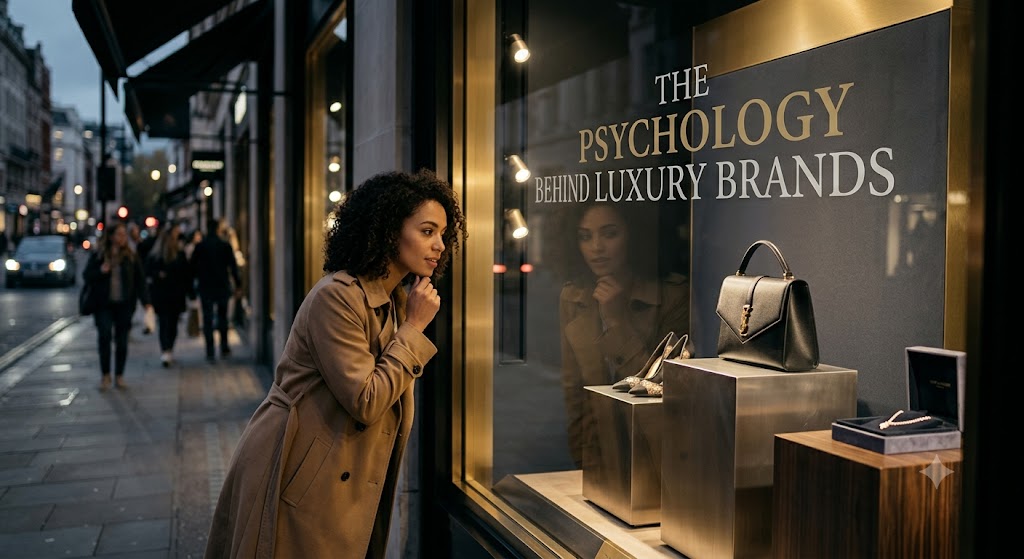
The psychology behind luxury brands is far more powerful than simply convincing people to buy expensive products. A luxury brand does not merely sell a handbag, watch, car, perfume or piece of jewellery. It sells meaning. It sells identity, status, exclusivity, aspiration and emotion. This is why people can willingly spend thousands of pounds on something that may perform a function similar to a product costing a fraction of the price. The difference is often not what the product does, but what owning it makes the customer feel.
Luxury brands have mastered one of the most interesting principles in human psychology: people do not always buy things because they need them. They buy things because of what those things represent. A person may need a watch to tell the time, but nobody needs a luxury watch that costs thousands of pounds to know whether it is 10:30 in the morning. The additional money is often paying for craftsmanship, heritage, design and materials, but it is also paying for symbolism. The watch can communicate success, taste, achievement and belonging without the owner saying a single word.
This is where the psychology of luxury begins. Luxury consumption is closely connected to the human desire for recognition. Throughout history, people have searched for ways to communicate their position within society. Before modern branding existed, people used clothing, jewellery, houses, vehicles and other possessions to demonstrate wealth or social standing. Luxury brands have simply transformed this ancient human behaviour into sophisticated commercial systems.
When someone purchases a luxury product, they may be purchasing more than an object. They may be purchasing a story about themselves. A luxury handbag can become a symbol of independence. A luxury car can represent achievement. An expensive watch can represent years of hard work. A designer outfit can communicate sophistication. A piece of jewellery can represent belonging to a particular social class or lifestyle.
This explains why luxury brands invest so heavily in storytelling. The customer is not simply being told what the product is. They are being invited to imagine who they could become by owning it. Marketing campaigns often feature beautiful locations, influential personalities, elegant environments and carefully constructed lifestyles. The product becomes part of a larger fantasy.
Psychologically, this is extremely powerful because humans are emotional creatures before they are rational consumers. We like to believe that we make purchasing decisions based entirely on logic, but many decisions begin with emotion and are later justified with reasoning. Someone may tell themselves that a luxury car has better engineering, better materials or better performance. Those factors may be true, but the emotional attraction often existed before the rational explanation was constructed.
One of the strongest psychological forces used by luxury brands is scarcity. People naturally tend to value things that appear difficult to obtain. When something is available everywhere, its perceived uniqueness can decline. When something is rare, limited or difficult to access, people often assign greater value to it.
Luxury brands understand this principle extremely well. Limited editions, exclusive collections, restricted availability and invitation only experiences can make customers feel that they are gaining access to something ordinary consumers cannot easily obtain. The psychological message is subtle but powerful: this is not for everybody.
That message matters because luxury is partly about separation. If everyone could easily own a particular luxury product, its ability to communicate status would weaken. A luxury product needs some degree of exclusivity to maintain its symbolic power. The very difficulty of obtaining it can become part of the product’s appeal.
This creates an interesting psychological paradox. Luxury brands sometimes make more money by refusing to sell to everyone who wants their products. Traditional businesses often try to maximise availability. Luxury businesses frequently protect desirability by controlling availability.
Exclusivity can also create a sense of belonging. Humans have a deep psychological desire to belong to groups. We want to feel accepted, recognised and connected to people who share our values or aspirations. Luxury brands can create communities around their products, allowing customers to feel that they are part of a particular world.
The Psychology Behind Luxury Brands
This is why luxury advertising rarely says, “Everybody should buy this.” Instead, the underlying message can be, “This is for people like you.” The customer is invited into an imagined community of successful, sophisticated or influential individuals.
The psychology becomes even more interesting when we consider status signalling. Humans constantly send signals to one another. We communicate through our speech, clothing, possessions, occupations, homes, cars and even the places we visit. Sometimes we consciously choose these signals. Other times we send them without realising it.
Luxury products can function as highly visible status signals. A recognisable designer handbag, watch, car or pair of shoes can communicate information about the person carrying or wearing it. The owner does not need to explain their financial position. The product may communicate it for them.
This is particularly important in environments where social status matters. In business, entertainment, fashion and social circles, appearance can influence how people perceive one another. Luxury brands therefore become tools of communication.
The fascinating part is that the signal does not necessarily have to be obvious to everyone. Some luxury products are deliberately understated. Their value may only be recognised by people who understand the brand, model or craftsmanship. This creates a form of insider knowledge. The customer is not merely displaying wealth. They are demonstrating that they understand the language of luxury.
This is one reason quiet luxury has become such an interesting concept. Some consumers prefer subtle designs without enormous logos because they want recognition from people who understand the details rather than attention from everyone. The psychology shifts from obvious status to sophisticated status.
Another powerful psychological principle behind luxury brands is the idea of self reward. People often associate luxury purchases with personal achievement. After working for years, building a business, receiving a promotion or reaching a financial milestone, a person may decide to buy something expensive as a reward.
The product becomes connected to a personal story. Every time the owner uses it, they may remember the achievement that made the purchase possible. In this way, the object becomes emotionally valuable.
This can explain why people sometimes develop strong emotional attachments to luxury possessions. The product may represent a chapter of their lives rather than simply being an item they purchased from a shop.
Luxury brands also understand aspiration. People frequently buy products that reflect the person they want to become rather than the person they currently are. This is one of the most powerful forces in consumer psychology.
A young entrepreneur may purchase a sophisticated watch because it makes them feel closer to the successful person they hope to become. Someone entering a professional environment may purchase premium clothing because it gives them confidence. Someone building a public image may invest in luxury accessories because they believe the appearance supports the identity they are creating.
The psychological principle is simple: we often use possessions to reinforce our desired identity.
This is why branding matters so much. A luxury brand is not simply a company name. It becomes a psychological shortcut. When consumers see a particular logo, colour, design style or product shape, they immediately associate it with a collection of ideas.
Luxury brands spend decades building these associations. They create consistency in their visual identity, packaging, stores, advertising, product design and customer experience. Over time, the brand becomes more than a name. It becomes an emotional symbol.
This is also why heritage is so important in luxury marketing. A brand with decades or centuries of history can create a perception of authenticity and legitimacy. Consumers may believe that purchasing from an established luxury house gives them access to a tradition that cannot easily be recreated by a new company.
The psychology of heritage is connected to trust. Something that has survived for generations can feel more valuable because its longevity suggests that other people have valued it before us.
Luxury brands therefore sell time as much as products. They sell the idea that their craftsmanship, traditions and identity have survived changing trends. In a world where many products are quickly produced and quickly forgotten, longevity itself can become a luxury.
Another important psychological factor is craftsmanship. People generally perceive products requiring exceptional skill, attention and time as more valuable. A handmade item can feel more special than something produced anonymously at enormous scale.
Luxury brands often highlight craftsmanship because it gives consumers a rational explanation for the premium price. The customer is not merely buying a brand name. They are buying materials, expertise, precision, history and human labour.
Whether every customer fully understands those technical details is another question. What matters psychologically is that craftsmanship provides a believable reason for the price.
Price itself is also psychologically fascinating. Many consumers assume that expensive products must be better. This does not mean that every expensive product is objectively superior to a cheaper alternative. It means that price can influence perception.
When consumers encounter a very high price, they may automatically associate it with quality, exclusivity and prestige. This is known as the price quality effect. In certain situations, people can perceive an expensive product as better partly because they know it is expensive.
Luxury brands understand that lowering prices can sometimes damage the very perception they have spent decades building. If a brand suddenly became heavily discounted everywhere, customers might begin questioning its exclusivity.
This is why luxury brands are extremely careful about promotions and discounting. A normal retailer may use discounts to increase demand. A luxury brand has to consider whether discounts could decrease perceived value.
There is another psychological mechanism involved here: cognitive dissonance. When someone spends a significant amount of money on something, they may feel pressure to believe that the purchase was worthwhile. The more expensive the purchase, the stronger the need to justify it can become.
A person who spends £10 on a product may forget about it quickly. Someone who spends £10,000 may spend considerably more time explaining why the purchase was justified. They may emphasise the craftsmanship, durability, history, exclusivity or investment value.
The mind wants consistency. If we believe we are rational people, spending a huge amount on something creates a psychological challenge. We therefore search for reasons that make the purchase feel sensible.
Luxury marketing can provide those reasons.
The customer experience is another major part of luxury psychology. Luxury is not only about what is sold. It is about how the customer feels while buying it.
A premium store may have carefully designed interiors, personalised service, exclusive packaging, attentive staff and an atmosphere that makes the customer feel important. Every detail contributes to the perception of value.
This demonstrates an important business lesson: people do not only remember what they bought. They remember how the experience made them feel.
Luxury brands therefore create environments where customers can temporarily experience a different version of themselves. Walking into an exclusive boutique can make someone feel wealthy, important, sophisticated or powerful.
That emotional experience can be just as valuable as the physical product.
Packaging plays a similar role. Luxury packaging can transform opening a product into a ritual. The box, texture, colours, smell, presentation and arrangement can communicate quality before the customer even touches the product.
This is not accidental. Every sensory detail contributes to the psychological experience.
Sound, lighting, scent, architecture, photography and even the language used by sales staff can influence perception. Luxury is often carefully designed across multiple senses.
Social proof is another major psychological force. Humans frequently look at what other people are buying to determine what is desirable or valuable. When celebrities, entrepreneurs, athletes or influencers use particular brands, those products can become more desirable.
The association works because people transfer characteristics from the individual to the product. If a respected celebrity is perceived as successful, fashionable or powerful, the brand associated with that person can inherit some of those perceptions.
This is why luxury brands have historically invested heavily in celebrity partnerships, fashion events, red carpet appearances and influential personalities.
However, there is a deeper psychological principle beneath celebrity endorsement. People often imitate individuals they admire. If we want to become more successful, attractive, sophisticated or influential, we may copy some of the behaviours and possessions associated with people who already represent those qualities in our minds.
Luxury brands effectively turn aspiration into consumption.
Social media has intensified this phenomenon. Platforms filled with carefully curated lifestyles can create constant exposure to luxury products. People see expensive cars, designer clothes, luxury hotels, watches, restaurants and exotic holidays repeatedly.
The danger is that social media can make exceptional lifestyles appear normal. A person may compare their ordinary life with somebody else’s carefully selected highlights and conclude that they are falling behind.
Luxury consumption can therefore become connected to social comparison. People may purchase products not because they genuinely love them, but because they fear appearing unsuccessful compared with others.
This is where luxury psychology can become unhealthy. There is a difference between buying something because it genuinely brings value and buying something because you desperately need other people to believe that you are valuable.
A luxury brand can enhance confidence, but it cannot permanently manufacture self worth.
This is an important distinction for consumers. A watch can represent an achievement, but it does not create the achievement. A designer suit can improve presentation, but it does not automatically create competence. A luxury car can communicate wealth, but it does not guarantee financial security.
The object can communicate a story, but the person still has to live the story.
This also explains why luxury consumption can become addictive. Once a person becomes accustomed to external symbols of status, maintaining that image can require increasingly expensive purchases. What once felt extraordinary can eventually feel ordinary.
Psychologists sometimes describe this phenomenon through hedonic adaptation. Humans tend to adjust to positive changes in their circumstances. A luxury purchase may create excitement initially, but after repeated exposure, the excitement can fade.
The person may then seek another purchase to recreate the original emotional high.
This can create a cycle where consumption becomes less about enjoyment and more about emotional regulation.
The smartest luxury consumers understand this. They recognise that luxury is most meaningful when it is aligned with personal values rather than insecurity.
There is also a fascinating relationship between luxury and control. In a world where many products are mass produced, luxury can provide the feeling of having something individual. Consumers may value customisation, personalisation and exclusivity because these features give them a sense of control over their identity.
A customised luxury item can feel like an extension of the individual rather than merely another product.
Luxury brands also create psychological distance through language. Instead of simply describing a product as expensive, they may describe it as exceptional, timeless, refined, iconic or exclusive. Words shape perception.
This demonstrates that luxury is partly constructed through meaning. Two products can perform similar functions while being perceived completely differently because of the stories surrounding them.
A simple bottle of water can cost very little. Place it in an exclusive environment, give it distinctive packaging, attach a powerful story and position it within a premium lifestyle, and consumers may perceive it differently.
The lesson extends far beyond luxury fashion.
Entrepreneurs can learn from the psychology behind luxury brands because every business is ultimately competing for attention, trust and perceived value. Customers rarely evaluate products only according to their technical features. They also evaluate how those products fit into their lives and identities.
A small business owner who understands this can stop competing only on price. Instead of asking, “How can I make my product cheaper?” they can ask, “How can I make my product more meaningful?”
That question changes everything.
The strongest brands create emotional associations that survive beyond individual transactions. They make customers feel something. They give people a reason to remember them and a reason to talk about them.
Luxury brands have become experts at this because they understand that perceived value can be just as important as functional value.
The psychology behind luxury brands therefore reveals something uncomfortable about human behaviour. People do not always buy what they need. They often buy what they want other people to believe about them.
Sometimes they buy confidence. Sometimes they buy belonging. Sometimes they buy recognition. Sometimes they buy nostalgia. Sometimes they buy a reward for surviving difficult years. Sometimes they buy a fantasy about the person they hope to become.
The product is simply the physical container for the emotion.
That is why luxury brands can command extraordinary prices. They are not selling leather, metal, fabric, glass or mechanical components alone. They are selling identity, scarcity, aspiration, status, experience, heritage and emotional meaning.
The greatest luxury brands understand that the human mind does not place value on objects purely according to their physical usefulness. We attach value according to stories, memories, associations and social meaning.
This is why a person can look at two watches that both tell the same time and feel completely different about them.
One is a watch.
The other is a symbol.
And in the world of luxury, symbols can be worth far more than materials.
Ultimately, the psychology behind luxury brands is the psychology of human desire. We want to be recognised. We want to belong. We want to feel successful. We want to distinguish ourselves. We want rewards for our effort. We want to express who we are and sometimes who we wish to become.
Luxury brands have simply learned how to package those desires and attach them to products.
The most important lesson for consumers is not that luxury is bad or that expensive products are meaningless. Luxury can represent genuine craftsmanship, creativity, heritage and personal achievement. The important question is why we want it.
If you can afford a luxury product and genuinely appreciate what it represents, there is nothing inherently wrong with buying it. But if you are destroying your financial future merely to convince strangers that you are successful, the psychology has become your master rather than your tool.
The strongest form of luxury may therefore be something that cannot be purchased from a boutique: financial freedom, peace of mind, control over your time and the confidence to live without constantly proving your worth to other people.
Because when you understand the psychology behind luxury brands, you begin to realise that the most expensive thing they sell may not be the product at all.
It may be the feeling that you are finally enough.

EarnSmartOnline.com.ng is dedicated to helping readers make smarter financial decisions through practical guides on online income, personal finance, technology, digital business, and wealth creation. Our goal is to provide reliable, easy-to-understand, and actionable content that empowers individuals to earn smarter, build sustainable income streams and achieve long-term financial success.
Recommended: Start Earning Online
- Ultimate Affiliate Marketing Program — learn affiliate marketing with a done-for-you sales system ($15). Check it out
- The Newbie Affiliate Guide — the beginner-friendly starter guide (~$6.68). Check it out
- Easy Dollar Maker — earn in dollars uploading AI images and videos from your phone ($17). Check it out
Disclosure: These are affiliate links. If you buy through them, I may earn a commission at no extra cost to you.



