
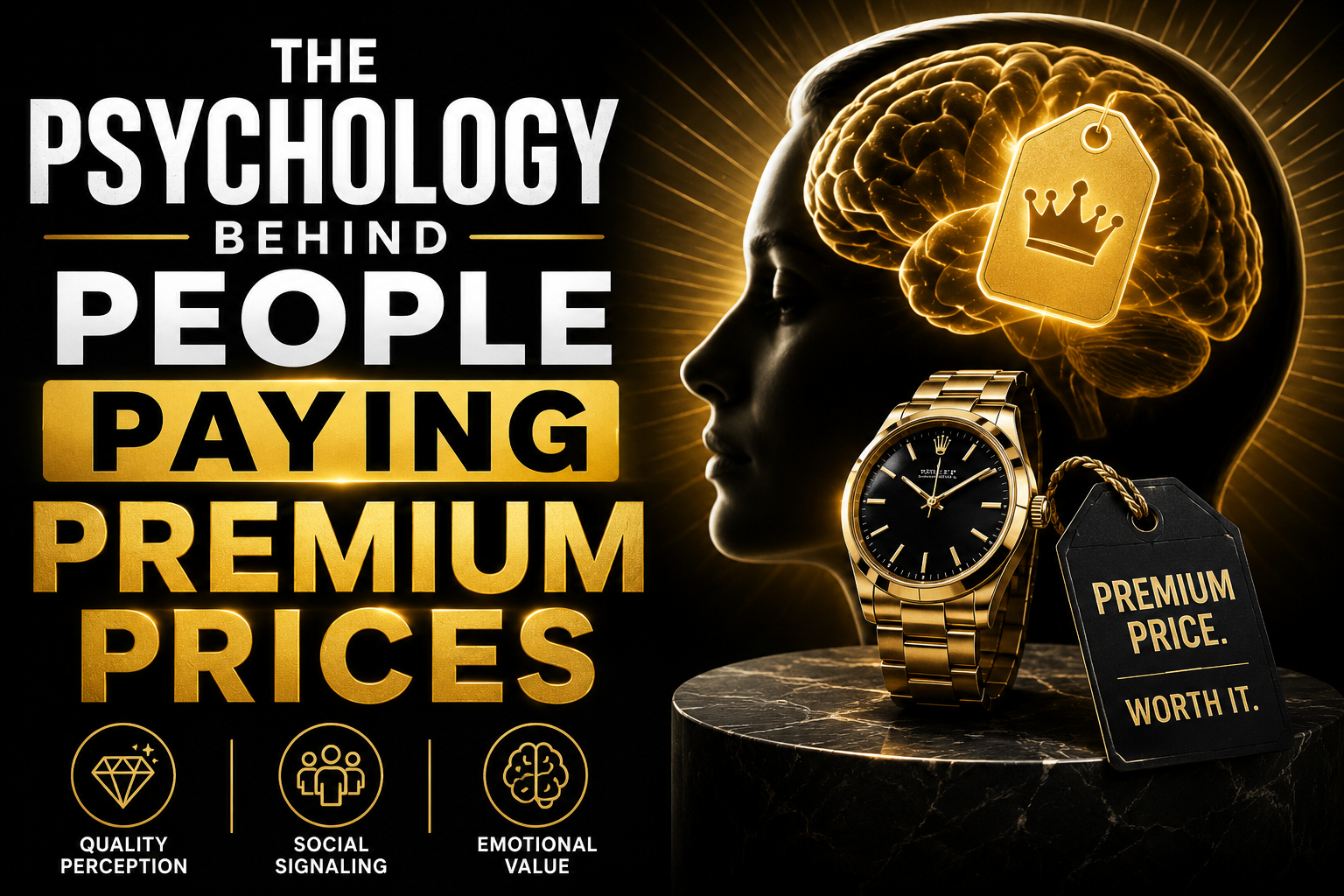
The Psychology Behind People Paying Premium Prices
People rarely pay premium prices because something is objectively “better” in a measurable sense. They pay because of perception, psychology, emotion, and the meaning they attach to the purchase. In most markets, especially in modern consumer economies, pricing is less about cost of production and more about how much pain, desire, identity, and trust are attached to the decision. Once you understand this, it becomes clear that premium pricing is not an accident. It is a carefully engineered psychological outcome shaped by human behavior.
At the core of premium pricing is perceived value. People do not respond to absolute value; they respond to relative value. A product or service is judged not in isolation but in comparison to alternatives, expectations, and emotional benchmarks. If something feels like it solves a deeper problem, elevates status, reduces uncertainty, or saves emotional energy, people are willing to pay far more than its actual cost. This is why two identical items can exist in the market and one sells for ten times more simply because it is presented differently.
Trust plays a central role in premium pricing. When people are uncertain, they tend to overpay for reassurance. In fact, uncertainty is one of the most powerful drivers of high spending. A trusted brand removes doubt, and removing doubt has a psychological price tag. This is why established brands can charge more even when cheaper alternatives exist. The buyer is not just purchasing a product; they are purchasing certainty, reduced risk, and peace of mind. In uncertain environments, people will always choose what feels safe over what feels cheap.
Identity also strongly influences premium purchasing behavior. People do not only buy what they need; they buy what they believe represents who they are or who they want to become. A premium product often signals belonging to a certain group or aspiration toward a certain lifestyle. This is why luxury brands thrive. They are not selling utility; they are selling identity reinforcement. When someone buys a premium product, they are often saying something about themselves without speaking. That silent communication is powerful enough to justify a higher price in their mind.
Emotion overrides logic more often than people admit. Even when individuals believe they are rational, most purchasing decisions are emotionally driven first and justified logically afterward. Premium pricing works because it taps into emotional triggers such as pride, fear of loss, admiration, comfort, and aspiration. If a product makes someone feel more confident, more respected, or more secure, its price becomes secondary. Emotional intensity increases willingness to pay, and marketers who understand this can position almost anything as premium.
Scarcity is another powerful psychological driver behind premium pricing. When something is perceived as limited, rare, or exclusive, its value increases in the human mind. Scarcity creates urgency and intensifies desire. People often assume that if something is harder to obtain, it must be more valuable. This perception is deeply rooted in survival instincts where rare resources were historically more valuable. Modern markets still operate on this ancient wiring. Limited editions, waiting lists, and exclusive access all exploit this psychological mechanism.
Social proof also shapes how people accept premium prices. When individuals see others paying a high price, especially people they admire or relate to, it validates the value of the product. Humans are social learners, meaning they often rely on others’ behavior to make decisions. If a product appears widely accepted or endorsed by influential groups, its price becomes easier to justify. In many cases, people do not want to risk being wrong socially, so they conform to perceived consensus, even if it means paying more.
Another important factor is perceived effort and craftsmanship. People tend to assign higher value to things they believe require more skill, time, or expertise to produce. Even when they cannot verify the actual effort involved, the perception alone is enough. This is why storytelling around creation matters so much. When a product is associated with mastery, precision, or artistry, its price feels justified. The mind equates difficulty with value, even when the correlation is not always accurate.
Convenience is also a hidden driver of premium pricing. People are often willing to pay more to reduce mental load, save time, or avoid complexity. In modern life, attention is one of the most limited resources. Anything that simplifies decision-making or removes friction becomes valuable. This is why subscription services, delivery systems, and automated solutions often command higher prices. People are not just paying for the product; they are paying for the absence of stress and effort.
Fear of regret plays a subtle but powerful role. Many people pay premium prices not because they are certain of the value, but because they fear making the wrong choice. This fear pushes them toward safer, more expensive options. The logic is simple in their mind: if something goes wrong, they would rather have chosen the “best” option than the cheapest one. Premium pricing benefits from this avoidance of regret because it frames expensive choices as safer long-term decisions.
Anchoring also influences how people interpret price. When individuals are first exposed to a high price, it resets their internal expectations. Everything below that anchor suddenly feels more reasonable, even if it is still expensive. Businesses use this effect strategically by presenting premium options first, making other options appear more affordable by comparison. This is not manipulation in a negative sense; it is how human cognition naturally processes numerical information.
There is also a strong link between confidence and pricing acceptance. People with lower confidence in their own judgment are more likely to accept premium prices without question. They assume that higher price equals better quality because they do not trust their ability to evaluate alternatives. On the other hand, more informed or experienced consumers may resist premium pricing unless they clearly see the added value. This creates a gap in markets where perception matters more than technical superiority.
Branding ties all these psychological elements together. A strong brand is essentially a trust shortcut. It reduces the cognitive effort required to evaluate a decision. Instead of analyzing every detail, people rely on brand reputation as a mental shortcut. This is why branding is often more valuable than the product itself. A strong brand can maintain premium pricing even in competitive markets because it controls perception, not just product quality.
Cultural influence also plays a role in shaping what is considered worth paying for. In some environments, high price is associated with status, success, and achievement. In such cultures, premium pricing becomes self-reinforcing because people associate cost with accomplishment. The higher the price, the stronger the symbolic value. This is why luxury markets continue to grow even during economic downturns.
Ultimately, premium pricing works because it aligns with how humans naturally think, not how they ideally should think. People are not purely rational economic agents. They are emotional, social, and psychologically driven beings who use shortcuts to navigate complex decisions. Premium prices succeed when they align with these shortcuts instead of fighting against them.
Understanding the psychology behind premium pricing is not just useful for businesses. It also helps individuals become more aware of their own decision-making patterns. When people recognize why they are willing to pay more for certain things, they gain better control over their financial behavior. At the same time, for creators, entrepreneurs, and marketers, this understanding becomes a powerful tool for building value that is perceived, trusted, and desired at a higher level.
In the end, premium pricing is not about the object itself. It is about the story, the trust, the identity, and the emotional experience wrapped around it. Whoever understands this does not just sell products. They shape perception, and perception is what ultimately determines price.

EarnSmartOnline.com.ng is dedicated to helping readers make smarter financial decisions through practical guides on online income, personal finance, technology, digital business, and wealth creation. Our goal is to provide reliable, easy-to-understand, and actionable content that empowers individuals to earn smarter, build sustainable income streams and achieve long-term financial success.
Recommended: Start Earning Online
- Ultimate Affiliate Marketing Program — learn affiliate marketing with a done-for-you sales system ($15). Check it out
- The Newbie Affiliate Guide — the beginner-friendly starter guide (~$6.68). Check it out
- Easy Dollar Maker — earn in dollars uploading AI images and videos from your phone ($17). Check it out
Disclosure: These are affiliate links. If you buy through them, I may earn a commission at no extra cost to you.



