
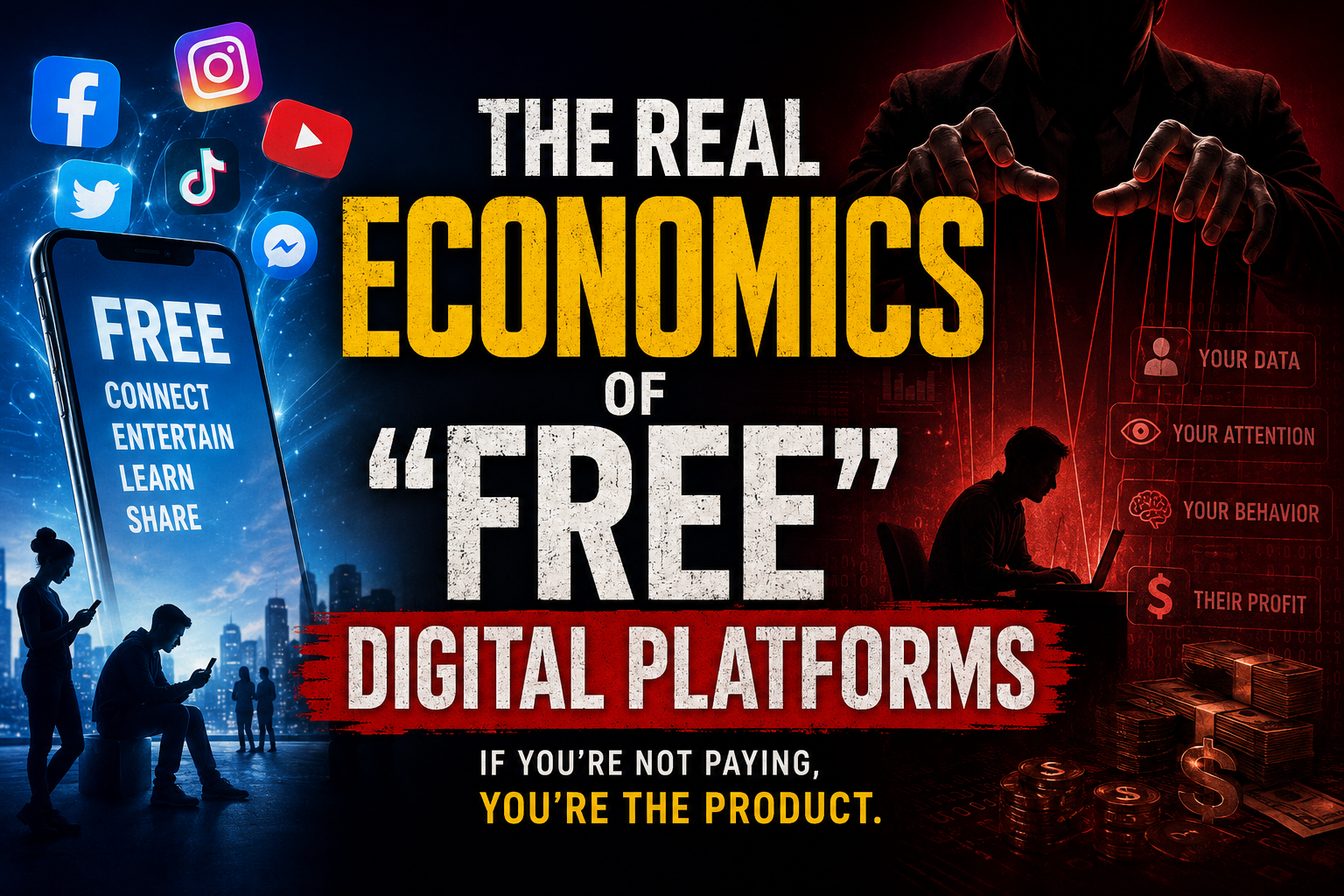
The Real Economics of “Free” Digital Platforms
The internet has transformed the way people communicate, work, shop, learn, entertain themselves and build businesses. Every day, billions of people open social media apps, search engines, email services, cloud storage platforms, messaging applications, streaming websites and countless other digital services without paying a single penny. This convenience has created the impression that the digital world is filled with products that cost nothing. However, one of the biggest misconceptions of the modern economy is the belief that digital platforms are genuinely free. Behind every “free” application, website or online service lies a sophisticated economic model carefully designed to generate enormous profits. The real economics of free digital platforms is not about charity, generosity or goodwill. It is about creating value, attracting attention, collecting data and converting human behaviour into revenue.
Whenever people download a free mobile application, create a social media account or sign up for an online service, they often feel they are receiving something valuable without giving anything in return. In reality, every interaction creates economic value for someone. Servers must be purchased and maintained. Engineers must be paid. Office buildings require rent. Cybersecurity teams work around the clock to protect systems. Marketing departments spend millions acquiring new users. Artificial intelligence models consume enormous computing resources. None of these expenses disappear simply because users are not charged directly. Someone always pays, and in most cases, that payment comes in forms many users never fully recognise.
One of the oldest sayings in business is that if you are not paying for the product, you may actually be the product. While this statement has become increasingly popular, it only scratches the surface of what truly happens behind digital platforms. The reality is far more complex. Users are not literally products. Instead, their attention, preferences, behaviour patterns, purchasing intentions, relationships, locations, browsing habits and countless other forms of information become valuable economic assets. Digital companies transform these assets into advertising opportunities, market intelligence, personalised recommendations and business insights that advertisers are willing to pay billions of dollars to access.
Attention has become one of the world’s most valuable resources. Every minute spent scrolling through a social media feed, watching online videos, reading articles or interacting with digital content creates opportunities for platforms to display advertisements, recommend products or influence purchasing behaviour. Since every person’s attention is limited to only twenty four hours each day, competition for that attention has become one of the fiercest battles in modern business. Companies no longer compete only by offering better products. They compete by capturing more minutes of your day.
The economics behind this competition explains why so many platforms invest heavily in user engagement. Endless scrolling, personalised notifications, recommendation algorithms, autoplay videos and customised content feeds are not simply technological innovations designed for convenience. They are carefully engineered systems intended to maximise user engagement. The longer people remain on a platform, the more advertisements they see, the more behavioural data they generate and the greater the revenue opportunities become.
Advertising remains one of the largest sources of income for free digital platforms. Businesses spend billions every year trying to reach potential customers. Traditional advertising through newspapers, television and radio relied largely on broad audience assumptions. Digital platforms introduced something far more powerful. They allow advertisers to target very specific groups of people based on age, interests, occupation, browsing history, purchasing behaviour, geographic location and hundreds of other variables. This precision dramatically increases advertising efficiency and explains why digital advertising has become such a dominant force in the global economy.
The ability to deliver personalised advertisements depends heavily on data collection. Every search query, website visit, online purchase, video watched, location visited and interaction contributes to an ever-growing profile of user behaviour. Many users underestimate how valuable these behavioural patterns become when combined across millions or even billions of individuals. A single piece of information may appear insignificant, but when aggregated with countless others, it creates highly detailed insights into consumer preferences and future purchasing decisions.
Artificial intelligence has accelerated this process dramatically. Modern machine learning systems analyse enormous quantities of user data to identify patterns invisible to human analysts. These systems predict which advertisements users are most likely to click, which products they may purchase, which content keeps them engaged longest and even which users are most likely to stop using the platform. These predictions enable companies to optimise both user experience and profitability simultaneously.
Network effects further strengthen the economic power of free digital platforms. A platform becomes increasingly valuable as more people join it. A messaging application with only ten users offers little value. The same application becomes indispensable when hundreds of millions of people adopt it. Social media platforms benefit enormously from this phenomenon because each new user potentially increases value for every existing user. This creates a self-reinforcing cycle where larger platforms attract even more users, making it increasingly difficult for smaller competitors to catch up.
The low monetary cost of joining free platforms significantly accelerates network growth. People are far more willing to experiment with new services when no payment is required. This reduces barriers to adoption and allows platforms to build massive user bases quickly. Once enough users join, network effects begin protecting the platform from competitors, creating substantial economic advantages.
Many successful technology companies intentionally operate at financial losses during their early years. Rather than focusing immediately on profits, they prioritise user growth. Investors often support these strategies because they understand that controlling a large user base can eventually generate enormous long-term profits. This explains why many startups provide generous free services while continuously expanding their customer base. They are investing in future economic dominance rather than immediate revenue.
Freemium business models have become another important component of digital platform economics. Under this model, basic services remain free while premium features require payment. This approach allows companies to attract millions of users without charging entry fees while generating income from a relatively small percentage willing to pay for advanced capabilities. Cloud storage services, productivity software, music streaming platforms and many educational websites successfully use this strategy.
Cross subsidisation also plays a significant role. Some companies provide free products because those products support other profitable business activities. A search engine may generate advertising revenue that finances free email services. A smartphone operating system may remain free because it encourages hardware sales. An online marketplace may offer free buyer services because seller commissions generate sufficient income. Understanding these relationships reveals that free services often function as components within much larger economic ecosystems.
Digital platforms have also transformed how businesses understand consumer behaviour. Traditional companies often relied on surveys, focus groups and historical sales reports. Modern digital businesses observe actual behaviour continuously. Instead of asking people what they might buy, platforms analyse what users actually search for, view, compare, purchase and recommend. This behavioural information often proves far more accurate than self-reported opinions, making it extraordinarily valuable for both product development and marketing.
Recommendation algorithms illustrate another fascinating aspect of digital economics. Streaming services recommend movies. Shopping platforms suggest products. Social media platforms prioritise certain posts. News websites personalise articles. While these recommendations improve convenience, they also maximise engagement by keeping users active longer. Increased engagement directly increases advertising opportunities, subscription retention and long-term profitability.
Data has frequently been described as the new oil, but this comparison has limitations. Oil becomes less valuable once consumed. Data often becomes more valuable when combined, analysed and reused. A single search history reveals limited information. Combined with location data, purchasing behaviour, social interactions and browsing history, it creates rich behavioural profiles capable of generating significant economic value repeatedly without being depleted.
Privacy has therefore become both an ethical issue and an economic asset. Users increasingly recognise that personal information carries financial value. Governments worldwide have introduced regulations requiring greater transparency regarding data collection and user consent. Businesses now invest heavily in compliance, cybersecurity and privacy management because public trust directly influences long-term profitability. Companies that mishandle customer data often suffer reputational damage, regulatory penalties and declining user confidence.
Trust itself has become one of the most valuable currencies within digital markets. Users willingly share information only when they believe companies will protect it responsibly. A single major security breach can erase years of carefully built trust. Consequently, cybersecurity spending has become not merely a technical necessity but an essential business investment. Protecting user data protects future revenue.
Digital platforms also benefit from economies of scale unlike many traditional businesses. Once software has been developed, serving additional users often costs relatively little compared to physical manufacturing. A company can distribute millions of software downloads without building millions of physical products. This scalability allows successful platforms to generate extraordinary profit margins once infrastructure costs have been covered.
Global accessibility further strengthens these economic advantages. Physical businesses often face geographic limitations. Digital platforms can expand internationally with remarkable speed. A mobile application created in one country may attract users across every continent within months. This global reach creates enormous market opportunities unavailable to many traditional industries.
Competition within digital markets remains intense despite the dominance of several major technology companies. Consumer preferences change rapidly. New technologies emerge continuously. Artificial intelligence, virtual reality, blockchain technologies, cloud computing and decentralised platforms constantly reshape competitive landscapes. Even industry leaders invest billions in research and development because technological leadership rarely remains permanent.
The creator economy represents another important evolution of free digital platforms. Content creators produce videos, articles, podcasts, newsletters, online courses and entertainment that attract audiences to digital platforms. Platforms benefit because creators increase user engagement, while creators benefit through advertising revenue sharing, sponsorships, subscriptions or direct audience support. This mutually beneficial relationship has created entirely new career opportunities unavailable only a decade ago.
Influencer marketing demonstrates how attention itself has become monetised. Individuals with loyal online audiences can generate substantial income by promoting products, recommending services or building personal brands. Their economic value derives not from manufacturing goods but from influencing purchasing decisions. This illustrates how digital platforms have expanded the definition of productive economic activity.
Consumers often believe free services reduce overall spending, yet digital platforms frequently stimulate additional consumption. Personalised advertisements encourage purchases precisely matched to individual interests. Recommendation systems expose users to products they may never have discovered independently. Flash sales, limited-time offers and behavioural targeting increase conversion rates by leveraging psychological principles alongside sophisticated data analysis.
Behavioural economics plays a central role throughout these systems. Humans naturally respond to social validation, novelty, convenience and personalised experiences. Digital platforms continuously optimise interfaces based on behavioural research to encourage greater participation. Every design choice, notification, recommendation and user interaction undergoes extensive testing aimed at improving engagement metrics.
Despite legitimate concerns surrounding privacy, competition and digital dependence, free platforms have undoubtedly created enormous economic value for society. Small businesses reach global customers without massive advertising budgets. Entrepreneurs launch companies using affordable cloud services. Students access educational resources previously unavailable. Families communicate instantly across continents. Remote workers collaborate efficiently regardless of location. These benefits demonstrate that free digital platforms produce substantial positive economic outcomes alongside legitimate challenges.
The future economics of free digital platforms will likely become even more sophisticated. Artificial intelligence will personalise services further. Privacy regulations will reshape data collection practices. Subscription models may continue expanding alongside advertising-supported services. Decentralised technologies could introduce alternative ownership structures where users participate more directly in platform governance and economic rewards.
Consumers must therefore develop greater digital literacy alongside financial literacy. Understanding how free platforms generate revenue enables individuals to make informed decisions about privacy, security, online behaviour and technology usage. Free does not necessarily mean exploitative, nor does paid always guarantee privacy. Every platform operates within its own unique economic model, requiring thoughtful evaluation rather than simplistic assumptions.
The real economics of free digital platforms ultimately teaches one of the most important lessons in modern business. Nothing of value is ever truly free. Every product, service or convenience carries costs that must eventually be covered through some combination of advertising, subscriptions, data, partnerships, premium services or complementary revenue streams. Recognising these invisible exchanges allows consumers, entrepreneurs and investors to better understand the digital economy shaping nearly every aspect of modern life.
As technology continues advancing, the distinction between users, customers, creators and businesses will become increasingly interconnected. Individuals who understand these economic relationships will be better positioned to protect their privacy, build sustainable online businesses, evaluate digital opportunities and participate intelligently in an economy where attention, trust, information and innovation have become some of the most valuable assets on earth. The future belongs not simply to those who use free digital platforms, but to those who understand the powerful economic forces operating beneath their seemingly cost-free surfaces.

EarnSmartOnline.com.ng is dedicated to helping readers make smarter financial decisions through practical guides on online income, personal finance, technology, digital business, and wealth creation. Our goal is to provide reliable, easy-to-understand, and actionable content that empowers individuals to earn smarter, build sustainable income streams and achieve long-term financial success.
Recommended: Start Earning Online
- Ultimate Affiliate Marketing Program — learn affiliate marketing with a done-for-you sales system ($15). Check it out
- The Newbie Affiliate Guide — the beginner-friendly starter guide (~$6.68). Check it out
- Easy Dollar Maker — earn in dollars uploading AI images and videos from your phone ($17). Check it out
Disclosure: These are affiliate links. If you buy through them, I may earn a commission at no extra cost to you.



