
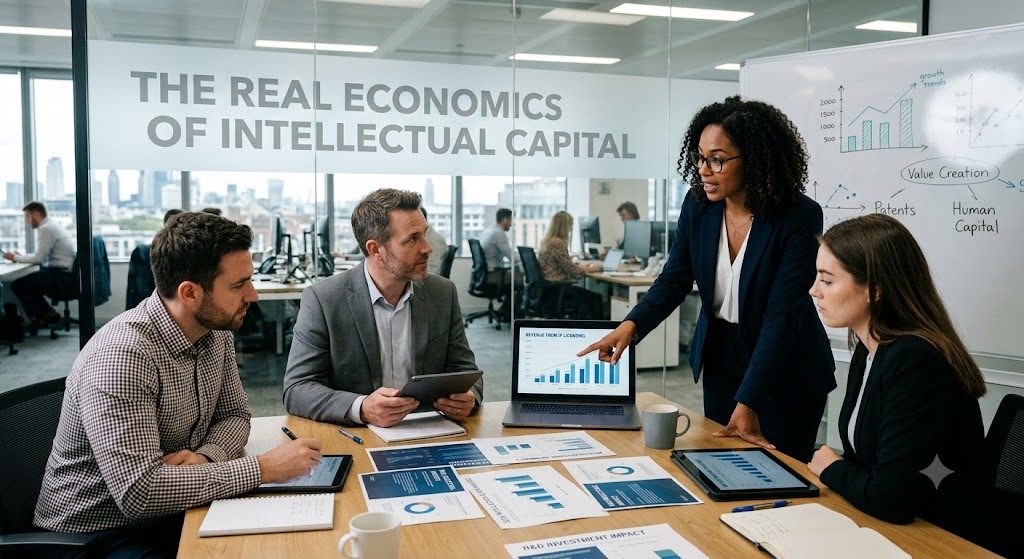
The Real Economics of Intellectual Capital
The real economics of intellectual capital has become one of the most important subjects in today’s economy, yet it remains one of the least understood. For generations, wealth was measured by what people could physically own. Land, factories, machinery, gold, buildings, and inventory represented the foundation of financial success. Companies competed by acquiring more equipment, employing more workers, and expanding their physical presence. Individuals measured success through tangible possessions. However, the digital economy has quietly changed these rules. Today, knowledge has become a form of capital that often produces greater returns than physical assets. Intellectual capital has emerged as one of the most valuable resources any individual or organisation can possess.
Many people still spend years trying to accumulate physical assets while neglecting the one asset that appreciates with continuous investment. Intellectual capital refers to the knowledge, skills, experience, creativity, relationships, systems, ideas, and problem-solving abilities that generate value. Unlike physical property that gradually wears out with use, intellectual capital often becomes more valuable the more it is applied, refined, and shared.
The economy rewards people who solve problems, not merely those who own tools. A software developer creates applications used by millions without owning a factory. A writer earns income from books that can be sold repeatedly without producing each copy manually. An online educator records one course that teaches thousands of students around the world. A consultant builds a business from years of experience rather than from expensive machinery. In every case, the greatest asset is not equipment but knowledge transformed into value.
This explains why many of the world’s most successful businesses possess relatively few physical assets compared to their market value. Their worth comes largely from intellectual property, innovation, customer trust, proprietary systems, talented employees, research capabilities, and recognised brands. Investors understand that future earnings increasingly depend on what people know rather than simply what they own.
Intellectual capital exists in three major forms. Human capital consists of individual knowledge, technical skills, creativity, experience, judgement, communication ability, and leadership qualities. Structural capital includes business systems, documented processes, patents, databases, software, operating procedures, trademarks, and organisational knowledge that remains even when employees leave. Relational capital represents customer loyalty, supplier relationships, professional networks, reputation, partnerships, and public trust. Together these forms of capital determine how effectively knowledge becomes economic value.
Many people mistakenly assume education automatically creates intellectual capital. Education provides information, but information alone rarely produces wealth. Intellectual capital develops when information is transformed into practical understanding through experience, experimentation, continuous learning, and application. Thousands of graduates leave universities every year possessing degrees but lacking valuable intellectual capital because they have never learned how to convert knowledge into solutions people are willing to pay for.
The marketplace rarely rewards knowledge for its own sake. It rewards useful knowledge. Someone may memorise hundreds of financial theories without becoming financially successful. Another individual with modest formal education may understand customers exceptionally well and build a thriving business. The difference lies in practical application rather than accumulated information.
Knowledge becomes intellectual capital only when it creates measurable value. Reading books about entrepreneurship does not automatically create wealth. Building a successful business using lessons learned from those books transforms knowledge into capital. Watching hundreds of programming tutorials means little until software is created that solves real problems. Learning photography techniques becomes valuable only when those skills generate income, preserve memories, or meet market demand.
One remarkable characteristic of intellectual capital is its ability to compound. Traditional assets generally appreciate slowly or depreciate over time. Knowledge, however, often multiplies. Every new skill strengthens previously acquired skills. A marketer who understands psychology communicates more effectively. A programmer who learns artificial intelligence increases the value of existing coding skills. A teacher who masters storytelling improves educational effectiveness dramatically. Skills reinforce one another, creating exponential rather than linear growth.
This compounding effect explains why continuous learners often outperform equally intelligent individuals who stop learning after formal education. Every additional skill increases the usefulness of existing knowledge. Small improvements accumulated consistently over many years eventually produce extraordinary competitive advantages that become difficult for others to replicate.
The digital revolution has dramatically increased the value of intellectual capital. Modern technology allows knowledge to scale globally with minimal additional cost. A book written once can sell indefinitely. A mobile application developed by a small team can reach millions of users. An online course recorded over several weeks may continue generating income for years. A YouTube tutorial viewed by thousands demonstrates how intellectual effort performed once creates ongoing value repeatedly.
Unlike manufacturing businesses that require additional raw materials for increased production, intellectual products often scale without proportional increases in cost. This creates enormous economic leverage. One well-designed digital product may generate more income than years of physical labour because it separates earnings from time invested.
Employers increasingly recruit individuals capable of thinking critically rather than simply following instructions. Automation has replaced many repetitive tasks, but creativity, emotional intelligence, strategic thinking, innovation, leadership, negotiation, and complex problem-solving remain uniquely valuable. These abilities represent forms of intellectual capital that machines struggle to replicate effectively.
Artificial intelligence further emphasises this reality. Many fear that AI will eliminate employment opportunities. While certain routine jobs may indeed disappear, the greatest opportunities belong to individuals who know how to combine human creativity with intelligent technology. People who understand how to use AI effectively increase rather than reduce the value of their intellectual capital. Technology rewards adaptable minds more than resistant attitudes.
Another important aspect of intellectual capital is credibility. Expertise without trust creates limited economic value. Customers purchase solutions from people they believe. Businesses collaborate with professionals whose competence has been demonstrated consistently. Investors support founders with strong reputations. Employers promote individuals known for reliability. Credibility transforms knowledge into commercial opportunity.
Reputation therefore becomes a powerful economic asset. Years of consistently delivering quality work create trust that cannot easily be purchased. While competitors may imitate products, they cannot easily duplicate a reputation built through integrity, consistency, and excellence. This explains why respected professionals often command significantly higher fees than equally skilled competitors lacking established credibility.
Networking also contributes significantly to intellectual capital. Relationships provide access to information, opportunities, partnerships, mentorship, referrals, and collaboration. Many career opportunities emerge not through formal applications but through trusted professional relationships. Networks distribute knowledge more rapidly than isolated learning ever could.
Curiosity serves as the engine that continually expands intellectual capital. Curious individuals ask better questions, notice hidden patterns, identify emerging trends, and remain open to new perspectives. They recognise that every conversation, challenge, failure, and success contains valuable lessons. Their willingness to keep learning allows their intellectual assets to appreciate continuously throughout life.
Reading remains one of the most cost-effective investments in intellectual capital. Books provide access to decades of experience from experts across countless disciplines. Instead of repeating mistakes already solved by others, readers accelerate learning by building upon existing knowledge. A relatively inexpensive book may permanently improve decision-making, leadership, communication, financial understanding, or technical competence, producing returns impossible to calculate accurately.
Experience, however, completes what reading begins. Real understanding develops through action. Mistakes reveal weaknesses in assumptions. Success confirms effective strategies. Practical application transforms abstract concepts into dependable knowledge. Every project completed, every customer served, every negotiation conducted, and every challenge overcome contributes to intellectual capital that no classroom can fully provide.
Many organisations now recognise that employee development represents an investment rather than an expense. Companies encouraging continuous training often outperform competitors because knowledgeable employees solve problems more efficiently, innovate more effectively, improve customer satisfaction, and identify profitable opportunities earlier. Organisational learning strengthens structural capital while simultaneously increasing human capital.
Knowledge sharing multiplies rather than diminishes intellectual capital. Unlike physical resources divided among users, knowledge expands through distribution. Teaching others often deepens personal understanding while strengthening professional reputation. Communities built around shared learning frequently generate innovation impossible within isolated environments.
Intellectual capital also influences adaptability. Economic conditions change rapidly. Entire industries evolve within a few years. Technologies become obsolete. Consumer preferences shift. Regulations change. Individuals relying solely on outdated technical skills become increasingly vulnerable. Those possessing strong learning abilities adapt successfully because they continuously acquire relevant knowledge.
One overlooked component of intellectual capital is decision-making quality. Better decisions produce better long-term outcomes. Knowledge improves judgement by providing broader perspectives, recognising patterns, evaluating risks, and anticipating consequences. Individuals making consistently sound decisions gradually accumulate advantages that appear insignificant daily but become extraordinary over decades.
Emotional intelligence deserves equal recognition. Technical expertise alone rarely guarantees success. The ability to communicate clearly, resolve conflicts, understand customer needs, motivate teams, negotiate effectively, and build lasting relationships often determines whether knowledge produces economic value. Emotional intelligence transforms technical competence into leadership and influence.
Creativity represents another powerful economic resource. Innovation rarely emerges from repeating established practices indefinitely. Creative thinkers identify overlooked opportunities, develop original solutions, improve existing products, and respond effectively to changing market conditions. As automation handles routine activities, creativity becomes increasingly valuable because originality cannot easily be automated.
Protecting intellectual capital also matters. Businesses secure patents, trademarks, copyrights, confidential processes, proprietary software, and trade secrets because unique knowledge creates competitive advantage. Individuals protect intellectual capital by continuously updating skills before they become obsolete, maintaining professional ethics, documenting valuable processes, and building personal brands associated with expertise.
Many people underestimate how personal branding strengthens intellectual capital. Publishing articles, speaking at events, sharing educational content, participating in professional discussions, and consistently demonstrating expertise increase visibility and credibility simultaneously. Opportunities frequently seek individuals already recognised as knowledgeable authorities.
The economics of intellectual capital also explains income inequality within many industries. Two professionals may possess similar educational qualifications yet earn vastly different incomes. The difference often results from communication ability, specialised expertise, reputation, innovation, leadership, negotiation skills, adaptability, and relationship-building capacity rather than formal credentials alone.
Continuous improvement remains essential because intellectual capital depreciates when neglected. Industries evolve rapidly. Software changes. Marketing strategies shift. Scientific discoveries replace previous assumptions. Skills once considered exceptional may become ordinary within a few years. Lifelong learning therefore protects the value of accumulated knowledge while creating opportunities unavailable to stagnant competitors.
One encouraging feature of intellectual capital is accessibility. Unlike inherited wealth or expensive property, knowledge remains available to anyone willing to invest time, discipline, and consistent effort. Libraries, online courses, podcasts, educational videos, professional communities, and practical experience provide affordable pathways toward valuable expertise. While everyone begins from different circumstances, nearly everyone possesses the ability to increase intellectual capital through deliberate learning.
Parents, educators, and leaders increasingly recognise that teaching people how to think often proves more valuable than simply teaching them what to think. Analytical reasoning, problem-solving ability, curiosity, adaptability, communication, and ethical judgement prepare individuals for unpredictable futures better than memorising static information alone.
The future economy will likely reward intellectual capital even more strongly than today’s economy. Artificial intelligence, biotechnology, automation, renewable energy, cybersecurity, advanced manufacturing, and digital communication continue transforming industries worldwide. Individuals capable of learning continuously, solving complex problems creatively, collaborating effectively, and adapting quickly will remain indispensable despite technological advancement.
Ultimately, the real economics of intellectual capital demonstrates that the most valuable investments rarely appear on traditional balance sheets. Knowledge, wisdom, creativity, credibility, relationships, adaptability, emotional intelligence, innovation, and disciplined learning create wealth that extends beyond financial income. They increase career opportunities, improve business performance, strengthen communities, enhance leadership, and provide resilience during uncertainty.
Money invested in depreciating possessions may eventually disappear. Money invested in valuable knowledge often continues generating returns throughout an entire lifetime. Every book studied, every skill mastered, every lesson learned from failure, every meaningful relationship developed, every problem solved, and every experience reflected upon increases intellectual capital. Over time these invisible assets become visible results.
Those who understand the real economics of intellectual capital stop viewing learning as an occasional activity and begin treating it as one of the highest-return investments available. They recognise that the world’s greatest opportunities increasingly belong not to those who simply work harder, but to those who think better, learn faster, adapt continuously, and transform knowledge into lasting value. In an economy driven by ideas, the wealthiest asset anyone can own may ultimately be the quality of their mind and their ability to use it wisely.

EarnSmartOnline.com.ng is dedicated to helping readers make smarter financial decisions through practical guides on online income, personal finance, technology, digital business, and wealth creation. Our goal is to provide reliable, easy-to-understand, and actionable content that empowers individuals to earn smarter, build sustainable income streams and achieve long-term financial success.
Recommended: Start Earning Online
- Ultimate Affiliate Marketing Program — learn affiliate marketing with a done-for-you sales system ($15). Check it out
- The Newbie Affiliate Guide — the beginner-friendly starter guide (~$6.68). Check it out
- Easy Dollar Maker — earn in dollars uploading AI images and videos from your phone ($17). Check it out
Disclosure: These are affiliate links. If you buy through them, I may earn a commission at no extra cost to you.



