
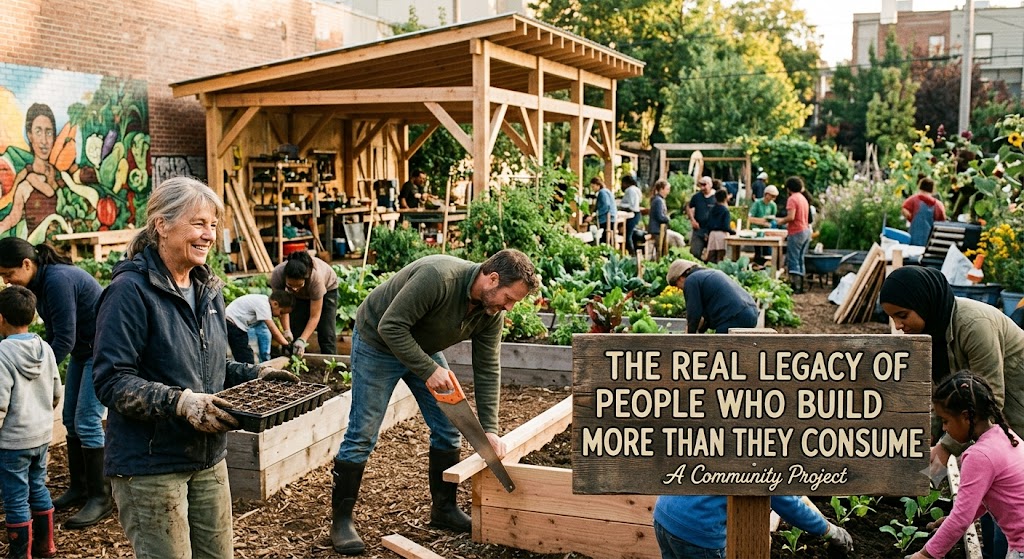
The Real Legacy of People Who Build More Than They Consume
The real legacy of people who build more than they consume is not measured by the size of their bank accounts, the luxury of their homes, or the number of expensive possessions they accumulate during their lifetime. Their true legacy is found in the value they leave behind long after they are gone. Every generation is faced with a simple but life-changing choice. It can spend most of its time consuming what others have created, or it can dedicate itself to building something that improves the lives of others. While consumption is natural and necessary, a life centred entirely on consuming leaves little behind. Building, on the other hand, creates a ripple effect that continues to influence people for decades, sometimes even centuries.
Modern society has become remarkably efficient at encouraging consumption. Every day, advertisements compete for attention, social media promotes lifestyles built around constant buying, and technology makes spending money easier than ever before. People are encouraged to upgrade, replace, subscribe, and acquire without giving equal thought to creating, inventing, teaching, investing, or serving. There is nothing inherently wrong with enjoying the products and services available today. The problem begins when consumption becomes the primary purpose of life instead of a reward for meaningful contribution.
History consistently celebrates builders. The people remembered across generations are rarely those who consumed the most. They are the individuals who created ideas, businesses, books, inventions, charities, schools, technologies, communities, and opportunities that benefited countless others. Their names remain relevant because they produced more value than they extracted from society. They solved problems instead of merely enjoying solutions created by others.
Every successful civilisation has been built by people who understood that lasting influence comes from contribution. Roads were built because someone decided transportation mattered. Universities exist because people believed knowledge should outlive individual lifetimes. Businesses employ millions because entrepreneurs chose to create opportunities instead of simply searching for them. Medical discoveries continue saving lives because researchers devoted themselves to building knowledge rather than merely consuming it.
One of the greatest misunderstandings about success is the belief that wealth alone defines achievement. Wealth certainly provides comfort, freedom, and opportunity, but wealth without contribution rarely creates a meaningful legacy. Someone may earn millions through fortunate circumstances, yet leave little behind that benefits society. Another person may build a modest business that employs local workers, supports families, mentors young entrepreneurs, and inspires innovation. The financial numbers may differ dramatically, but the second individual often leaves the greater legacy.
Building extends far beyond starting companies or inventing products. Parents build when they raise children with integrity and wisdom. Teachers build when they shape future leaders. Writers build when they preserve knowledge for generations yet unborn. Artists build through creativity that inspires millions. Farmers build food security. Engineers build infrastructure. Programmers build digital solutions. Volunteers build stronger communities. Every meaningful contribution expands human progress.
Consumption, by contrast, produces temporary satisfaction. A new car eventually becomes an old car. The latest smartphone becomes outdated. Fashion trends disappear. Luxury holidays become memories. Material possessions lose value over time. Even expensive lifestyles require constant maintenance to preserve appearances. Building creates something fundamentally different. A useful invention continues solving problems. A valuable book continues educating readers. A successful business continues providing employment. A strong family continues passing values from one generation to another.
One reason many people remain trapped in cycles of consumption is because building often requires patience. Consumption provides immediate gratification. Building demands delayed rewards. Buying something exciting takes minutes. Creating something valuable may require years of disciplined effort. Human nature naturally gravitates towards immediate pleasure, making builders relatively rare in every generation.
The digital age has amplified this challenge. Endless entertainment, online shopping, social media feeds, and streaming platforms compete for every available minute. Entire industries are designed to maximise attention rather than maximise contribution. Hours disappear consuming videos, news, opinions, and entertainment without producing anything of lasting value. While relaxation has its place, many people unknowingly spend far more time consuming than creating.
Builders approach time differently. They understand that every hour invested in learning, practising, designing, writing, teaching, or improving systems creates assets that may continue producing value indefinitely. They ask different questions. Instead of asking what they can buy, they ask what they can build. Instead of wondering what the world can offer them, they wonder what problems they can solve.
Perhaps the greatest characteristic shared by builders is responsibility. They refuse to believe someone else must improve every situation. When they identify a problem, they look for solutions instead of complaints. They recognise gaps in the market, weaknesses in existing systems, and opportunities for improvement. While consumers wait for better circumstances, builders create them.
This mindset affects every area of life. Financially, builders acquire assets instead of liabilities whenever possible. Professionally, they develop valuable skills instead of relying entirely on job security. Personally, they cultivate strong relationships instead of expecting constant emotional support from others. Intellectually, they create knowledge rather than endlessly collecting information they never apply.
Building also requires courage because creation always invites criticism. Every successful entrepreneur faced doubters before becoming successful. Every respected author faced rejection before publication. Every influential inventor encountered failure before success. Consumers rarely experience this level of resistance because consumption involves little risk. Builders willingly accept uncertainty because they understand that meaningful achievement demands resilience.
Another defining feature of builders is long-term thinking. Consumers frequently optimise for today’s comfort. Builders optimise for tomorrow’s possibilities. They willingly sacrifice immediate pleasure for future impact. They invest in education before results become visible. They save money before emergencies arise. They develop systems before growth demands them. They plant trees knowing future generations may enjoy the shade.
Long-term thinking explains why builders frequently appear unconventional during the early stages of their journeys. While others spend disposable income on status symbols, builders invest in productive assets. While others spend evenings consuming entertainment, builders spend evenings developing expertise. While others chase trends, builders master timeless principles. Their decisions may seem unusual until years later when compound progress becomes visible.
Compounding represents one of the most powerful forces working in favour of builders. Every skill learned improves future learning capacity. Every satisfied customer increases referrals. Every published article attracts new readers. Every investment generates additional opportunities. Every meaningful relationship expands influence. Small acts of consistent creation eventually produce extraordinary results that appear almost effortless to outside observers.
Legacy itself operates according to similar principles. Few legacies emerge from one dramatic achievement. Most are built through thousands of ordinary decisions repeated consistently over many years. Integrity practiced daily becomes trust. Generosity expressed regularly becomes community impact. Excellence maintained consistently becomes reputation. Wisdom shared repeatedly becomes influence across generations.
Families provide perhaps the clearest example of building versus consuming. Parents who merely provide material possessions may satisfy temporary desires, but parents who build character, discipline, confidence, resilience, and compassion leave immeasurably greater inheritances. Financial wealth can disappear within a generation. Strong values often continue influencing descendants for centuries.
Businesses reveal the same principle. Companies focused solely on extracting profits frequently disappear when market conditions change. Businesses committed to solving genuine customer problems often thrive because they continuously create value. Their financial success becomes a natural consequence of consistent contribution rather than the sole objective.
Communities flourish when builders outnumber consumers. Volunteers strengthen neighbourhoods. Local entrepreneurs create employment. Mentors develop future leaders. Responsible citizens maintain public trust. Charitable organisations support vulnerable populations. Educational institutions cultivate knowledge. Every healthy society depends upon individuals willing to contribute more than they withdraw.
Technology has made building more accessible than at any previous point in history. A single individual can publish books read worldwide, launch businesses serving international customers, teach millions through online platforms, develop software solving global problems, or create educational content viewed across continents. The barriers to creation have fallen dramatically, making excuses increasingly difficult to justify.
Yet the abundance of opportunity also creates greater responsibility. Access to powerful tools means each individual must decide whether those tools will primarily serve consumption or creation. The same smartphone can become a source of endless distraction or a platform for building businesses, educating audiences, learning valuable skills, and solving meaningful problems.
Building requires discipline because valuable work often occurs before recognition arrives. Most worthwhile projects spend long periods unnoticed. Authors write manuscripts nobody has requested. Entrepreneurs improve products before customers appear. Musicians practise privately before performing publicly. Athletes train relentlessly before winning championships. Builders trust the process long before receiving external validation.
Recognition, ironically, often arrives after contribution rather than before it. Society rewards those who consistently solve problems, improve lives, and create value. Fame pursued directly frequently proves elusive. Influence earned through meaningful contribution tends to endure because it rests upon genuine usefulness.
Many people mistakenly assume they must build something revolutionary to leave a meaningful legacy. This belief discourages action because revolutionary achievements appear unattainable. In reality, countless ordinary contributions collectively transform societies. A helpful teacher, an honest business owner, a dependable employee, a compassionate healthcare worker, or a dedicated parent may influence more lives than many famous personalities.
Legacy should therefore be understood as accumulated contribution rather than accumulated possessions. The question is not simply how much someone earned, but how many lives became better because that person existed. Did they leave systems that continue functioning? Did they transfer knowledge? Did they create opportunities? Did they solve persistent problems? Did they inspire others to become builders themselves?
The most remarkable aspect of builders is that they often multiply themselves. A teacher inspires future teachers. A successful entrepreneur mentors future entrepreneurs. A generous philanthropist encourages further generosity. A wise parent raises responsible children who repeat similar patterns. Building creates multiplication whereas consumption usually creates only temporary satisfaction.
Economic progress itself depends upon this multiplication effect. Every invention becomes the foundation for future innovation. Every scientific discovery enables additional discoveries. Every technological advancement creates entirely new industries. Builders extend civilisation by expanding what becomes possible for everyone else.
There is also profound personal satisfaction in building. Consumption provides excitement that gradually fades. Building produces fulfilment rooted in purpose. Watching an idea become reality, seeing customers benefit from a product, observing students master difficult concepts, or witnessing children develop strong character provides lasting meaning that possessions alone rarely deliver.
Financial freedom also becomes more sustainable when based upon creation. Income generated through assets, intellectual property, businesses, investments, or valuable skills tends to prove more resilient than income dependent entirely upon trading time for money. Builders create systems capable of producing value beyond their direct physical effort.
The principle applies equally to personal character. People either build discipline or consume excuses. They either build resilience or consume comfort. They either build wisdom or consume information without application. Character itself represents one of the greatest projects any individual can undertake because every external achievement ultimately depends upon internal foundations.
Future generations will inherit the consequences of today’s builders. The books written today may educate tomorrow’s leaders. The companies established today may employ millions decades from now. The technologies developed today may transform healthcare, education, communication, and transportation for future societies. Every act of meaningful creation extends beyond its original creator.
Ultimately, the real legacy of people who build more than they consume is measured not by what they owned, but by what continues growing after they are gone. Buildings eventually age, currencies fluctuate, markets change, and possessions disappear. Yet ideas continue spreading. Values continue shaping families. Knowledge continues educating minds. Businesses continue creating opportunities. Communities continue benefiting from foundations laid by previous generations.
Every person must eventually answer a deeply personal question. When your lifetime is examined years from now, will it be remembered primarily for what you accumulated or for what you contributed? Will your presence have increased the total value available to the world, or merely increased the amount you personally consumed? The answer is determined not by one extraordinary decision but by thousands of ordinary choices made consistently throughout life.
The people who leave the deepest footprints in history are rarely those who asked for more from the world. They are those who gave the world more than they took. They understood that success is temporary unless it creates opportunity for others, that wealth is incomplete unless it produces lasting value, and that influence matters most when it inspires future builders. Their greatest inheritance is not the possessions they leave behind but the possibilities they create for generations yet to come. That is the real legacy of people who build more than they consume, and it is a legacy that remains valuable long after every material possession has faded into history.

EarnSmartOnline.com.ng is dedicated to helping readers make smarter financial decisions through practical guides on online income, personal finance, technology, digital business, and wealth creation. Our goal is to provide reliable, easy-to-understand, and actionable content that empowers individuals to earn smarter, build sustainable income streams and achieve long-term financial success.
Recommended: Start Earning Online
- Ultimate Affiliate Marketing Program — learn affiliate marketing with a done-for-you sales system ($15). Check it out
- The Newbie Affiliate Guide — the beginner-friendly starter guide (~$6.68). Check it out
- Easy Dollar Maker — earn in dollars uploading AI images and videos from your phone ($17). Check it out
Disclosure: These are affiliate links. If you buy through them, I may earn a commission at no extra cost to you.



