
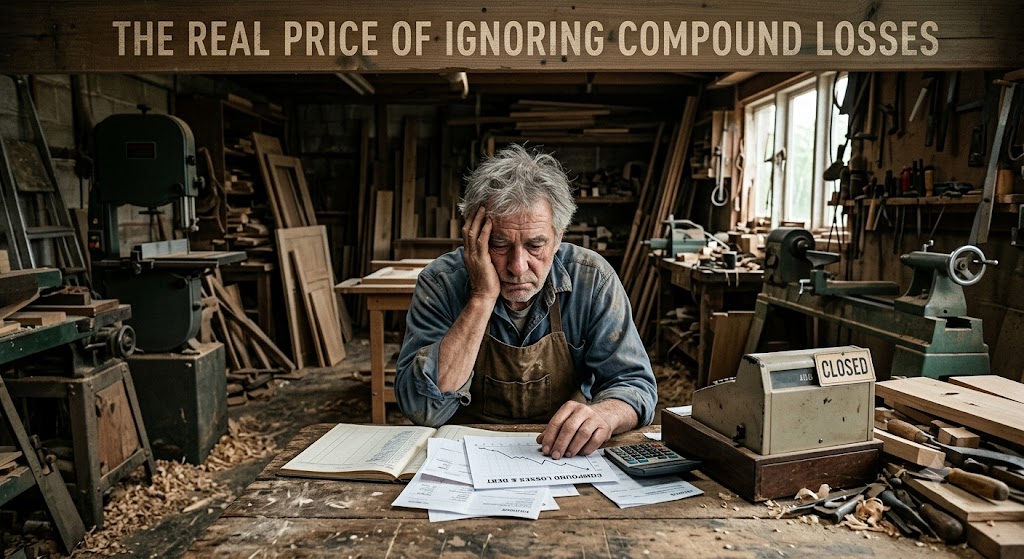
The Real Price of Ignoring Compound Losses
Most people have heard of compound interest. Financial experts talk about it constantly. Books praise it as one of the greatest forces in wealth creation. Investors dream about it. Savers rely on it. Entrepreneurs structure businesses around it. Yet there is another side of compounding that receives far less attention. It is quieter, less exciting, and far more dangerous. It is called compound loss.
Compound gains can make a person wealthy over decades, but compound losses can quietly destroy a lifetime of hard work without making much noise. They rarely arrive all at once. Instead, they creep into everyday life through tiny decisions that appear harmless. One unnecessary expense today, another tomorrow, one ignored investment opportunity, one unpaid debt, one unhealthy financial habit, and before long those small losses begin multiplying against each other.
This is the real price of ignoring compound losses. It is not simply the money you lose today. It is the fortune that money could have created tomorrow.
Most people judge financial decisions based only on immediate outcomes. If buying an expensive phone does not leave them broke today, they assume the purchase was affordable. If skipping savings this month causes no immediate hardship, they believe nothing significant has happened. If they postpone investing for another year, they convince themselves there will always be another opportunity. What they fail to see is that every financial decision has a future attached to it.
Money is one of the few resources that has the ability to reproduce itself. When invested wisely, it generates additional money. When neglected, it loses the opportunity to multiply. Every pound, dollar, euro or naira that disappears today takes its future earnings with it. The loss is never just the original amount. It is every future opportunity that amount could have produced.
Imagine someone who wastes the equivalent of £10 every day on unnecessary purchases. The amount appears insignificant. Many people spend far more without thinking twice. Yet over thirty years, those daily expenses amount to thousands. If invested consistently instead, they could have grown into a substantial financial asset through compounding. The real loss is not the daily spending. The real loss is decades of growth that never had the chance to happen.
This is why financially successful people often appear unusually careful with small amounts of money. It is not because they are stingy. It is because they understand multiplication better than subtraction. They know that every unnecessary loss reduces future opportunities.
Compound losses affect far more than investments. Debt is perhaps the most obvious example. Many people borrow money believing they are only paying back the original amount with a little extra. In reality, interest compounds against them. Missed payments generate penalties. Penalties increase balances. Higher balances generate more interest. Before long, a relatively small loan becomes an overwhelming financial burden.
Credit card debt demonstrates this perfectly. A person who only makes minimum payments may spend years paying interest while barely reducing the principal balance. Every month they delay repayment, compound losses continue working silently against them. What began as a temporary financial solution gradually transforms into a long-term financial prison.
Inflation is another invisible form of compound loss that many people underestimate. Every year prices increase while idle cash loses purchasing power. Someone who stores money without allowing it to grow may feel financially secure because the numbers remain the same. Yet the value of that money quietly declines. Ten years later, the same amount purchases significantly fewer goods and services.
Ignoring inflation is not standing still financially. It is moving backwards.
This explains why saving money alone is no longer enough. Saving without growth allows inflation to compound against your purchasing power. Wealth preservation requires investments capable of growing faster than inflation over the long term.
Compound losses also appear in career decisions. A person who refuses to develop new skills because learning seems difficult may save time today. However, over the next decade they gradually become less valuable in the job market. Their income stagnates while others continue improving. Promotions become harder to obtain. Better opportunities disappear. Employers begin favouring workers with updated knowledge.
The original loss was not simply refusing to take a course. It was losing years of higher earning potential.
Technology has accelerated this reality. Industries evolve faster than ever before. Skills that were valuable ten years ago may now be outdated. Those who continually invest in personal development benefit from compound gains in knowledge, while those who stop learning experience compound losses in relevance.
Relationships follow similar patterns. Trust compounds positively when people consistently demonstrate honesty, reliability and integrity. However, dishonesty compounds negatively. One broken promise weakens confidence. Repeated disappointments damage relationships further. Eventually trust disappears completely.
Many broken relationships do not collapse because of one dramatic event. They collapse because of years of small neglected problems that accumulated through compound loss.
Health provides another powerful example. Poor eating habits rarely produce immediate consequences. Missing exercise today may not noticeably affect tomorrow. Sleeping too little for one week may seem manageable. Yet unhealthy decisions compound over years.
Weight increases gradually. Energy declines slowly. Medical conditions develop silently. Recovery becomes increasingly difficult because every unhealthy habit strengthens the next.
Likewise, healthy habits also compound. Regular exercise improves cardiovascular health. Better health increases productivity. Higher productivity creates greater earning potential. Increased earnings create more investment opportunities. The benefits multiply far beyond physical fitness alone.
Time itself compounds.
Every wasted hour represents more than sixty lost minutes. It represents knowledge not acquired, relationships not strengthened, opportunities not explored and skills not developed.
Successful people understand that time invested wisely compounds into experience, wisdom and capability.
Those who waste time repeatedly often underestimate the cumulative effect. Years later they wonder why others have advanced so much further despite having started from similar positions.
Businesses experience compound losses whenever they ignore small operational problems. Poor customer service leads to negative reviews. Negative reviews reduce customer trust. Lower trust reduces sales. Reduced sales limit investment in quality improvements. Eventually competitors overtake the business.
The decline appears sudden to outsiders, but internally it began years earlier through countless ignored details.
The same principle applies to reputation. A strong reputation takes years to build through consistent reliability. However, repeated carelessness gradually weakens credibility. Customers stop recommending the business. Employees lose confidence. Investors hesitate. Opportunities disappear.
Reputation compounds in both directions.
One of the greatest dangers of compound losses is their invisibility during the early stages.
Most destructive habits begin painlessly.
- Overspending feels enjoyable.
- Procrastination feels comfortable.
- Skipping investments feels harmless.
- Ignoring budgeting feels easier.
- Avoiding difficult conversations feels safer.
- Postponing learning feels convenient.
Because the immediate consequences are small, people continue repeating the behaviour.
Only years later do they discover the enormous accumulated cost.
Psychologists describe this tendency as present bias. Human beings naturally value immediate comfort more than future rewards. We often sacrifice long-term prosperity for short-term satisfaction without recognising the exchange we are making.
Marketing companies understand this extremely well. They encourage consumers to think in monthly payments rather than total costs. They promote instant gratification over delayed rewards. They make luxury appear necessary while making patience seem outdated.
The result is a society increasingly vulnerable to compound losses.
Financial freedom rarely disappears through one catastrophic mistake.
More often it disappears through thousands of ordinary decisions.
- An unnecessary subscription.
- Impulse purchases.
- Ignoring savings.
- Postponing investments.
- Paying unnecessary fees.
- Carrying expensive debt.
- Living beyond one’s means.
Each decision seems insignificant alone.
Together they create enormous financial consequences.
Compound losses also affect business owners who fail to innovate.
Markets evolve continuously. Consumer preferences change. New competitors emerge. Technology transforms industries.
Businesses that ignore these gradual shifts often believe everything is fine because current profits remain stable.
Eventually disruption arrives.
By then competitors have already captured customers.
Recovery becomes expensive or impossible because years of missed adaptation have compounded into irreversible decline.
Governments experience similar effects.
Neglecting infrastructure, education or healthcare rarely creates immediate national crises. Yet decades of underinvestment gradually reduce productivity, increase economic inefficiency and weaken competitiveness.
Societies, like individuals, cannot escape compound consequences.
Fortunately, compound losses can be reversed before they become permanent.
- The first step is awareness.
- Most people cannot correct problems they refuse to acknowledge.
- Tracking spending reveals financial leaks.
- Monitoring investments exposes missed opportunities.
- Reviewing habits uncovers repeated mistakes.
- Measuring progress prevents invisible decline.
- Awareness interrupts negative compounding before it accelerates.
The second step involves replacing destructive habits with constructive ones.
- Instead of spending first and saving whatever remains, save first and spend the remainder.
- Instead of postponing investing until income increases, begin investing consistently regardless of amount.
- Instead of accumulating unnecessary debt, reduce liabilities systematically.
- Instead of consuming information endlessly, apply what you learn immediately.
- Positive habits eventually compound against previous losses.
The third step requires patience.
- Many people abandon good financial habits because results appear slow initially.
- Compounding always appears unimpressive during its early stages.
- The first few years often show little visible progress.
- Then growth accelerates.
- This explains why consistency matters more than intensity.
- Occasional large investments rarely outperform decades of disciplined investing.
- Likewise, occasional budgeting cannot overcome years of careless spending.
- Financial transformation occurs through repeated intelligent decisions.
Another important lesson is understanding opportunity cost.
Whenever money is spent unnecessarily, something else becomes impossible.
- That purchase may eliminate future investment.
- That investment may have generated passive income.
- That passive income may have created financial independence.
- Opportunity costs compound just as powerfully as financial returns.
Many people measure purchases only by their price.
Successful investors measure purchases by everything that purchase prevents.
- Compound losses also influence mindset.
- Repeated negative thinking reduces confidence.
- Reduced confidence discourages action.
- Fewer actions create fewer opportunities.
- Limited opportunities reinforce negative thinking.
The cycle strengthens itself.
Positive thinking alone is not enough, but constructive thinking combined with disciplined action produces positive compound effects over time.
Education represents one of the greatest compound investments available.
- Every book read increases understanding.
- Greater understanding improves decisions.
- Better decisions produce stronger financial outcomes.
- Improved outcomes provide resources for further learning.
- Knowledge compounds throughout life because each new lesson builds upon previous understanding.
This explains why lifelong learners frequently outperform individuals who stop developing after formal education.
Perhaps the greatest tragedy of compound losses is that they are entirely avoidable.
Nobody needs extraordinary intelligence to benefit from compounding.
Nobody needs enormous wealth.
Nobody needs perfect timing.
Success often belongs to those who simply avoid making the same costly mistakes repeatedly.
Small improvements repeated consistently eventually outperform dramatic efforts maintained briefly.
Likewise, small mistakes repeated consistently eventually overwhelm even large incomes.
Every financial decision is planting a seed.
Some seeds produce future prosperity.
Others produce future regret.
The harvest depends less on individual decisions than on repeated patterns.
This is why financial discipline is ultimately about protecting tomorrow rather than restricting today.
Every pound saved, every investment made, every unnecessary expense avoided and every useful skill acquired represents another positive compound effect working quietly in your favour.
Ignoring compound losses may not feel expensive today.
It rarely hurts immediately.
It rarely attracts attention.
It rarely creates headlines.
Yet year after year it quietly steals opportunities, purchasing power, wealth, confidence and freedom.
By the time many people recognise its effects, decades have already passed.
The encouraging truth is that compounding works in whichever direction you choose. Negative habits can be replaced with positive ones. Poor financial decisions can be corrected. New skills can be learned. Investments can begin today. Debt can be reduced. Better systems can be built.
Every positive decision made consistently weakens the power of previous losses while strengthening future gains.
The real price of ignoring compound losses is not measured only in money. It is measured in the opportunities never taken, the wealth never created, the freedom never experienced and the legacy never built.
The earlier you recognise the invisible cost of negative compounding, the sooner you can place the same powerful force on your side. Time will compound either your mistakes or your wisdom. Every day you choose which one will grow.

EarnSmartOnline.com.ng is dedicated to helping readers make smarter financial decisions through practical guides on online income, personal finance, technology, digital business, and wealth creation. Our goal is to provide reliable, easy-to-understand, and actionable content that empowers individuals to earn smarter, build sustainable income streams and achieve long-term financial success.
Recommended: Start Earning Online
- Ultimate Affiliate Marketing Program — learn affiliate marketing with a done-for-you sales system ($15). Check it out
- The Newbie Affiliate Guide — the beginner-friendly starter guide (~$6.68). Check it out
- Easy Dollar Maker — earn in dollars uploading AI images and videos from your phone ($17). Check it out
Disclosure: These are affiliate links. If you buy through them, I may earn a commission at no extra cost to you.



