
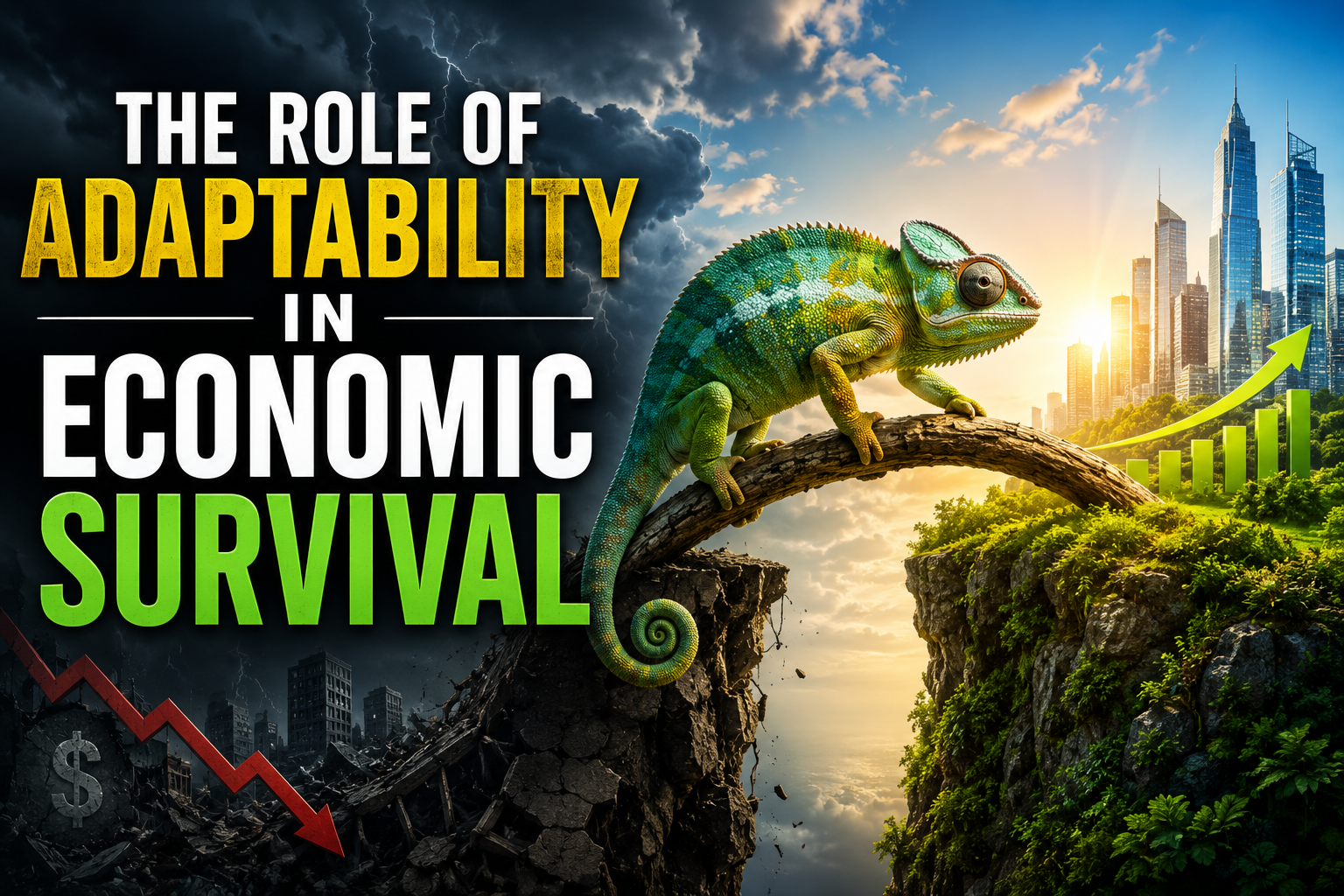
The Role of Adaptability in Economic Survival
In every economic era, survival has never been determined only by how hard people work, but by how well they adjust when conditions change. Markets shift, industries evolve, technology disrupts, and consumer behavior transforms in ways that often punish rigidity and reward flexibility. The role of adaptability in economic survival is not a modern invention, but in today’s fast moving world, it has become one of the most important factors separating those who thrive from those who struggle. People often assume financial stability comes from doing one thing consistently for a long time, but history repeatedly shows that consistency without adaptability eventually leads to decline.
Adaptability in an economic sense is the ability to respond to changes in income sources, job structures, business environments, and market expectations without losing momentum. It is not simply about reacting to crisis situations, but about anticipating change and adjusting early enough to remain relevant. Those who survive economically are rarely the ones who resist change the longest. They are the ones who notice change early, understand its direction, and reposition themselves before pressure becomes survival-threatening.
One of the clearest examples of adaptability is found in labor markets. In the past, people could rely on a single skill set for decades and expect stable employment until retirement. Today, that assumption is increasingly unrealistic. Industries are being reshaped by automation, digital transformation, and global competition. A skill that is valuable today may become less relevant within a few years. Workers who recognize this shift and continuously upgrade their skills tend to remain employable, while those who resist learning new systems often find themselves displaced, not because they are lazy, but because they became outdated in a changing environment.
Economic survival is not only about employment. It also applies strongly to entrepreneurship. Businesses that once dominated entire markets have disappeared because they failed to adapt to new consumer expectations or technological innovation. On the other hand, smaller businesses that remain flexible often survive longer and sometimes even overtake larger competitors. Adaptability allows businesses to pivot when demand changes, adjust pricing when competition intensifies, or shift delivery methods when new platforms emerge. Without this flexibility, even a profitable business can collapse when external conditions shift faster than internal systems can respond.
At the individual level, adaptability is deeply tied to financial resilience. People who depend on a single income stream are more vulnerable to economic shocks. Job loss, industry decline, or unexpected disruptions can instantly destabilize their financial situation. However, individuals who develop multiple skills, explore different income opportunities, or remain open to transitioning between industries are better protected. Their survival does not depend on a single pillar, but on a structure that can be adjusted when one part becomes unstable.
Psychologically, adaptability requires a willingness to let go of identity attachment. Many people struggle economically not because they lack ability, but because they are emotionally tied to a specific version of themselves. Someone may identify strongly as a banker, teacher, technician, or trader, and resist shifting into new roles even when conditions demand it. This attachment can become a barrier to survival. Economic environments do not reward identity loyalty. They reward usefulness. The moment usefulness shifts elsewhere, survival depends on the willingness to shift along with it.
Another important aspect of adaptability is learning agility. This is the speed at which someone can acquire new knowledge and apply it effectively. In fast changing economies, the ability to learn quickly is often more valuable than what has already been learned. Knowledge has a shorter shelf life today than in previous generations. People who continue learning, unlearning, and relearning tend to remain economically relevant. Those who stop learning often discover that their experience no longer translates into value in new environments.
Adaptability also plays a critical role in financial decision making. Economic conditions are not static, and what works in one period may not work in another. For example, investment strategies that perform well during growth phases may not be suitable during downturns. Spending habits that are manageable during high income periods can become dangerous during income reduction. Individuals who adjust their financial behavior based on changing conditions tend to avoid long term damage, while those who maintain fixed habits regardless of context often experience financial strain.
In broader economic systems, adaptability determines how societies respond to global disruptions. Countries that invest in education, innovation, and flexible economic policies tend to recover faster from crises. Their ability to redirect resources, support emerging industries, and retrain their workforce creates resilience. On the other hand, economies that rely too heavily on outdated industries or resist structural change often experience prolonged stagnation. Economic survival at a national level depends heavily on the same principle that applies to individuals and businesses, which is responsiveness to change.
Technology has accelerated the need for adaptability more than any other factor. Digital tools have reshaped communication, commerce, and production. Entire industries have been transformed within short periods. People who embrace technology and learn how to use it to enhance their productivity often find new opportunities, while those who ignore it gradually lose access to modern economic participation. The ability to integrate technology into work and business is now a baseline requirement for survival in many sectors.
Social adaptability is another dimension that influences economic outcomes. Networks, relationships, and collaboration opportunities often shift alongside economic changes. People who remain open to new connections and are willing to engage with different groups tend to discover opportunities earlier. Economic survival is not only about individual effort but also about positioning within evolving networks of value exchange. Isolation reduces adaptability, while connection increases exposure to new possibilities.
One of the most overlooked aspects of adaptability is emotional resilience. Economic change often brings uncertainty, and uncertainty can lead to fear-based decision making. People who panic during change tend to make decisions that worsen their situation, such as selling assets at the wrong time, quitting opportunities prematurely, or avoiding necessary risks. Emotional adaptability allows individuals to remain calm enough to evaluate situations clearly and respond strategically rather than react impulsively.
Adaptability also influences long term wealth building. Wealth is not created in a straight line. It requires navigating cycles, adjusting strategies, and responding to shifting conditions. People who build wealth successfully are often those who understand when to conserve resources, when to expand, and when to reposition. Their financial growth is not based on rigid formulas but on dynamic decision making aligned with real world conditions.
Interestingly, adaptability is often developed through experience rather than theory. People become more adaptable when they encounter challenges that force them to adjust. However, waiting for hardship to teach adaptability can be costly. It is more effective to develop adaptability intentionally by exposing oneself to new environments, learning diverse skills, and practicing flexibility in smaller decisions before larger crises occur.
There is also a strong connection between adaptability and opportunity recognition. Opportunities rarely appear in obvious forms. They often emerge as changes in behavior, shifts in demand, or disruptions in existing systems. People who are adaptable tend to notice these signals earlier because they are not locked into a fixed way of seeing the world. Their openness allows them to interpret change as potential rather than threat.
Ultimately, economic survival is not about avoiding change but about mastering response to change. Stability in the modern economy is not guaranteed by holding on to the same position indefinitely, but by maintaining the ability to move when necessary. The world continues to evolve, and economic systems evolve with it. Those who align themselves with this reality tend to remain stable even in unstable environments.
Adaptability does not eliminate challenges, but it changes their impact. A challenge in a rigid system becomes a breaking point, while in an adaptable system it becomes a transition point. This difference determines whether a person, business, or economy collapses under pressure or grows through it. The ability to adapt is not just a survival skill, but a long term strategy for relevance, resilience, and sustained economic participation in a constantly shifting world.

EarnSmartOnline.com.ng is dedicated to helping readers make smarter financial decisions through practical guides on online income, personal finance, technology, digital business, and wealth creation. Our goal is to provide reliable, easy-to-understand, and actionable content that empowers individuals to earn smarter, build sustainable income streams and achieve long-term financial success.
Recommended: Start Earning Online
- Ultimate Affiliate Marketing Program — learn affiliate marketing with a done-for-you sales system ($15). Check it out
- The Newbie Affiliate Guide — the beginner-friendly starter guide (~$6.68). Check it out
- Easy Dollar Maker — earn in dollars uploading AI images and videos from your phone ($17). Check it out
Disclosure: These are affiliate links. If you buy through them, I may earn a commission at no extra cost to you.



