
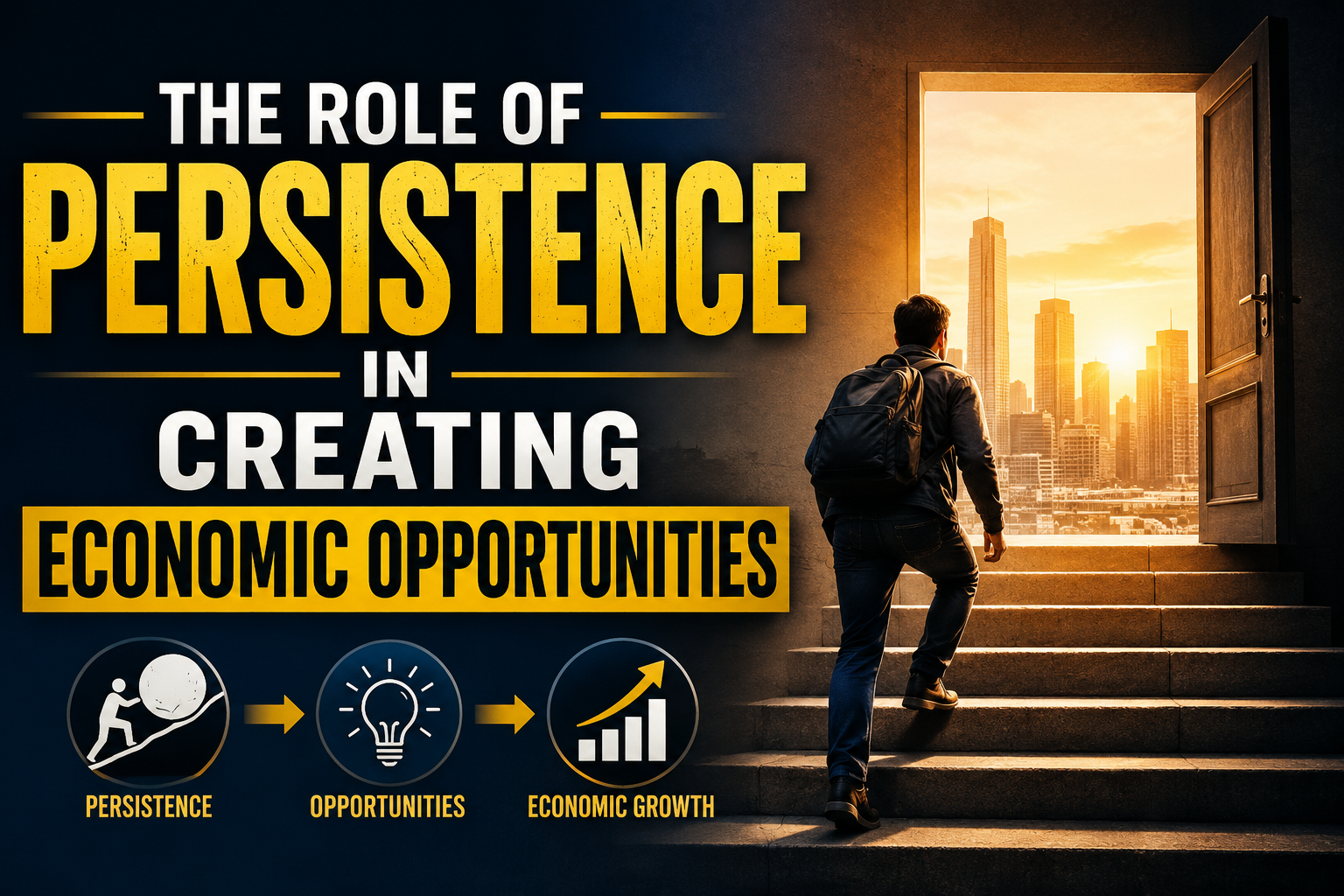
The Role of Persistence in Creating Economic Opportunities
Most people think economic opportunities are discovered like hidden treasure, as though the right job, business idea, investment, or breakthrough moment simply appears to those lucky enough to stumble upon it. But in reality, opportunities behave less like buried gold and more like doors that respond to pressure. They open slowly, sometimes reluctantly, and often only to those who keep knocking long after others have walked away. Persistence is not just a personality trait in this process. It is a form of economic leverage that compounds over time, reshaping how the world responds to you and what it decides to offer you.
At the beginning of any pursuit, persistence looks unimpressive. A person trying to break into a new field, build a business, or find financial stability often experiences repeated rejection, silence, or failure. Many interpret this early resistance as a sign to stop, assuming it means they are on the wrong path. But early resistance is not a verdict on potential. It is a filtering mechanism. The economy, like any system of demand and supply, does not immediately reward intention. It tests consistency. Those who continue through the early phase of no visible reward begin to separate themselves from the majority who quit too soon.
Persistence works because most environments are designed for attrition. Markets, industries, and even workplaces are filled with people who start but do not continue. This creates a strange imbalance where sustained effort becomes rare and therefore valuable. When someone continues showing up after enthusiasm fades, after external motivation disappears, and after results seem delayed, they begin to occupy a different category in the eyes of systems and people. They move from being just another participant to being someone dependable, and dependability is one of the most underpriced assets in any economy.
Economic opportunities rarely announce themselves directly. Instead, they accumulate around people who have already proven they can handle responsibility over time. A freelancer who continues delivering work consistently begins to receive referrals without asking. An employee who persists in solving problems eventually becomes the person trusted with larger projects. An entrepreneur who refuses to quit after early failures slowly builds a reputation that attracts partners, customers, or investors. In each case, persistence is not just effort repeated. It is credibility built gradually through time.
What many fail to see is that persistence changes perception. At first, effort is invisible and interchangeable with everyone else’s. But as time stretches on, people begin to associate your presence with reliability. This shift is subtle but powerful. In economic terms, perception often determines access. When decision makers believe you are unlikely to disappear when things get difficult, they are more willing to include you in opportunities that require endurance. This is why long-term consistency often matters more than early brilliance.
There is also a compounding effect that persistence creates in skill development. Most economically valuable skills do not become useful immediately. They require repetition, correction, and refinement. The person who persists through this process eventually reaches a level where their skill becomes rare enough to attract economic reward. Meanwhile, those who abandon the process early never cross the threshold where competence becomes visible to the market. Persistence, therefore, is not just about waiting. It is about transforming time into capability.
Another overlooked aspect is that persistence increases exposure. The longer someone stays active in a field, the more situations they encounter, the more people they meet, and the more unexpected connections they form. Many economic opportunities do not come from direct pursuit but from indirect exposure over time. A conversation leads to a project, a failed attempt leads to a new direction, or repeated visibility leads to recognition. Without persistence, this network effect never has time to develop.
However, persistence is often misunderstood as blind repetition. In reality, effective persistence includes adjustment. It is not about doing the same thing in the same way forever. It is about continuing forward while refining approach based on feedback. This is what turns effort into progress rather than stagnation. People who persist intelligently learn faster, adapt quicker, and increase their probability of eventually finding the right economic alignment. Persistence without learning leads to exhaustion, but persistence with reflection leads to advancement.
One of the most important truths about economic opportunity is that timing matters, but timing is unpredictable. Many people quit just before conditions shift in their favor. Markets change, industries evolve, and demand patterns shift in ways that are difficult to forecast. Those who persist long enough increase their chances of being present when conditions finally align. In this sense, persistence is not just endurance. It is a way of staying in the game long enough for randomness to work in your favor.
Persistence also reshapes internal psychology. As individuals continue pushing through difficulty, they begin to develop a stronger sense of control over outcomes. This shift in mindset influences decision making. People who persist tend to take more calculated risks, pursue larger opportunities, and recover faster from setbacks. Over time, this creates a self reinforcing cycle where persistence builds confidence, and confidence improves the quality of actions taken, which in turn increases the likelihood of economic reward.
At a deeper level, persistence filters identity. Many people believe they want certain economic outcomes, but their willingness to continue under pressure reveals the truth. Those who persist are effectively proving to themselves and the world that their goals are not temporary interests but sustained commitments. This alignment between identity and action is what eventually leads to transformation. Economic opportunities often emerge not simply because someone wants them, but because they have demonstrated through time that they are ready for them.
Ultimately, persistence creates economic opportunity because it interacts with every major force in value creation. It builds trust, increases skill, expands networks, improves timing probability, strengthens psychology, and enhances visibility. While talent, intelligence, and luck all play roles in economic success, persistence is the factor that determines whether those other elements ever get enough time to matter. In a world where most people stop early, the simple act of continuing becomes a powerful economic strategy.

EarnSmartOnline.com.ng is dedicated to helping readers make smarter financial decisions through practical guides on online income, personal finance, technology, digital business, and wealth creation. Our goal is to provide reliable, easy-to-understand, and actionable content that empowers individuals to earn smarter, build sustainable income streams and achieve long-term financial success.
Recommended: Start Earning Online
- Ultimate Affiliate Marketing Program — learn affiliate marketing with a done-for-you sales system ($15). Check it out
- The Newbie Affiliate Guide — the beginner-friendly starter guide (~$6.68). Check it out
- Easy Dollar Maker — earn in dollars uploading AI images and videos from your phone ($17). Check it out
Disclosure: These are affiliate links. If you buy through them, I may earn a commission at no extra cost to you.



