
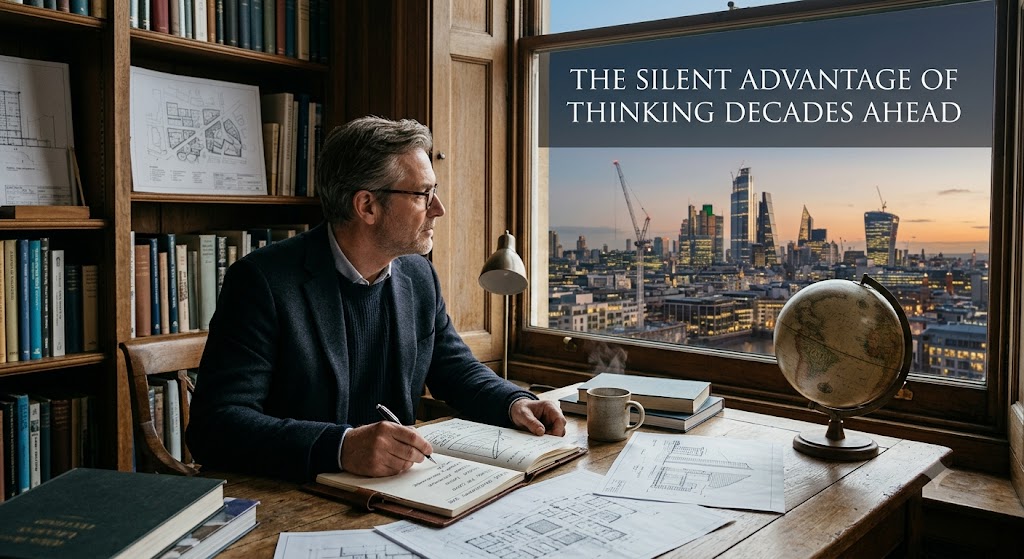
The Silent Advantage of Thinking Decades Ahead
There is a quiet advantage that rarely makes headlines, earns applause, or attracts immediate admiration. It is the ability to think decades ahead. In a world obsessed with instant gratification, overnight success, viral moments, and quick profits, people who train themselves to think ten, twenty, or even fifty years into the future possess a competitive edge that cannot easily be copied. They are not necessarily smarter than everyone else. They are not always richer at the beginning. They may not even appear successful in the early stages of their journey. Yet as the years unfold, the gap between them and those who only think about tomorrow becomes impossible to ignore.
Modern society rewards speed. News changes every hour. Social media trends disappear within days. Businesses rise and fall almost overnight. Consumers want immediate delivery, immediate entertainment, immediate results, and immediate satisfaction. Unfortunately, this culture of urgency has quietly trained millions of people to think only about the next payday, the next purchase, the next promotion, or the next vacation. Very few pause to ask where today’s decisions will place them twenty years from now. Even fewer organise their lives around that answer.
The irony is that almost everything valuable in life requires time. Strong character takes years to develop. Financial security grows through consistent decisions rather than lucky moments. Healthy relationships mature through trust built over countless experiences. Great businesses earn their reputation one satisfied customer at a time. Physical health reflects years of habits rather than a few weeks of exercise. Knowledge accumulates book by book, lesson by lesson, mistake by mistake. Nature itself demonstrates this principle. Mighty forests begin as tiny seeds. Massive rivers are formed from countless streams. Mountains are shaped by forces working patiently over thousands of years. The greatest achievements are usually the result of invisible progress that continues long before anyone notices.
Thinking decades ahead changes the questions people ask themselves. Instead of asking whether something feels good today, they ask whether it will still matter twenty years from now. Instead of asking how quickly they can earn money, they ask how they can create value that continues generating income long after the initial work has been completed. Instead of wondering whether they can afford something, they ask whether owning it will improve or complicate their future. These seemingly small changes in perspective eventually create enormous differences in outcomes.
One of the greatest benefits of long-term thinking is that it reduces emotional decision-making. People focused only on the present often react to every market fluctuation, every criticism, every setback, and every temptation. Their decisions become driven by emotions instead of principles. Fear causes them to sell opportunities too early. Excitement causes them to chase unrealistic promises. Envy pushes them into unnecessary spending. Impatience convinces them to abandon worthwhile goals just before meaningful progress begins. Someone who thinks decades ahead recognises that temporary emotions should never dictate permanent decisions.
History repeatedly demonstrates this truth. Many of the world’s most respected companies were not built in a single year. Their founders endured economic recessions, failed products, changing technologies, fierce competition, and countless disappointments. Yet their commitment to a long-term vision allowed them to outlast competitors who were only interested in quick profits. The same principle applies to individuals. Careers built patiently often outlast careers built on temporary popularity. Investments held wisely frequently outperform constant buying and selling. Relationships nurtured over decades become stronger than those based only on excitement.
Thinking decades ahead also changes how people view education. Many individuals stop learning shortly after completing formal schooling. They assume that obtaining a certificate marks the end of their educational journey. Long-term thinkers understand that every decade introduces new technologies, industries, opportunities, and challenges. Skills that are valuable today may become obsolete tomorrow. Entire professions disappear while entirely new careers emerge. Continuous learning therefore becomes less of a hobby and more of a survival strategy.
Knowledge compounds in much the same way money compounds. Reading one book may not dramatically change someone’s life. Reading one thousand books over twenty years almost certainly will. Learning one new skill may produce only modest benefits. Developing dozens of complementary skills throughout a lifetime creates extraordinary opportunities. The remarkable thing about knowledge is that nobody can permanently take it away. Economic downturns may reduce income. Businesses may fail. Investments may lose value. But the ability to think clearly, solve problems, communicate effectively, and continue learning remains one of the safest long-term assets anyone can possess.
Financial success is perhaps one of the clearest examples of the silent advantage of long-term thinking. Many people focus primarily on increasing income. While earning more money is certainly important, lasting wealth depends far more on what happens after the income is received. Small, consistent financial decisions repeated over several decades often outperform dramatic financial moves made occasionally. Saving regularly, investing patiently, avoiding unnecessary debt, living below one’s means, and allowing compound growth sufficient time to work have transformed countless ordinary earners into financially secure individuals.
The power of compound growth remains one of the least appreciated forces in personal finance because its greatest rewards appear only after years of consistency. During the early years, progress appears painfully slow. Many people become discouraged because they expect immediate results. However, those who remain committed eventually reach a point where time begins working for them rather than against them. This principle applies far beyond investing. Relationships compound. Skills compound. Reputation compounds. Trust compounds. Experience compounds. Small improvements made consistently eventually produce results that seem almost unbelievable to those who only observe the final outcome.
Thinking decades ahead also transforms the way people approach their careers. Instead of constantly searching for jobs offering slightly higher salaries, long-term thinkers focus on building rare skills, strong reputations, meaningful professional relationships, and personal credibility. They understand that opportunities often arrive through trust rather than advertisements. Employers promote people they believe can consistently solve problems. Clients return to professionals they trust. Business partners collaborate with individuals whose character has been proven over time.
Reputation itself is one of the most valuable long-term investments available. Every promise kept strengthens it. Every commitment honoured reinforces it. Every ethical decision protects it. Conversely, one dishonest action, one broken promise, or one unethical shortcut can destroy years of patient reputation building. Those who think decades ahead recognise that protecting credibility is often more valuable than chasing immediate financial gain.
Relationships also benefit enormously from long-term thinking. Many friendships fail because people focus only on present convenience. Families experience unnecessary conflict because temporary emotions overshadow lifelong bonds. Marriages struggle when immediate disappointments receive more attention than shared futures. Thinking decades ahead encourages forgiveness, patience, empathy, and communication because people understand that preserving meaningful relationships often delivers greater long-term rewards than winning short-term arguments.
Parents naturally understand this principle better than most. They invest years of effort into raising children without expecting immediate returns. They sacrifice sleep, comfort, money, and personal time because they are motivated by a vision extending decades into the future. They understand that character cannot be taught overnight and that every conversation, every example, and every lesson contributes to the adults their children eventually become.
Health provides another powerful illustration. The body quietly records daily habits long before visible consequences appear. Poor nutrition, lack of exercise, chronic stress, inadequate sleep, and unhealthy lifestyles may not produce immediate illness, but over decades they gradually shape physical wellbeing. Likewise, regular exercise, balanced nutrition, proper rest, and preventive healthcare may not produce dramatic daily transformations, yet they significantly influence quality of life in later years. Those who think decades ahead treat their bodies as lifelong assets rather than temporary conveniences.
Technology has dramatically shortened attention spans, making long-term thinking even more valuable. Notifications compete constantly for attention. Endless entertainment encourages distraction. Algorithms prioritise immediate engagement rather than meaningful reflection. As a result, deep thinking has become increasingly rare. Yet the ability to ignore distractions and maintain focus on long-term objectives has become one of the greatest competitive advantages in the modern world.
Business leaders who think decades ahead rarely chase every new trend. Instead, they focus on enduring human needs. Technologies evolve rapidly, but people consistently desire trust, convenience, security, efficiency, belonging, health, and opportunity. Companies built around solving timeless human problems often survive technological revolutions because they adapt their methods without abandoning their mission.
The same principle applies to personal success. Tools change. Industries evolve. Markets fluctuate. Human nature remains remarkably consistent. People will always value honesty, competence, reliability, kindness, wisdom, creativity, and leadership. Investing decades in developing these qualities rarely becomes outdated.
One fascinating characteristic of long-term thinkers is their willingness to appear unsuccessful in the short term. They willingly postpone immediate rewards because they understand delayed gratification. They spend evenings studying while others seek constant entertainment. They invest money while others spend it. They build businesses while others seek quick comfort. They practise skills while others look for shortcuts. Their choices may appear ordinary or even unnecessary at first, yet time quietly multiplies every disciplined decision.
Perhaps the greatest misunderstanding surrounding success is the belief that extraordinary outcomes require extraordinary actions. In reality, remarkable lives are often built through remarkably ordinary habits repeated consistently for many years. Reading daily. Saving regularly. Exercising consistently. Keeping promises. Learning continuously. Managing emotions. Serving others. Thinking carefully before making important decisions. None of these activities appear dramatic on any single day. Together, over decades, they transform lives.
Thinking decades ahead also creates emotional resilience. Temporary failures lose much of their power when viewed through the lens of a lifetime. A disappointing year does not define an entire career. A failed business does not eliminate future opportunities. A rejected application does not determine someone’s ultimate potential. Long-term thinkers recognise that setbacks are chapters, not conclusions.
History honours builders more than spectators. The individuals remembered generations later usually dedicated themselves to projects extending far beyond their own immediate benefit. They planted trees whose shade they would never enjoy. They established institutions that continued serving society long after they were gone. They wrote books that educated people they would never meet. They created businesses that employed future generations. Their vision extended beyond personal comfort into lasting contribution.
This perspective fundamentally changes the meaning of success. Success becomes less about acquiring possessions and more about creating lasting value. Wealth becomes more than money. Influence becomes more than popularity. Achievement becomes more than recognition. Legacy becomes more than personal accomplishment.
There is also tremendous peace in thinking decades ahead. People no longer feel compelled to compete with everyone else’s visible progress. They stop comparing their beginning to someone else’s middle. They understand that genuine achievement follows different timelines for different people. This reduces anxiety, strengthens patience, and encourages wiser decisions.
The future belongs not necessarily to the fastest people but to those who remain consistent long enough for time to amplify their efforts. Time rewards discipline. It rewards patience. It rewards preparation. It rewards integrity. It rewards continuous improvement. Every year quietly magnifies the consequences of today’s habits, making long-term thinking one of the most practical skills anyone can develop.
Many people spend enormous energy attempting to predict the future. Yet the more valuable skill is preparing for multiple possible futures through adaptability, learning, strong character, financial responsibility, meaningful relationships, and lifelong curiosity. Nobody can accurately predict every technological breakthrough, economic shift, or cultural change. However, those who consistently improve themselves remain prepared regardless of which future eventually arrives.
The silent advantage of thinking decades ahead is not found in predicting tomorrow with perfect accuracy. It lies in making decisions today that remain wise regardless of what tomorrow brings. It means planting seeds without demanding immediate harvests. It means choosing principles over impulses, preparation over panic, consistency over excitement, and legacy over temporary applause.
Years from now, many people will wonder why certain individuals seem fortunate. They will admire their financial stability, respected reputation, strong relationships, excellent health, valuable knowledge, and calm confidence. What they may never fully see are the thousands of ordinary decisions quietly made over decades. The unseen mornings of discipline. The unnoticed evenings of study. The invisible sacrifices. The patient investments. The promises kept when nobody was watching. The opportunities declined because they conflicted with long-term goals.
That is the true silent advantage. It is not dramatic. It rarely receives immediate recognition. It cannot be purchased overnight or copied instantly. It grows quietly beneath the surface while the world celebrates louder, faster, and shorter-lived achievements. Eventually, however, time reveals what impatience never can. Those who consistently think decades ahead often discover that their greatest advantage was never talent, luck, or perfect timing. It was simply the wisdom to understand that the best time to build an extraordinary future is always today, one thoughtful decision at a time.

EarnSmartOnline.com.ng is dedicated to helping readers make smarter financial decisions through practical guides on online income, personal finance, technology, digital business, and wealth creation. Our goal is to provide reliable, easy-to-understand, and actionable content that empowers individuals to earn smarter, build sustainable income streams and achieve long-term financial success.
Recommended: Start Earning Online
- Ultimate Affiliate Marketing Program — learn affiliate marketing with a done-for-you sales system ($15). Check it out
- The Newbie Affiliate Guide — the beginner-friendly starter guide (~$6.68). Check it out
- Easy Dollar Maker — earn in dollars uploading AI images and videos from your phone ($17). Check it out
Disclosure: These are affiliate links. If you buy through them, I may earn a commission at no extra cost to you.



