
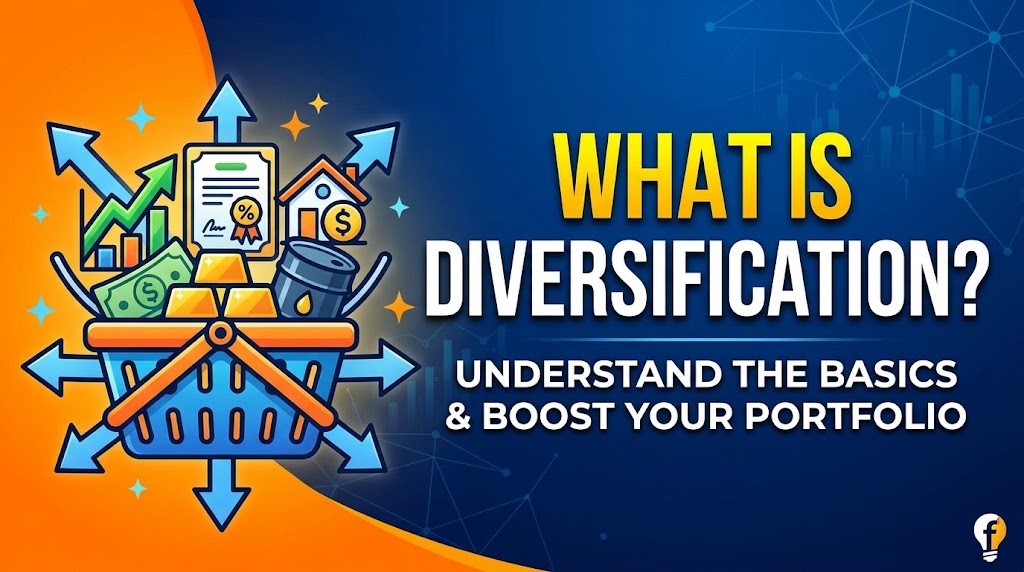
What is diversification?
What is diversification? Diversification is one of the most important concepts in personal finance and investing because it helps investors manage risk by spreading their money across different investments rather than depending entirely on one asset, company, industry, market or source of income. The basic idea is simple: instead of putting all your financial eggs in one basket, you spread them across several baskets so that a problem affecting one area does not necessarily destroy your entire financial position.
When people first begin learning about investing, they often focus on finding the investment that will make the most money. They may search for the fastest growing company, the cryptocurrency that could multiply in value, the property that could appreciate significantly or the business opportunity that promises extraordinary returns. While looking for opportunities is not necessarily wrong, focusing entirely on maximum returns can cause investors to underestimate risk. Diversification provides a different way of thinking. Instead of asking only how much money an investment could make, a diversified investor also asks what could happen if that investment performs badly.
What is diversification? At its simplest, diversification means spreading investments across different assets or opportunities so that the performance of one investment does not determine the outcome of the entire portfolio. If all your money is invested in one company and that company experiences serious financial problems, your entire investment could suffer. If your money is spread across several companies, industries, asset classes and geographical markets, the poor performance of one investment may have a smaller impact on the overall portfolio.
Diversification is based on a fundamental principle of risk management. Different investments do not always move in exactly the same direction at the same time. When one investment falls, another may remain stable or rise. This does not eliminate investment risk, but it can reduce the effect of problems concentrated in one particular investment.
Imagine someone has £10,000 and decides to put the entire amount into shares of one company. If that company performs extremely well, the investor could benefit significantly. However, if the company experiences a major setback, the investor could suffer a substantial loss. Now imagine another investor has the same £10,000 but spreads it across several companies in different industries and also allocates some money to other types of investments. A problem affecting one company may still cause a loss, but it may not have the same devastating effect on the entire portfolio.
This example explains why diversification matters. It is not about avoiding risk completely. Investing always involves some degree of risk. Diversification is about avoiding unnecessary concentration of risk.
There are several ways investors can diversify. One approach is diversification across asset classes. Asset classes include categories such as shares, bonds, property, cash and other investments. Each asset class can behave differently depending on economic conditions, interest rates, inflation, investor sentiment and other factors. Holding different asset classes can therefore provide a broader approach to managing investment risk.
Another form of diversification involves investing in different companies. Instead of putting all your money into one company, you can spread investments across several businesses. Even within the same industry, companies can experience very different outcomes. One company may grow rapidly while another struggles with competition, management problems or declining demand.
Diversification can also happen across industries. An investor might have exposure to technology, healthcare, consumer goods, financial services, energy and other sectors. This approach reduces dependence on the performance of one particular industry.
Geographical diversification is another important consideration. Investors can spread their investments across different countries or regions rather than concentrating entirely on one national economy. Economic conditions vary from country to country, so geographical diversification can provide exposure to different markets and economic opportunities. However, international investing also introduces additional considerations such as currency movements, political risks, taxation and regulatory differences.
What is diversification when applied to a small investor? It does not necessarily mean buying dozens of individual investments. A beginner with limited money does not need to own hundreds of different companies individually to have a diversified portfolio. Some investment products are already designed to provide exposure to many assets at once. For example, certain funds can hold shares from numerous companies, allowing an investor to gain broad exposure through a single investment.
This is one reason diversified funds and index based investment products are often discussed in beginner investing. Instead of trying to identify the winning company in advance, an investor can gain exposure to a broad collection of companies or assets. The result can be a simpler approach to diversification.
However, diversification does not automatically mean that every portfolio containing many investments is well diversified. An investor could own ten different technology companies and still have significant concentration risk in the technology sector. Owning many investments is not necessarily the same as having genuine diversification.
The key question is whether the investments are sufficiently different in the risks they face. If several investments are likely to rise and fall together because they depend on the same economic conditions, the portfolio may be less diversified than it appears.
For example, someone could own shares in several companies but have all of them operating in the same industry. If that industry experiences a major downturn, many of the investments could decline at the same time. The investor has multiple holdings but may still have significant exposure to one underlying risk.
This is why understanding what is diversification requires going beyond simply counting investments. True diversification considers the relationship between investments and the risks affecting them.
One of the biggest advantages of diversification is that it can reduce the impact of individual investment failures. Companies can collapse, industries can experience downturns, property markets can weaken and economic conditions can change. A diversified investor is not protected from these events, but the portfolio may be less vulnerable to any single event.
Diversification can also help investors manage emotional decision making. Investing all your money in one asset can create intense emotional pressure. If the investment falls significantly, the investor may panic and sell at the worst possible moment. A diversified portfolio can potentially make the overall investment journey less emotionally extreme because the investor is not depending entirely on one holding.
This does not mean diversified portfolios cannot experience major losses. During severe market downturns, many investments can decline simultaneously. Diversification is therefore not a guarantee against losses. It is a risk management strategy, not a magic shield.
This distinction is extremely important. Some people misunderstand diversification and assume that spreading money across several investments means they cannot lose money. That is incorrect. Diversification can reduce certain types of risk, particularly concentration risk, but it cannot eliminate market risk.
Another important consideration is that diversification can also limit some gains. If you put all your money into an investment that eventually becomes extremely successful, you could potentially make more money than someone whose money was spread across many investments. However, the opposite is also true. If that investment fails, the concentrated investor can suffer dramatically.
Diversification therefore involves accepting that you may not capture the maximum possible return from the single best performing investment. In exchange, you may reduce the damage caused by the worst performing investment.
This is one of the central trade offs in investing. Higher potential returns often come with higher risk. Diversification seeks to create a balance between growth and risk rather than relying entirely on one outcome.
Diversification can also apply beyond investing. Personal finance diversification can include having multiple sources of income. Someone who depends entirely on one salary may face serious financial difficulties if that employment disappears. Developing additional income sources can provide another layer of financial resilience.
For example, a person might have employment income, income from a small business, freelance income, investment income or income from digital assets and intellectual property. This does not mean every person needs multiple businesses or several jobs. It simply means that financial diversification can involve reducing excessive dependence on one source.
The same principle can apply to business owners. A business that depends entirely on one customer, one product or one marketing platform may face significant risks. If that customer leaves, the product becomes obsolete or the platform changes its rules, revenue could fall sharply. Diversifying customers, products, services and distribution channels can make the business more resilient.
However, diversification should not become an excuse to spread yourself too thin. This is another important lesson when asking what is diversification. More is not always better.
An investor who owns too many investments may struggle to understand what they own, monitor performance effectively or maintain a coherent strategy. A business owner who launches too many unrelated products may dilute attention and resources. A person who starts too many income streams may become exhausted and perform poorly across all of them.
Effective diversification is therefore about balance.
The goal is not to own everything. The goal is to avoid unnecessary dependence on one thing.
This distinction can transform the way people think about personal finance. Instead of asking whether one investment is the best, you can ask how that investment fits into your overall financial strategy.
A sensible diversification strategy should also reflect an individual’s goals, risk tolerance, time horizon and financial circumstances. Someone investing for a long term goal may have a different strategy from someone who needs the money soon. Someone with a stable income may have different financial needs from someone whose income fluctuates significantly.
There is no single diversification strategy that is perfect for everyone.
Age can also influence investment decisions, although age alone should not determine a financial strategy. Other factors such as income, financial responsibilities, existing assets, emergency savings and investment objectives are important.
Risk tolerance is particularly important. Two people with identical incomes may have completely different reactions to investment losses. One person might remain calm during a significant market decline while another may panic. Understanding your own ability and willingness to tolerate volatility can help you determine how much risk is appropriate.
Diversification can also help protect investors from overconfidence. After experiencing success with one investment, people can begin to believe that they have discovered a formula for easy money. This can encourage them to put increasingly large amounts of money into the same strategy.
Unfortunately, previous success does not guarantee future success.
Markets change. Businesses change. Technology changes. Consumer behaviour changes. Governments introduce new regulations. Economic conditions shift. An investment that performed exceptionally well in the past may not continue doing so indefinitely.
Diversification provides a reminder that no single investment deserves unlimited confidence.
Another common mistake is confusing diversification with random investing. Buying investments simply because they are different does not necessarily create a good portfolio. Every investment should have a reason for being included.
A strong financial strategy begins with understanding your goals. Once you know what you are trying to achieve, you can consider how different investments might contribute to that objective.
Investors should also remember that diversification involves costs. Buying and selling investments may involve fees, taxes or other expenses depending on the investment and jurisdiction. Owning too many investments can also make management more complicated.
This means diversification should be intentional rather than excessive.
For beginners, one of the simplest approaches to understanding diversification is to imagine a table with several legs. If the table depends entirely on one leg, it is unstable. If it has several strong legs, the failure of one leg may not necessarily cause the entire table to collapse. The purpose is not to create an unlimited number of legs. It is to create enough support for stability.
The same idea applies to personal finance.
If all your wealth depends on one company, one property, one customer, one job or one income source, you may have concentration risk. Diversification can help create additional support.
However, diversification should never replace proper research. Owning many investments does not make poor investments good. Investors still need to understand what they are buying, what risks are involved, what fees apply and how the investment fits into their overall financial plan.
It is also important to review diversification over time. Investment values change, meaning that a portfolio that was balanced initially may become concentrated later. If one investment grows dramatically while others remain stable, its percentage of the portfolio can increase significantly.
This is why some investors periodically rebalance their portfolios. Rebalancing involves adjusting investments to bring the portfolio closer to its intended allocation. The appropriate frequency and method depend on the individual’s strategy, costs and circumstances.
Ultimately, what is diversification? Diversification is a method of managing financial risk by spreading investments or sources of income across different areas instead of relying excessively on one. It does not guarantee profits. It does not prevent losses. It does not make investing risk free. What it can do is reduce the potential damage caused by concentration in a particular investment, company, industry, market or income source.
The most important lesson is that diversification is not about predicting the future perfectly. Nobody knows exactly which company will become the next major success story, which industry will outperform next year or which market will experience the strongest growth. Diversification accepts this uncertainty and builds a strategy that does not require one prediction to be correct.
For ordinary investors, this can be a powerful mindset. Instead of trying to find one perfect investment, focus on building a financial structure that can survive different outcomes.
You do not need to know exactly what will happen tomorrow to make sensible financial decisions today.
You simply need to recognise that putting everything in one place can make your financial future unnecessarily dependent on one outcome.
That is the real reason diversification matters. It is not about being afraid of investment risk. It is about respecting risk enough to manage it.
When used thoughtfully, diversification can become an important part of a long term personal finance strategy. It can help investors avoid excessive concentration, manage uncertainty and build portfolios that are designed not only to grow but also to withstand setbacks.
The smartest financial strategy is rarely the one that promises the biggest reward without acknowledging the possibility of failure. Sustainable wealth building requires understanding both opportunity and risk.
Diversification helps bring those two ideas together.
Rather than asking only, “How much can I make from this investment?” a financially disciplined investor also asks, “What happens to my financial future if this investment goes wrong?”
That second question can be the difference between chasing returns and managing wealth.
And that is why understanding what is diversification is so important for anyone who wants to become more confident, disciplined and deliberate with money.

EarnSmartOnline.com.ng is dedicated to helping readers make smarter financial decisions through practical guides on online income, personal finance, technology, digital business, and wealth creation. Our goal is to provide reliable, easy-to-understand, and actionable content that empowers individuals to earn smarter, build sustainable income streams and achieve long-term financial success.
Recommended: Start Earning Online
- Ultimate Affiliate Marketing Program — learn affiliate marketing with a done-for-you sales system ($15). Check it out
- The Newbie Affiliate Guide — the beginner-friendly starter guide (~$6.68). Check it out
- Easy Dollar Maker — earn in dollars uploading AI images and videos from your phone ($17). Check it out
Disclosure: These are affiliate links. If you buy through them, I may earn a commission at no extra cost to you.



