
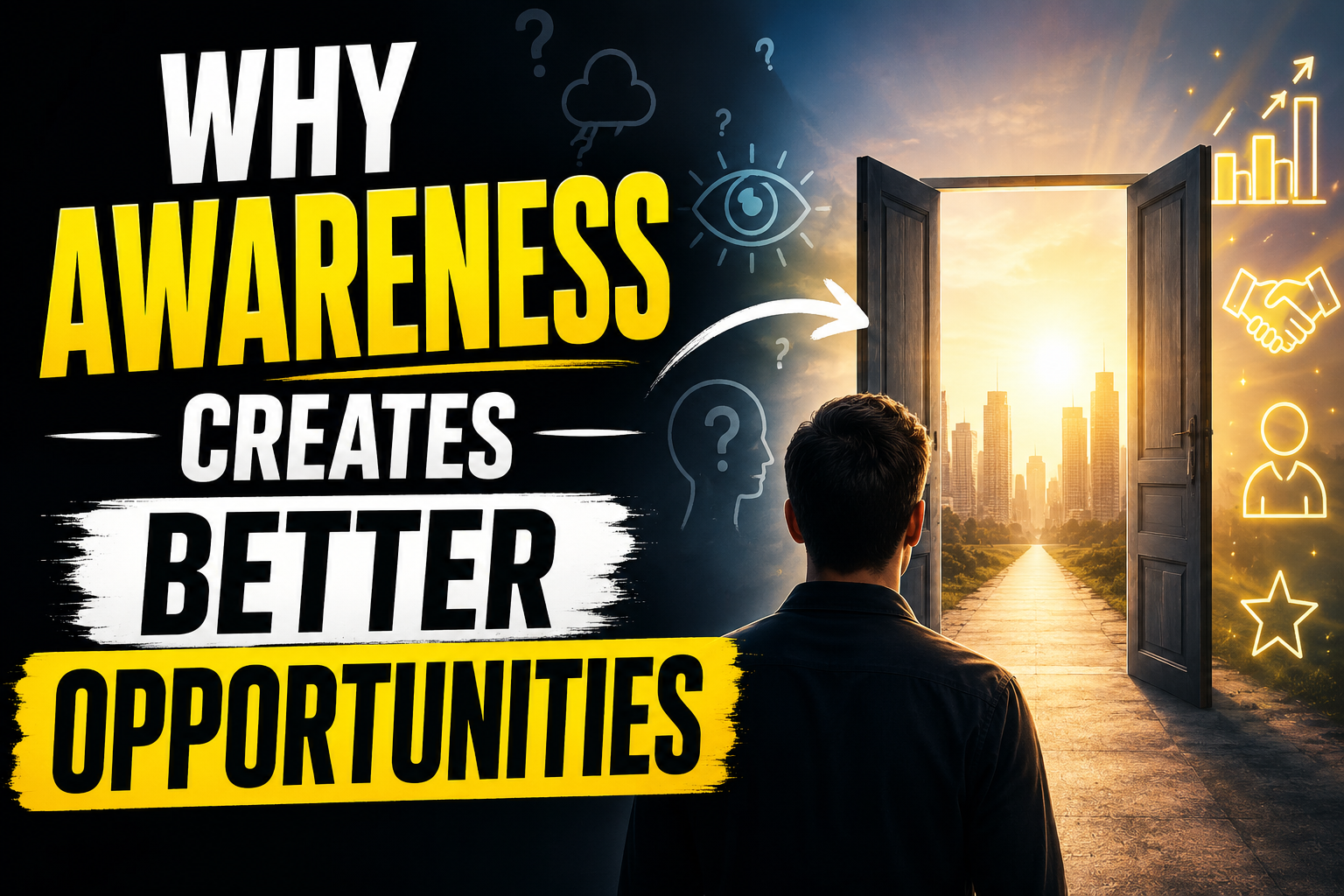
Why Awareness Creates Better Opportunities
Most people assume opportunities are things that arrive randomly, like luck knocking on a door or success appearing at the right time for a select few. But in reality, opportunities are far more connected to awareness than chance. The way you perceive your environment, the attention you give to patterns, and your ability to notice what others ignore all play a powerful role in determining what becomes available to you. Awareness is not just a mental state, it is a filter that determines what you can see, what you can use, and what you can act upon. In many cases, people are surrounded by opportunities but simply cannot recognize them because their awareness is not developed enough to interpret what is in front of them.
Awareness begins with attention. What you repeatedly focus on shapes what your mind considers important. Two people can be in the same environment and experience completely different realities because they are not paying attention to the same things. One person might walk through a marketplace and only see noise and distraction, while another notices unmet needs, pricing gaps, customer behavior, and hidden demand. The difference is not intelligence but awareness. Attention trains the mind to pick up signals that others dismiss, and over time this becomes a form of internal guidance that constantly points toward potential opportunities.
As awareness expands, so does pattern recognition. Opportunities rarely appear as fully formed events. Instead, they emerge as patterns that slowly develop over time. A shift in consumer behavior, a new technology gaining traction, or a recurring problem in a community are all early signs of opportunity. However, without awareness, these signals appear meaningless. People often miss these patterns because they are focused on immediate survival or routine thinking. Those who develop awareness start to notice repetition in problems, behaviors, and gaps, and this repetition becomes the foundation for identifying where value can be created.
Another important aspect of awareness is understanding human behavior. Many of the most valuable opportunities are rooted in predictable human needs and emotions. People want convenience, safety, recognition, efficiency, and comfort. When you become more aware of how people think and act, you begin to see opportunities not as abstract ideas but as solutions to real human problems. For example, frustration in a process is often a signal that something can be improved. Complaints, delays, confusion, or inefficiency are not just problems, they are indicators of unmet demand. Awareness allows you to interpret these signals correctly.
Awareness also improves decision making speed. People with low awareness often hesitate because everything looks uncertain or unclear. They struggle to see which direction is valuable because they cannot interpret the environment effectively. On the other hand, increased awareness reduces confusion. It does not eliminate risk, but it makes patterns more visible, allowing faster and more confident decisions. In fast changing environments, speed of understanding often matters more than raw intelligence. Those who can quickly interpret situations are more likely to act before opportunities disappear.
One of the strongest effects of awareness is that it reduces blindness caused by routine. Many people live on autopilot, repeating the same actions, following the same routes, and engaging in the same conversations. This routine creates mental blindness. When everything becomes familiar, the brain stops actively analyzing. Opportunities, however, often exist outside of routine thinking. They appear in changes, disruptions, and small inconsistencies. Awareness breaks autopilot thinking and forces the mind to actively observe again. This shift alone can completely change the quality of opportunities a person notices.
Awareness also creates better timing. Opportunities are not only about what you see but when you see it. A good idea discovered too late loses value, while a simple idea acted upon early can become extremely powerful. People with high awareness tend to sense timing more accurately because they are constantly observing shifts in their environment. They notice when something is becoming more relevant, when interest is growing, or when a problem is becoming more urgent. This sensitivity to timing gives them a natural advantage in acting before saturation or competition increases.
Another important dimension is self awareness. External opportunities are often connected to internal readiness. A person may see an opportunity but still fail to act because they lack the skills, confidence, or discipline to execute. Self awareness helps you understand your strengths, weaknesses, and limitations clearly. This allows you to align yourself with opportunities that match your current capacity while also identifying what you need to improve in order to access higher levels of opportunity in the future. Without self awareness, people often chase opportunities they are not prepared for or ignore ones they are perfectly suited for.
Awareness also enhances learning ability. When you are more aware, you do not just consume information passively, you interpret it in context. Every piece of knowledge becomes connected to real situations, problems, and patterns. This makes learning more practical and applicable. As your understanding deepens, you begin to see connections between different fields and ideas. These connections often lead to creative insights, which are a major source of unique opportunities. Innovation usually comes from combining existing ideas in ways that others have not noticed, and awareness is what allows those combinations to become visible.
Social awareness is another powerful layer. Many opportunities come through people, relationships, and networks. When you are socially aware, you begin to understand influence, trust, communication, and value exchange at a deeper level. You notice who has access to resources, who is solving important problems, and where collaboration can create mutual benefit. This allows you to position yourself in environments where opportunities are more likely to flow. In many cases, being in the right network is not about luck but about awareness of where value is being created socially.
Awareness also helps you identify wasted energy. Many people spend time on activities that do not move them closer to meaningful outcomes simply because they are not aware of better alternatives. When awareness improves, you begin to recognize inefficiencies in your time, effort, and focus. This creates room for better decisions. Instead of being busy, you become intentional. Instead of reacting to everything, you begin to select what matters. This shift naturally leads to better positioning, which increases the likelihood of encountering valuable opportunities.
Ultimately, awareness changes your relationship with reality. Instead of seeing life as something that happens to you, you begin to see it as something you can interpret, influence, and respond to intelligently. Opportunities do not necessarily increase in number, but your ability to recognize them increases significantly. This is why some people seem lucky while others struggle, even when they are in the same environment. The difference is not the environment itself, but the level of awareness applied to it.
When awareness becomes a habit, it transforms how you move through the world. You stop missing signals, you stop ignoring patterns, and you stop overlooking potential value. Instead, you begin to see possibilities in places where others only see routine. Over time, this creates a compounding effect. Better awareness leads to better decisions, better decisions lead to better positioning, and better positioning leads to more opportunities. In this way, awareness becomes one of the most powerful forces behind long term success, not because it creates opportunity directly, but because it allows you to recognize and act on the opportunities that were always there.

EarnSmartOnline.com.ng is dedicated to helping readers make smarter financial decisions through practical guides on online income, personal finance, technology, digital business, and wealth creation. Our goal is to provide reliable, easy-to-understand, and actionable content that empowers individuals to earn smarter, build sustainable income streams and achieve long-term financial success.
Recommended: Start Earning Online
- Ultimate Affiliate Marketing Program — learn affiliate marketing with a done-for-you sales system ($15). Check it out
- The Newbie Affiliate Guide — the beginner-friendly starter guide (~$6.68). Check it out
- Easy Dollar Maker — earn in dollars uploading AI images and videos from your phone ($17). Check it out
Disclosure: These are affiliate links. If you buy through them, I may earn a commission at no extra cost to you.



