
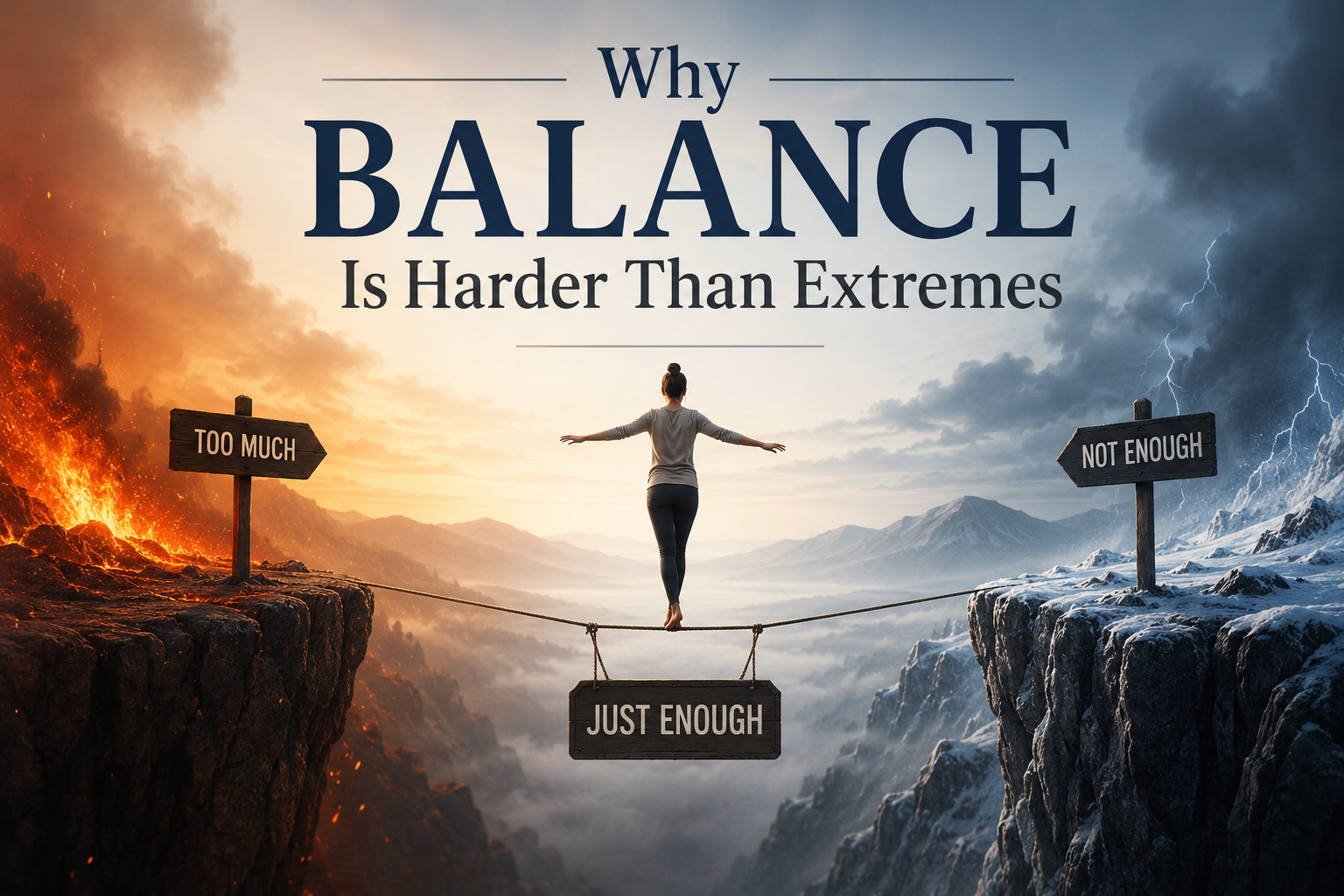
Why Balance Is Harder Than Extremes
Balance is one of those ideas everyone praises but very few people actually live by. In theory, it sounds simple and attractive. People often say things like balance your work and life, balance your emotions, balance your spending, or balance ambition with rest. Yet in practice, balance is one of the hardest states for human beings to maintain. What makes it even more interesting is that extremes often feel easier, more natural, and more rewarding in the short term. This is why so many people drift toward excess in different areas of life without even realizing it. Whether it is work, money, relationships, emotions, or personal habits, humans tend to oscillate between extremes far more than they remain in a stable middle ground.
One reason balance is so difficult is because extremes provide immediate clarity. When someone becomes extremely focused on one goal, such as making money, building a career, or achieving success, the direction feels very clear. There is no confusion about what to do next because everything is centered around that single pursuit. Similarly, when someone shifts fully into rest, relaxation, or avoidance, that too feels clear because there are fewer demands and less pressure. Balance, on the other hand, requires constant adjustment. It demands awareness, decision making, and restraint all at once. Instead of moving in a straight line, a balanced life requires continuous correction, like steering a vehicle carefully to stay on course.
Another reason extremes feel easier is because they reduce internal conflict. A person who is fully committed to work does not need to negotiate with themselves about leisure time. Likewise, someone who has completely detached from ambition does not feel the pressure of high expectations. Balance creates tension because it forces both sides of life to coexist. You are required to work hard while also resting. You must save money while also spending responsibly. You must stay disciplined while also being flexible. This dual responsibility creates mental friction, and most people naturally prefer the simplicity of single direction thinking over complex moderation.
Psychologically, extremes also produce stronger emotional feedback. When people go all in on something, the results feel more intense. Success feels more rewarding, and failure feels more dramatic. Even unhealthy extremes can feel addictive because they create emotional highs that moderation cannot match. Balance, however, often feels less exciting. It is steady, predictable, and gradual. The human brain is wired to respond strongly to stimulation, so it often misinterprets intensity as progress. This is why people may overwork themselves, overspend, overeat, or overindulge in entertainment. The emotional reward system encourages extremes even when they are not sustainable.
Society also plays a role in making balance harder. Modern culture tends to glorify extremes in subtle ways. Hustle culture promotes overworking as a sign of ambition. Social media rewards extreme lifestyles, extreme opinions, and extreme achievements because they attract attention. Even entertainment thrives on exaggeration rather than moderation. As a result, people are constantly exposed to messages that push them toward one extreme or another. Rarely does anyone go viral for living a quiet, balanced, and stable life, even though that is often what leads to long term well being.
Another challenge is that balance requires wisdom, while extremes only require emotion. It does not take much thought to become obsessed with something or to abandon responsibility altogether. These reactions are often emotional and impulsive. Balance, however, requires reflection. It requires the ability to pause, evaluate consequences, and adjust behavior based on long term thinking. This level of awareness is not automatic. It must be developed through experience, mistakes, and conscious effort. That is why many people only learn balance after experiencing the negative consequences of living in extremes for too long.
Time also plays an important role in this difficulty. Extremes often produce faster results, while balance produces slower but more sustainable outcomes. A person who works excessively may see financial gains quickly, while a person who invests consistently over time builds more stable wealth. However, human patience is limited. People tend to prefer what works now over what works later. This short term bias makes extremes more appealing because they appear to deliver results faster, even if those results are not stable. Balance requires trusting the process, and that trust is difficult when immediate rewards are visible elsewhere.
There is also the issue of identity. Extremes often give people a strong sense of identity. Someone can identify as a workaholic, a minimalist, a high achiever, or someone who lives completely free of structure. These identities are simple and easy to define. Balance, however, does not fit neatly into identity labels. A balanced person is not fully one thing or another, which can feel less defined in a world that values clear categorization. This makes some people unconsciously avoid balance because it feels like losing a strong sense of self, even though it actually represents maturity and control.
Ironically, extremes often lead back to imbalance anyway. Too much work leads to burnout. Too much rest leads to stagnation. Too much saving leads to missed opportunities, while too much spending leads to financial stress. Too much discipline can become rigidity, while too much flexibility can become chaos. This creates a cycle where people swing from one extreme to another, trying to correct previous imbalances without ever finding a stable middle ground. Balance is not a fixed point but a continuous adjustment that prevents these swings from becoming destructive.
One of the deepest reasons balance is difficult is because it requires self awareness in real time. It is not something you achieve once and maintain forever. Life constantly changes, and so must your approach. What is balanced today may become extreme tomorrow depending on circumstances. For example, during a growth phase in life, more effort and focus may be required. During recovery phases, more rest and reflection may be necessary. True balance is dynamic rather than static, which makes it harder to master because it cannot be reduced to a simple formula.
Emotional discipline is another major factor. Extremes often allow people to follow emotions without resistance. If someone feels like escaping responsibility, they can fully disengage. If they feel motivated, they can push themselves excessively. Balance requires regulating these emotional impulses instead of obeying them completely. This does not mean ignoring emotions, but rather managing them intelligently. That level of control is difficult because emotions are powerful and immediate, while discipline is quiet and long term.
Despite all these challenges, balance remains one of the most valuable states a person can develop. It is the foundation of sustainability in health, finances, relationships, and personal growth. While extremes may produce bursts of progress or pleasure, they often come with hidden costs that eventually require correction. Balance reduces these costs by distributing energy, attention, and resources in a more stable way. It may not feel dramatic, but it creates endurance, which is far more powerful over time.
Ultimately, the difficulty of balance reveals something important about human nature. People are naturally drawn to intensity, simplicity, and emotional highs. Balance goes against these instincts by requiring patience, awareness, and restraint. It asks people to choose long term stability over short term excitement. This is why balance is not just a habit but a skill that must be developed deliberately. It is not about avoiding extremes entirely, but about learning how to navigate between them without losing control.
In the end, balance is harder than extremes because it requires mastery over both action and restraint at the same time. It demands awareness when it would be easier to act blindly, and discipline when it would be easier to give in. Yet this difficulty is also what makes balance powerful. Anyone can live at the edge of excess or deficiency, but it takes maturity to live in a space where decisions are guided by wisdom rather than impulse. And while extremes may feel louder and more exciting, balance is what quietly builds a life that lasts.

EarnSmartOnline.com.ng is dedicated to helping readers make smarter financial decisions through practical guides on online income, personal finance, technology, digital business, and wealth creation. Our goal is to provide reliable, easy-to-understand, and actionable content that empowers individuals to earn smarter, build sustainable income streams and achieve long-term financial success.
Recommended: Start Earning Online
- Ultimate Affiliate Marketing Program — learn affiliate marketing with a done-for-you sales system ($15). Check it out
- The Newbie Affiliate Guide — the beginner-friendly starter guide (~$6.68). Check it out
- Easy Dollar Maker — earn in dollars uploading AI images and videos from your phone ($17). Check it out
Disclosure: These are affiliate links. If you buy through them, I may earn a commission at no extra cost to you.



