
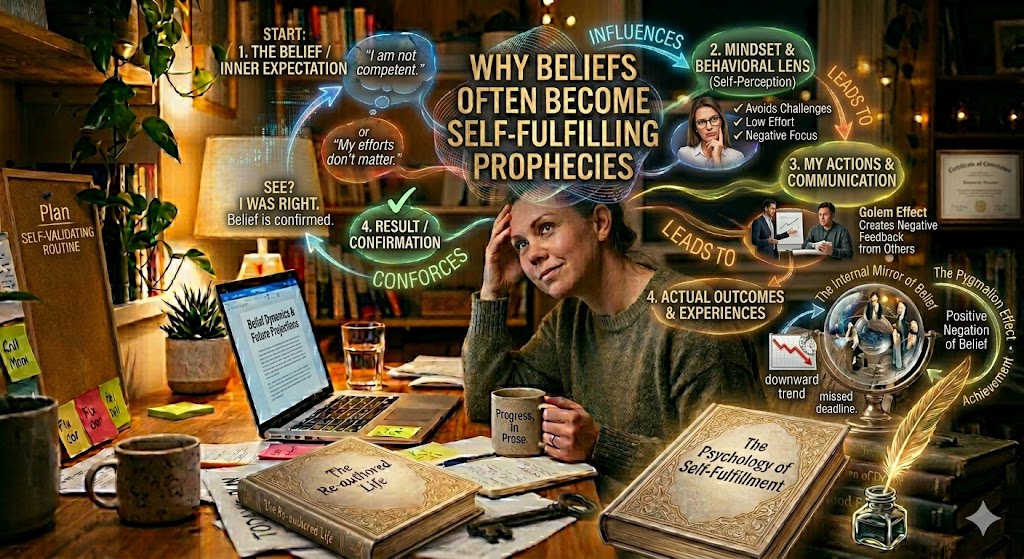
Why Beliefs Often Become Self-Fulfilling Prophecies
Human beings like to think they make decisions based on facts, logic, and reality. However, a closer look at human behavior reveals that people are often guided by something much more powerful than facts alone. They are guided by what they believe. Beliefs shape expectations, influence decisions, affect emotions, and ultimately determine actions. This is why beliefs often become self-fulfilling prophecies. What people expect to happen frequently influences what actually happens, not because of magic or destiny, but because beliefs quietly guide behavior in ways that create corresponding outcomes.
A self-fulfilling prophecy occurs when a person believes something strongly enough that their actions begin to make that belief come true. The belief may not have been true initially, but because it influences choices and behavior, it eventually becomes reality. This phenomenon can be observed in nearly every area of life including relationships, careers, education, business, health, and personal development. The human mind has a remarkable ability to create evidence that supports its existing beliefs while ignoring evidence that contradicts them.
Consider a student who believes they are naturally bad at mathematics. Because of this belief, they may approach math assignments with fear and hesitation. They may spend less time studying because they assume failure is inevitable. They may avoid asking questions because they feel embarrassed. As a result, their performance suffers. When they receive poor grades, the outcome appears to confirm the original belief. The student concludes that they were right all along, not realizing that the belief itself influenced the behavior that produced the poor result.
The same principle applies in professional life. A person who believes they will never succeed may unconsciously avoid opportunities that could lead to advancement. They may hesitate to apply for better positions, avoid taking calculated risks, or fail to promote their skills. Their lack of action creates limited opportunities, and the resulting lack of success reinforces the belief that success was never possible for them. In reality, the belief acted as a hidden force shaping their decisions.
Relationships provide another powerful example. Someone who believes that people cannot be trusted may constantly expect betrayal. This expectation may cause them to become suspicious, defensive, and emotionally distant. Over time, these behaviors can strain relationships and push others away. Eventually, relationships fail, seemingly confirming the person’s belief that people are indeed untrustworthy. Yet the original belief may have played a major role in creating the outcome.
One reason beliefs become self-fulfilling prophecies is that they influence perception. Human beings do not see reality exactly as it is. Instead, they interpret reality through mental filters shaped by past experiences, assumptions, and expectations. Two people can experience the same situation and reach completely different conclusions because they view events through different belief systems. A person who believes opportunities are everywhere may notice possibilities that others overlook. A person who believes opportunities are scarce may focus primarily on obstacles and limitations.
Beliefs also influence confidence. Confidence affects how people speak, act, and respond to challenges. Someone who believes they are capable is more likely to take initiative, persist through setbacks, and remain optimistic during difficult times. These behaviors increase the likelihood of success. On the other hand, someone who believes they are incapable may give up quickly, avoid challenges, and interpret setbacks as proof of personal inadequacy. Their actions reduce the likelihood of success and strengthen their negative beliefs.
The workplace offers countless examples of self-fulfilling prophecies. Managers who believe certain employees are high performers often provide them with more opportunities, encouragement, and responsibilities. Those employees frequently rise to meet expectations and perform better. Conversely, employees viewed negatively may receive fewer opportunities and less support, causing their performance to decline. This phenomenon is sometimes referred to as the Pygmalion Effect, where higher expectations lead to improved performance.
The influence of beliefs extends beyond individuals and affects entire communities and societies. Groups that collectively believe they are capable of progress often invest more effort into education, innovation, and economic development. Communities that adopt beliefs centered on hopelessness or victimhood may struggle to create positive change because those beliefs influence collective actions and expectations. While external circumstances certainly matter, beliefs often determine how people respond to those circumstances.
Negative self-beliefs are particularly dangerous because they tend to operate quietly beneath conscious awareness. Many people never stop to question the assumptions they carry about themselves. They may believe they are not intelligent enough, talented enough, attractive enough, or fortunate enough to succeed. These beliefs become invisible rules governing behavior. Over time, individuals may organize their entire lives around assumptions that were never objectively true.
The brain contributes to this process through a psychological tendency known as confirmation bias. Confirmation bias causes people to seek, notice, and remember information that supports existing beliefs while disregarding contradictory evidence. If someone believes they are unlucky, they will likely remember every disappointment and overlook many successes. If someone believes they are competent, they may interpret challenges as temporary obstacles rather than permanent failures. In both cases, the mind actively reinforces existing beliefs.
One fascinating aspect of self-fulfilling prophecies is that they can work in positive ways as well. Believing in the possibility of improvement often creates behaviors that lead to improvement. A person who believes they can learn new skills is more likely to invest time in learning. A person who believes financial stability is achievable is more likely to develop productive financial habits. Positive beliefs do not guarantee success, but they increase the likelihood of taking actions that move a person closer to desired outcomes.
This does not mean people should ignore reality or adopt unrealistic optimism. Effective beliefs are not based on fantasy. Instead, they are grounded in possibility, growth, and personal responsibility. Believing that challenges can be overcome is very different from pretending challenges do not exist. Productive beliefs encourage action. Unproductive beliefs encourage passivity.
History is filled with examples of individuals who achieved extraordinary success because they believed something different from what others believed. Inventors, entrepreneurs, leaders, and innovators often saw possibilities where others saw impossibilities. Their beliefs motivated them to continue working despite criticism, rejection, and failure. Had they adopted the prevailing negative beliefs around them, many of their achievements might never have occurred.
The reverse is also true. Many people with great potential never fully realize their abilities because limiting beliefs hold them back. Their talents remain hidden, not because opportunities never existed, but because their beliefs prevented them from recognizing or pursuing those opportunities. Potential alone is rarely enough. Beliefs determine whether potential is developed or neglected.
Changing beliefs is not always easy because beliefs become deeply connected to identity. People often defend familiar beliefs even when those beliefs harm them. The mind prefers certainty and consistency. Challenging a long-held belief can feel uncomfortable because it requires admitting that previous assumptions may have been incorrect. However, growth often begins when people start questioning beliefs they have accepted without examination.
One practical way to challenge limiting beliefs is to look for evidence that contradicts them. If someone believes they are incapable of success, they can examine moments when they solved problems, learned new skills, or achieved meaningful goals. If someone believes opportunities never come their way, they can actively search for examples of opportunities they may have overlooked. This process helps weaken the grip of negative assumptions.
Another effective approach is to focus on actions rather than feelings. Waiting to feel confident before taking action often leads to stagnation. In many cases, confidence develops after action, not before it. By consistently engaging in productive behaviors, people create experiences that gradually reshape beliefs. Small victories accumulate, and over time, new beliefs emerge from repeated evidence.
Ultimately, beliefs often become self-fulfilling prophecies because they shape how people interpret reality, influence how they behave, and determine how they respond to opportunities and challenges. The stories people tell themselves about who they are and what is possible have tremendous power. While not every belief becomes reality, beliefs significantly increase the likelihood of certain outcomes by guiding decisions and actions in predictable directions.
The most important lesson is that beliefs are not always facts. Many of the limitations people accept as reality are actually assumptions that have never been tested. When individuals learn to examine, question, and reshape their beliefs, they gain greater control over their lives. A belief can act like a prison that restricts possibility, or it can act like a bridge that leads to growth. The choice of which beliefs to nurture may ultimately determine the quality of one’s future. Because whether people realize it or not, they are often living in the direction of their strongest beliefs, and those beliefs have a remarkable way of becoming the reality they expect to see.

EarnSmartOnline.com.ng is dedicated to helping readers make smarter financial decisions through practical guides on online income, personal finance, technology, digital business, and wealth creation. Our goal is to provide reliable, easy-to-understand, and actionable content that empowers individuals to earn smarter, build sustainable income streams and achieve long-term financial success.
Recommended: Start Earning Online
- Ultimate Affiliate Marketing Program — learn affiliate marketing with a done-for-you sales system ($15). Check it out
- The Newbie Affiliate Guide — the beginner-friendly starter guide (~$6.68). Check it out
- Easy Dollar Maker — earn in dollars uploading AI images and videos from your phone ($17). Check it out
Disclosure: These are affiliate links. If you buy through them, I may earn a commission at no extra cost to you.



